China Variable Air Volume (VAV) Market Size & Growth Rate
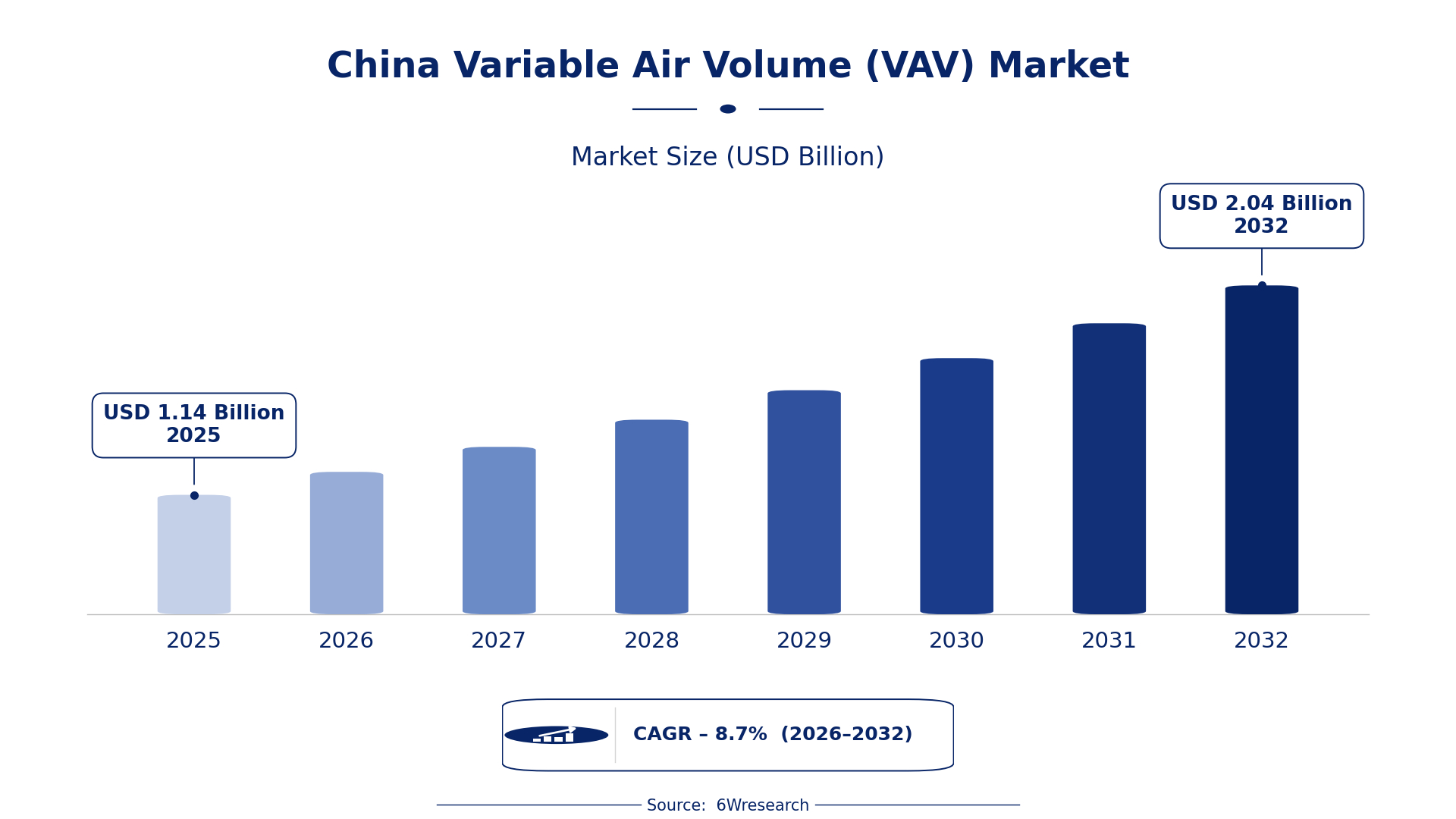
According to 6Wresearch internal database and industry insights, the China Variable Air Volume (VAV) Market was valued at USD 1.14 billion in 2025 and is projected to reach USD 2.04 billion by 2032, growing at a CAGR of approximately 8.7% during 2026–2032.
China Variable Air Volume (VAV) Market Highlights
| Report Metric | Details |
| Report Name | China Variable Air Volume (VAV) Market |
| Market Size 2025 | USD 1.14 billion |
| Market Size 2032 | USD 2.04 billion |
| Absolute Growth 2025–2032 | USD 0.90 billion |
| CAGR 2026–2032 | 8.7% |
| Peak Annual Growth | 10.5% in 2028 |
| Forecast Period | 2026–2032 |
| Historical Data | 2022–2025 |
| Base Year | 2025 |
| Leading Box Type, 2025 | Single Duct VAV (43% share) |
| Leading Control Type, 2025 | Analog/Digital (39% share) |
| Leading Application Area, 2025 | Commercial Buildings (45% share) |
| Leading End User, 2025 | HVAC Contractors (54% share) |
| Fastest-Growing Box Type | Fan-Powered VAV (9.8% CAGR) |
| Fastest-Growing Control Type | Programmable (11.3% CAGR) |
| Fastest-Growing Application Area | Hospitals (10.9% CAGR) |
| Fastest-Growing End User | Energy Consultants (11.0% CAGR) |
| Growing Sector | Hospitals |
| Key End Users | Commercial Buildings, Office Spaces, Hospitals, Schools |
China Variable Air Volume (VAV) Market Year-wise Growth Rate and Key Drivers (2022–2032)
This graph illustrates the annual growth rates of the market from 2022 to 2032, highlighting a steady upward trajectory and projected market expansion over the forecast period.
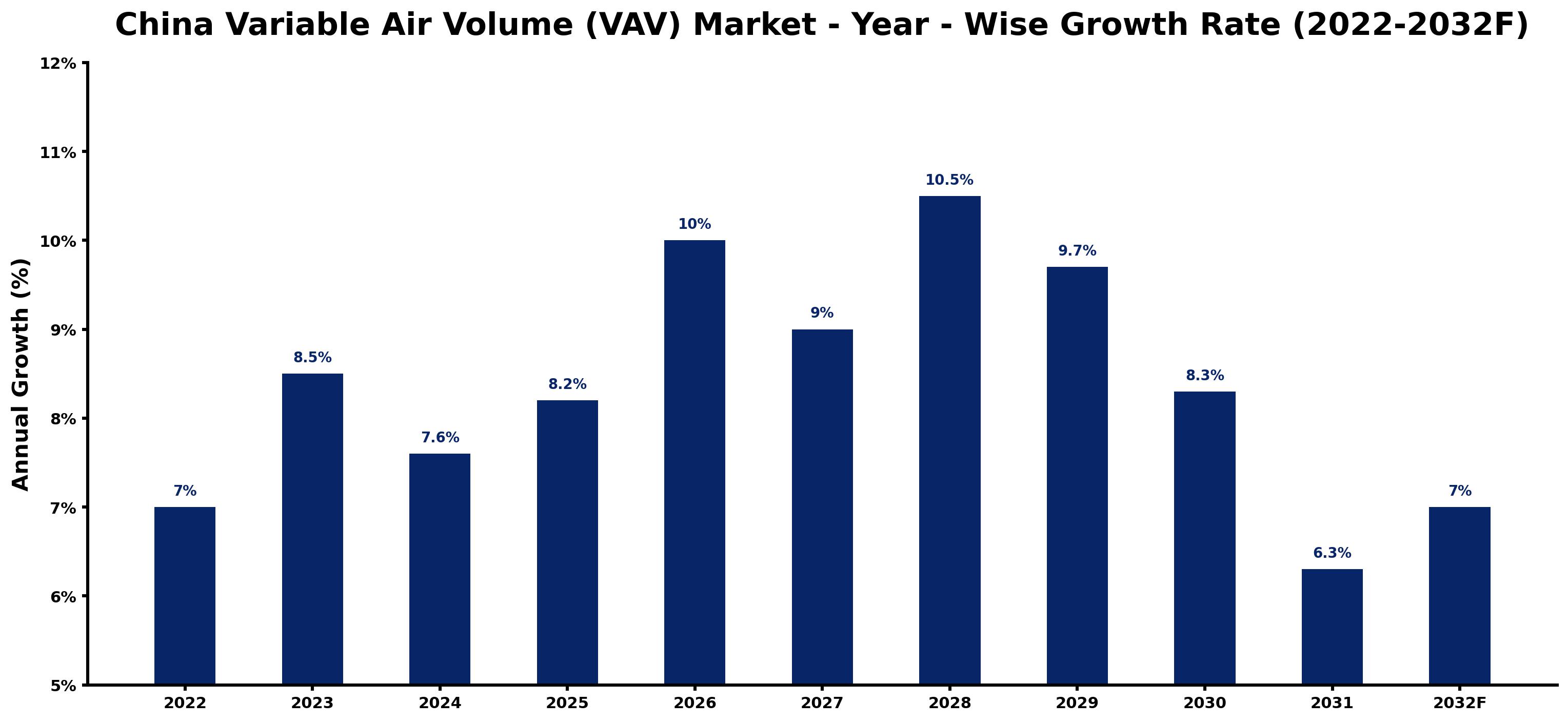
Year by year, the estimates below pair each growth rate with the development that shaped it.
| Year | Estimated Annual Growth (%) | Market Rationale |
| 2022 | 7.0 | The market experienced steady growth, driven by increasing commercial construction activities. |
| 2023 | 8.5 | Demand surged as energy efficiency initiatives gained traction among building owners. |
| 2024 | 7.6 | Growth slowed slightly due to rising material costs impacting project budgets. |
| 2025 | 8.2 | The market rebounded with renewed investments in energy-efficient HVAC systems. |
| 2026 | 10.0 | Rapid urbanisation and infrastructure development will propel demand for VAV systems. |
| 2027 | 9.0 | Growth is expected to decelerate as the market stabilises after previous peaks. |
| 2028 | 10.5 | A peak in demand will occur as new regulations incentivise energy-efficient installations. |
| 2029 | 9.7 | The market will continue to grow, albeit at a slower pace due to maturing demand. |
| 2030 | 8.3 | Growth is projected to slow as the market approaches saturation in major urban areas. |
| 2031 | 6.3 | The market will experience further deceleration as competition intensifies among suppliers. |
| 2032 | 7.0 | Demand is expected to rise again as new energy efficiency standards are implemented. |
Note: Market size estimations and growth projections presented in this report are based on 6Wresearch's proprietary forecasting methodology, utilizing the latest available industry data, government publications, and primary research inputs.
China Variable Air Volume (VAV) Market Synopsis
The Variable Air Volume (VAV) market in China includes HVAC systems that adjust airflow according to thermal loads. These systems aim to enhance indoor air quality and energy efficiency across various building types. The China Variable Air Volume (VAV) Market is expanding due to strong demand from commercial construction and infrastructure projects. Energy efficiency initiatives, such as the 'Green Building Action Plan', drive purchases. With the HVAC market valued at approximately 60 billion USD in 2022, the outlook remains optimistic as urbanisation continues to fuel demand.
Market Dynamics Impact Analysis (2026–2032)
| Factor | Type | Impact | Primary Segment Affected |
| Increasing demand for energy-efficient systems in commercial buildings | Driver | High | Commercial Buildings |
| Rising urbanisation leading to new construction projects | Driver | High | Office Spaces |
| Growing need for energy-efficient HVAC solutions | Opportunity | High | Hospitals |
| Investment in smart building technologies | Opportunity | High | Commercial Buildings |
| High installation costs of VAV systems | Restraint | Medium | Single Duct VAV |
| Limited awareness among smaller contractors about VAV benefits | Restraint | Medium | HVAC Contractors |
| The Variable Air Volume (VAV) market in China faces regulatory hurdles | Challenge | High | Dual Duct VAV |
| Inconsistent enforcement of energy efficiency standards | Challenge | Medium | Fan-Powered VAV |
Evaluation of Drivers in China Variable Air Volume (VAV) Market (2026–2032)
The table below links each growth driver to the segment it affects and the evidence for it.
| Drivers | Primary Segment Affected | Why It Matters (Evidence) |
| Growing emphasis on energy efficiency in commercial buildings | Commercial Buildings | This trend has led to a 15% increase in VAV system installations since 2020. |
| Urbanisation driving new office space developments | Office Spaces | Urban areas are experiencing a surge in demand for VAV systems to improve comfort and efficiency, with installations projected to rise significantly. |
| Rising healthcare standards necessitating advanced HVAC solutions | Hospitals | The installed base of VAV systems in hospitals reached 10,000 units in 2022, reflecting increased focus on air quality. |
| Government initiatives promoting energy-efficient technologies | Commercial Buildings | The 'Green Building Action Plan' aims to improve energy efficiency across sectors, encouraging VAV system adoption. |
| Technological advancements in HVAC controls | Programmable | Programmable controls are projected to grow significantly, reflecting a shift towards more efficient HVAC solutions. |
The Variable Air Volume (VAV) market in China is growing on the back of increasing demand from commercial buildings, urbanisation, and technological advancements. The installation of VAV systems has surged, driven by energy efficiency requirements, with a notable increase since 2020. Rising healthcare standards are reflected in the installed base of VAV systems in hospitals, which reached 10,000 units in 2022. Additionally, the adoption of programmable controls is projected to grow significantly, reflecting a shift towards more efficient HVAC solutions.
Evaluation of Restraints in China Variable Air Volume (VAV) Market
The following restraints limit how fast demand can grow.
| Market Restraint | Primary Segment Affected | Why It Matters (Evidence) |
| High installation costs of VAV systems | Single Duct VAV | Installation costs can deter smaller projects, limiting market penetration in budget-sensitive segments. |
| Limited awareness among smaller contractors about VAV benefits | HVAC Contractors | Many smaller contractors lack knowledge about VAV systems, which hinders their adoption and market growth. |
| Inconsistent enforcement of energy efficiency standards | Dual Duct VAV | Variability in regulation enforcement can lead to uncertainty in compliance and installation, impacting market confidence. |
| Challenges in retrofitting existing buildings with VAV systems | Fan-Powered VAV | Retrofitting can be complex and costly, limiting upgrades in older infrastructures and delaying projects. |
| Competition from alternative HVAC technologies | Analog/Digital | Emerging technologies may divert investment away from traditional VAV systems, affecting market share. |
China Variable Air Volume (VAV) Market Challenges
The China Variable Air Volume (VAV) market faces a skills shortage, particularly in the installation and maintenance of these systems. This gap arises from the rapid growth of the HVAC industry, which has outpaced the development of training programmes, leading to project delays for contractors. Technological limitations present another challenge, as many existing systems are outdated, hindering the transition to energy-efficient VAV solutions and causing higher operational costs for building owners. Regulatory challenges complicate the situation; adapting to evolving energy efficiency standards can impose substantial compliance costs on suppliers, ultimately raising expenses for buyers.
Trends in the China Variable Air Volume (VAV) Market
Below mentioned are some of the trends shaping the China Variable Air Volume (VAV) Market growth.
- Shift Towards Energy-Efficient HVAC Solutions: Commercial building owners are increasingly adopting energy-efficient HVAC systems, driven by regulations. The 'Green Building Action Plan' aims to improve energy efficiency, with a projected 30% reduction in energy consumption.
- Growth in Smart Control Technologies: There is a rising trend towards smart control technologies in HVAC systems. Programmable controls are expected to see a CAGR of 11.3% from 2026 to 2032, enhancing operational efficiency.
- Increased Focus on Indoor Air Quality: The demand for improved indoor air quality is prompting the adoption of VAV systems. Hospitals are leading this trend, with an installed base of 10,000 VAV units in 2022.
- Expansion of VAV Systems in Urban Areas: Urbanisation is driving the expansion of VAV systems in office spaces. As urban areas grow, the demand for efficient HVAC solutions is expected to rise significantly.
Investment Opportunities in the China Variable Air Volume (VAV) Market
Below are the investment opportunities with the strongest case in the China Variable Air Volume (VAV) Market.
- Investment in Energy-Efficient Technologies: With the HVAC market valued at approximately 60 billion USD, there is an opportunity to invest in energy-efficient technologies. HVAC contractors can benefit from the 'Green Building Action Plan', which promotes sustainable practices.
- Partnerships with Local Contractors: Now is an ideal time for foreign firms to partner with local contractors to penetrate the market. Collaborations can enhance service delivery and market reach, particularly in urban areas.
- Focus on Hospital Upgrades: The healthcare sector is increasingly focusing on upgrading HVAC systems. Suppliers can target hospitals, which are projected to see a rise in VAV installations due to new regulations.
- Expansion into Emerging Urban Areas: Emerging urban areas present opportunities for VAV system installations. Targeting these regions can lead to increased market share and revenue growth as demand rises.
Government Initiatives in the China Variable Air Volume (VAV) Market
The '14th Five-Year Plan for Ecological and Environmental Protection', launched in 2021, focuses on improving energy efficiency in HVAC systems. This plan aims to enhance the overall energy performance of buildings, thereby increasing the demand for VAV systems. Additionally, the 'Building Energy Efficiency Promotion Law', revised in 2021, strengthens regulations on HVAC installations, ensuring compliance with energy efficiency standards and promoting the adoption of advanced technologies in the sector. These measures directly influence VAV producers and buyers by creating a more supportive environment for energy-efficient solutions.
The National Development and Reform Commission oversees the implementation of various energy efficiency initiatives. The 'Green Building Evaluation Standard', updated in 2022, includes specific guidelines for VAV systems, ensuring they meet stringent performance criteria. Furthermore, the 'Energy Efficiency Labeling Program', initiated in 2020, encourages the adoption of energy-efficient HVAC products, providing buyers with clear information on system performance. These initiatives enable producers to align their offerings with regulatory expectations, enhancing market competitiveness.
Future Insight of the China Variable Air Volume (VAV) Market
The China Variable Air Volume (VAV) market will evolve by 2032, driven by several key factors. The 'Green Building Action Plan' launched in 2023 will encourage the adoption of energy-efficient systems across multiple sectors. Urbanisation will fuel demand for VAV systems, especially in commercial buildings, with installations expected to rise by 20% over the next decade. Stricter regulatory frameworks will ensure VAV systems meet high energy efficiency standards, benefiting both buyers and suppliers. Technological advancements will facilitate the integration of smart HVAC solutions, improving energy management capabilities.
Market Segmentation Analysis
Each segment group is reviewed below, with the leader by share and the fastest grower by CAGR.
By Box Type – Single Duct VAV Dominated, Fan-Powered VAV Expected to Grow Fastest
According to Bhawna Singh, Assistant Manager at 6Wresearch, Single Duct VAV held a 43% share of the China Variable Air Volume (VAV) Market by box type in 2025. Single Duct VAV systems dominate the market share as they are widely used for individual zone control in commercial buildings, making them a staple in urban environments like Shanghai and Beijing. Their efficiency and adaptability to varying thermal loads contribute significantly to their popularity among HVAC contractors. The quickest growth will come from Fan-Powered VAV, forecast to expand at a CAGR of 9.8% between 2026 and 2032. Fan-Powered VAV systems are experiencing rapid growth due to their ability to enhance airflow and temperature control in larger spaces, aligning with the increasing demand for energy-efficient HVAC solutions. This trend is further supported by government initiatives aimed at improving energy efficiency in buildings. Suppliers should focus on promoting Fan-Powered VAV systems to capitalise on the growing demand for advanced HVAC technologies.
By Control Type – Analog/Digital Dominated, Programmable Expected to Grow Fastest
In 2025, Analog/Digital led the control type split with a 39% share. Analog/Digital control types hold the largest market share as they are essential for the effective operation of VAV systems across various applications. Their reliability and ease of use make them the preferred choice for HVAC contractors involved in system installations and maintenance. Programmable is set to record the highest CAGR in this split, 11.3% over 2026–2032. Programmable control types are rapidly gaining traction as they allow for automated adjustments to air volume based on real-time demand, which is crucial for enhancing energy efficiency. This growth is particularly relevant as the market shifts towards smart building technologies and automated solutions. Buyers should consider investing in programmable controls to optimise energy efficiency and improve the performance of their HVAC systems.
By Application Area – Commercial Buildings Dominated, Hospitals Expected to Grow Fastest
The largest application area category in 2025 was Commercial Buildings, with a 45% share of total revenue. Commercial Buildings represent the largest application area for VAV systems, driven by the ongoing commercial construction boom in China. These systems are vital for maintaining indoor air quality and energy efficiency in high-traffic environments. Hospitals are projected to grow fastest, at a CAGR of 10.9% during 2026–2032. Hospitals are the fastest-growing application area as they require strict air quality and comfort standards, driving demand for advanced VAV solutions. The installed base of VAV systems in hospitals reached 10,000 units in 2022, highlighting this trend. Suppliers should target hospitals with tailored VAV solutions to meet the stringent requirements for air quality and energy efficiency.
By End User – HVAC Contractors Dominated, Energy Consultants Expected to Grow Fastest
HVAC Contractors accounted for a 54% market share by end user in 2025. HVAC Contractors account for the largest share of the market as they are the primary users responsible for the installation and maintenance of VAV systems. Their expertise is vital for ensuring the efficient operation of these systems across various building types, including commercial and institutional facilities. Over 2026–2032, Energy Consultants are expected to post the fastest growth, at a CAGR of 11.0%. Energy Consultants are rapidly emerging as a key segment, providing critical advice on energy efficiency improvements that are increasingly important in today's regulatory environment. Their influence is expected to grow as energy regulations become more stringent, driving demand for their expertise. Suppliers should engage with energy consultants to effectively promote energy-efficient VAV solutions and expand their market reach.
Key Attractiveness of the Report
- 10 Years of Market Numbers
- Historical Data Starting from 2022 to 2025
- Base Year 2025
- Forecast Data until 2032
- Key Performance Indicators Impacting the Market
- Major Upcoming Developments and Projects
Key Highlights of the Report:
- China Variable Air Volume (VAV) Market Outlook
- Market Size of China Variable Air Volume (VAV) Market, 2025
- Forecast of China Variable Air Volume (VAV) Market, 2032
- Historical Data and Forecast of China Variable Air Volume (VAV) Revenues & Volume for the Period 2022 - 2032F
- China Variable Air Volume (VAV) Market Trend Evolution
- China Variable Air Volume (VAV) Market Drivers and Challenges
- China Variable Air Volume (VAV) Price Trends
- China Variable Air Volume (VAV) Porter's Five Forces
- China Variable Air Volume (VAV) Industry Life Cycle
- Historical Data and Forecast of China Variable Air Volume (VAV) Market Revenues & Volume By Box Type for the Period 2022 - 2032F
- Historical Data and Forecast of China Variable Air Volume (VAV) Market Revenues & Volume By Single Duct VAV for the Period 2022 - 2032F
- Historical Data and Forecast of China Variable Air Volume (VAV) Market Revenues & Volume By Dual Duct VAV for the Period 2022 - 2032F
- Historical Data and Forecast of China Variable Air Volume (VAV) Market Revenues & Volume By Fan-Powered VAV for the Period 2022 - 2032F
- Historical Data and Forecast of China Variable Air Volume (VAV) Market Revenues & Volume By Series/Parallel VAV for the Period 2022 - 2032F
- Historical Data and Forecast of China Variable Air Volume (VAV) Market Revenues & Volume By Control Type for the Period 2022 - 2032F
- Historical Data and Forecast of China Variable Air Volume (VAV) Market Revenues & Volume By Analog/Digital for the Period 2022 - 2032F
- Historical Data and Forecast of China Variable Air Volume (VAV) Market Revenues & Volume By Pneumatic for the Period 2022 - 2032F
- Historical Data and Forecast of China Variable Air Volume (VAV) Market Revenues & Volume By ECM Motor for the Period 2022 - 2032F
- Historical Data and Forecast of China Variable Air Volume (VAV) Market Revenues & Volume By Programmable for the Period 2022 - 2032F
- Historical Data and Forecast of China Variable Air Volume (VAV) Market Revenues & Volume By Application Area for the Period 2022 - 2032F
- Historical Data and Forecast of China Variable Air Volume (VAV) Market Revenues & Volume By Commercial Buildings for the Period 2022 - 2032F
- Historical Data and Forecast of China Variable Air Volume (VAV) Market Revenues & Volume By Hospitals for the Period 2022 - 2032F
- Historical Data and Forecast of China Variable Air Volume (VAV) Market Revenues & Volume By Schools for the Period 2022 - 2032F
- Historical Data and Forecast of China Variable Air Volume (VAV) Market Revenues & Volume By Office Spaces for the Period 2022 - 2032F
- Historical Data and Forecast of China Variable Air Volume (VAV) Market Revenues & Volume By End User for the Period 2022 - 2032F
- Historical Data and Forecast of China Variable Air Volume (VAV) Market Revenues & Volume By HVAC Contractors for the Period 2022 - 2032F
- Historical Data and Forecast of China Variable Air Volume (VAV) Market Revenues & Volume By Mechanical Engineers for the Period 2022 - 2032F
- Historical Data and Forecast of China Variable Air Volume (VAV) Market Revenues & Volume By Facility Managers for the Period 2022 - 2032F
- Historical Data and Forecast of China Variable Air Volume (VAV) Market Revenues & Volume By Energy Consultants for the Period 2022 - 2032F
- China Variable Air Volume (VAV) Import Export Trade Statistics
- Market Opportunity Assessment By Box Type
- Market Opportunity Assessment By Control Type
- Market Opportunity Assessment By Application Area
- Market Opportunity Assessment By End User
- China Variable Air Volume (VAV) Top Companies Market Share
- China Variable Air Volume (VAV) Competitive Benchmarking By Technical and Operational Parameters
- China Variable Air Volume (VAV) Company Profiles
- China Variable Air Volume (VAV) Key Strategic Recommendations
Market Covered
The report offers an extensive study of the following market segments.
By Box Type
- Single Duct VAV
- Dual Duct VAV
- Fan-Powered VAV
- Series/Parallel VAV
By Control Type
- Analog/Digital
- Pneumatic
- ECM Motor
- Programmable
By Application Area
- Commercial Buildings
- Hospitals
- Schools
- Office Spaces
By End User
- HVAC Contractors
- Mechanical Engineers
- Facility Managers
- Energy Consultants































