India Vector-Borne Disease Market Size & Growth Rate
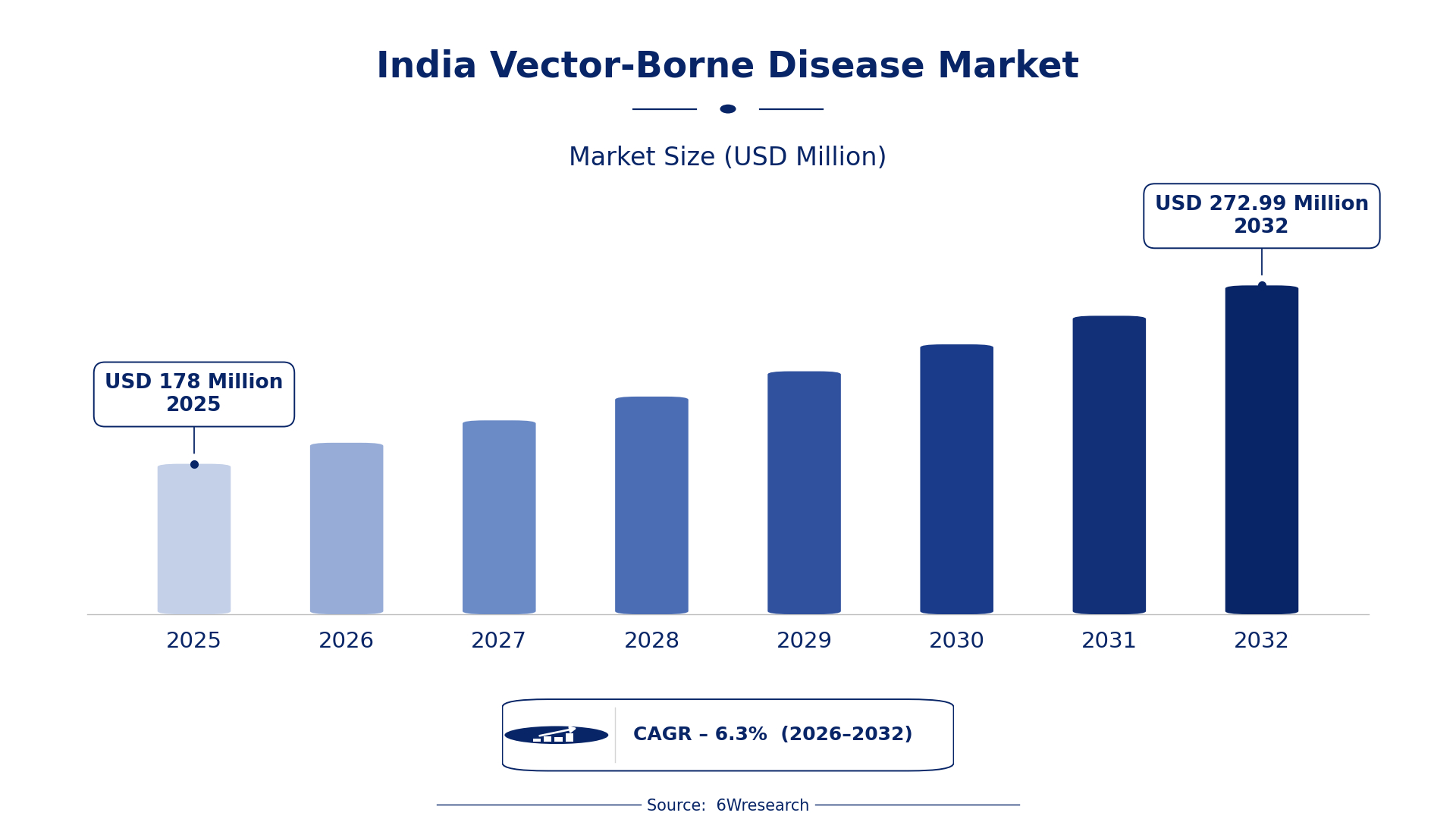
According to 6Wresearch internal database and industry insights, the India Vector-Borne Disease Market was valued at USD 178.0 million in 2025 and is projected to reach USD 272.99 million by 2032, growing at a CAGR of approximately 6.3% during 2026–2032.
India Vector-Borne Disease Market Highlights
| Report Metric | Details |
| Report Name | India Vector-Borne Disease Market |
| Market Size 2025 | USD 178.0 million |
| Market Size 2032 | USD 272.99 million |
| Absolute Growth 2025–2032 | USD 94.99 million |
| CAGR 2026–2032 | 6.3% |
| Peak Annual Growth | 8.5% in 2027 |
| Forecast Period | 2026–2032 |
| Historical Data | 2022–2025 |
| Base Year | 2025 |
| Leading Disease Type, 2025 | Malaria (38% share) |
| Leading Transmission Vector, 2025 | Mosquito (Anopheles) (49% share) |
| Leading Prevention Strategy, 2025 | Insecticide/Nets (45% share) |
| Leading End User, 2025 | Public Health Bodies (50% share) |
| Fastest-Growing Disease Type | Zika Virus (8.0% CAGR) |
| Fastest-Growing Transmission Vector | Mosquito (Aedes) (7.5% CAGR) |
| Fastest-Growing Prevention Strategy | Environmental Control (8.3% CAGR) |
| Fastest-Growing End User | Government Programs (7.9% CAGR) |
| Growing Sector | Public Health |
| Key End Users | Public Health Bodies, Government Programs, NGOs, Rural Clinics |
India Vector-Borne Disease Market Year-wise Growth Rate and Key Drivers (2022–2032)
This graph illustrates the annual growth rates of the market from 2022 to 2032, highlighting a steady upward trajectory and projected market expansion over the forecast period.
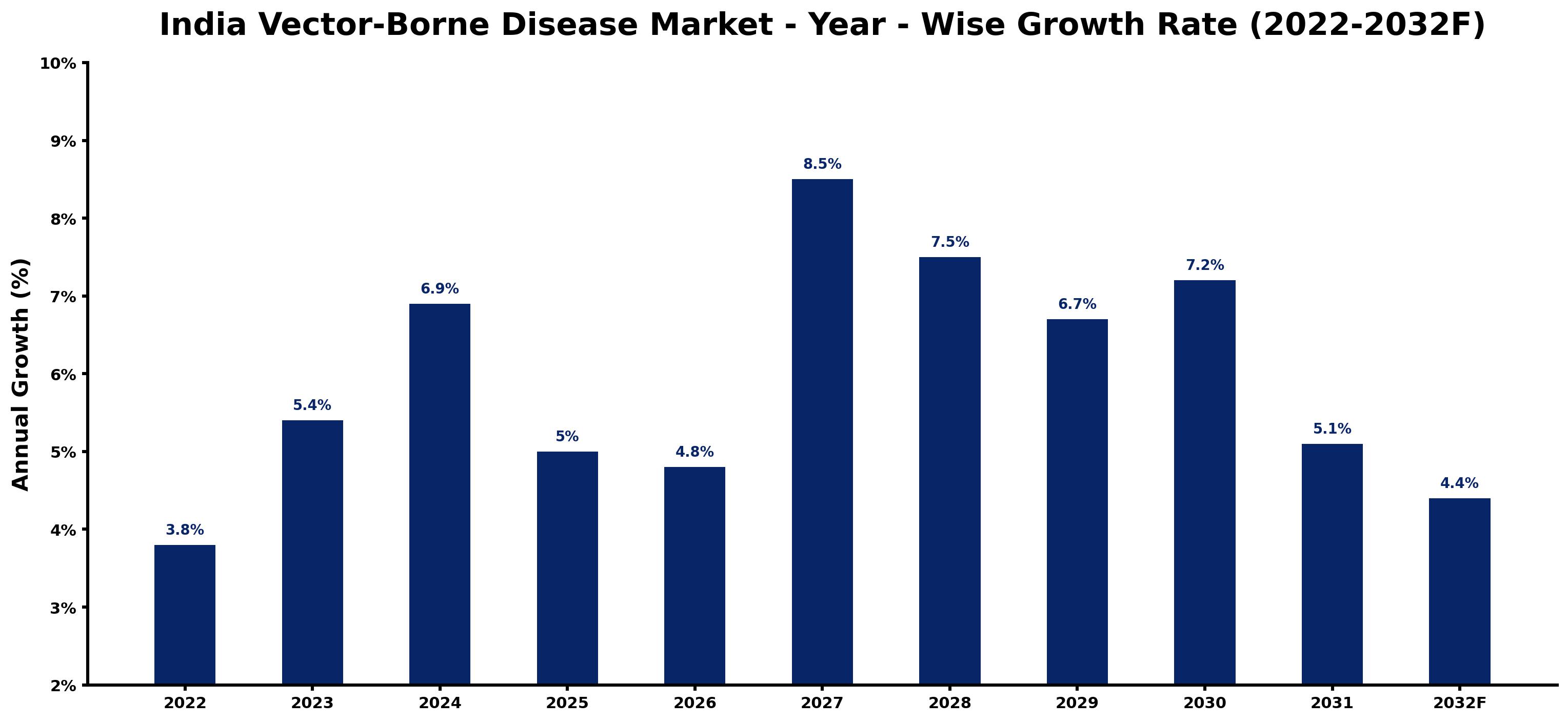
Below, each year's estimated growth is shown next to the factor that most influenced it.
| Year | Estimated Annual Growth (%) | Market Rationale |
| 2022 | 3.8 | The market experienced steady growth due to the National Health Mission's ongoing public health initiatives. |
| 2023 | 5.4 | Increased funding for vector control initiatives from the National Vector Borne Disease Control Programme contributed to faster growth this year. |
| 2024 | 6.9 | The implementation of new health strategies under the National Health Policy led to further growth acceleration. |
| 2025 | 5.0 | A slowdown in growth occurred as the market adjusted to previous gains from increased public health efforts. |
| 2026 | 4.8 | Continued investment in vector control initiatives is expected to cause a further slowdown in growth. |
| 2027 | 8.5 | A surge in demand for insecticide-treated nets driven by government campaigns will drive significant growth this year. |
| 2028 | 7.5 | Growth is projected to slow again as the market stabilises after the peak in 2027. |
| 2029 | 6.7 | The market is expected to continue to grow, albeit at a slower pace than the previous year due to ongoing challenges. |
| 2030 | 7.2 | A renewed focus on malaria eradication strategies under the National Vector Borne Disease Control Programme is expected to spur growth this year. |
| 2031 | 5.1 | Growth is projected to slow as the market adjusts to the effects of previous initiatives and funding allocations. |
| 2032 | 4.4 | The market is expected to continue its gradual growth trend, supported by sustained public health efforts. |
Note: Market size estimations and growth projections presented in this report are based on 6Wresearch's proprietary forecasting methodology, utilizing the latest available industry data, government publications, and primary research inputs.
India Vector-Borne Disease Market Synopsis
Vector-Borne Disease in India encompasses illnesses transmitted by vectors such as mosquitoes. These diseases, including malaria and dengue, are managed through various control methods like insecticides and environmental management. The India Vector-Borne Disease Market is expanding due to increased public health efforts and funding from government initiatives. In 2023, the government allocated INR 200 crores for vector control, highlighting the urgency of addressing these health issues. The National Vector Borne Disease Control Programme aims to eliminate malaria by 2030, further driving demand for effective prevention strategies.
Market Dynamics Impact Analysis (2026–2032)
| Factor | Type | Impact | Primary Segment Affected |
| Increased funding for vector control initiatives | Driver | High | Insecticide/Nets |
| Growing public health awareness about vector-borne diseases | Driver | High | Public Health Bodies |
| Investment in environmentally friendly insecticides | Opportunity | Medium | Environmental Control |
| Rising demand for housing improvements in malaria-prone areas | Opportunity | Medium | Housing Improvement |
| Limited awareness in rural areas about vector control | Restraint | High | Public Health Bodies |
| Challenges in implementing effective surveillance systems | Restraint | High | Government Programs |
| High costs associated with vector control measures | Challenge | Medium | Insecticide/Nets |
| Delays in approval processes for new vector control products | Challenge | Medium | Antimalarial Drugs |
Evaluation of Drivers in India Vector-Borne Disease Market (2026–2032)
The table below links each growth driver to the segment it affects and the evidence for it.
| Drivers | Primary Segment Affected | Why It Matters (Evidence) |
| Increased government funding for vector control initiatives | Insecticide/Nets | The National Health Mission allocated INR 200 crores for vector control, boosting purchases of insecticide-treated nets and improving prevention efforts. |
| Rising public health campaigns to combat malaria | Public Health Bodies | The National Vector Borne Disease Control Programme promotes awareness, leading to higher demand for prevention strategies and increased funding. |
| Growing investment in environmentally friendly insecticides | Environmental Control | The Integrated Vector Management Programme encourages the use of eco-friendly products, increasing their market share and adoption among producers. |
| Demand for improved housing conditions in endemic areas | Housing Improvement | The government initiated projects to improve housing, reducing vector breeding sites and increasing related investments in vector management. |
| Expansion of rural health clinics providing treatment | Rural Clinics | Increased funding for rural clinics enhances access to treatment, driving demand for antimalarial drugs and improving health outcomes. |
The Vector-Borne Disease market in India is expanding as government funding rises, public health campaigns increase, and investment in eco-friendly insecticides grows. The National Health Mission allocated INR 200 crores for vector control initiatives, boosting sales of insecticide-treated nets. Public health campaigns, particularly through the National Vector Borne Disease Control Programme, raise awareness and demand for prevention strategies. Investment in improving housing conditions in endemic areas is also on the rise, as government projects aim to reduce vector breeding sites. Additionally, the expansion of rural health clinics improves access to treatment, driving demand for antimalarial drugs and enhancing health outcomes.
Evaluation of Restraints in India Vector-Borne Disease Market
Below mentioned are some major restraints and their influence on market dynamics.
| Market Restraint | Primary Segment Affected | Why It Matters (Evidence) |
| Limited budget allocations for vector control initiatives | Public Health Bodies | The government allocated only INR 200 crores for vector control in 2023, restricting the capacity of public health bodies to implement comprehensive strategies. |
| Regulatory compliance delays | Insecticide/Nets | Compliance with ISO 9001 standards can prolong product approvals, hindering timely access to essential insecticide-treated nets. |
| Supply chain disruptions | Antimalarial Drugs | 70% of malaria cases in 2022 were reported from five states, straining resources and delaying the supply of antimalarial drugs. |
| Limited awareness in rural areas | Rural Clinics | Public health initiatives often overlook rural clinics, leading to insufficient education on vector-borne disease prevention. |
| Environmental challenges | Environmental Control | Inadequate infrastructure for environmental control measures can impede effective vector management in urban areas. |
India Vector-Borne Disease Market Challenges
The India Vector-Borne Disease Market faces intense competition among producers, which drives down prices and can compromise the quality of vector control products. Buyers, particularly public health initiatives, are constrained by limited budgets; the government allocated only INR 200 crores for vector control in 2023, insufficient to meet rising demands. Regulatory hurdles create delays; compliance with ISO 9001 standards can prolong product approvals, hindering timely access to essential treatments. Supply chain disruptions are pronounced, as 70% of malaria cases in 2022 came from just five states, straining resources and delaying response efforts for health authorities.
Trends in the India Vector-Borne Disease Market
Four trends stand out in the India Vector-Borne Disease Market.
- Shift in Focus to Community Engagement in Vector Management: India is increasingly emphasising community involvement in vector management practices. The Vector Control Strategy launched in 2023 aims to improve local participation, with community-led initiatives expected to enhance outcomes.
- Increase in Distribution of Insecticide-Treated Nets: In 2023, the government initiated a campaign to distribute insecticide-treated nets in high-risk areas. This effort is projected to reach millions, improving prevention strategies against malaria and dengue.
- Transition from Chemical to Environmentally Friendly Insecticides: The Integrated Vector Management Programme is promoting environmentally friendly insecticides to combat resistance. This shift is expected to improve the efficacy of vector control measures across India.
- Expansion of Housing Improvement Projects in Malaria-Prone Areas: In 2023, the government launched projects to improve housing conditions in malaria-prone areas. This initiative aims to reduce vector breeding sites and improve overall public health.
Investment Opportunities in the India Vector-Borne Disease Market
Investors looking at the India Vector-Borne Disease Market should consider the following areas.
- Partnerships with Local NGOs for Community Health Initiatives: Now is an ideal time to partner with local NGOs focused on vector control. Collaborating with these organisations can improve outreach and effectiveness in urban areas, where dengue is endemic and prevention is critical.
- Supply of Eco-Friendly Insecticides: The demand for environmentally friendly insecticides is rising, driven by government initiatives. Suppliers can enter this market by aligning with the Integrated Vector Management Programme's goals and providing compliant products.
- Investment in Rural Health Clinics: Investing in rural health clinics is essential as they expand access to treatment. The government is increasing funding for these clinics, presenting opportunities for healthcare providers to enhance services.
- Focus on Housing Improvement Solutions: With the government's emphasis on improving housing conditions in malaria-prone areas, there is a growing need for innovative housing solutions that reduce vector breeding sites and enhance public health.
Government Initiatives in the India Vector-Borne Disease Market
The National Health Policy 2017 outlines strategies for controlling vector-borne diseases as a priority for public health. This policy has led to the establishment of various initiatives aimed at reducing malaria incidence and improving public health infrastructure. The National Vector Borne Disease Control Programme, operational since 2003, aims to eliminate malaria by 2030 through enhanced surveillance and vector control measures. In 2022, the National Health Mission allocated INR 200 crores for vector control initiatives targeting endemic regions. These measures guide producers and buyers in the vector control market by providing necessary funding and strategic direction.
In 2023, the Ministry of Health launched a campaign to distribute insecticide-treated nets in high-risk areas, funded by the National Health Mission. This initiative aims to improve prevention strategies against vector-borne diseases. The Indian Council of Medical Research conducts research on vector-borne diseases, supporting the development of effective control measures. The National Centre for Disease Control monitors outbreaks and provides guidelines, ensuring that public health bodies have the necessary information to respond effectively. These agencies play a vital role in implementing vector control strategies across the country, with funding allocated for various initiatives.
Future Insight of the India Vector-Borne Disease Market
The India Vector-Borne Disease Market will undergo significant changes by 2032, driven by enhanced public health initiatives and advancements in vector control methods. The National Vector Borne Disease Control Programme targets a 90% reduction in malaria incidence by 2030, fostering collaboration among health authorities. Research from the Indian Council of Medical Research is expected to lead to new vaccines and treatments that improve disease management. Additionally, projects focused on upgrading housing conditions in malaria-prone areas will strengthen prevention strategies.
Market Segmentation Analysis
The analysis below covers each segmentation, its leading category in 2025 and its fastest-growing category through 2032.
By Disease Type – Malaria Dominated, Zika Virus Expected to Grow Fastest
According to Bhawna Singh, Assistant Manager at 6Wresearch, Malaria accounted for a 38% market share by disease type in 2025. Malaria holds the largest market share due to its widespread presence, with India reporting 1.5 million cases in 2022. The National Vector Borne Disease Control Programme actively targets malaria, making it a primary focus of public health efforts. Zika Virus is projected to grow fastest, at a CAGR of 8.0% during 2026–2032. The Zika Virus is experiencing rapid growth due to limited outbreaks, which have prompted increased awareness and response strategies. This heightened focus on Zika reflects a shift in public health priorities as new threats emerge. Suppliers should align their strategies to support the increasing demand for Zika-related interventions while continuing to address malaria control.
By Transmission Vector – Mosquito (Anopheles) Dominated, Mosquito (Aedes) Expected to Grow Fastest
Mosquito (Anopheles) held a 49% share of the India Vector-Borne Disease Market by transmission vector in 2025. The Mosquito (Anopheles) is the leading vector, responsible for malaria transmission across India, particularly in regions with high case reports. Its prevalence in endemic areas solidifies its dominant market share. The quickest growth will come from Mosquito (Aedes), forecast to expand at a CAGR of 7.5% between 2026 and 2032. The Mosquito (Aedes) is growing rapidly as a primary vector for dengue and chikungunya, driven by urbanisation and climate factors that favour its proliferation. This trend indicates a shift in vector control strategies towards Aedes management. Buyers must adapt to the rising importance of Aedes control measures to effectively combat the increasing incidence of dengue and chikungunya.
By Prevention Strategy – Insecticide/Nets Dominated, Environmental Control Expected to Grow Fastest
The largest prevention strategy category in 2025 was Insecticide/Nets, with a 45% share of total revenue. Insecticide/Nets hold the largest market share as they are essential for malaria prevention, particularly in states like Odisha and Chhattisgarh where malaria cases are prevalent. The government's initiative to distribute insecticide-treated nets in high-risk areas further strengthens their dominant position. Environmental Control is set to record the highest CAGR in this split, 8.3% over 2026–2032. Environmental Control is experiencing rapid growth due to its critical role in managing vector habitats, especially in urban regions where dengue fever is endemic. The increasing emphasis on sustainable practices in public health is driving this segment's expansion. This trend indicates that suppliers must focus on developing integrated solutions that combine insecticide use with environmental management to effectively combat vector-borne diseases.
By End User – Public Health Bodies Dominated, Government Programs Expected to Grow Fastest
Public Health Bodies took a 50% share of end user in 2025, more than any other category. Public Health Bodies command the largest share as they lead the charge in vector-borne disease control initiatives, implementing strategies that directly impact public health outcomes. Their established role in managing outbreaks ensures continued investment in this area. Over 2026–2032, Government Programs are expected to post the fastest growth, at a CAGR of 7.9%. Government Programs are experiencing the fastest growth as they implement national health initiatives aimed at controlling vector-borne diseases. Increased funding and focus on public health strategies are driving this expansion. Suppliers must engage with government programs to align their offerings with national health priorities and funding opportunities.
Key Attractiveness of the Report
- 10 Years of Market Numbers
- Historical Data Starting from 2022 to 2025
- Base Year 2025
- Forecast Data until 2032
- Key Performance Indicators Impacting the Market
- Major Upcoming Developments and Projects
Key Highlights of the Report:
- India Vector-Borne Disease Market Outlook
- Market Size of India Vector-Borne Disease Market, 2025
- Forecast of India Vector-Borne Disease Market, 2032
- Historical Data and Forecast of India Vector-Borne Disease Revenues & Volume for the Period 2022 - 2032F
- India Vector-Borne Disease Market Trend Evolution
- India Vector-Borne Disease Market Drivers and Challenges
- India Vector-Borne Disease Price Trends
- India Vector-Borne Disease Porter's Five Forces
- India Vector-Borne Disease Industry Life Cycle
- Historical Data and Forecast of India Vector-Borne Disease Market Revenues & Volume By Disease Type for the Period 2022 - 2032F
- Historical Data and Forecast of India Vector-Borne Disease Market Revenues & Volume By Zika Virus for the Period 2022 - 2032F
- Historical Data and Forecast of India Vector-Borne Disease Market Revenues & Volume By Malaria for the Period 2022 - 2032F
- Historical Data and Forecast of India Vector-Borne Disease Market Revenues & Volume By West Nile Virus for the Period 2022 - 2032F
- Historical Data and Forecast of India Vector-Borne Disease Market Revenues & Volume By Chagas Disease for the Period 2022 - 2032F
- Historical Data and Forecast of India Vector-Borne Disease Market Revenues & Volume By Transmission Vector for the Period 2022 - 2032F
- Historical Data and Forecast of India Vector-Borne Disease Market Revenues & Volume By Mosquito (Aedes) for the Period 2022 - 2032F
- Historical Data and Forecast of India Vector-Borne Disease Market Revenues & Volume By Mosquito (Anopheles) for the Period 2022 - 2032F
- Historical Data and Forecast of India Vector-Borne Disease Market Revenues & Volume By Culex Mosquito for the Period 2022 - 2032F
- Historical Data and Forecast of India Vector-Borne Disease Market Revenues & Volume By Kissing Bugs for the Period 2022 - 2032F
- Historical Data and Forecast of India Vector-Borne Disease Market Revenues & Volume By Prevention Strategy for the Period 2022 - 2032F
- Historical Data and Forecast of India Vector-Borne Disease Market Revenues & Volume By Insecticide/Nets for the Period 2022 - 2032F
- Historical Data and Forecast of India Vector-Borne Disease Market Revenues & Volume By Antimalarial Drugs for the Period 2022 - 2032F
- Historical Data and Forecast of India Vector-Borne Disease Market Revenues & Volume By Environmental Control for the Period 2022 - 2032F
- Historical Data and Forecast of India Vector-Borne Disease Market Revenues & Volume By Housing Improvement for the Period 2022 - 2032F
- Historical Data and Forecast of India Vector-Borne Disease Market Revenues & Volume By End User for the Period 2022 - 2032F
- Historical Data and Forecast of India Vector-Borne Disease Market Revenues & Volume By Public Health Bodies for the Period 2022 - 2032F
- Historical Data and Forecast of India Vector-Borne Disease Market Revenues & Volume By Government Programs for the Period 2022 - 2032F
- Historical Data and Forecast of India Vector-Borne Disease Market Revenues & Volume By NGOs for the Period 2022 - 2032F
- Historical Data and Forecast of India Vector-Borne Disease Market Revenues & Volume By Rural Clinics for the Period 2022 - 2032F
- India Vector-Borne Disease Import Export Trade Statistics
- Market Opportunity Assessment By Disease Type
- Market Opportunity Assessment By Transmission Vector
- Market Opportunity Assessment By Prevention Strategy
- Market Opportunity Assessment By End User
- India Vector-Borne Disease Top Companies Market Share
- India Vector-Borne Disease Competitive Benchmarking By Technical and Operational Parameters
- India Vector-Borne Disease Company Profiles
- India Vector-Borne Disease Key Strategic Recommendations
Market Covered
The report offers an extensive study of the following market segments.
By Disease Type
- Zika Virus
- Malaria
- West Nile Virus
- Chagas Disease
By Transmission Vector
- Mosquito (Aedes)
- Mosquito (Anopheles)
- Culex Mosquito
- Kissing Bugs
By Prevention Strategy
- Insecticide/Nets
- Antimalarial Drugs
- Environmental Control
- Housing Improvement
By End User
- Public Health Bodies
- Government Programs
- NGOs
- Rural Clinics































