China Vector-Borne Disease Market Size & Growth Rate
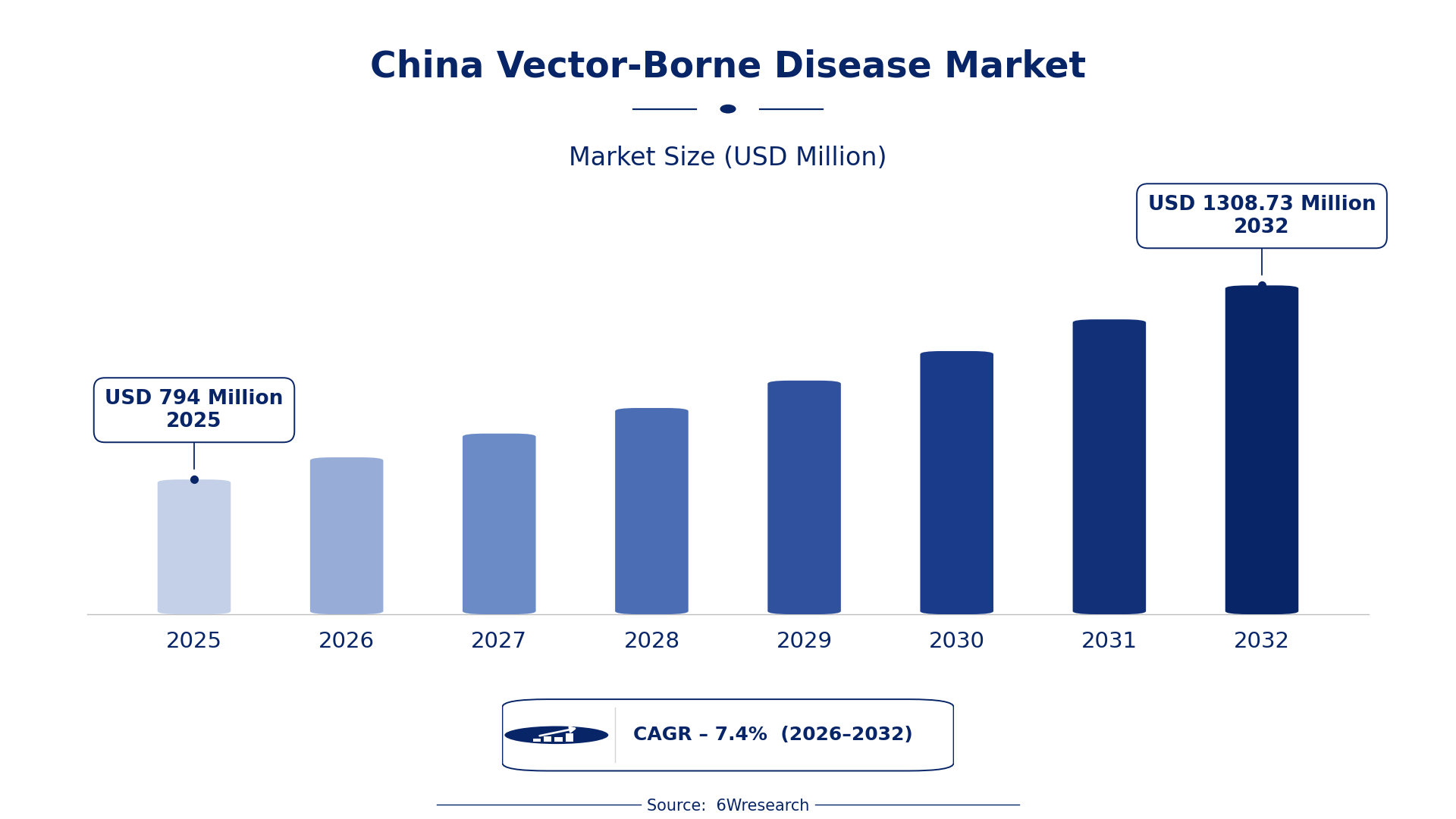
According to 6Wresearch internal database and industry insights, the China Vector-Borne Disease Market was valued at USD 794.0 million in 2025 and is projected to reach USD 1,308.73 million by 2032, growing at a CAGR of approximately 7.4% during 2026–2032.
China Vector-Borne Disease Market Highlights
| Report Metric | Details |
| Report Name | China Vector-Borne Disease Market |
| Market Size 2025 | USD 794.0 million |
| Market Size 2032 | USD 1,308.73 million |
| Absolute Growth 2025–2032 | USD 514.73 million |
| CAGR 2026–2032 | 7.4% |
| Peak Annual Growth | 10.4% in 2032 |
| Forecast Period | 2026–2032 |
| Historical Data | 2022–2025 |
| Base Year | 2025 |
| Leading Disease Type, 2025 | Zika Virus (45% share) |
| Leading Transmission Vector, 2025 | Mosquito (Aedes) (41% share) |
| Leading Prevention Strategy, 2025 | Insecticide/Nets (48% share) |
| Leading End User, 2025 | Public Health Bodies (39% share) |
| Fastest-Growing Disease Type | Malaria (9.1% CAGR) |
| Fastest-Growing Transmission Vector | Mosquito (Anopheles) (9.7% CAGR) |
| Fastest-Growing Prevention Strategy | Antimalarial Drugs (8.5% CAGR) |
| Fastest-Growing End User | Government Programs (10.0% CAGR) |
| Growing Sector | Public Health |
| Key End Users | Public Health Bodies, Government Programs, Rural Clinics, NGOs |
China Vector-Borne Disease Market Year-wise Growth Rate and Key Drivers (2022–2032)
This graph illustrates the annual growth rates of the market from 2022 to 2032, highlighting a steady upward trajectory and projected market expansion over the forecast period.
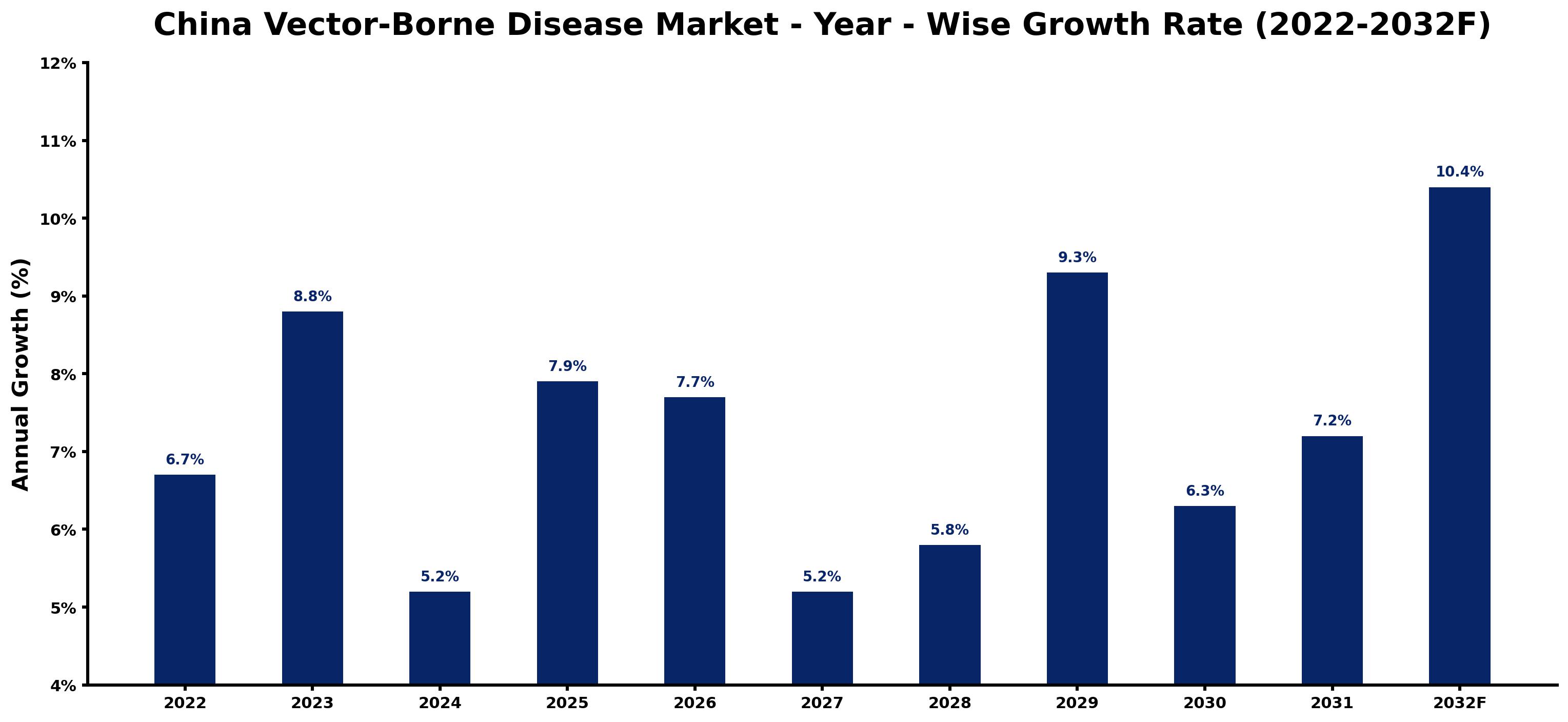
The following table presents the estimated annual growth rate for each year together with the principal factor influencing market performance.
| Year | Estimated Annual Growth (%) | Market Rationale |
| 2022 | 6.7 | The public health sector focused on malaria management and prevention strategies. |
| 2023 | 8.8 | Increased funding and awareness campaigns led to higher case reporting and control measures. |
| 2024 | 5.2 | A slowdown in growth occurred as the focus shifted towards long-term prevention strategies. |
| 2025 | 7.9 | The National Malaria Elimination Program's initiatives boosted malaria management efforts significantly. |
| 2026 | 7.7 | Public health bodies continued to implement strategies, but growth slowed due to resource allocation. |
| 2027 | 5.2 | A focus on environmental control measures contributed to ongoing growth despite a slowdown. |
| 2028 | 5.8 | Public health campaigns increased awareness, leading to a rise in preventive measures. |
| 2029 | 9.3 | The introduction of new insecticide-treated nets improved prevention efforts and boosted growth. |
| 2030 | 6.3 | Growth slowed as the market adjusted to new strategies and resource distribution. |
| 2031 | 7.2 | Public health bodies enhanced their initiatives, resulting in renewed growth in vector control. |
| 2032 | 10.4 | A peak growth rate is expected as comprehensive strategies yield significant results. |
Note: Market size estimations and growth projections presented in this report are based on 6Wresearch's proprietary forecasting methodology, utilizing the latest available industry data, government publications, and primary research inputs.
China Vector-Borne Disease Market Synopsis
Vector-Borne Disease in China includes illnesses transmitted by vectors such as mosquitoes. These diseases, caused by various pathogens, necessitate effective prevention and control strategies like insecticides and health education. The China Vector-Borne Disease Market is expanding due to heightened public health initiatives, especially in rural areas where outbreaks occur frequently. The National Malaria Elimination Program aims for zero indigenous malaria cases by 2025, increasing the demand for effective vector control measures. With a population exceeding 1.4 billion, the need for robust disease management solutions remains critical.
Market Dynamics Impact Analysis (2026–2032)
| Factor | Type | Impact | Primary Segment Affected |
| Increased funding for vector control programs | Driver | High | Public Health Bodies |
| Growing awareness of vector-borne diseases | Driver | High | Government Programs |
| Rising demand for insecticide-treated nets | Opportunity | High | Insecticide/Nets |
| Expansion of environmental control measures | Opportunity | Medium | Environmental Control |
| Limited public awareness in rural areas | Restraint | High | Public Health Bodies |
| Resource allocation challenges in rural health services | Restraint | Medium | Rural Clinics |
| The ongoing prevalence of malaria in certain regions | Challenge | High | Malaria |
| Insufficient infrastructure for effective disease surveillance | Challenge | Medium | Government Programs |
Evaluation of Drivers in China Vector-Borne Disease Market (2026–2032)
The main growth drivers and the segments they affect most are set out below.
| Drivers | Primary Segment Affected | Why It Matters (Evidence) |
| Increased public health funding | Public Health Bodies | In 2022, China allocated approximately $200 million for vector-borne disease control, supporting disease management efforts. |
| Awareness campaigns on disease prevention | Government Programs | Annual public awareness campaigns educate over 1.4 billion citizens on vector-borne disease prevention. |
| Distribution of insecticide-treated nets | Insecticide/Nets | In 2023, over 2 million insecticide-treated nets were distributed in high-risk areas, increasing prevention measures. |
| Implementation of environmental control measures | Environmental Control | The National Vector Control Strategy launched in 2022 focuses on reducing breeding sites for vectors. |
| Support from international health organizations | Public Health Bodies | Collaboration with the WHO improves the effectiveness of malaria control initiatives in endemic regions. |
Growth across the Vector-Borne Disease market in China is anchored in increased public health funding, awareness campaigns, and the distribution of insecticide-treated nets. Annual public awareness campaigns educate over 1.4 billion citizens, driving demand for preventive measures. In 2023, over 2 million insecticide-treated nets were distributed in high-risk areas, enhancing prevention efforts. The National Vector Control Strategy launched in 2022 focuses on reducing breeding sites for vectors, further supporting growth in this sector.
Evaluation of Restraints in China Vector-Borne Disease Market
The following restraints limit how fast demand can grow.
| Market Restraint | Primary Segment Affected | Why It Matters (Evidence) |
| Limited public awareness in rural areas | Public Health Bodies | In rural areas, awareness campaigns reach fewer individuals, leading to lower preventive measures and higher disease incidence. |
| Resource allocation challenges in rural health services | Rural Clinics | Inadequate funding and resources hinder the effectiveness of rural clinics in managing vector-borne diseases. |
| Insufficient infrastructure for effective disease surveillance | Government Programs | Weak infrastructure limits the ability of government programs to monitor and respond to outbreaks promptly. |
| Inconsistent implementation of vector control measures | Environmental Control | Variability in local government commitment affects the consistency of environmental control measures across regions. |
| Cultural beliefs affecting health-seeking behaviour | Public Health Bodies | Cultural factors may lead to delays in seeking treatment, impacting disease management efforts. |
China Vector-Borne Disease Market Challenges
The China Vector-Borne Disease market faces a critical skills shortage among healthcare workers, which hampers effective management of outbreaks in rural areas. This gap exists due to a lack of comprehensive training programs, resulting in delayed responses that can endanger thousands of patients. High costs of vector control measures pose another challenge; the annual budget of approximately $200 million often falls short, causing resource constraints for essential interventions. Regulatory hurdles also complicate operations, as compliance with the National Standard for Insecticides can postpone the introduction of new products, affecting distributors' ability to respond swiftly to emerging threats.
Trends in the China Vector-Borne Disease Market
Four trends stand out in the China Vector-Borne Disease Market.
- Shift from Reactive to Proactive Disease Management: In 2022, China prioritised proactive measures against vector-borne diseases. The National Malaria Elimination Program emphasises prevention rather than reaction, aiming for zero indigenous malaria cases by 2025.
- Transition to Integrated Vector Management: The Integrated Vector Management Strategy, launched in 2022, promotes a holistic approach to vector control. This strategy aims to reduce vector populations by 50% in endemic regions by 2025.
- Emerging Focus on Environmental Control: In 2023, the Biodiversity Conservation Plan was introduced to improve environmental control measures. This plan aims to manage vector habitats effectively, reducing disease transmission in high-risk areas.
- Increased Distribution of Insecticide-Treated Nets: The distribution of over 2 million insecticide-treated nets in 2023 marks a significant shift in prevention strategy. This initiative directly targets high-risk populations, improving malaria management.
Investment Opportunities in the China Vector-Borne Disease Market
Several openings in the China Vector-Borne Disease Market merit attention from investors.
- Growing Need for Insecticide-Treated Nets: With over 30,000 malaria cases reported in 2022, there is a pressing need for insecticide-treated nets. Public health bodies in rural areas are key buyers, and partnerships can improve distribution.
- Investment in Environmental Control Solutions: The launch of the Biodiversity Conservation Plan creates opportunities for environmental control solutions. Local governments in endemic regions are potential buyers, facilitating entry through partnerships.
- Demand for Antimalarial Drugs: The projected increase in malaria cases necessitates a steady supply of antimalarial drugs. Public health bodies are the primary buyers, and local production can meet this demand effectively.
- Expansion of Public Health Campaigns: With annual public awareness campaigns reaching millions, there is an opportunity to invest in educational materials and resources. Public health bodies are looking for partners to improve outreach.
Government Initiatives in the China Vector-Borne Disease Market
The 'Integrated Vector Management Strategy' launched by the National Health Commission in 2022 strengthens existing laws by promoting a coordinated approach to vector control. This measure complements the 'National Malaria Elimination Action Plan,' updated in 2021, which targets complete eradication of malaria by 2025 with a budget of $150 million. Together, these initiatives aim to improve the overall framework for managing vector-borne diseases across China. The integration of these strategies enhances the effectiveness of disease management efforts in rural and endemic areas.
Public health bodies utilise the 'National Vector Control Program' established in 2020 to implement effective vector control measures. This program provides funding and resources to local health departments, enabling them to significantly reduce vector populations. In 2023, the 'Dengue Fever Prevention and Control Program' was initiated, focusing on southern provinces with high incidence rates, further improving disease management efforts. These programs allow local authorities to respond more effectively to outbreaks, enhancing public health outcomes.
Future Insight of the China Vector-Borne Disease Market
The China Vector-Borne Disease market is set for substantial transformation by 2032, driven by strategic public health initiatives and advancements in technology. The National Malaria Elimination Program targets zero indigenous cases by 2025, which will improve disease management efforts. In 2023, over 2 million insecticide-treated nets were distributed, providing crucial protection for vulnerable populations. Environmental control measures will increasingly integrate into vector management strategies, while ongoing public education campaigns will encourage community engagement in prevention, ultimately reducing the incidence of these diseases.
Market Segmentation Analysis
The analysis below covers each segmentation, its leading category in 2025 and its fastest-growing category through 2032.
By Disease Type – Zika Virus Dominated, Malaria Expected to Grow Fastest
According to Bhawna Singh, Assistant Manager at 6Wresearch, the largest disease type category in 2025 was Zika Virus, with a 45% share of total revenue. The Zika Virus segment holds the largest share due to its recognition and monitoring by public health authorities, despite limited cases reported in China. The National Health Commission's focus on vector control programs contributes to the ongoing awareness and management of this disease. Malaria is set to record the highest CAGR in this split, 9.1% over 2026–2032. Malaria is experiencing rapid growth as the National Malaria Elimination Program aims for zero indigenous cases by 2025, driving increased funding and resources. The approximately 30,000 reported cases in 2022 highlight the urgency of addressing this endemic issue. Suppliers should align their strategies with government initiatives to effectively address the rising demand for malaria control products.
By Transmission Vector – Mosquito (Aedes) Dominated, Mosquito (Anopheles) Expected to Grow Fastest
Mosquito (Aedes) held a 41% share of the China Vector-Borne Disease Market by transmission vector in 2025. The Mosquito (Aedes) segment holds the largest share due to its critical role in transmitting dengue and Zika, which are significant health concerns in China. The distribution of over 2 million insecticide-treated nets in high-risk areas showcases the commitment to controlling this vector effectively. Mosquito (Anopheles) is projected to grow fastest, at a CAGR of 9.7% during 2026–2032. The Mosquito (Anopheles) segment is growing rapidly because of its key role in malaria transmission, with intensified public health efforts targeting malaria management. The ongoing distribution of insecticide-treated nets will likely further strengthen control measures against this vector. Suppliers should focus on developing products that target both Aedes and Anopheles mosquitoes to meet increasing public health demands.
By Prevention Strategy – Insecticide/Nets Dominated, Antimalarial Drugs Expected to Grow Fastest
With a 48% revenue share in 2025, Insecticide/Nets was the largest prevention strategy category. Insecticide/Nets dominate the market share as they are widely used for preventing malaria and dengue, bolstered by substantial government distribution efforts in high-risk regions. The WHO's endorsement of long-lasting insecticide nets underscores their vital role in vector control strategies. The quickest growth will come from Antimalarial Drugs, forecast to expand at a CAGR of 8.5% between 2026 and 2032. Antimalarial Drugs are witnessing the fastest growth due to their essential role in treating malaria cases, particularly in light of the National Malaria Elimination Program's ambitious goals. Increased funding and public health campaigns are significantly boosting the demand for effective treatment options. Suppliers of antimalarial drugs should prepare for heightened demand as public health initiatives increasingly focus on malaria treatment.
By End User – Public Health Bodies Dominated, Government Programs Expected to Grow Fastest
Public Health Bodies accounted for a 39% market share by end user in 2025. Public Health Bodies command the largest share as they oversee disease surveillance and control, playing a crucial role in managing vector-borne diseases across China. Their active involvement in the National Vector Control Strategy ensures a sustained emphasis on public health initiatives. Over 2026–2032, Government Programs are expected to post the fastest growth, at a CAGR of 10.0%. Government Programs are experiencing rapid growth as they implement nationwide vector control initiatives, reflecting a stronger focus on public health within government priorities. The annual budget of approximately $200 million for vector-borne disease control highlights a robust commitment to these programs. Suppliers should engage with government programs to align their offerings with national health objectives and funding opportunities.
Key Attractiveness of the Report
- 10 Years of Market Numbers
- Historical Data Starting from 2022 to 2025
- Base Year 2025
- Forecast Data until 2032
- Key Performance Indicators Impacting the Market
- Major Upcoming Developments and Projects
Key Highlights of the Report:
- China Vector-Borne Disease Market Outlook
- Market Size of China Vector-Borne Disease Market, 2025
- Forecast of China Vector-Borne Disease Market, 2032
- Historical Data and Forecast of China Vector-Borne Disease Revenues & Volume for the Period 2022 - 2032F
- China Vector-Borne Disease Market Trend Evolution
- China Vector-Borne Disease Market Drivers and Challenges
- China Vector-Borne Disease Price Trends
- China Vector-Borne Disease Porter's Five Forces
- China Vector-Borne Disease Industry Life Cycle
- Historical Data and Forecast of China Vector-Borne Disease Market Revenues & Volume By Disease Type for the Period 2022 - 2032F
- Historical Data and Forecast of China Vector-Borne Disease Market Revenues & Volume By Zika Virus for the Period 2022 - 2032F
- Historical Data and Forecast of China Vector-Borne Disease Market Revenues & Volume By Malaria for the Period 2022 - 2032F
- Historical Data and Forecast of China Vector-Borne Disease Market Revenues & Volume By West Nile Virus for the Period 2022 - 2032F
- Historical Data and Forecast of China Vector-Borne Disease Market Revenues & Volume By Chagas Disease for the Period 2022 - 2032F
- Historical Data and Forecast of China Vector-Borne Disease Market Revenues & Volume By Transmission Vector for the Period 2022 - 2032F
- Historical Data and Forecast of China Vector-Borne Disease Market Revenues & Volume By Mosquito (Aedes) for the Period 2022 - 2032F
- Historical Data and Forecast of China Vector-Borne Disease Market Revenues & Volume By Mosquito (Anopheles) for the Period 2022 - 2032F
- Historical Data and Forecast of China Vector-Borne Disease Market Revenues & Volume By Culex Mosquito for the Period 2022 - 2032F
- Historical Data and Forecast of China Vector-Borne Disease Market Revenues & Volume By Kissing Bugs for the Period 2022 - 2032F
- Historical Data and Forecast of China Vector-Borne Disease Market Revenues & Volume By Prevention Strategy for the Period 2022 - 2032F
- Historical Data and Forecast of China Vector-Borne Disease Market Revenues & Volume By Insecticide/Nets for the Period 2022 - 2032F
- Historical Data and Forecast of China Vector-Borne Disease Market Revenues & Volume By Antimalarial Drugs for the Period 2022 - 2032F
- Historical Data and Forecast of China Vector-Borne Disease Market Revenues & Volume By Environmental Control for the Period 2022 - 2032F
- Historical Data and Forecast of China Vector-Borne Disease Market Revenues & Volume By Housing Improvement for the Period 2022 - 2032F
- Historical Data and Forecast of China Vector-Borne Disease Market Revenues & Volume By End User for the Period 2022 - 2032F
- Historical Data and Forecast of China Vector-Borne Disease Market Revenues & Volume By Public Health Bodies for the Period 2022 - 2032F
- Historical Data and Forecast of China Vector-Borne Disease Market Revenues & Volume By Government Programs for the Period 2022 - 2032F
- Historical Data and Forecast of China Vector-Borne Disease Market Revenues & Volume By NGOs for the Period 2022 - 2032F
- Historical Data and Forecast of China Vector-Borne Disease Market Revenues & Volume By Rural Clinics for the Period 2022 - 2032F
- China Vector-Borne Disease Import Export Trade Statistics
- Market Opportunity Assessment By Disease Type
- Market Opportunity Assessment By Transmission Vector
- Market Opportunity Assessment By Prevention Strategy
- Market Opportunity Assessment By End User
- China Vector-Borne Disease Top Companies Market Share
- China Vector-Borne Disease Competitive Benchmarking By Technical and Operational Parameters
- China Vector-Borne Disease Company Profiles
- China Vector-Borne Disease Key Strategic Recommendations
Market Covered
The report offers an extensive study of the following market segments.
By Disease Type
- Zika Virus
- Malaria
- West Nile Virus
- Chagas Disease
By Transmission Vector
- Mosquito (Aedes)
- Mosquito (Anopheles)
- Culex Mosquito
- Kissing Bugs
By Prevention Strategy
- Insecticide/Nets
- Antimalarial Drugs
- Environmental Control
- Housing Improvement
By End User
- Public Health Bodies
- Government Programs
- NGOs
- Rural Clinics































