India VEGF Inhibitors Market Size & Growth Rate
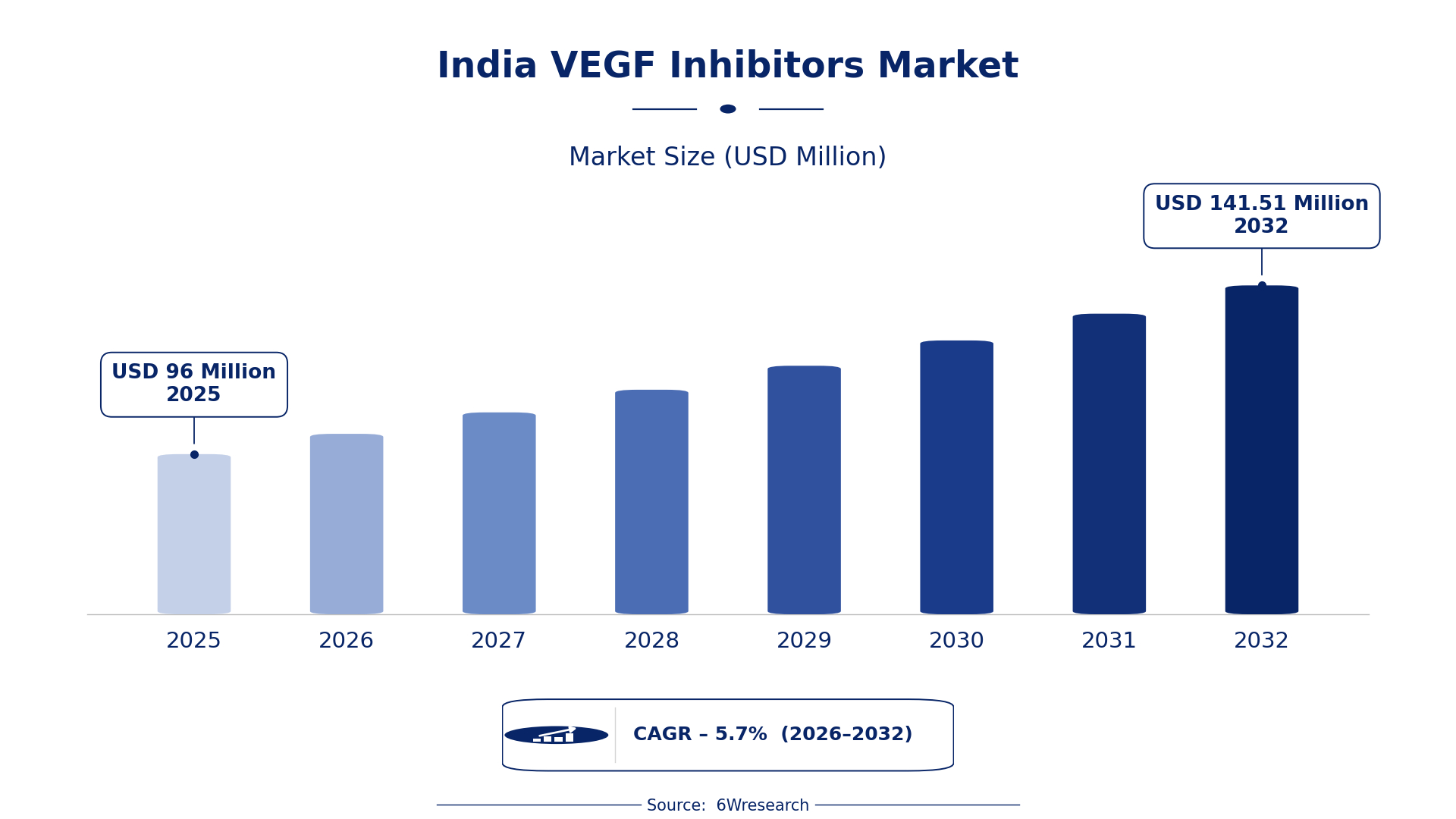
According to 6Wresearch internal database and industry insights, the India VEGF Inhibitors Market was valued at USD 96.0 million in 2025 and is projected to reach USD 141.51 million by 2032, growing at a CAGR of approximately 5.7% during 2026–2032.
India VEGF Inhibitors Market Highlights
| Report Metric | Details |
| Report Name | India VEGF Inhibitors Market |
| Market Size 2025 | USD 96.0 million |
| Market Size 2032 | USD 141.51 million |
| Absolute Growth 2025–2032 | USD 45.51 million |
| CAGR 2026–2032 | 5.7% |
| Peak Annual Growth | 7.7% in 2032 |
| Forecast Period | 2026–2032 |
| Historical Data | 2022–2025 |
| Base Year | 2025 |
| Leading Drug Class, 2025 | Monoclonal Antibodies (43% share) |
| Leading Delivery Route, 2025 | Intravenous (44% share) |
| Leading Application, 2025 | Cancer Therapy (47% share) |
| Leading End User, 2025 | Hospitals (43% share) |
| Fastest-Growing Drug Class | Biosimilars (7.6% CAGR) |
| Fastest-Growing Delivery Route | Oral (7.6% CAGR) |
| Fastest-Growing Application | Ophthalmic Conditions (8.3% CAGR) |
| Fastest-Growing End User | Specialty Clinics (7.1% CAGR) |
| Growing Sector | Oncology |
| Key End Users | Hospitals, Specialty Clinics, Oncology Departments |
India VEGF Inhibitors Market Year-wise Growth Rate and Key Drivers (2022–2032)
This graph illustrates the annual growth rates of the market from 2022 to 2032, highlighting a steady upward trajectory and projected market expansion over the forecast period.
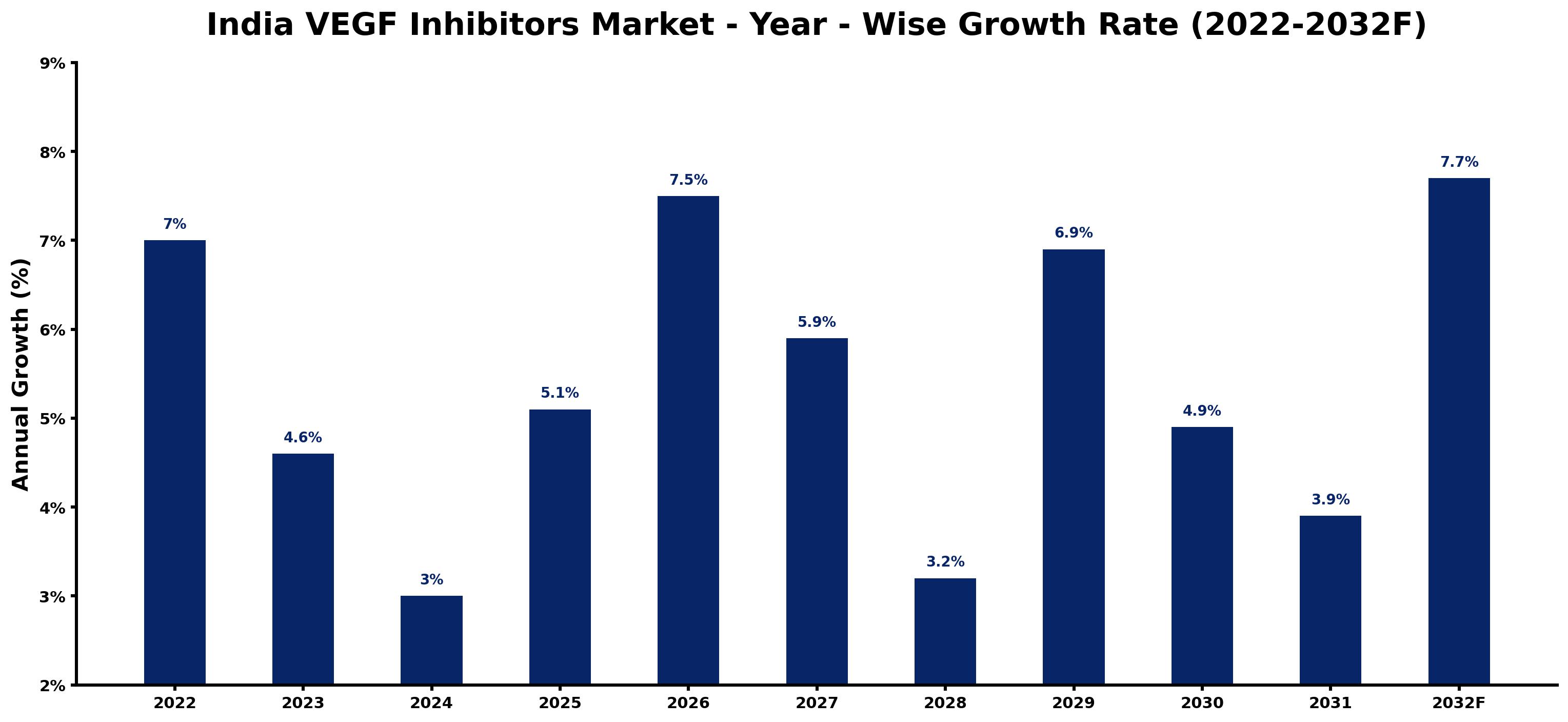
Each row of the following table gives one year's estimated growth and the event or demand shift that explains it.
| Year | Estimated Annual Growth (%) | Market Rationale |
| 2022 | 7.0 | The market experienced strong demand due to over 1 million new cancer cases reported annually. |
| 2023 | 4.6 | Growth slowed as the market adjusted to new treatment protocols established by the Indian Council of Medical Research. |
| 2024 | 3.0 | Continued adjustments in treatment access contributed to a further slowdown in growth. |
| 2025 | 5.1 | An increase in oncology departments boosted demand for VEGF inhibitors in hospitals across India. |
| 2026 | 7.5 | The market rebounded as hospitals expanded their oncology services, driving higher purchases of VEGF inhibitors. |
| 2027 | 5.9 | Growth slowed as hospitals faced challenges in sourcing new treatments amid regulatory scrutiny. |
| 2028 | 3.2 | The market continued to grow slowly as outpatient treatment options gained popularity. |
| 2029 | 6.9 | Demand increased as the National Health Mission improved cancer care access in rural areas. |
| 2030 | 4.9 | Growth slowed as hospitals adjusted to new treatment guidelines and patient needs. |
| 2031 | 3.9 | The market saw a further slowdown as competition intensified among treatment providers. |
| 2032 | 7.7 | A surge in demand is expected as the Cancer Care Programme improves treatment facilities nationwide. |
Note: Market size estimations and growth projections presented in this report are based on 6Wresearch's proprietary forecasting methodology, utilizing the latest available industry data, government publications, and primary research inputs.
India VEGF Inhibitors Market Synopsis
The VEGF Inhibitors Market in India encompasses drugs that block vascular endothelial growth factor, which is essential for tumor growth. These drugs are primarily produced through biotechnological processes and are used mainly in oncology and ophthalmology. The market is expanding due to a high demand for cancer treatments, driven by over 1 million new cases annually and investments in healthcare infrastructure. Initiatives such as the National Health Mission are improving access to cancer care across rural areas, leading to increased purchases of VEGF inhibitors.
Market Dynamics Impact Analysis (2026–2032)
| Factor | Type | Impact | Primary Segment Affected |
| High incidence of cancer cases driving treatment demand. | Driver | High | Cancer Therapy |
| Growing number of oncology departments in hospitals. | Driver | High | Oncology Departments |
| Increasing investment in rural healthcare facilities. | Opportunity | High | Hospitals |
| Rising demand for outpatient treatment options. | Opportunity | Medium | Specialty Clinics |
| Regulatory challenges in drug approval processes. | Restraint | High | Monoclonal Antibodies |
| Limited access to advanced treatment options in rural areas. | Restraint | Medium | Ophthalmic Conditions |
| High costs of new treatment options affecting affordability. | Challenge | High | Cancer Therapy |
| Delays in regulatory approvals impacting market entry. | Challenge | Medium | Monoclonal Antibodies |
Evaluation of Drivers in India VEGF Inhibitors Market (2026–2032)
The factors lifting demand, and the evidence behind each, are summarised below.
| Drivers | Primary Segment Affected | Why It Matters (Evidence) |
| High incidence of cancer cases. | Cancer Therapy | Over 1 million new cancer cases annually drive hospitals to increase purchases of VEGF inhibitors. |
| Expansion of oncology departments in hospitals. | Oncology Departments | Over 200 hospitals equipped with oncology departments are increasing their procurement of VEGF inhibitors. |
| Investment in rural healthcare initiatives. | Hospitals | The National Health Mission's focus on rural cancer care is improving treatment access and driving demand. |
| Increasing outpatient treatment options. | Specialty Clinics | The rise in outpatient therapies is prompting specialty clinics to procure more VEGF inhibitors. |
| Rising awareness of cancer treatment protocols. | Oncology Departments | The Indian Society of Medical and Pediatric Oncology promotes awareness, increasing demand for VEGF inhibitors. |
Growth across the VEGF Inhibitors market in India is anchored in the rising incidence of cancer cases, the expansion of oncology departments, and investments in rural healthcare. Over 1 million new cancer cases annually drive hospitals to increase purchases of these drugs. The growing number of outpatient treatment options is leading specialty clinics to procure more VEGF inhibitors. Increased awareness of treatment protocols is also supporting market growth, as more healthcare providers adopt these protocols.
Evaluation of Restraints in India VEGF Inhibitors Market
The table below lists the restraints and the evidence behind each.
| Market Restraint | Primary Segment Affected | Why It Matters (Evidence) |
| Regulatory challenges in drug approval processes. | Monoclonal Antibodies | The Drug Controller General of India enforces strict regulations, delaying the entry of new VEGF inhibitors into the market. |
| Limited access to advanced treatment options in rural areas. | Ophthalmic Conditions | The National Health Mission's initiatives have yet to fully bridge the gap in treatment access for rural patients. |
| High costs of new treatment options affecting affordability. | Cancer Therapy | The Ministry of Health and Family Welfare's subsidy scheme targets low-income families but does not cover all patients. |
| Intensifying competition among treatment providers. | Specialty Clinics | Increased competition among clinics is creating price pressures, impacting profitability for providers. |
| Delays in regulatory approvals impacting market entry. | Monoclonal Antibodies | The Central Drugs Standard Control Organization's lengthy approval processes hinder timely access to new treatments. |
India VEGF Inhibitors Market Challenges
Buyers in the India VEGF inhibitors market encounter delays in accessing effective treatments due to lengthy approval processes, which can take up to 18 months. This challenge arises from stringent regulations enforced by the Drug Controller General of India, impacting timely care for over 1 million new cancer patients each year. Limited local suppliers create sourcing challenges for distributors, resulting in increased production timelines by 30%. A shortage of skilled professionals in biopharmaceutical manufacturing leads to operational inefficiencies, raising production costs by approximately 15% for manufacturers. Compliance with ISO 9001:2015 standards places a burden on small producers, limiting their competitive edge in the market.
Trends in the India VEGF Inhibitors Market
Buyers and suppliers in the India VEGF Inhibitors Market are adjusting to the following trends.
- Shift towards Outpatient Treatment Options: India is experiencing a shift towards outpatient treatment options for cancer therapy, as more patients prefer convenient care. By 2025, outpatient therapies are projected to account for a significant share of treatments, improving patient access.
- Increased Focus on Rural Healthcare: The National Health Mission's initiatives are improving cancer care access in rural areas, aiming to reach 500,000 patients annually by 2025. This focus is driving demand for VEGF inhibitors in underserved regions.
- Growing Adoption of Biosimilars: The market is seeing a growing adoption of biosimilars as cost-effective alternatives to original biologics. By 2025, biosimilars are projected to capture a notable share of the VEGF inhibitors market, appealing to budget-conscious healthcare providers.
- Expansion of Oncology Departments in Hospitals: Over 200 hospitals in India are expanding their oncology departments, which is expected to significantly increase demand for VEGF inhibitors. This growth is projected to improve treatment capacity and patient outcomes.
Investment Opportunities in the India VEGF Inhibitors Market
Several openings in the India VEGF Inhibitors Market merit attention from investors.
- Investment in Cancer Treatment Facilities: The Cancer Care Programme launched by the National Health Mission in 2021 is improving treatment facilities, creating a demand for VEGF inhibitors. With a target of reaching 500,000 patients annually, this presents a notable opportunity for suppliers.
- Growing Demand for Outpatient Therapies: The increasing shift towards outpatient therapies is creating a need for more convenient treatment options. Specialty clinics are looking to invest in VEGF inhibitors to meet this demand, driven by rising patient numbers.
- Focus on Rural Healthcare Initiatives: With the National Health Mission aiming to improve cancer care access in rural areas, there is a pressing need for effective treatments. This presents an opportunity for suppliers to partner with healthcare providers in these regions.
- Expansion of Oncology Departments: The growth of oncology departments in over 200 hospitals is creating a demand for advanced cancer treatments. Suppliers can enter this market by collaborating with hospitals to provide VEGF inhibitors.
Government Initiatives in the India VEGF Inhibitors Market
The Cancer Care Programme launched by the National Health Mission in 2021 improves cancer treatment facilities across India, particularly in rural areas. This programme builds on the National Cancer Control Programme updated in 2020, which aimed to improve early detection and treatment access. The new programme targets a significant increase in treatment capacity, focusing on underserved populations and aiming to enhance patient outcomes through better access to VEGF inhibitors. The initiative is expected to improve treatment availability for at least 500,000 patients annually, thus expanding the market for these drugs.
Healthcare providers benefit from the Ayushman Bharat scheme, which provides health insurance coverage for cancer treatments, including VEGF inhibitors. This scheme, operational since 2018, has been instrumental in subsidising treatment costs for economically weaker sections. Additionally, the Ministry of Health and Family Welfare's 2022 initiative to subsidise cancer treatment costs for low-income families targets 500,000 patients annually, further improving access to necessary therapies. The Central Drugs Standard Control Organization oversees the implementation of these measures, ensuring compliance and effectiveness.
Future Insight of the India VEGF Inhibitors Market
The India VEGF inhibitors market will experience significant transformations by 2032, driven by advancements in biotechnology and a surge in clinical trials for new therapies. The National Health Mission's initiative to improve cancer care access in rural areas will expand the patient base, creating new opportunities for suppliers. The market for monoclonal antibodies is set to grow substantially, stimulating demand for VEGF inhibitors and prompting producers to innovate. With over 200 hospitals equipped with oncology departments, the infrastructure for delivering these treatments will enhance, benefiting both buyers and suppliers.
Market Segmentation Analysis
The analysis below covers each segmentation, its leading category in 2025 and its fastest-growing category through 2032.
By Drug Class – Monoclonal Antibodies Dominated, Biosimilars Expected to Grow Fastest
According to Bhawna Singh, Assistant Manager at 6Wresearch, with a 43% revenue share in 2025, Monoclonal Antibodies was the largest drug class category. Monoclonal antibodies dominate the India VEGF inhibitors market due to their effectiveness in targeted cancer therapy, making them the preferred option among healthcare providers. Their extensive use in over 200 hospitals highlights their critical role in treating cancer patients across the country. Biosimilars are set to record the highest CAGR in this split, 7.6% over 2026–2032. Biosimilars are rapidly gaining traction as cost-effective alternatives, appealing to a larger patient demographic. The projected growth of the monoclonal antibodies market by 2025 indicates a strong shift towards these affordable options. Suppliers should prioritise the development of biosimilars to align with the increasing demand for cost-effective treatment solutions.
By Delivery Route – Intravenous Dominated, Oral Expected to Grow Fastest
Intravenous held a 44% share of the India VEGF Inhibitors Market by delivery route in 2025. Intravenous delivery is the most prevalent method for administering VEGF inhibitors, especially in hospital settings where immediate therapeutic effects are vital. This method allows healthcare professionals to maintain a high level of control during treatment, ensuring patient safety and efficacy. The quickest growth will come from Oral, forecast to expand at a CAGR of 7.6% between 2026 and 2032. Oral delivery is rapidly gaining popularity due to its convenience for outpatient treatments, reflecting a shift in patient preferences towards less invasive options. The growing trend of outpatient care is propelling this segment's swift growth. Suppliers must focus on developing oral formulations to meet the evolving preferences of patients and healthcare providers.
By Application – Cancer Therapy Dominated, Ophthalmic Conditions Expected to Grow Fastest
Cancer Therapy took a 47% share of application in 2025, more than any other category. Cancer therapy holds the largest market share for VEGF inhibitors due to the staggering annual incidence of over 1 million new cancer cases in India. The treatment protocols established by the Indian Council of Medical Research further reinforce the demand for these therapies. Ophthalmic Conditions are projected to grow fastest, at a CAGR of 8.3% during 2026–2032. Ophthalmic conditions are witnessing rapid growth as awareness increases, leading to a surge in patient treatment requests. Ongoing clinical trials for new VEGF inhibitors specifically targeting these eye conditions are propelling this segment's expansion. Suppliers should explore opportunities to develop and market treatments for ophthalmic conditions to capitalise on this growth trend.
By End User – Hospitals Dominated, Specialty Clinics Expected to Grow Fastest
The largest end user category in 2025 was Hospitals, with a 43% share of total revenue. Hospitals dominate the market for VEGF inhibitors as they are the primary settings for administering these critical treatments, ensuring a substantial market share. The presence of advanced treatment facilities in over 200 hospitals underscores their pivotal role in the healthcare landscape. Over 2026–2032, Specialty Clinics are expected to post the fastest growth, at a CAGR of 7.1%. Specialty clinics are becoming increasingly relevant in outpatient therapies, indicating a shift towards more convenient treatment options for patients. This growth is further encouraged by efforts to improve cancer care access in rural areas by 2025. Suppliers should focus on building relationships with specialty clinics to enhance their market presence and meet the rising demand for outpatient care.
Key Attractiveness of the Report
- 10 Years of Market Numbers
- Historical Data Starting from 2022 to 2025
- Base Year 2025
- Forecast Data until 2032
- Key Performance Indicators Impacting the Market
- Major Upcoming Developments and Projects
Key Highlights of the Report:
- India VEGF Inhibitors Market Outlook
- Market Size of India VEGF Inhibitors Market, 2025
- Forecast of India VEGF Inhibitors Market, 2032
- Historical Data and Forecast of India VEGF Inhibitors Revenues & Volume for the Period 2022 - 2032F
- India VEGF Inhibitors Market Trend Evolution
- India VEGF Inhibitors Market Drivers and Challenges
- India VEGF Inhibitors Price Trends
- India VEGF Inhibitors Porter's Five Forces
- India VEGF Inhibitors Industry Life Cycle
- Historical Data and Forecast of India VEGF Inhibitors Market Revenues & Volume By Drug Class for the Period 2022 - 2032F
- Historical Data and Forecast of India VEGF Inhibitors Market Revenues & Volume By Monoclonal Antibodies for the Period 2022 - 2032F
- Historical Data and Forecast of India VEGF Inhibitors Market Revenues & Volume By Small Molecule Inhibitors for the Period 2022 - 2032F
- Historical Data and Forecast of India VEGF Inhibitors Market Revenues & Volume By Fusion Proteins for the Period 2022 - 2032F
- Historical Data and Forecast of India VEGF Inhibitors Market Revenues & Volume By Biosimilars for the Period 2022 - 2032F
- Historical Data and Forecast of India VEGF Inhibitors Market Revenues & Volume By Delivery Route for the Period 2022 - 2032F
- Historical Data and Forecast of India VEGF Inhibitors Market Revenues & Volume By Intravenous for the Period 2022 - 2032F
- Historical Data and Forecast of India VEGF Inhibitors Market Revenues & Volume By Oral for the Period 2022 - 2032F
- Historical Data and Forecast of India VEGF Inhibitors Market Revenues & Volume By Subcutaneous for the Period 2022 - 2032F
- Historical Data and Forecast of India VEGF Inhibitors Market Revenues & Volume By IV/SC for the Period 2022 - 2032F
- Historical Data and Forecast of India VEGF Inhibitors Market Revenues & Volume By Application for the Period 2022 - 2032F
- Historical Data and Forecast of India VEGF Inhibitors Market Revenues & Volume By Cancer Therapy for the Period 2022 - 2032F
- Historical Data and Forecast of India VEGF Inhibitors Market Revenues & Volume By Ophthalmic Conditions for the Period 2022 - 2032F
- Historical Data and Forecast of India VEGF Inhibitors Market Revenues & Volume By Age-Related Macular Deg. for the Period 2022 - 2032F
- Historical Data and Forecast of India VEGF Inhibitors Market Revenues & Volume By Renal Cell Carcinoma for the Period 2022 - 2032F
- Historical Data and Forecast of India VEGF Inhibitors Market Revenues & Volume By End User for the Period 2022 - 2032F
- Historical Data and Forecast of India VEGF Inhibitors Market Revenues & Volume By Hospitals for the Period 2022 - 2032F
- Historical Data and Forecast of India VEGF Inhibitors Market Revenues & Volume By Specialty Clinics for the Period 2022 - 2032F
- Historical Data and Forecast of India VEGF Inhibitors Market Revenues & Volume By Eye Care Centers for the Period 2022 - 2032F
- Historical Data and Forecast of India VEGF Inhibitors Market Revenues & Volume By Oncology Departments for the Period 2022 - 2032F
- India VEGF Inhibitors Import Export Trade Statistics
- Market Opportunity Assessment By Drug Class
- Market Opportunity Assessment By Delivery Route
- Market Opportunity Assessment By Application
- Market Opportunity Assessment By End User
- India VEGF Inhibitors Top Companies Market Share
- India VEGF Inhibitors Competitive Benchmarking By Technical and Operational Parameters
- India VEGF Inhibitors Company Profiles
- India VEGF Inhibitors Key Strategic Recommendations
Market Covered
This report examines the market across the segments below.
By Drug Class
- Monoclonal Antibodies
- Small Molecule Inhibitors
- Fusion Proteins
- Biosimilars
By Delivery Route
- Intravenous
- Oral
- Subcutaneous
- IV/SC
By Application
- Cancer Therapy
- Ophthalmic Conditions
- Age-Related Macular Deg.
- Renal Cell Carcinoma
By End User
- Hospitals
- Specialty Clinics
- Eye Care Centers
- Oncology Departments































