China VEGF Inhibitors Market Size & Growth Rate
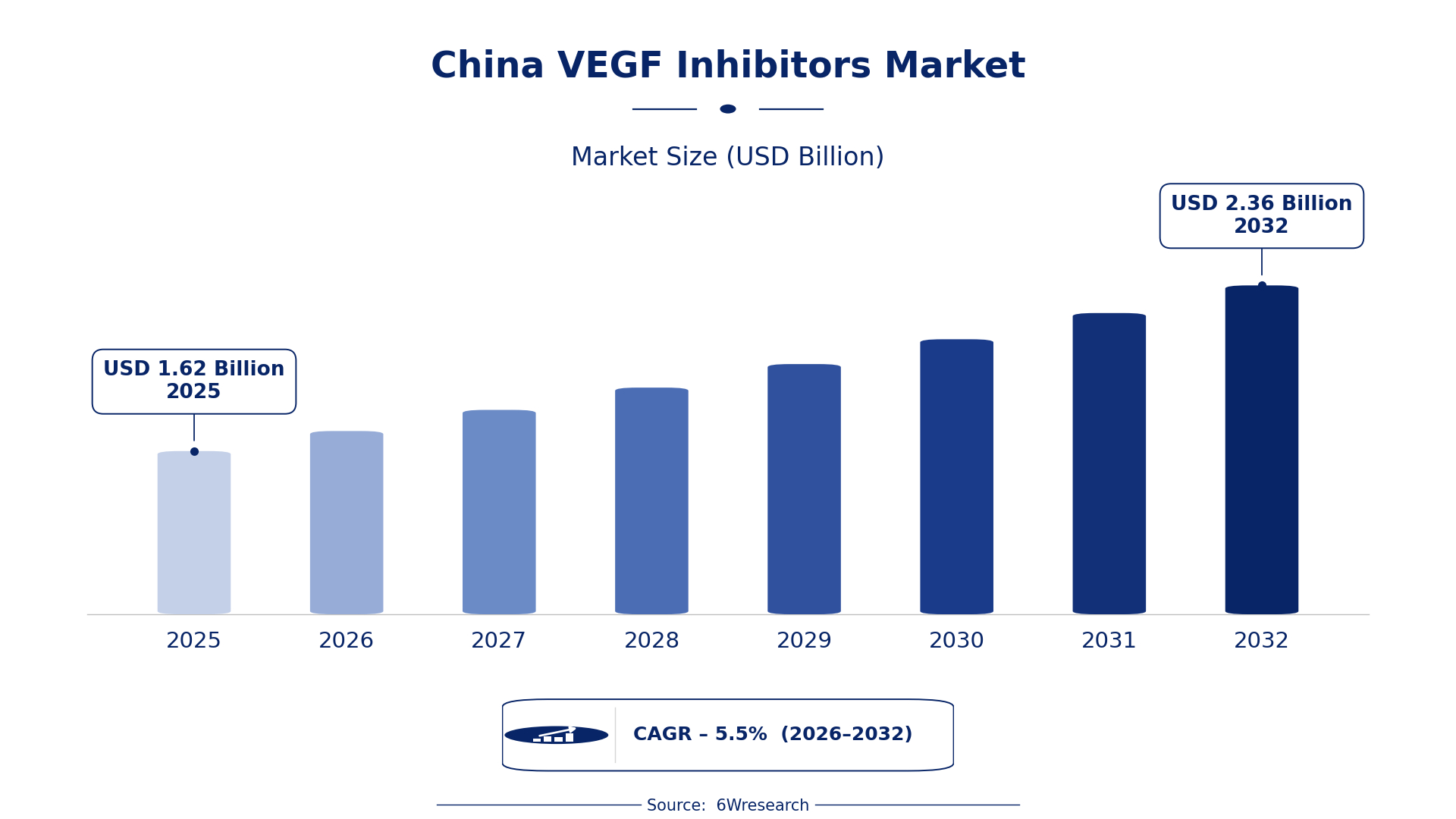
According to 6Wresearch internal database and industry insights, the China VEGF Inhibitors Market was valued at USD 1.62 billion in 2025 and is projected to reach USD 2.36 billion by 2032, growing at a CAGR of approximately 5.5% during 2026–2032.
China VEGF Inhibitors Market Highlights
| Report Metric | Details |
| Report Name | China VEGF Inhibitors Market |
| Market Size 2025 | USD 1.62 billion |
| Market Size 2032 | USD 2.36 billion |
| Absolute Growth 2025–2032 | USD 0.74 billion |
| CAGR 2026–2032 | 5.5% |
| Peak Annual Growth | 7.5% in 2027 |
| Forecast Period | 2026–2032 |
| Historical Data | 2022–2025 |
| Base Year | 2025 |
| Leading Drug Class, 2025 | Monoclonal Antibodies (34% share) |
| Leading Delivery Route, 2025 | Intravenous (39% share) |
| Leading Application, 2025 | Cancer Therapy (40% share) |
| Leading End User, 2025 | Hospitals (46% share) |
| Fastest-Growing Drug Class | Biosimilars (6.9% CAGR) |
| Fastest-Growing Delivery Route | Subcutaneous (7.2% CAGR) |
| Fastest-Growing Application | Ophthalmic Conditions (6.6% CAGR) |
| Fastest-Growing End User | Specialty Clinics (7.1% CAGR) |
| Growing Sector | Cancer Treatment |
| Key End Users | Hospitals, Specialty Clinics, Oncology Departments, Eye Care Centers |
China VEGF Inhibitors Market Year-wise Growth Rate and Key Drivers (2022–2032)
This graph illustrates the annual growth rates of the market from 2022 to 2032, highlighting a steady upward trajectory and projected market expansion over the forecast period.
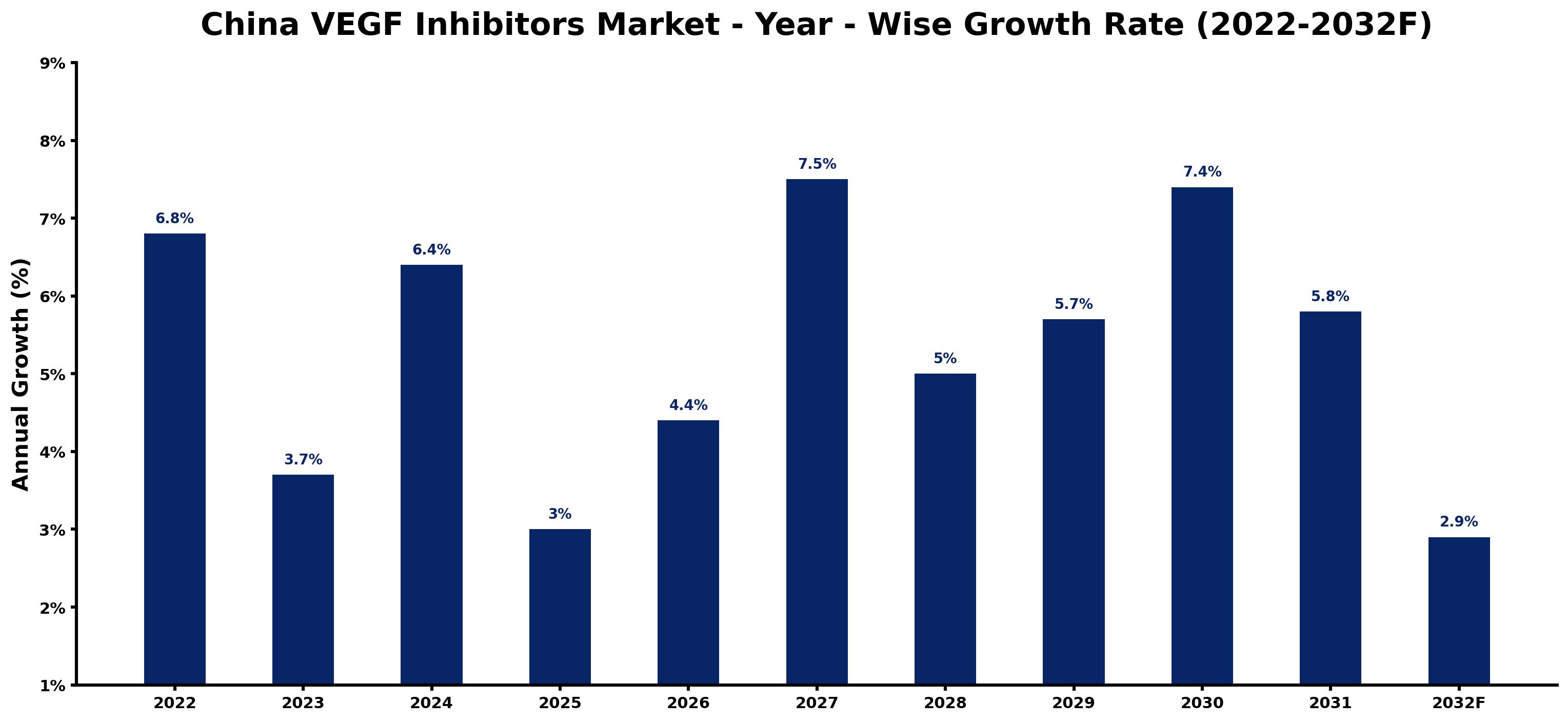
Below, each year's estimated growth is shown next to the factor that most influenced it.
| Year | Estimated Annual Growth (%) | Market Rationale |
| 2022 | 6.8 | The market experienced growth due to increased patient treatments for cancer. |
| 2023 | 3.7 | Growth slowed as the market adjusted to the previous year's high demand. |
| 2024 | 6.4 | The market rebounded with renewed interest in targeted cancer therapies. |
| 2025 | 3.0 | Growth slowed again as hospitals faced budget constraints in treatment costs. |
| 2026 | 4.4 | Investment in cancer treatment facilities is expected to drive demand higher. |
| 2027 | 7.5 | The market is projected to peak with a surge in approvals for new therapies. |
| 2028 | 5.0 | Growth is expected to slow as competition among treatment options increases. |
| 2029 | 5.7 | Demand is anticipated to rise again as specialty clinics expand their service offerings. |
| 2030 | 7.4 | A rise in government initiatives to combat cancer is expected to boost market growth. |
| 2031 | 5.8 | Growth is projected to slow as the market matures and faces regulatory challenges. |
| 2032 | 2.9 | The market will continue to grow but at a reduced rate as saturation occurs. |
Note: Market size estimations and growth projections presented in this report are based on 6Wresearch's proprietary forecasting methodology, utilizing the latest available industry data, government publications, and primary research inputs.
China VEGF Inhibitors Market Synopsis
The VEGF Inhibitors Market in China encompasses drugs that block vascular endothelial growth factor, which is vital for tumor growth and angiogenesis. These inhibitors are primarily produced through biotechnological processes and are essential in cancer therapy, especially for renal cell carcinoma and age-related macular degeneration. The market is expanding due to increased patient treatments, driven by hospitals and specialty clinics. In 2022, over 1 million patients received cancer treatment, highlighting the rising demand for effective therapies. The 'National Cancer Prevention and Control Program' aims to reduce cancer incidence by 10% by 2030, further supporting market growth.
Market Dynamics Impact Analysis (2026–2032)
| Factor | Type | Impact | Primary Segment Affected |
| Increasing patient population requiring cancer treatment | Driver | High | Cancer Therapy |
| Growing number of oncology departments in hospitals | Driver | High | Hospitals |
| Rising demand for targeted therapies in specialty clinics | Opportunity | High | Specialty Clinics |
| Expansion of treatment facilities in rural areas | Opportunity | High | Oncology Departments |
| High treatment costs limiting patient access | Restraint | High | Cancer Therapy |
| Regulatory hurdles for new drug approvals | Restraint | Medium | Biosimilars |
| Limited awareness of treatment options among patients | Challenge | Medium | Ophthalmic Conditions |
| Competition from alternative therapies in cancer treatment | Challenge | High | Renal Cell Carcinoma |
Evaluation of Drivers in China VEGF Inhibitors Market (2026–2032)
The main growth drivers and the segments they affect most are set out below.
| Drivers | Primary Segment Affected | Why It Matters (Evidence) |
| Increased investment in cancer treatment facilities | Hospitals | The installed base of VEGF inhibitors in hospitals is estimated at 30,000 units, prompting more purchases. |
| Rising patient numbers for cancer therapies | Cancer Therapy | In 2022, over 1 million patients received treatment for cancer, driving demand for effective therapies. |
| Expansion of specialty clinics focusing on cancer treatment | Specialty Clinics | The total number of specialty clinics treating ophthalmic conditions reached 1,200 in 2022. |
| Government initiatives improving access to treatments | Oncology Departments | The 'Cancer Treatment Advancement Plan' aims to improve access to VEGF inhibitors across rural areas. |
| Growing awareness of age-related macular degeneration | Ophthalmic Conditions | The average age of patients treated for age-related macular degeneration is 75 years, increasing demand. |
Growth in the VEGF Inhibitors market in China comes from increased investment in cancer treatment facilities, with over 30,000 units installed in hospitals. Rising patient numbers for cancer therapies drive demand, as more than 1 million patients received treatment in 2022. The expansion of specialty clinics focusing on cancer treatment has led to a growing number of facilities. Awareness of age-related macular degeneration is increasing, particularly among older patients.
Evaluation of Restraints in China VEGF Inhibitors Market
The key brakes on demand, and where they bite hardest, are shown below.
| Market Restraint | Primary Segment Affected | Why It Matters (Evidence) |
| High treatment costs limiting patient access | Cancer Therapy | The average treatment cost for a course of VEGF inhibitors is approximately 100,000 CNY, restricting affordability. |
| Regulatory hurdles for new drug approvals | Biosimilars | The fast-track pathway for biosimilars registration has stringent requirements, delaying market entry. |
| Limited awareness of treatment options among patients | Ophthalmic Conditions | Many patients remain unaware of available therapies for age-related macular degeneration, affecting uptake. |
| Competition from alternative therapies in cancer treatment | Renal Cell Carcinoma | Emerging therapies are vying for market share, complicating treatment decisions for healthcare providers. |
| Inconsistent supply chain for raw materials | Monoclonal Antibodies | Disruptions in the supply chain can lead to delays in production and availability of treatments. |
China VEGF Inhibitors Market Challenges
The China VEGF Inhibitors Market still has to solve a few problems, and the first is intense competition among suppliers. This arises from over 2,500 oncology departments competing for market share, which drives down prices and reduces profit margins for producers. Next, technological limitations hinder the production of advanced VEGF inhibitors, delaying the introduction of new treatments for hospitals and specialty clinics. Regulatory hurdles complicate market entry, as compliance with the National Medical Products Administration can extend approval timelines by up to six months for new products. The average treatment cost of approximately 100,000 CNY poses a financial burden on patients, limiting access to therapies for many individuals.
Trends in the China VEGF Inhibitors Market
Four trends stand out in the China VEGF Inhibitors Market.
- Shift from Traditional to Targeted Cancer Therapies: China is increasingly adopting targeted cancer therapies, with the National Cancer Prevention and Control Program promoting these treatments. In 2023, the government allocated 500 million CNY for cancer research, improving access to advanced therapies.
- Growing Focus on Age-Related Macular Degeneration Treatments: The rise in elderly patients has led to a greater emphasis on treatments for age-related macular degeneration. The average age of treated patients is 75 years, highlighting the need for effective therapies in this demographic.
- Expansion of Specialty Clinics for Cancer Treatment: Specialty clinics are expanding their services to cater to cancer patients, with 1,200 clinics now treating ophthalmic conditions. This growth reflects a 15% increase in the use of VEGF inhibitors for renal cell carcinoma from 2021 to 2022.
- Increased Government Funding for Cancer Research: The Chinese government is prioritising cancer research funding, with 500 million CNY allocated in 2023. This investment aims to improve treatment options and patient outcomes across the country.
Investment Opportunities in the China VEGF Inhibitors Market
Below are the investment opportunities with the strongest case in the China VEGF Inhibitors Market.
- Investment in Advanced Cancer Treatment Facilities: Investment opportunities are emerging in advanced cancer treatment facilities, particularly in rural areas. The 'Cancer Treatment Advancement Plan' aims to improve access to VEGF inhibitors, presenting a chance for local partnerships.
- Supply of Innovative VEGF Inhibitors: There is a growing demand for innovative VEGF inhibitors in specialty clinics. The expansion of these clinics presents a valuable opportunity for suppliers to meet rising demand.
- Partnerships for Biosimilars Development: Opportunities for partnerships in biosimilars development are increasing as regulations evolve. Collaborating with local firms can facilitate entry into the expanding market for cost-effective alternatives.
- Enhancing Awareness of Treatment Options: There is an opportunity to boost awareness of VEGF inhibitors among patients. Engaging with healthcare providers in oncology departments can drive education and increase treatment uptake.
Government Initiatives in the China VEGF Inhibitors Market
The National Medical Products Administration regulates VEGF inhibitors in China, ensuring safety and efficacy in treatments. The updated 'National Drug Policy' in 2021 includes subsidies for cancer therapies, making them more accessible to patients. This policy change has encouraged hospitals to adopt new therapies, improving patient outcomes. The 'Cancer Treatment Advancement Plan' launched in 2023 aims to improve access to VEGF inhibitors, particularly in rural areas, with an allocation of 500 million CNY for cancer research. The Chinese Society of Clinical Oncology provides guidelines that align with these government efforts, promoting best practices in cancer treatment.
In 2023, the National Health Commission launched the 'Cancer Treatment Advancement Plan', allocating 500 million CNY for cancer research. This initiative aims to improve access to VEGF inhibitors, particularly in rural areas. The plan supports the establishment of new treatment facilities, ensuring that patients receive timely care. The Chinese Society of Clinical Oncology provides guidelines that align with these government efforts, promoting best practices in cancer treatment.
Future Insight of the China VEGF Inhibitors Market
The China VEGF Inhibitors Market is expected to evolve by 2032, influenced by several key factors. The 'National Cancer Prevention and Control Program' aims to reduce cancer incidence by 10% by 2030, which will increase demand for effective treatments. Advancements in biotechnology will improve the efficacy of VEGF inhibitors, enhancing patient outcomes. The allocation of 500 million CNY for cancer research in 2023 will support innovation in treatment options. The implementation of ISO 9001 standards will ensure higher quality manufacturing processes, benefiting both suppliers and buyers.
Market Segmentation Analysis
The report offers a comprehensive study of the following market segments and their leading categories in the market.
By Drug Class – Monoclonal Antibodies Dominated, Biosimilars Expected to Grow Fastest
According to Bhawna Singh, Assistant Manager at 6Wresearch, in 2025, Monoclonal Antibodies led the drug class split with a 34% share. Monoclonal antibodies hold the largest share in the China VEGF inhibitors market as they are integral to targeted cancer therapies, particularly in hospitals. Their widespread use is evidenced by the substantial installed base of approximately 30,000 units across these facilities. Over 2026–2032, Biosimilars are expected to post the fastest growth, at a CAGR of 6.9%. Biosimilars are experiencing rapid growth due to their cost-effective nature, appealing to a market that increasingly prioritises affordability in cancer treatments. The government's allocation of 500 million CNY for cancer research in 2023 is likely to further boost the adoption of these alternatives. Suppliers should focus on developing biosimilars to meet the rising demand for affordable cancer therapies.
By Delivery Route – Intravenous Dominated, Subcutaneous Expected to Grow Fastest
With a 39% revenue share in 2025, Intravenous was the largest delivery route category. Intravenous delivery is the leading method for administering VEGF inhibitors, especially for systemic therapies in hospitals across China. This route is preferred for its efficiency in ensuring quick drug absorption into the bloodstream, making it vital for patient treatment. Subcutaneous is set to record the highest CAGR in this split, 7.2% over 2026–2032. Subcutaneous delivery is gaining popularity as a more convenient option, allowing patients to receive treatment outside hospital environments. As patient preferences shift towards less invasive methods, this segment is projected to experience notable growth. Suppliers may need to invest in subcutaneous formulations to align with evolving patient preferences and enhance their market share.
By Application – Cancer Therapy Dominated, Ophthalmic Conditions Expected to Grow Fastest
Cancer Therapy took a 40% share of application in 2025, more than any other category. Cancer therapy is the primary application for VEGF inhibitors, driven by the high incidence of cancer in China, where over 1 million patients received treatment in 2022. This focus on oncology ensures a steady demand for these drugs in hospitals nationwide. The quickest growth will come from Ophthalmic Conditions, forecast to expand at a CAGR of 6.6% between 2026 and 2032. Ophthalmic conditions are emerging as a rapidly growing application, with an increasing number of specialty clinics treating eye diseases. The rise in age-related macular degeneration cases among the elderly population further fuels this growth. Suppliers should consider expanding their product offerings to include treatments for ophthalmic conditions to capitalise on this emerging market.
By End User – Hospitals Dominated, Specialty Clinics Expected to Grow Fastest
Hospitals held a 46% share of the China VEGF Inhibitors Market by end user in 2025. Hospitals dominate the end-user segment for VEGF inhibitors, serving as the primary locations for administering these therapies due to their extensive resources and high patient volumes. With over 2,500 oncology departments nationwide, hospitals are well-equipped to manage comprehensive cancer treatments effectively. Specialty Clinics are projected to grow fastest, at a CAGR of 7.1% during 2026–2032. Specialty clinics are quickly becoming a significant segment, focusing on specific treatments and personalised patient care. As the number of these clinics grows, the demand for targeted therapies in these settings is expected to rise substantially. Suppliers should strengthen partnerships with specialty clinics to leverage the increasing demand for personalised cancer treatments.
Key Attractiveness of the Report
- 10 Years of Market Numbers
- Historical Data Starting from 2022 to 2025
- Base Year 2025
- Forecast Data until 2032
- Key Performance Indicators Impacting the Market
- Major Upcoming Developments and Projects
Key Highlights of the Report:
- China VEGF Inhibitors Market Outlook
- Market Size of China VEGF Inhibitors Market, 2025
- Forecast of China VEGF Inhibitors Market, 2032
- Historical Data and Forecast of China VEGF Inhibitors Revenues & Volume for the Period 2022 - 2032F
- China VEGF Inhibitors Market Trend Evolution
- China VEGF Inhibitors Market Drivers and Challenges
- China VEGF Inhibitors Price Trends
- China VEGF Inhibitors Porter's Five Forces
- China VEGF Inhibitors Industry Life Cycle
- Historical Data and Forecast of China VEGF Inhibitors Market Revenues & Volume By Drug Class for the Period 2022 - 2032F
- Historical Data and Forecast of China VEGF Inhibitors Market Revenues & Volume By Monoclonal Antibodies for the Period 2022 - 2032F
- Historical Data and Forecast of China VEGF Inhibitors Market Revenues & Volume By Small Molecule Inhibitors for the Period 2022 - 2032F
- Historical Data and Forecast of China VEGF Inhibitors Market Revenues & Volume By Fusion Proteins for the Period 2022 - 2032F
- Historical Data and Forecast of China VEGF Inhibitors Market Revenues & Volume By Biosimilars for the Period 2022 - 2032F
- Historical Data and Forecast of China VEGF Inhibitors Market Revenues & Volume By Delivery Route for the Period 2022 - 2032F
- Historical Data and Forecast of China VEGF Inhibitors Market Revenues & Volume By Intravenous for the Period 2022 - 2032F
- Historical Data and Forecast of China VEGF Inhibitors Market Revenues & Volume By Oral for the Period 2022 - 2032F
- Historical Data and Forecast of China VEGF Inhibitors Market Revenues & Volume By Subcutaneous for the Period 2022 - 2032F
- Historical Data and Forecast of China VEGF Inhibitors Market Revenues & Volume By IV/SC for the Period 2022 - 2032F
- Historical Data and Forecast of China VEGF Inhibitors Market Revenues & Volume By Application for the Period 2022 - 2032F
- Historical Data and Forecast of China VEGF Inhibitors Market Revenues & Volume By Cancer Therapy for the Period 2022 - 2032F
- Historical Data and Forecast of China VEGF Inhibitors Market Revenues & Volume By Ophthalmic Conditions for the Period 2022 - 2032F
- Historical Data and Forecast of China VEGF Inhibitors Market Revenues & Volume By Age-Related Macular Deg. for the Period 2022 - 2032F
- Historical Data and Forecast of China VEGF Inhibitors Market Revenues & Volume By Renal Cell Carcinoma for the Period 2022 - 2032F
- Historical Data and Forecast of China VEGF Inhibitors Market Revenues & Volume By End User for the Period 2022 - 2032F
- Historical Data and Forecast of China VEGF Inhibitors Market Revenues & Volume By Hospitals for the Period 2022 - 2032F
- Historical Data and Forecast of China VEGF Inhibitors Market Revenues & Volume By Specialty Clinics for the Period 2022 - 2032F
- Historical Data and Forecast of China VEGF Inhibitors Market Revenues & Volume By Eye Care Centers for the Period 2022 - 2032F
- Historical Data and Forecast of China VEGF Inhibitors Market Revenues & Volume By Oncology Departments for the Period 2022 - 2032F
- China VEGF Inhibitors Import Export Trade Statistics
- Market Opportunity Assessment By Drug Class
- Market Opportunity Assessment By Delivery Route
- Market Opportunity Assessment By Application
- Market Opportunity Assessment By End User
- China VEGF Inhibitors Top Companies Market Share
- China VEGF Inhibitors Competitive Benchmarking By Technical and Operational Parameters
- China VEGF Inhibitors Company Profiles
- China VEGF Inhibitors Key Strategic Recommendations
Market Covered
Segments analysed in this report are listed below.
By Drug Class
- Monoclonal Antibodies
- Small Molecule Inhibitors
- Fusion Proteins
- Biosimilars
By Delivery Route
- Intravenous
- Oral
- Subcutaneous
- IV/SC
By Application
- Cancer Therapy
- Ophthalmic Conditions
- Age-Related Macular Deg.
- Renal Cell Carcinoma
By End User
- Hospitals
- Specialty Clinics
- Eye Care Centers
- Oncology Departments































