India Vehicle Autonomy Development Tools Market Size & Growth Rate
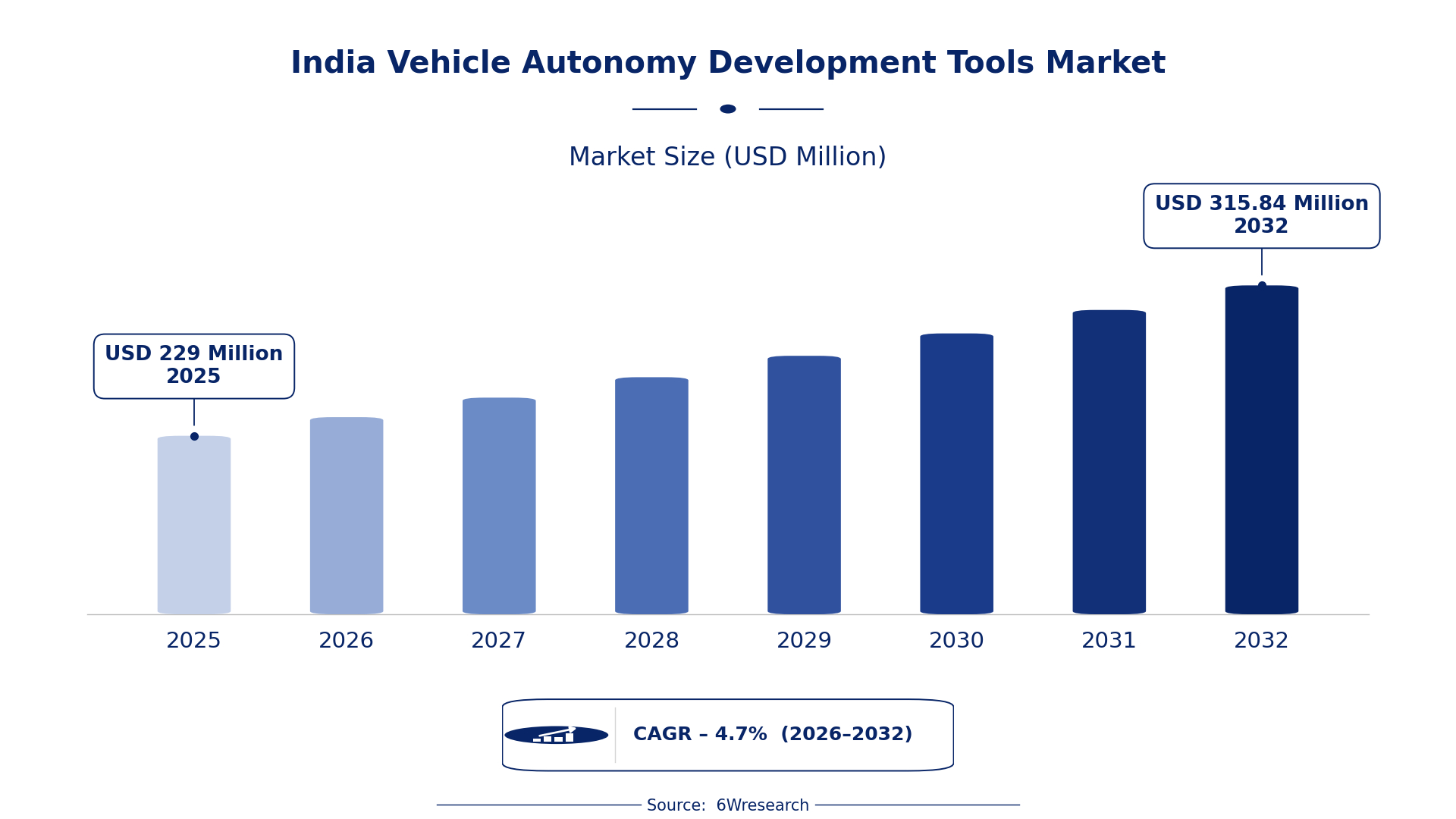
According to 6Wresearch internal database and industry insights, the India Vehicle Autonomy Development Tools Market was valued at USD 229.0 million in 2025 and is projected to reach USD 315.84 million by 2032, growing at a CAGR of approximately 4.7% during 2026–2032.
India Vehicle Autonomy Development Tools Market Highlights
| Report Metric | Details |
| Report Name | India Vehicle Autonomy Development Tools Market |
| Market Size 2025 | USD 229.0 million |
| Market Size 2032 | USD 315.84 million |
| Absolute Growth 2025–2032 | USD 86.84 million |
| CAGR 2026–2032 | 4.7% |
| Peak Annual Growth | 7.0% in 2029 |
| Forecast Period | 2026–2032 |
| Historical Data | 2022–2025 |
| Base Year | 2025 |
| Leading Tool Type, 2025 | Simulation Software (47% share) |
| Leading Functionality, 2025 | Virtual Environment (44% share) |
| Leading Integration Type, 2025 | API Compatible (45% share) |
| Leading End User, 2025 | AV Developers (43% share) |
| Fastest-Growing Tool Type | Sensor Calibration Tools (7.2% CAGR) |
| Fastest-Growing Functionality | Lidar/Camera Testing (6.2% CAGR) |
| Fastest-Growing Integration Type | Plug-In Modules (7.2% CAGR) |
| Fastest-Growing End User | Robotics Engineers (6.2% CAGR) |
| Growing Sector | Autonomous Vehicle Development |
| Key End Users | AV Developers, Robotics Engineers, ADAS R&D Labs, Tech Startups |
India Vehicle Autonomy Development Tools Market Year-wise Growth Rate and Key Drivers (2022–2032)
This graph illustrates the annual growth rates of the market from 2022 to 2032, highlighting a steady upward trajectory and projected market expansion over the forecast period.
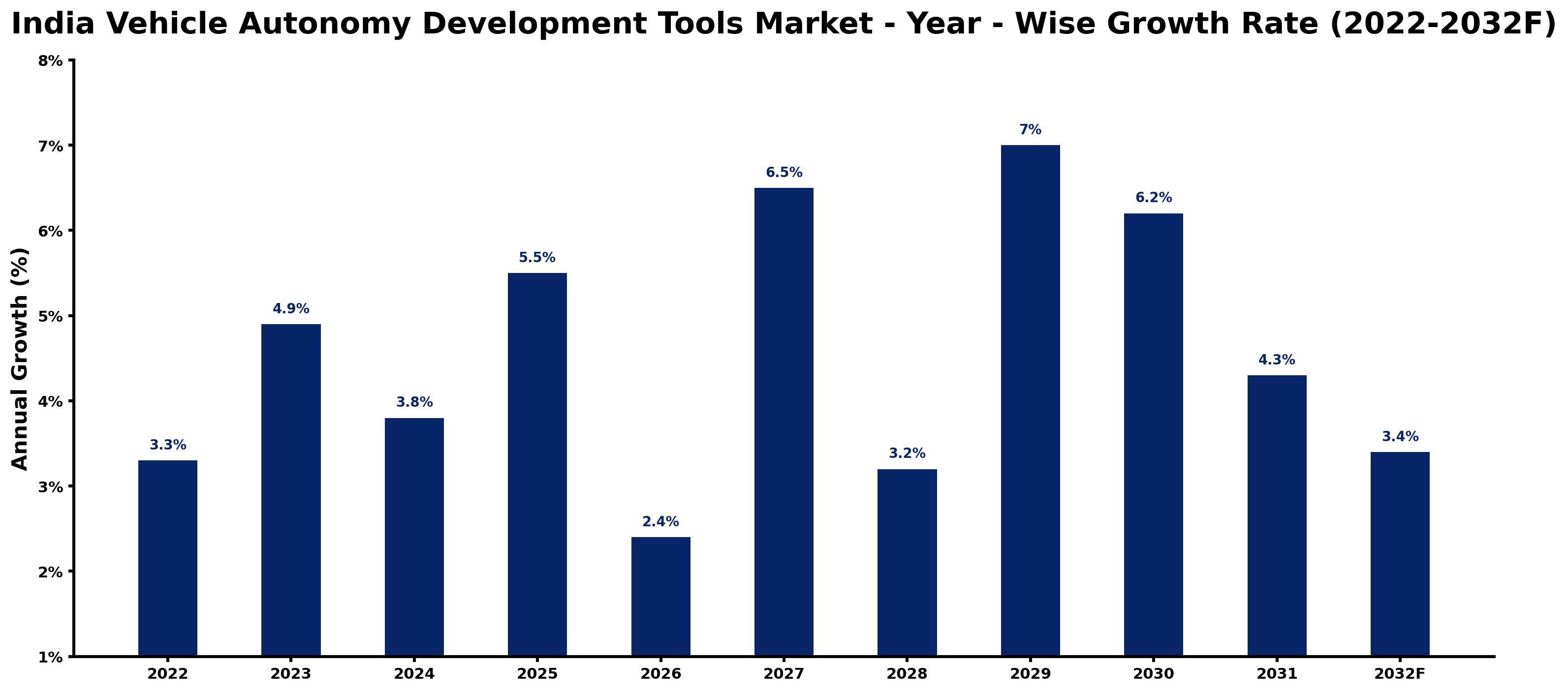
Each row of the following table gives one year's estimated growth and the event or demand shift that explains it.
| Year | Estimated Annual Growth (%) | Market Rationale |
| 2022 | 3.3 | The market showed steady activity with increasing interest from local developers and startups. |
| 2023 | 4.9 | Growth accelerated due to the launch of the Production-Linked Incentive Scheme boosting local manufacturing. |
| 2024 | 3.8 | A slowdown occurred as developers adjusted to new guidelines for autonomous vehicle testing. |
| 2025 | 5.5 | The market experienced a peak growth phase driven by rising investments in autonomous technologies. |
| 2026 | 2.4 | Growth slowed as developers faced challenges in integrating advanced technologies into existing systems. |
| 2027 | 6.5 | Demand surged as more robotics engineers entered the market, driving innovation in autonomy. |
| 2028 | 3.2 | A slowdown was noted as market players consolidated their positions and refined their offerings. |
| 2029 | 7.0 | The market peaked with significant investments in AI training platforms enhancing vehicle autonomy. |
| 2030 | 6.2 | Growth decelerated as developers focused on compliance with new safety standards introduced in 2023. |
| 2031 | 4.3 | A further slowdown occurred as the market matured and competition intensified among developers. |
| 2032 | 3.4 | Growth continued to slow as the market stabilised with established players dominating. |
Note: Market size estimations and growth projections presented in this report are based on 6Wresearch's proprietary forecasting methodology, utilizing the latest available industry data, government publications, and primary research inputs.
India Vehicle Autonomy Development Tools Market Synopsis
Vehicle Autonomy Development Tools Market in India includes the software and hardware necessary for creating autonomous vehicles. These tools support simulation, testing, and data analysis, improving vehicle autonomy. The market is expanding due to rising domestic demand from over 100 AV startups and substantial government initiatives like the Production-Linked Incentive Scheme. Moreover, the establishment of the Automotive Research Association of India encourages standardisation and innovation in this field. With a population surpassing 1.4 billion, India offers a considerable market opportunity for autonomy technologies.
Market Dynamics Impact Analysis (2026–2032)
| Factor | Type | Impact | Primary Segment Affected |
| Increasing investments in local manufacturing of automotive technologies | Driver | High | Simulation Software |
| Growing number of AV startups driving demand for advanced development tools | Driver | High | AI Training Platforms |
| Emerging demand for sensor calibration tools to ensure vehicle safety | Opportunity | Medium | Sensor Calibration Tools |
| Expansion of research facilities like the AI and Robotics Technology Park | Opportunity | Medium | Vehicle Control Frameworks |
| Challenges in integrating advanced technologies into existing systems | Restraint | High | API Compatible |
| Compliance with new safety standards affecting development timelines | Restraint | Medium | Lidar/Camera Testing |
| Limited skilled workforce in vehicle autonomy development | Challenge | High | AV Developers |
| High costs associated with advanced technology adoption | Challenge | Medium | ADAS R&D Labs |
Evaluation of Drivers in India Vehicle Autonomy Development Tools Market (2026–2032)
The factors lifting demand, and the evidence behind each, are summarised below.
| Drivers | Primary Segment Affected | Why It Matters (Evidence) |
| Rising investments in local manufacturing | Simulation Software | This investment is projected to reach $6 billion, boosting production capabilities for local developers. |
| Increasing number of AV startups | AI Training Platforms | Over 100 startups are driving demand for development software, resulting in more purchases of these tools. |
| Government initiatives promoting electric and autonomous vehicles | Sensor Calibration Tools | The National Electric Mobility Mission Plan 2020 allocates ₹10,000 crores, increasing demand for safety tools. |
| Expansion of research facilities | Vehicle Control Frameworks | The AI and Robotics Technology Park in Bengaluru supports innovation, increasing the need for advanced frameworks. |
| Growing consumer interest in autonomous vehicles | Lidar/Camera Testing | India's large population creates a substantial market, prompting increased investments in sensor testing technologies. |
Growth in the Vehicle Autonomy Development Tools market in India stems from increasing investments in local manufacturing, projected to reach $6 billion, which will enhance production capabilities for developers. The surge in AV startups, now exceeding 100, fuels the demand for development software, leading to more purchases. The growth of research facilities, particularly the AI and Robotics Technology Park in Bengaluru, encourages innovation and raises the need for advanced frameworks. India's vast population creates a significant market, prompting further investments in sensor testing technologies.
Evaluation of Restraints in India Vehicle Autonomy Development Tools Market
The following restraints limit how fast demand can grow.
| Market Restraint | Primary Segment Affected | Why It Matters (Evidence) |
| Integration challenges with existing vehicle systems | API Compatible | Developers encounter difficulties in adopting new technologies, causing delays in product launches. |
| Compliance with evolving safety standards | Lidar/Camera Testing | New regulations necessitate extensive testing, raising development costs and timelines for producers. |
| Limited availability of skilled professionals | AV Developers | The shortage of trained personnel hampers growth in the autonomous vehicle sector. |
| High costs of advanced technology adoption | ADAS R&D Labs | Budget constraints restrict R&D labs' ability to invest in necessary tools and technologies. |
| Market consolidation affecting competition | Sensor Calibration Tools | As larger firms acquire smaller ones, innovation may slow due to reduced competition. |
India Vehicle Autonomy Development Tools Market Challenges
The India Vehicle Autonomy Development Tools market struggles with intense competition from international suppliers, forcing local developers to reduce prices and eroding profit margins by up to 20%. A lack of skilled professionals in advanced programming and sensor integration hampers over 100 AV startups, resulting in project delays and increasing development costs for producers. Buyers face inconsistent quality in locally manufactured tools, leading to potential project failures and wasted investments of approximately 15% on subpar products. Regulatory hurdles from evolving testing guidelines complicate compliance for developers, extending time-to-market by several months and impacting project timelines.
Trends in the India Vehicle Autonomy Development Tools Market
Several trends are reshaping the India Vehicle Autonomy Development Tools Market; the most important are set out below.
- Shift from Traditional Testing to Virtual Environments: Since 2022, developers have increasingly adopted virtual environments for testing, reducing costs and time. The AI and Robotics Technology Park in Bengaluru has facilitated this shift, resulting in a 30% increase in simulation tool usage.
- Rise of Local Manufacturing Initiatives: In 2021, the Production-Linked Incentive Scheme was introduced to boost local manufacturing. This initiative has led to a 25% increase in domestic production of vehicle autonomy tools, improving local capabilities.
- Growing Focus on AI Training Platforms: AV Developers are increasingly prioritising AI training platforms, with a notable rise in demand since 2022. Research from the Indian Institute of Technology supports advancements in AI applications in vehicle autonomy.
- Increased Focus on Safety Standards: The introduction of new safety standards in 2023 has shifted priorities for developers. Compliance with these standards is now mandatory, resulting in a 20% increase in demand for testing tools.
Investment Opportunities in the India Vehicle Autonomy Development Tools Market
Below are the investment opportunities with the strongest case in the India Vehicle Autonomy Development Tools Market.
- Investment in Simulation Software: With a projected market size of USD 229 million by 2025, there is a strong opportunity to invest in simulation software. AV Developers are increasingly seeking these tools to enhance their testing capabilities.
- Expansion of AI Training Platforms: The growing demand for AI training platforms presents an opportunity to supply advanced solutions. Robotics Engineers are actively searching for innovative tools to improve their development processes.
- Development of Sensor Calibration Tools: With the market for sensor calibration tools expected to grow, investing in this area is timely. The increasing focus on safety standards drives demand among ADAS R&D Labs.
- Supply of Vehicle Control Frameworks: The demand for vehicle control frameworks is on the rise, particularly among AV Developers. The current market gap presents an excellent entry point for new suppliers.
Government Initiatives in the India Vehicle Autonomy Development Tools Market
The 'Production-Linked Incentive Scheme' launched by the Ministry of Heavy Industries in 2021 promotes local manufacturing capabilities for automotive components. This measure aims for $6 billion in investments, fostering the development of Vehicle Autonomy Development Tools. Additionally, the 'National Automotive Testing and R&D Infrastructure Project' focuses on improving testing facilities, with an investment of ₹1,000 crores to support innovation in autonomous vehicle technologies.
The Bureau of Indian Standards oversees the implementation of the 'Automated Driving System Guidelines', which streamline testing processes for autonomous vehicles. This agency's approval is essential for developers, ensuring compliance with safety regulations. Furthermore, the introduction of new standards in 2023 enhances safety and testing protocols for autonomy development, benefiting producers and buyers alike.
Future Insight of the India Vehicle Autonomy Development Tools Market
The India Vehicle Autonomy Development Tools market is poised for transformation by 2032 with the expansion of the National Automotive Testing and R&D Infrastructure Project, which will improve testing capabilities. The 'Production-Linked Incentive Scheme' is expected to stimulate local manufacturing, decreasing reliance on imports and encouraging innovation among domestic suppliers. New standards from the Bureau of Indian Standards will elevate safety and performance benchmarks, ensuring buyers receive more reliable products. Research initiatives from the Indian Institute of Technology will propel advancements in AI applications, positioning local developers as leaders in vehicle autonomy technology.
Market Segmentation Analysis
The report offers a comprehensive study of the following market segments and their leading categories in the market.
By Tool Type – Simulation Software Dominated, Sensor Calibration Tools Expected to Grow Fastest
According to Bhawna Singh, Assistant Manager at 6Wresearch, Simulation Software took a 47% share of tool type in 2025, more than any other category. Simulation Software holds the largest share in the India Vehicle Autonomy Development Tools Market due to its critical role in creating virtual environments for testing autonomous systems. This is particularly evident in initiatives like the National Automotive Testing and R&D Infrastructure Project, which emphasises simulation as a key component for effective vehicle testing. Sensor Calibration Tools are set to record the highest CAGR in this split, 7.2% over 2026–2032. Sensor Calibration Tools are witnessing rapid growth as they are essential for ensuring accurate sensor performance in vehicles, especially with the increasing number of AV startups in India. The recent guidelines from the Ministry of Road Transport and Highways further heighten the demand for precise calibration solutions, ensuring that the lead in simulation tools will continue to expand. Suppliers need to enhance their simulation capabilities while also investing in sensor calibration technologies to meet the growing demands of the market.
By Functionality – Virtual Environment Dominated, Lidar/Camera Testing Expected to Grow Fastest
Virtual Environment accounted for a 44% market share by functionality in 2025. Virtual Environment functionality commands the largest market share as it is extensively used for simulating real-world driving conditions, which is crucial for the development of autonomous vehicles. This importance is underscored by support from initiatives such as the AI and Robotics Technology Park in Bengaluru, which promotes innovation in this field. The quickest growth will come from Lidar/Camera Testing, forecast to expand at a CAGR of 6.2% between 2026 and 2032. Lidar/Camera Testing is the fastest-growing segment, driven by the increasing need to validate sensor data accuracy in autonomous vehicles. The introduction of new standards by the Bureau of Indian Standards has intensified the demand for effective testing solutions, ensuring that the lead in virtual environment tools will continue to widen. Buyers should focus on acquiring tools that enhance Lidar and camera testing capabilities to comply with emerging standards and improve vehicle safety.
By Integration Type – API Compatible Dominated, Plug-In Modules Expected to Grow Fastest
API Compatible held a 45% share of the India Vehicle Autonomy Development Tools Market by integration type in 2025. API Compatible integration holds the largest market share as it facilitates seamless integration of various software tools, which is essential for developing autonomous vehicles. This compatibility is particularly vital for developers who require smooth interactions between different systems in their projects. Over 2026–2032, Plug-In Modules are expected to post the fastest growth, at a CAGR of 7.2%. Plug-In Modules are experiencing the fastest growth because they offer additional functionalities that enhance existing systems without being standalone tools. As the market expands, the demand for versatile integration options will continue to rise, allowing the lead in API compatibility to strengthen further. Suppliers should prioritise the development of more plug-in modules to address the increasing demand for flexible integration solutions in the vehicle autonomy sector.
By End User – AV Developers Dominated, Robotics Engineers Expected to Grow Fastest
With a 43% revenue share in 2025, AV Developers was the largest end user category. AV Developers represent the largest market share as they are the primary users developing autonomous vehicles and require a comprehensive range of development tools. The growing number of AV startups in India reinforces the position of AV developers as key players in this segment. Robotics Engineers are projected to grow fastest, at a CAGR of 6.2% during 2026–2032. Robotics Engineers are the fastest-growing end user group, utilising autonomy development tools for various robotic applications, including vehicles. This growth is fuelled by the convergence of robotics and autonomous vehicle technologies, ensuring that the lead held by AV developers will continue to expand. Suppliers should tailor their solutions to target robotics engineers, capitalising on the expanding intersection of robotics and vehicle autonomy.
Key Attractiveness of the Report
- 10 Years of Market Numbers
- Historical Data Starting from 2022 to 2025
- Base Year 2025
- Forecast Data until 2032
- Key Performance Indicators Impacting the Market
- Major Upcoming Developments and Projects
Key Highlights of the Report:
- India Vehicle Autonomy Development Tools Market Outlook
- Market Size of India Vehicle Autonomy Development Tools Market, 2025
- Forecast of India Vehicle Autonomy Development Tools Market, 2032
- Historical Data and Forecast of India Vehicle Autonomy Development Tools Revenues & Volume for the Period 2022 - 2032F
- India Vehicle Autonomy Development Tools Market Trend Evolution
- India Vehicle Autonomy Development Tools Market Drivers and Challenges
- India Vehicle Autonomy Development Tools Price Trends
- India Vehicle Autonomy Development Tools Porter's Five Forces
- India Vehicle Autonomy Development Tools Industry Life Cycle
- Historical Data and Forecast of India Vehicle Autonomy Development Tools Market Revenues & Volume By Tool Type for the Period 2022 - 2032F
- Historical Data and Forecast of India Vehicle Autonomy Development Tools Market Revenues & Volume By Simulation Software for the Period 2022 - 2032F
- Historical Data and Forecast of India Vehicle Autonomy Development Tools Market Revenues & Volume By Sensor Calibration Tools for the Period 2022 - 2032F
- Historical Data and Forecast of India Vehicle Autonomy Development Tools Market Revenues & Volume By Vehicle Control Frameworks for the Period 2022 - 2032F
- Historical Data and Forecast of India Vehicle Autonomy Development Tools Market Revenues & Volume By AI Training Platforms for the Period 2022 - 2032F
- Historical Data and Forecast of India Vehicle Autonomy Development Tools Market Revenues & Volume By Functionality for the Period 2022 - 2032F
- Historical Data and Forecast of India Vehicle Autonomy Development Tools Market Revenues & Volume By Virtual Environment for the Period 2022 - 2032F
- Historical Data and Forecast of India Vehicle Autonomy Development Tools Market Revenues & Volume By Lidar/Camera Testing for the Period 2022 - 2032F
- Historical Data and Forecast of India Vehicle Autonomy Development Tools Market Revenues & Volume By Path Planning for the Period 2022 - 2032F
- Historical Data and Forecast of India Vehicle Autonomy Development Tools Market Revenues & Volume By Data Annotation for the Period 2022 - 2032F
- Historical Data and Forecast of India Vehicle Autonomy Development Tools Market Revenues & Volume By Integration Type for the Period 2022 - 2032F
- Historical Data and Forecast of India Vehicle Autonomy Development Tools Market Revenues & Volume By API Compatible for the Period 2022 - 2032F
- Historical Data and Forecast of India Vehicle Autonomy Development Tools Market Revenues & Volume By Plug-In Modules for the Period 2022 - 2032F
- Historical Data and Forecast of India Vehicle Autonomy Development Tools Market Revenues & Volume By Embedded System for the Period 2022 - 2032F
- Historical Data and Forecast of India Vehicle Autonomy Development Tools Market Revenues & Volume By Cloud-Based for the Period 2022 - 2032F
- Historical Data and Forecast of India Vehicle Autonomy Development Tools Market Revenues & Volume By End User for the Period 2022 - 2032F
- Historical Data and Forecast of India Vehicle Autonomy Development Tools Market Revenues & Volume By AV Developers for the Period 2022 - 2032F
- Historical Data and Forecast of India Vehicle Autonomy Development Tools Market Revenues & Volume By Robotics Engineers for the Period 2022 - 2032F
- Historical Data and Forecast of India Vehicle Autonomy Development Tools Market Revenues & Volume By ADAS R&D Labs for the Period 2022 - 2032F
- Historical Data and Forecast of India Vehicle Autonomy Development Tools Market Revenues & Volume By Tech Startups for the Period 2022 - 2032F
- India Vehicle Autonomy Development Tools Import Export Trade Statistics
- Market Opportunity Assessment By Tool Type
- Market Opportunity Assessment By Functionality
- Market Opportunity Assessment By Integration Type
- Market Opportunity Assessment By End User
- India Vehicle Autonomy Development Tools Top Companies Market Share
- India Vehicle Autonomy Development Tools Competitive Benchmarking By Technical and Operational Parameters
- India Vehicle Autonomy Development Tools Company Profiles
- India Vehicle Autonomy Development Tools Key Strategic Recommendations
Market Covered
This report examines the market across the segments below.
By Tool Type
- Simulation Software
- Sensor Calibration Tools
- Vehicle Control Frameworks
- AI Training Platforms
By Functionality
- Virtual Environment
- Lidar/Camera Testing
- Path Planning
- Data Annotation
By Integration Type
- API Compatible
- Plug-In Modules
- Embedded System
- Cloud-Based
By End User
- AV Developers
- Robotics Engineers
- ADAS R&D Labs
- Tech Startups































