China Vehicle Autonomy Development Tools Market Size & Growth Rate
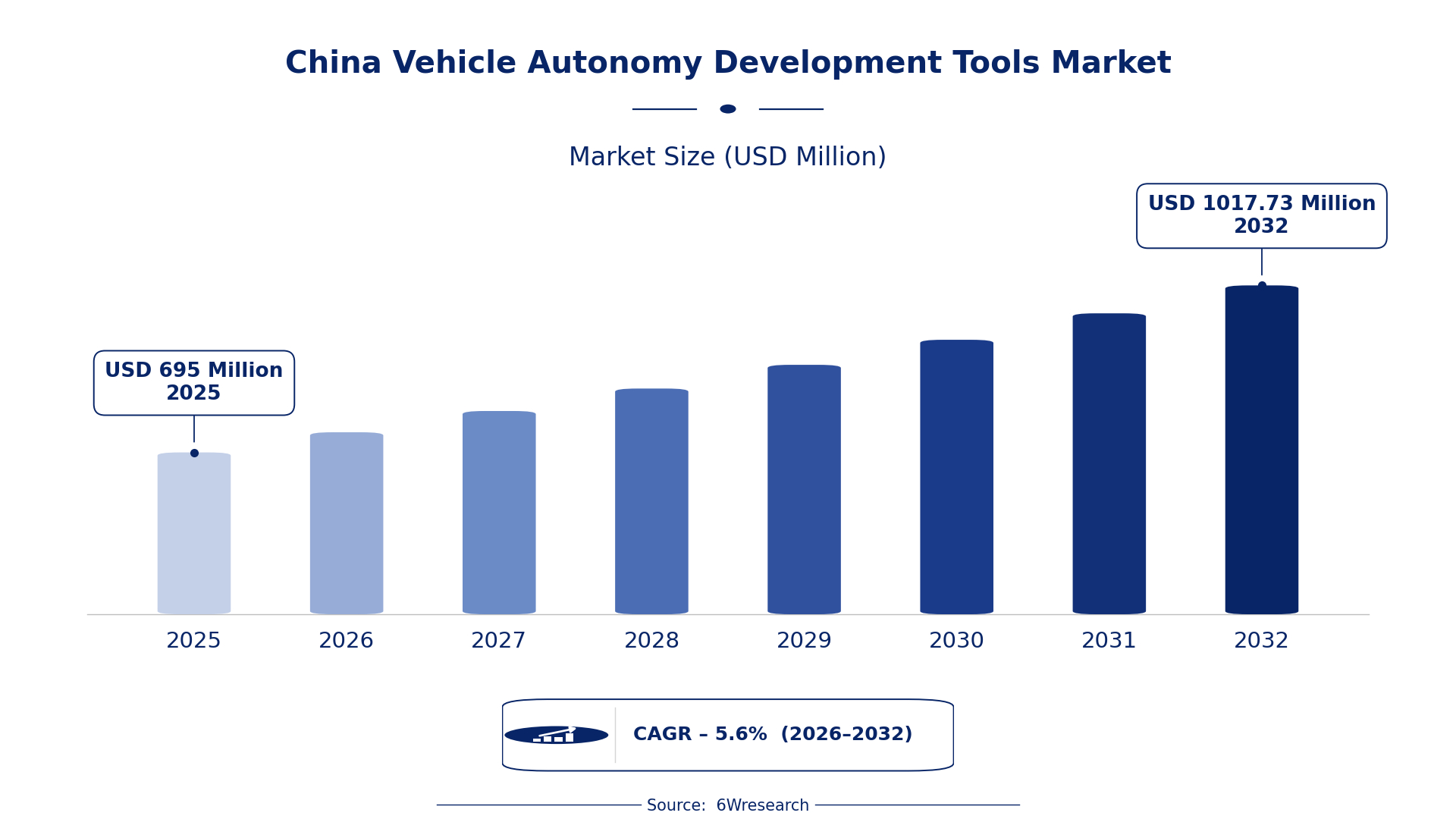
According to 6Wresearch internal database and industry insights, the China Vehicle Autonomy Development Tools Market was valued at USD 695.0 million in 2025 and is projected to reach USD 1,017.73 million by 2032, growing at a CAGR of approximately 5.6% during 2026–2032.
China Vehicle Autonomy Development Tools Market Highlights
| Report Metric | Details |
| Report Name | China Vehicle Autonomy Development Tools Market |
| Market Size 2025 | USD 695.0 million |
| Market Size 2032 | USD 1,017.73 million |
| Absolute Growth 2025–2032 | USD 322.73 million |
| CAGR 2026–2032 | 5.6% |
| Peak Annual Growth | 7.4% in 2028 |
| Forecast Period | 2026–2032 |
| Historical Data | 2022–2025 |
| Base Year | 2025 |
| Leading Tool Type, 2025 | Simulation Software (51% share) |
| Leading Functionality, 2025 | Virtual Environment (37% share) |
| Leading Integration Type, 2025 | API Compatible (44% share) |
| Leading End User, 2025 | AV Developers (48% share) |
| Fastest-Growing Tool Type | AI Training Platforms (8.4% CAGR) |
| Fastest-Growing Functionality | Data Annotation (7.9% CAGR) |
| Fastest-Growing Integration Type | Cloud-Based (7.3% CAGR) |
| Fastest-Growing End User | Tech Startups (8.1% CAGR) |
| Growing Sector | autonomous vehicles |
| Key End Users | AV Developers, Tech Startups, ADAS R&D Labs |
China Vehicle Autonomy Development Tools Market Year-wise Growth Rate and Key Drivers (2022–2032)
This graph illustrates the annual growth rates of the market from 2022 to 2032, highlighting a steady upward trajectory and projected market expansion over the forecast period.
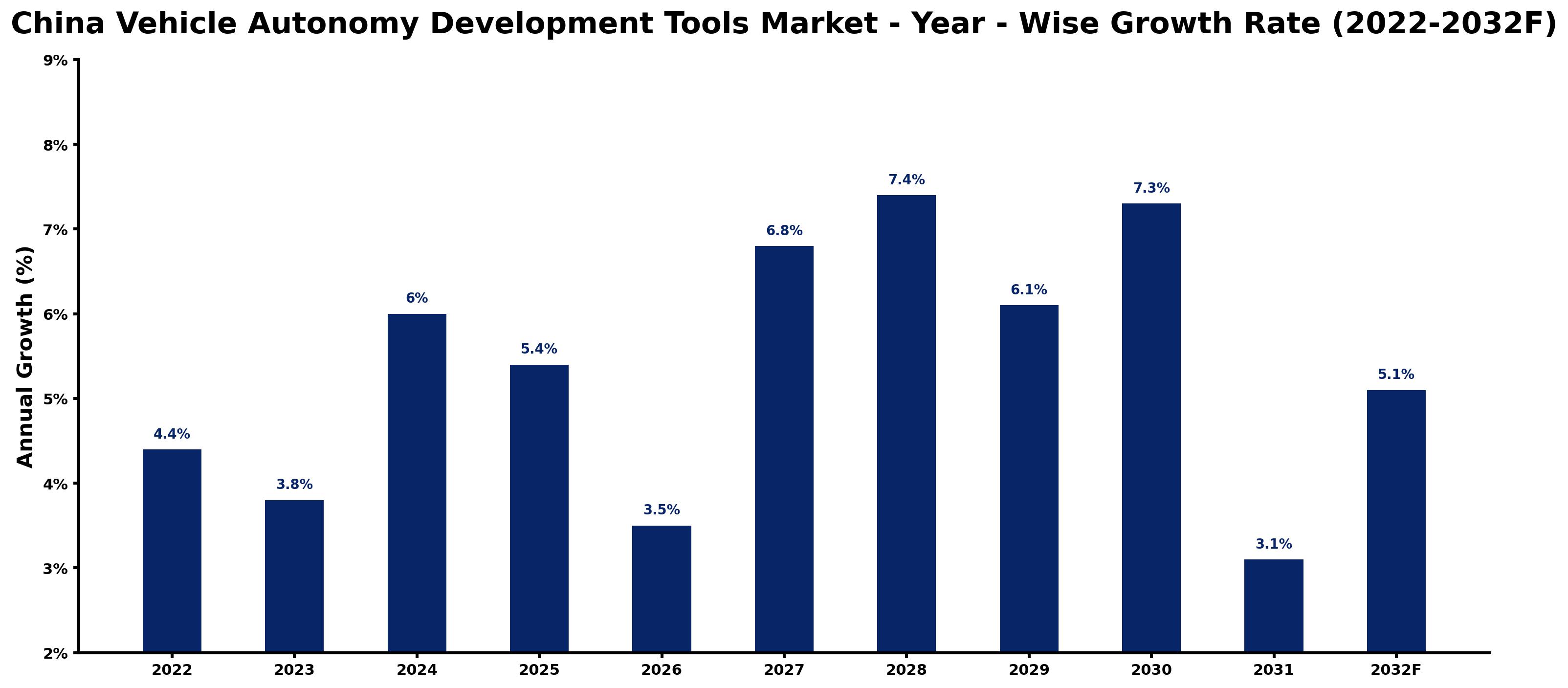
The table below sets out the estimated growth rate for each year and the main factor behind it.
| Year | Estimated Annual Growth (%) | Market Rationale |
| 2022 | 4.4 | The market experienced steady growth as demand for autonomous vehicles increased, driven by the booming automotive sector. |
| 2023 | 3.8 | Growth slowed due to regulatory adjustments and increased competition among AV developers in the Beijing region. |
| 2024 | 6.0 | The introduction of the updated National Standard for Autonomous Vehicles boosted growth as companies adapted to the new safety protocols. |
| 2025 | 5.4 | Demand remained strong, driven by investments in AV technology under the 'Made in China 2025' initiative. |
| 2026 | 3.5 | Growth is expected to slow as the market adjusts to compliance with new regulations and evolving technology. |
| 2027 | 6.8 | A resurgence in investment from tech startups is projected to spur faster growth in the market. |
| 2028 | 7.4 | The peak growth rate is expected as advancements in AI training platforms gain traction among developers. |
| 2029 | 6.1 | Growth is projected to slow as the market matures and competition intensifies among key players. |
| 2030 | 7.3 | A renewed focus on innovation is expected to lead to faster growth as new applications are developed in the Beijing region. |
| 2031 | 3.1 | Growth is projected to slow as the market stabilises and faces ongoing regulatory challenges. |
| 2032 | 5.1 | The market is expected to grow as new technologies and standards are adopted, improving development capabilities. |
Note: Market size estimations and growth projections presented in this report are based on 6Wresearch's proprietary forecasting methodology, utilizing the latest available industry data, government publications, and primary research inputs.
China Vehicle Autonomy Development Tools Market Synopsis
The China Vehicle Autonomy Development Tools Market includes the software and hardware necessary for the development of autonomous vehicles. These tools support the simulation of driving scenarios, sensor calibration, and AI training. Growth in this market is driven by the thriving automotive sector, which produced over 25 million vehicles in 2022. Demand is fuelled by more than 300 active AV developers and substantial investments in AV technology, totalling approximately $10 billion in 2022, propelled by the 'New Energy Vehicle Industry Development Plan' and the 'Intelligent Vehicle Innovation Action Plan'.
Market Dynamics Impact Analysis (2026–2032)
| Factor | Type | Impact | Primary Segment Affected |
| Increasing demand for simulation software in AV testing processes. | Driver | High | Simulation Software |
| Growing integration of Lidar technology in new autonomous vehicles. | Driver | High | Sensor Calibration Tools |
| The rise of AV developers in urban areas creates a demand for advanced tools. | Opportunity | High | AV Developers |
| Investment in AV technology is expected to increase, creating new market avenues. | Opportunity | High | Tech Startups |
| High competition among AV developers limits market share for new entrants. | Restraint | Medium | AV Developers |
| Regulatory challenges slow down the adoption of new technologies. | Restraint | Medium | Sensor Calibration Tools |
| Skilled workforce shortages hinder the development of AV technologies. | Challenge | High | AI Training Platforms |
| High costs associated with advanced testing facilities limit accessibility. | Challenge | Medium | Lidar/Camera Testing |
Evaluation of Drivers in China Vehicle Autonomy Development Tools Market (2026–2032)
The main growth drivers and the segments they affect most are set out below.
| Drivers | Primary Segment Affected | Why It Matters (Evidence) |
| The demand for simulation software is fuelled by its use in over 70% of AV testing processes. | Simulation Software | This high adoption rate leads to increased purchases from AV developers, improving their testing capabilities. |
| Integration of Lidar technology is essential for 60% of new autonomous vehicles. | Sensor Calibration Tools | This necessity drives demand for calibration tools among manufacturers, ensuring accurate sensor performance. |
| Investment in AV technology reached approximately $10 billion in 2022, boosting development. | AI Training Platforms | This funding encourages AV developers to enhance their capabilities and expand their offerings. |
| The Beijing region has become a hub for AV technology development, attracting substantial investment. | Vehicle Control Frameworks | This concentration of resources leads to more purchases of control frameworks, improving operational efficiency. |
| The 'Made in China 2025' initiative emphasises the development of autonomous vehicles. | Data Annotation | This national focus increases demand for data annotation tools among developers, facilitating AI training. |
The Vehicle Autonomy Development Tools market in China is growing on the back of increasing demand for simulation software, which is essential for over 70% of AV testing processes. Investment in AV technology reached approximately $10 billion in 2022, enabling developers to enhance their capabilities. The integration of Lidar technology in 60% of new autonomous vehicles necessitates the purchase of sensor calibration tools. Additionally, the Beijing region has emerged as a hub for AV technology development, driving demand for vehicle control frameworks. This combination of factors creates a vibrant market for AV development tools, leading to increased purchases from various buyer groups.
Evaluation of Restraints in China Vehicle Autonomy Development Tools Market
The key brakes on demand, and where they bite hardest, are shown below.
| Market Restraint | Primary Segment Affected | Why It Matters (Evidence) |
| High competition among AV developers limits market share for new entrants. | AV Developers | This competitive environment makes it difficult for newcomers to establish a foothold, affecting their ability to secure funding. |
| Regulatory challenges slow down the adoption of new technologies. | Sensor Calibration Tools | Compliance with new safety protocols can delay product launches, impacting time-to-market for manufacturers. |
| Limited talent affects the pace of innovation and deployment. | AI Training Platforms | Skilled workforce shortages hinder the development of AV technologies, resulting in slower project completion. |
| High costs associated with advanced testing facilities limit accessibility. | Lidar/Camera Testing | These expenses restrict smaller companies from entering the market, reducing competition and innovation. |
| Market maturity leads to slower growth rates as competition intensifies. | Vehicle Control Frameworks | A saturated market reduces opportunities for rapid expansion, impacting overall market performance. |
China Vehicle Autonomy Development Tools Market Challenges
Buyers in the China Vehicle Autonomy Development Tools market face regulatory hurdles, as updated national standards for AV testing in 2023 impose stricter compliance requirements that can delay project timelines by up to six months. Supply chain disruptions stem from dependence on imported Lidar technology, which is integrated into 60% of new autonomous vehicles, resulting in increased costs and project delays for manufacturers. Competition is fierce among over 300 active AV developers, driving prices down and squeezing margins for suppliers, which may limit their ability to invest in R&D. Technology adoption remains uneven; only 70% of AV testing processes utilise simulation software, restricting development efficiency for buyers and stifling innovation.
Trends in the China Vehicle Autonomy Development Tools Market
Four trends stand out in the China Vehicle Autonomy Development Tools Market.
- Shift in AV Testing to Cloud-Based Solutions: The Beijing region is transitioning towards cloud-based integration in AV projects, with 80% of new developments embracing this model. This change enhances collaboration and efficiency among developers, enabling quicker project completion.
- Emergence of AI Training Platforms in Universities: AV developers are increasingly partnering with over 50 universities that have implemented AI training platforms for research. This trend stimulates innovation and broadens the talent pool in the industry, enhancing development capabilities.
- Increased Focus on Lidar Technology: The integration of Lidar technology in 60% of new autonomous vehicles is transforming the industry. This trend is apparent in key development zones such as Shanghai International Automobile City, driving demand for testing tools.
- Rise of Tech Startups in AV Development: Since 2021, tech startups have emerged as influential players in the AV market, achieving a growth rate of 8.1%. Their fresh approaches are driving demand for advanced development tools, creating opportunities for established firms.
Investment Opportunities in the China Vehicle Autonomy Development Tools Market
The following opportunities in the China Vehicle Autonomy Development Tools Market pair current demand with a clear way in.
- Partnerships with Universities for Research: With over 50 universities adopting AI training platforms, there is an opportunity for collaboration. AV developers can partner with these institutions to improve research capabilities and access new talent.
- Investment in Lidar Testing Facilities: Investment in Lidar testing facilities is essential, especially in provinces like Guangdong and Jiangsu. This presents an opportunity for companies to establish testing capabilities and attract clients, strengthening their market position.
- Collaboration with Tech Startups: The rise of tech startups in the AV sector creates a demand for advanced tools. Established firms can invest in partnerships to supply these startups with necessary technologies, driving innovation.
- Expansion in the Beijing Region: The Beijing region is a hub for AV technology development, with substantial investment potential. Companies can enter this market through joint ventures or local partnerships, capitalising on the growing demand.
Government Initiatives in the China Vehicle Autonomy Development Tools Market
The 'New Energy Vehicle Industry Development Plan' by the Ministry of Industry and Information Technology aims to boost AV production capacity by 30% by 2025. This initiative supports the growth of the Vehicle Autonomy Development Tools market by encouraging manufacturers to adopt advanced technologies. Additionally, the 'Green Vehicle Initiative' offers subsidies for companies developing environmentally friendly AV technologies, promoting investment in sustainable solutions. These measures create a supportive environment for AV development, benefiting both producers and buyers.
The 'Intelligent Vehicle Innovation Action Plan' overseen by the National Development and Reform Commission focuses on enhancing research funding for AV technologies. This scheme supports various projects aimed at improving safety and efficiency in AV development. Furthermore, the Ministry of Transport introduced new regulations for AV testing on public roads in 2023, ensuring compliance and safety for consumers. These regulations assist buyers by establishing clear guidelines for testing, building confidence in the market.
Future Insight of the China Vehicle Autonomy Development Tools Market
The China Vehicle Autonomy Development Tools market will experience substantial changes by 2032, driven by key factors. Investment in AV technology is projected to increase, supported by government subsidies under the 'Green Vehicle Initiative', which will strengthen development capabilities. The establishment of Lidar testing facilities in five major provinces will improve the reliability of autonomous systems. Initiatives like the 'Intelligent Vehicle Innovation Action Plan' will further stimulate growth, resulting in a more competitive environment for both buyers and suppliers.
Market Segmentation Analysis
The analysis below covers each segmentation, its leading category in 2025 and its fastest-growing category through 2032.
By Tool Type – Simulation Software Dominated, AI Training Platforms Expected to Grow Fastest
According to Bhawna Singh, Assistant Manager at 6Wresearch, Simulation Software accounted for a 51% market share by tool type in 2025. Simulation software dominates the China Vehicle Autonomy Development Tools Market because it is crucial for creating virtual driving scenarios, with over 70% of AV testing processes relying on it. This widespread usage highlights its importance among AV developers striving to enhance vehicle autonomy. Over 2026–2032, AI Training Platforms are expected to post the fastest growth, at a CAGR of 8.4%. AI training platforms are witnessing rapid growth, particularly in over 50 universities where they are integrated into research initiatives, which is vital for developing advanced vehicle decision-making systems. This educational focus indicates a strong future demand for these platforms as the industry evolves. Suppliers should prioritise the development of simulation software to cater to the substantial demand from AV developers and educational institutions.
By Functionality – Virtual Environment Dominated, Data Annotation Expected to Grow Fastest
In 2025, Virtual Environment led the functionality split with a 37% share. The virtual environment functionality commands the largest market share as it is extensively used for safe testing of autonomous vehicles, ensuring compliance with updated safety protocols. This application is essential for meeting the rigorous standards set by regulatory bodies in the industry. Data Annotation is set to record the highest CAGR in this split, 7.9% over 2026–2032. Data annotation is the fastest-growing segment, driven by its critical role in training models for autonomous vehicles, which is essential for addressing the demands of a rapidly evolving market. The increasing need for accurate data to improve model performance propels this segment forward. Investing in data annotation tools will enable buyers to enhance their AI training processes and improve vehicle performance.
By Integration Type – API Compatible Dominated, Cloud-Based Expected to Grow Fastest
The largest integration type category in 2025 was API Compatible, with a 44% share of total revenue. API compatible tools hold the largest market share due to their ability to support integration with various development tools, which is vital for AV developers. This compatibility ensures a seamless workflow within the complex environment of vehicle autonomy development. Cloud-Based is projected to grow fastest, at a CAGR of 7.3% during 2026–2032. Cloud-based integration is experiencing rapid growth, facilitating remote access and collaboration among developers, which is increasingly important in the dynamic AV industry. The trend towards cloud solutions is becoming standard in 80% of new AV projects, indicating a significant shift. Suppliers must focus on cloud-based solutions to align with the industry's transition towards collaborative and remote development practices.
By End User – AV Developers Dominated, Tech Startups Expected to Grow Fastest
AV Developers held a 48% share of the China Vehicle Autonomy Development Tools Market by end user in 2025. AV developers account for the largest share of the market as they are the primary users of vehicle autonomy development tools, driving demand for innovative solutions. Their established presence and ongoing projects solidify their dominant position in the market. The quickest growth will come from Tech Startups, forecast to expand at a CAGR of 8.1% between 2026 and 2032. Tech startups are the fastest-growing segment, emerging as key players in developing innovative solutions for autonomous vehicles. Their agility and focus on cutting-edge technologies are accelerating growth in this area. Suppliers should target tech startups to seize new opportunities and promote innovation in the vehicle autonomy sector.
Key Attractiveness of the Report
- 10 Years of Market Numbers
- Historical Data Starting from 2022 to 2025
- Base Year 2025
- Forecast Data until 2032
- Key Performance Indicators Impacting the Market
- Major Upcoming Developments and Projects
Key Highlights of the Report:
- China Vehicle Autonomy Development Tools Market Outlook
- Market Size of China Vehicle Autonomy Development Tools Market, 2025
- Forecast of China Vehicle Autonomy Development Tools Market, 2032
- Historical Data and Forecast of China Vehicle Autonomy Development Tools Revenues & Volume for the Period 2022 - 2032F
- China Vehicle Autonomy Development Tools Market Trend Evolution
- China Vehicle Autonomy Development Tools Market Drivers and Challenges
- China Vehicle Autonomy Development Tools Price Trends
- China Vehicle Autonomy Development Tools Porter's Five Forces
- China Vehicle Autonomy Development Tools Industry Life Cycle
- Historical Data and Forecast of China Vehicle Autonomy Development Tools Market Revenues & Volume By Tool Type for the Period 2022 - 2032F
- Historical Data and Forecast of China Vehicle Autonomy Development Tools Market Revenues & Volume By Simulation Software for the Period 2022 - 2032F
- Historical Data and Forecast of China Vehicle Autonomy Development Tools Market Revenues & Volume By Sensor Calibration Tools for the Period 2022 - 2032F
- Historical Data and Forecast of China Vehicle Autonomy Development Tools Market Revenues & Volume By Vehicle Control Frameworks for the Period 2022 - 2032F
- Historical Data and Forecast of China Vehicle Autonomy Development Tools Market Revenues & Volume By AI Training Platforms for the Period 2022 - 2032F
- Historical Data and Forecast of China Vehicle Autonomy Development Tools Market Revenues & Volume By Functionality for the Period 2022 - 2032F
- Historical Data and Forecast of China Vehicle Autonomy Development Tools Market Revenues & Volume By Virtual Environment for the Period 2022 - 2032F
- Historical Data and Forecast of China Vehicle Autonomy Development Tools Market Revenues & Volume By Lidar/Camera Testing for the Period 2022 - 2032F
- Historical Data and Forecast of China Vehicle Autonomy Development Tools Market Revenues & Volume By Path Planning for the Period 2022 - 2032F
- Historical Data and Forecast of China Vehicle Autonomy Development Tools Market Revenues & Volume By Data Annotation for the Period 2022 - 2032F
- Historical Data and Forecast of China Vehicle Autonomy Development Tools Market Revenues & Volume By Integration Type for the Period 2022 - 2032F
- Historical Data and Forecast of China Vehicle Autonomy Development Tools Market Revenues & Volume By API Compatible for the Period 2022 - 2032F
- Historical Data and Forecast of China Vehicle Autonomy Development Tools Market Revenues & Volume By Plug-In Modules for the Period 2022 - 2032F
- Historical Data and Forecast of China Vehicle Autonomy Development Tools Market Revenues & Volume By Embedded System for the Period 2022 - 2032F
- Historical Data and Forecast of China Vehicle Autonomy Development Tools Market Revenues & Volume By Cloud-Based for the Period 2022 - 2032F
- Historical Data and Forecast of China Vehicle Autonomy Development Tools Market Revenues & Volume By End User for the Period 2022 - 2032F
- Historical Data and Forecast of China Vehicle Autonomy Development Tools Market Revenues & Volume By AV Developers for the Period 2022 - 2032F
- Historical Data and Forecast of China Vehicle Autonomy Development Tools Market Revenues & Volume By Robotics Engineers for the Period 2022 - 2032F
- Historical Data and Forecast of China Vehicle Autonomy Development Tools Market Revenues & Volume By ADAS R&D Labs for the Period 2022 - 2032F
- Historical Data and Forecast of China Vehicle Autonomy Development Tools Market Revenues & Volume By Tech Startups for the Period 2022 - 2032F
- China Vehicle Autonomy Development Tools Import Export Trade Statistics
- Market Opportunity Assessment By Tool Type
- Market Opportunity Assessment By Functionality
- Market Opportunity Assessment By Integration Type
- Market Opportunity Assessment By End User
- China Vehicle Autonomy Development Tools Top Companies Market Share
- China Vehicle Autonomy Development Tools Competitive Benchmarking By Technical and Operational Parameters
- China Vehicle Autonomy Development Tools Company Profiles
- China Vehicle Autonomy Development Tools Key Strategic Recommendations
Market Covered
Segments analysed in this report are listed below.
By Tool Type
- Simulation Software
- Sensor Calibration Tools
- Vehicle Control Frameworks
- AI Training Platforms
By Functionality
- Virtual Environment
- Lidar/Camera Testing
- Path Planning
- Data Annotation
By Integration Type
- API Compatible
- Plug-In Modules
- Embedded System
- Cloud-Based
By End User
- AV Developers
- Robotics Engineers
- ADAS R&D Labs
- Tech Startups































