India Vehicle Body Materials Market Size & Growth Rate
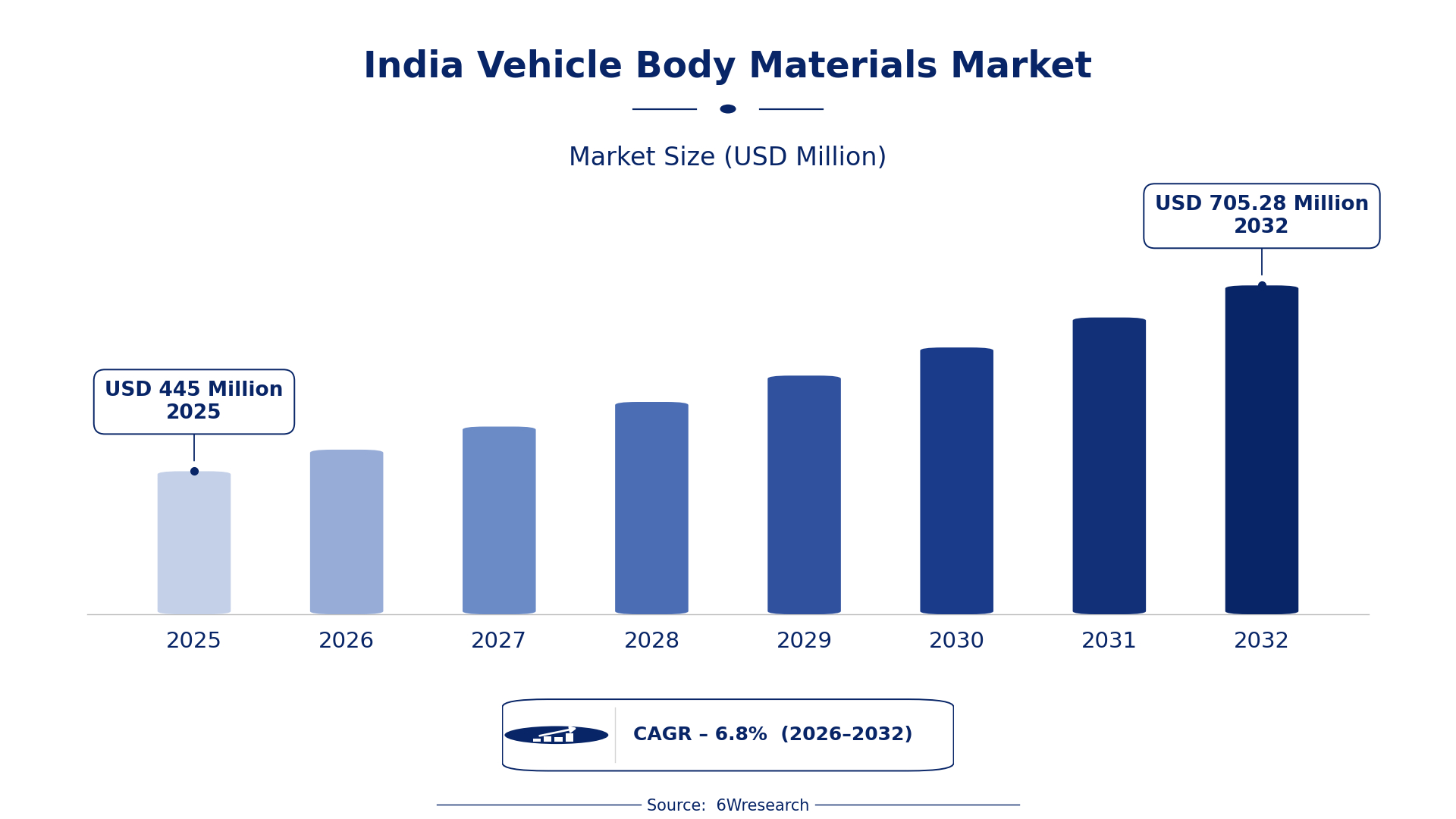
According to 6Wresearch internal database and industry insights, the India Vehicle Body Materials Market was valued at USD 445.0 million in 2025 and is projected to reach USD 705.28 million by 2032, growing at a CAGR of approximately 6.8% during 2026–2032.
India Vehicle Body Materials Market Highlights
| Report Metric | Details |
| Report Name | India Vehicle Body Materials Market |
| Market Size 2025 | USD 445.0 million |
| Market Size 2032 | USD 705.28 million |
| Absolute Growth 2025–2032 | USD 260.28 million |
| CAGR 2026–2032 | 6.8% |
| Peak Annual Growth | 8.8% in 2031 |
| Forecast Period | 2026–2032 |
| Historical Data | 2022–2025 |
| Base Year | 2025 |
| Leading Material Type, 2025 | High Strength Steel (49% share) |
| Leading Composition Type, 2025 | Alloyed (50% share) |
| Leading Application Area, 2025 | Passenger Cars (52% share) |
| Leading End User, 2025 | Auto Part Suppliers (47% share) |
| Fastest-Growing Material Type | Aluminum Alloys (8.5% CAGR) |
| Fastest-Growing Composition Type | Lightweight (8.4% CAGR) |
| Fastest-Growing Application Area | Electric Vehicles (8.5% CAGR) |
| Fastest-Growing End User | EV OEMs (9.4% CAGR) |
| Growing Sector | Electric Vehicles |
| Key End Users | Auto Part Suppliers, EV OEMs, Component Manufacturers |
India Vehicle Body Materials Market Year-wise Growth Rate and Key Drivers (2022–2032)
This graph illustrates the annual growth rates of the market from 2022 to 2032, highlighting a steady upward trajectory and projected market expansion over the forecast period.
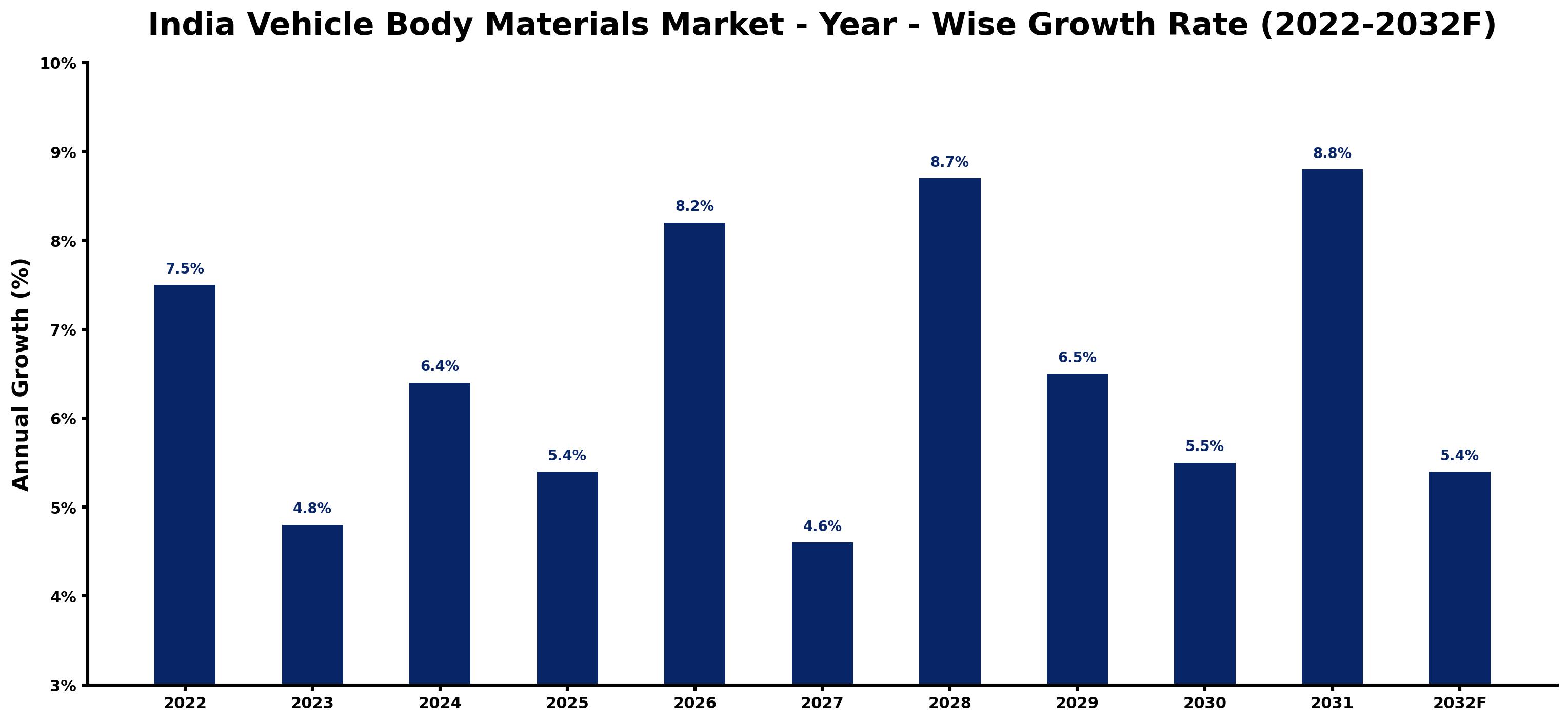
Below, each year's estimated growth is shown next to the factor that most influenced it.
| Year | Estimated Annual Growth (%) | Market Rationale |
| 2022 | 7.5 | The automotive industry produced 4.4 million passenger vehicles, driving demand for materials. |
| 2023 | 4.8 | Growth slowed as manufacturers adjusted to evolving demand patterns and supply chain issues. |
| 2024 | 6.4 | Increased production of electric vehicles boosted demand for lightweight materials. |
| 2025 | 5.4 | Demand for high strength steel remained strong, but growth slowed compared to the previous year. |
| 2026 | 8.2 | The introduction of new automotive standards will drive demand for compliant materials. |
| 2027 | 4.6 | The market is expected to experience a slowdown as manufacturers face challenges in sourcing materials. |
| 2028 | 8.7 | Growing electric vehicle production is projected to accelerate demand for aluminum alloys. |
| 2029 | 6.5 | The demand for lightweight materials continues, but growth is expected to slow as manufacturers adapt to market conditions. |
| 2030 | 5.5 | Manufacturers will adjust to new emission standards, affecting material choices and demand. |
| 2031 | 8.8 | The market is expected to peak as investment in new technologies and materials drives growth. |
| 2032 | 5.4 | Demand is projected to stabilise as manufacturers adapt to market conditions and production capacities. |
Note: Market size estimations and growth projections presented in this report are based on 6Wresearch's proprietary forecasting methodology, utilizing the latest available industry data, government publications, and primary research inputs.
India Vehicle Body Materials Market Synopsis
Vehicle Body Materials in India encompass various substances used to construct vehicle exteriors, including metals and composites. These materials are essential for improving safety, reducing weight, and enhancing aesthetic appeal. The India Vehicle Body Materials Market is growing due to the thriving automotive industry, with significant demand from domestic manufacturers and the rise of electric vehicle production. In 2022, India's automotive industry produced 4.4 million passenger vehicles, contributing to the increasing need for advanced materials. The Automotive Mission Plan 2026 aims to establish India as a global automotive manufacturing hub, further driving market growth.
Market Dynamics Impact Analysis (2026–2032)
| Factor | Type | Impact | Primary Segment Affected |
| High demand for lightweight materials to improve fuel efficiency and meet emission standards. | Driver | High | Lightweight |
| The growing electric vehicle segment requires advanced materials for performance and weight reduction. | Driver | High | Electric Vehicles |
| The market gap for high strength steel presents opportunities for suppliers to meet rising demand. | Opportunity | High | High Strength Steel |
| Investment in EV infrastructure development creates demand for lightweight materials. | Opportunity | High | Aluminum Alloys |
| Supply chain disruptions can hinder material availability for manufacturers, affecting production. | Restraint | High | Alloyed |
| Compliance with stringent standards can increase production costs for manufacturers. | Restraint | High | Thermoplastic Polymers |
| The Vehicle Body Materials Market in India faces challenges in sourcing quality materials. | Challenge | High | Carbon Fiber Composites |
| High production costs can limit the competitiveness of domestic manufacturers. | Challenge | Medium | Auto Part Suppliers |
Evaluation of Drivers in India Vehicle Body Materials Market (2026–2032)
The table below links each growth driver to the segment it affects and the evidence for it.
| Drivers | Primary Segment Affected | Why It Matters (Evidence) |
| Growing investment in electric vehicle production increases demand for lightweight materials. | Lightweight | In 2023, the government announced a ₹10,000 crore fund to support EV infrastructure development, driving material purchases. |
| Increased production of passenger vehicles boosts demand for high strength steel. | High Strength Steel | Approximately 50% of materials used in passenger cars are high strength steel, leading to higher purchases. |
| The rise of electric vehicles necessitates the use of aluminum alloys for their lightweight properties. | Aluminum Alloys | The market for aluminum alloys is projected to grow due to the demand from EV manufacturers. |
| The Automotive Mission Plan 2026 aims to improve manufacturing capabilities, driving material demand. | Alloyed | This plan encourages local production of automotive components, increasing the need for alloyed materials. |
| The Bureau of Indian Standards sets quality benchmarks, ensuring material compliance and driving demand. | Thermoplastic Polymers | Compliance with IS 2062 for steel drives the demand for certified materials in vehicle production. |
Growth in the Vehicle Body Materials market in India comes from increased investment in electric vehicle production, which drives demand for lightweight materials. The production of 4.4 million passenger vehicles in 2022 significantly boosted demand for high strength steel, which accounts for approximately 50% of materials used. The emphasis on compliance with quality standards also drives demand for thermoplastic polymers in automotive applications. The growing focus on sustainability further increases the need for innovative material solutions.
Evaluation of Restraints in India Vehicle Body Materials Market
The table below lists the restraints and the evidence behind each.
| Market Restraint | Primary Segment Affected | Why It Matters (Evidence) |
| Supply chain disruptions can limit the availability of high-quality materials for manufacturers. | High Strength Steel | In 2022, disruptions affected the timely delivery of materials, impacting production schedules. |
| Compliance with stringent standards can increase production costs for manufacturers. | Aluminum Alloys | Manufacturers face higher costs to meet the Bureau of Indian Standards' requirements. |
| Limited availability of skilled labour can hinder production efficiency in the automotive sector. | Lightweight | The automotive industry produced 4.4 million vehicles in 2022, but skilled labour shortages persist. |
| High production costs can limit the competitiveness of domestic manufacturers. | Auto Part Suppliers | Increased costs for raw materials affect pricing strategies and market competitiveness. |
| Market fluctuations can lead to uncertainty in material pricing, affecting procurement decisions. | Thermoplastic Polymers | Volatility in global markets impacts the pricing of thermoplastic materials. |
India Vehicle Body Materials Market Challenges
The India Vehicle Body Materials market encounters several practical challenges, beginning with fierce competition among suppliers. This heightened competition stems from a surge in the number of manufacturers, which drives prices down and compresses margins for producers. Increasing raw material costs further complicate the landscape, as fluctuations in steel prices can escalate production costs by 15% for manufacturers. Many producers struggle to keep pace with technological advancements, resulting in delays of up to six months for buyers awaiting new product launches. Regulatory standards set by the Bureau of Indian Standards can add compliance costs, potentially raising expenses by 5% for manufacturers.
Trends in the India Vehicle Body Materials Market
The trends below show where the India Vehicle Body Materials Market is heading.
- Shift towards Lightweight Materials: The automotive industry is increasingly adopting lightweight materials to improve fuel efficiency. The demand for lightweight materials surged in 2022, with high strength steel accounting for approximately 50% of materials used in passenger cars.
- Growing Electric Vehicle Segment: Electric vehicle manufacturers are prioritising aluminum alloys for their lightweight properties. In 2022, the market for aluminum alloys is expected to grow due to rising EV production, which demands lighter materials.
- Increased Compliance with Standards: The Bureau of Indian Standards has intensified focus on material quality, leading to higher compliance rates. In 2022, compliance with IS 2062 for steel has driven demand for certified materials in vehicle production.
- Expansion of Automotive Manufacturing: The Automotive Mission Plan 2026 is driving investment in local manufacturing capabilities. The plan aims to establish India as a global automotive hub, increasing demand for various vehicle body materials.
Investment Opportunities in the India Vehicle Body Materials Market
Below are the investment opportunities with the strongest case in the India Vehicle Body Materials Market.
- ₹10,000 crore Fund for EV Infrastructure: The government's ₹10,000 crore fund offers a chance for suppliers of lightweight materials. This funding is aimed at supporting the development of electric vehicle infrastructure, generating demand for materials in the EV sector.
- Investment in Manufacturing Facilities: The expanding automotive sector presents opportunities for joint ventures in manufacturing facilities. Collaborating with local manufacturers can ease market entry and boost production capacity.
- Rising Demand for High Strength Steel: The market gap for high strength steel provides an opportunity for suppliers. Given that high strength steel accounts for 50% of materials used, companies can take advantage of this demand.
- Focus on Sustainable Materials: The growing emphasis on sustainability opens doors for suppliers of eco-friendly materials. The automotive industry is increasingly shifting towards sustainable practices, raising demand for innovative material solutions.
Government Initiatives in the India Vehicle Body Materials Market
The Faster Adoption and Manufacturing of Hybrid and Electric Vehicles (FAME) scheme, initiated in 2020, supports the development of EV infrastructure and promotes the use of electric vehicles. This initiative builds on previous policies by offering financial incentives for manufacturers and buyers, facilitating the transition to electric mobility. The scheme aims to allocate ₹10,000 crore to enhance EV infrastructure, benefiting both producers and consumers.
The Bureau of Indian Standards supervises various automotive initiatives, funding projects to bolster local manufacturing capabilities and improve the quality of automotive components. This plan seeks to establish India as a global automotive hub, with an anticipated investment of ₹1.5 lakh crore by 2026, benefiting producers and buyers alike.
Future Insight of the India Vehicle Body Materials Market
By 2032, buyers and suppliers in the India Vehicle Body Materials market can expect substantial changes driven by several key factors. The National Automotive Testing and R&D Infrastructure Project will strengthen research capabilities, encouraging innovation in material development. A new fund for EV infrastructure is likely to boost demand for lightweight materials that meet BS VI emission standards. The Automotive Mission Plan 2026 aims to position India as a global automotive manufacturing hub, promoting investments in advanced production facilities. These developments will probably lead to improved efficiency and reduced costs for producers.
Market Segmentation Analysis
The report offers a comprehensive study of the following market segments and their leading categories in the market.
By Material Type – High Strength Steel Dominated, Aluminum Alloys Expected to Grow Fastest
According to Bhawna Singh, Assistant Manager at 6Wresearch, High Strength Steel held a 49% share of the India Vehicle Body Materials Market by material type in 2025. High strength steel commands the largest share in the India Vehicle Body Materials Market due to its critical role in ensuring vehicle frame integrity. It is a preferred choice among manufacturers, particularly in passenger vehicles where approximately 50% of materials used are high strength steel. Aluminum Alloys are projected to grow fastest, at a CAGR of 8.5% during 2026–2032. Aluminum alloys are witnessing rapid growth driven by the increasing demand for electric vehicles, which require lightweight and corrosion-resistant materials. This segment's expansion is further supported by government initiatives that promote EV infrastructure development, enhancing the overall market for aluminum alloys. Suppliers should focus on enhancing their aluminum alloy offerings to seize the growing demand from the electric vehicle sector.
By Composition Type – Alloyed Dominated, Lightweight Expected to Grow Fastest
Alloyed took a 50% share of composition type in 2025, more than any other category. The alloyed segment leads the market share as it provides enhanced mechanical properties, ensuring durability and performance in vehicle body materials. Manufacturers favour this composition type to meet stringent safety and performance standards, thereby maintaining its leading position. The quickest growth will come from Lightweight, forecast to expand at a CAGR of 8.4% between 2026 and 2032. Lightweight materials are the fastest-growing segment, driven by the urgent need for improved fuel efficiency in vehicles, especially in light of BS VI emission standards. As regulations tighten, the demand for lightweight solutions will continue to rise, further propelling this segment's growth. Buyers should prioritise sourcing lightweight materials to comply with evolving emission standards and enhance vehicle efficiency.
By Application Area – Passenger Cars Dominated, Electric Vehicles Expected to Grow Fastest
In 2025, Passenger Cars led the application area split with a 52% share. Passenger cars represent the largest application area for vehicle body materials, holding a significant share of the market. The high production volume of 4.4 million passenger vehicles in 2022 highlights the importance of this segment in the overall market structure. Over 2026–2032, Electric Vehicles are expected to post the fastest growth, at a CAGR of 8.5%. Electric vehicles are the fastest-growing application area, largely due to their lightweight requirements that align with current automotive trends. This segment's growth is fuelled by increasing consumer interest in sustainable transportation options, indicating a shift in market focus. Manufacturers must adapt their material offerings to meet the specific needs of the electric vehicle market to remain competitive.
By End User – Auto Part Suppliers Dominated, EV OEMs Expected to Grow Fastest
With a 47% revenue share in 2025, Auto Part Suppliers was the largest end user category. Auto part suppliers hold the largest share of the end user market, playing a vital role in the supply chain for vehicle materials. Their established relationships with automotive manufacturers ensure a steady demand for various body materials, solidifying their leading position. EV OEMs are set to record the highest CAGR in this split, 9.4% over 2026–2032. EV OEMs are the fastest-growing end user segment, driven by the surging demand for lightweight materials essential for electric vehicle production. This trend is bolstered by government initiatives aimed at promoting electric vehicle adoption, further enhancing the market for EV OEMs. Suppliers should strategically align their product development with the needs of EV OEMs to capitalise on this burgeoning market.
Key Attractiveness of the Report
- 10 Years of Market Numbers
- Historical Data Starting from 2022 to 2025
- Base Year 2025
- Forecast Data until 2032
- Key Performance Indicators Impacting the Market
- Major Upcoming Developments and Projects
Key Highlights of the Report:
- India Vehicle Body Materials Market Outlook
- Market Size of India Vehicle Body Materials Market, 2025
- Forecast of India Vehicle Body Materials Market, 2032
- Historical Data and Forecast of India Vehicle Body Materials Revenues & Volume for the Period 2022 - 2032F
- India Vehicle Body Materials Market Trend Evolution
- India Vehicle Body Materials Market Drivers and Challenges
- India Vehicle Body Materials Price Trends
- India Vehicle Body Materials Porter's Five Forces
- India Vehicle Body Materials Industry Life Cycle
- Historical Data and Forecast of India Vehicle Body Materials Market Revenues & Volume By Material Type for the Period 2022 - 2032F
- Historical Data and Forecast of India Vehicle Body Materials Market Revenues & Volume By High Strength Steel for the Period 2022 - 2032F
- Historical Data and Forecast of India Vehicle Body Materials Market Revenues & Volume By Aluminum Alloys for the Period 2022 - 2032F
- Historical Data and Forecast of India Vehicle Body Materials Market Revenues & Volume By Carbon Fiber Composites for the Period 2022 - 2032F
- Historical Data and Forecast of India Vehicle Body Materials Market Revenues & Volume By Thermoplastic Polymers for the Period 2022 - 2032F
- Historical Data and Forecast of India Vehicle Body Materials Market Revenues & Volume By Composition Type for the Period 2022 - 2032F
- Historical Data and Forecast of India Vehicle Body Materials Market Revenues & Volume By Alloyed for the Period 2022 - 2032F
- Historical Data and Forecast of India Vehicle Body Materials Market Revenues & Volume By Lightweight for the Period 2022 - 2032F
- Historical Data and Forecast of India Vehicle Body Materials Market Revenues & Volume By Reinforced for the Period 2022 - 2032F
- Historical Data and Forecast of India Vehicle Body Materials Market Revenues & Volume By Moldable for the Period 2022 - 2032F
- Historical Data and Forecast of India Vehicle Body Materials Market Revenues & Volume By Application Area for the Period 2022 - 2032F
- Historical Data and Forecast of India Vehicle Body Materials Market Revenues & Volume By Passenger Cars for the Period 2022 - 2032F
- Historical Data and Forecast of India Vehicle Body Materials Market Revenues & Volume By Electric Vehicles for the Period 2022 - 2032F
- Historical Data and Forecast of India Vehicle Body Materials Market Revenues & Volume By Sports Cars for the Period 2022 - 2032F
- Historical Data and Forecast of India Vehicle Body Materials Market Revenues & Volume By Bumper Panels for the Period 2022 - 2032F
- Historical Data and Forecast of India Vehicle Body Materials Market Revenues & Volume By End User for the Period 2022 - 2032F
- Historical Data and Forecast of India Vehicle Body Materials Market Revenues & Volume By Auto Part Suppliers for the Period 2022 - 2032F
- Historical Data and Forecast of India Vehicle Body Materials Market Revenues & Volume By EV OEMs for the Period 2022 - 2032F
- Historical Data and Forecast of India Vehicle Body Materials Market Revenues & Volume By Performance Vehicle Makers for the Period 2022 - 2032F
- Historical Data and Forecast of India Vehicle Body Materials Market Revenues & Volume By Component Manufacturers for the Period 2022 - 2032F
- India Vehicle Body Materials Import Export Trade Statistics
- Market Opportunity Assessment By Material Type
- Market Opportunity Assessment By Composition Type
- Market Opportunity Assessment By Application Area
- Market Opportunity Assessment By End User
- India Vehicle Body Materials Top Companies Market Share
- India Vehicle Body Materials Competitive Benchmarking By Technical and Operational Parameters
- India Vehicle Body Materials Company Profiles
- India Vehicle Body Materials Key Strategic Recommendations
Market Covered
The report offers an extensive study of the following market segments.
By Material Type
- High Strength Steel
- Aluminum Alloys
- Carbon Fiber Composites
- Thermoplastic Polymers
By Composition Type
- Alloyed
- Lightweight
- Reinforced
- Moldable
By Application Area
- Passenger Cars
- Electric Vehicles
- Sports Cars
- Bumper Panels
By End User
- Auto Part Suppliers
- EV OEMs
- Performance Vehicle Makers
- Component Manufacturers































