India Vehicle Comfort Sensors Market Size & Growth Rate
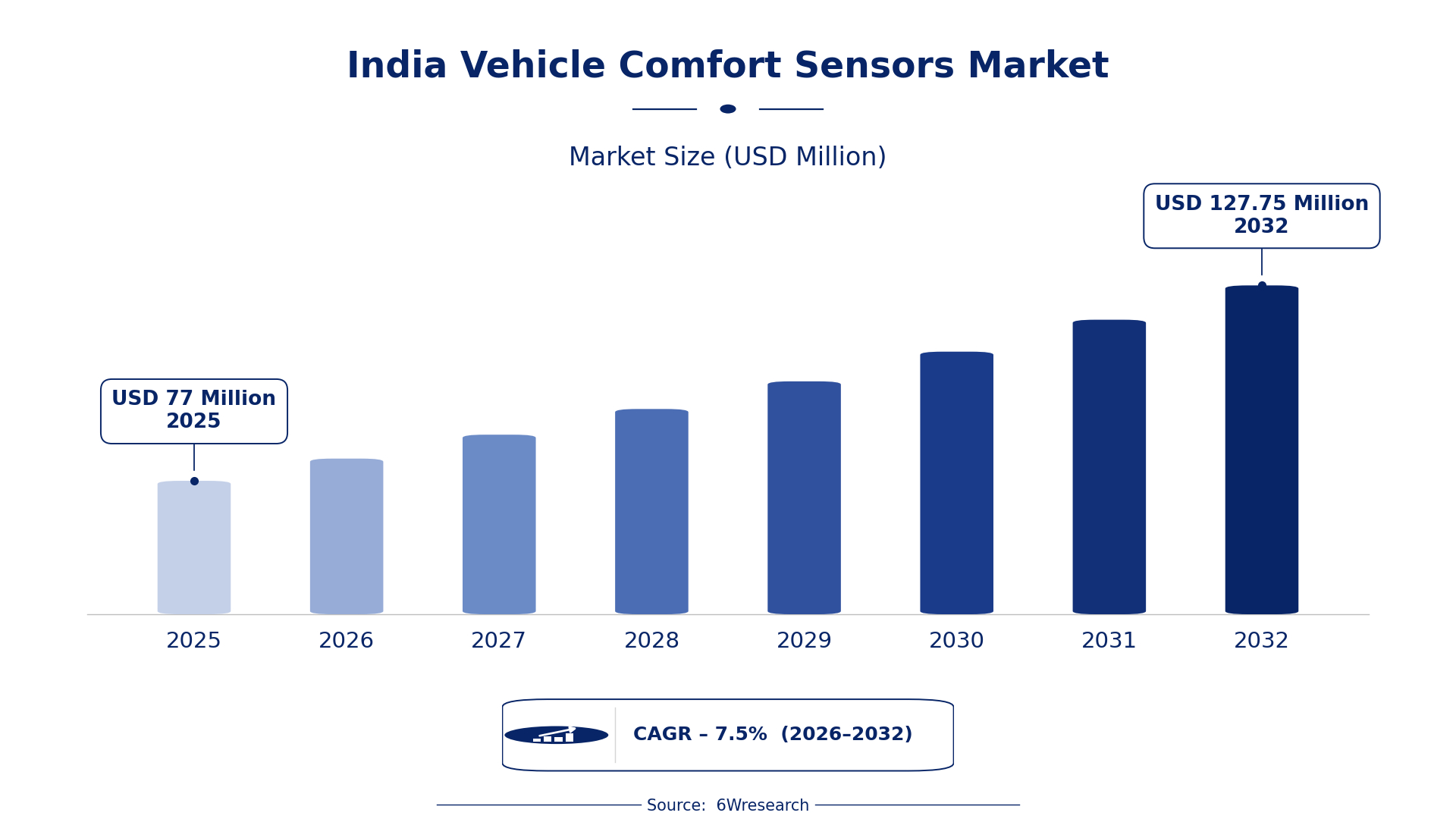
According to 6Wresearch internal database and industry insights, the India Vehicle Comfort Sensors Market was valued at USD 77.0 million in 2025 and is projected to reach USD 127.75 million by 2032, growing at a CAGR of approximately 7.5% during 2026–2032.
India Vehicle Comfort Sensors Market Highlights
| Report Metric | Details |
| Report Name | India Vehicle Comfort Sensors Market |
| Market Size 2025 | USD 77.0 million |
| Market Size 2032 | USD 127.75 million |
| Absolute Growth 2025–2032 | USD 50.75 million |
| CAGR 2026–2032 | 7.5% |
| Peak Annual Growth | 10.1% in 2031 |
| Forecast Period | 2026–2032 |
| Historical Data | 2022–2025 |
| Base Year | 2025 |
| Leading Sensor Type, 2025 | Cabin Temperature Sensors (37% share) |
| Leading Functionality, 2025 | Presence Detection (43% share) |
| Leading Integration Area, 2025 | HVAC (49% share) |
| Leading End User, 2025 | Luxury Vehicle OEMs (32% share) |
| Fastest-Growing Functionality | Thermal Regulation (10.0% CAGR) |
| Fastest-Growing Integration Area | Cabin Seating (9.6% CAGR) |
| Fastest-Growing End User | Interior System OEMs (9.3% CAGR) |
| Growing Sector | Luxury Vehicles |
| Key End Users | Luxury Vehicle OEMs, Interior System OEMs, Airbag System Suppliers |
India Vehicle Comfort Sensors Market Year-wise Growth Rate and Key Drivers (2022–2032)
This graph illustrates the annual growth rates of the market from 2022 to 2032, highlighting a steady upward trajectory and projected market expansion over the forecast period.
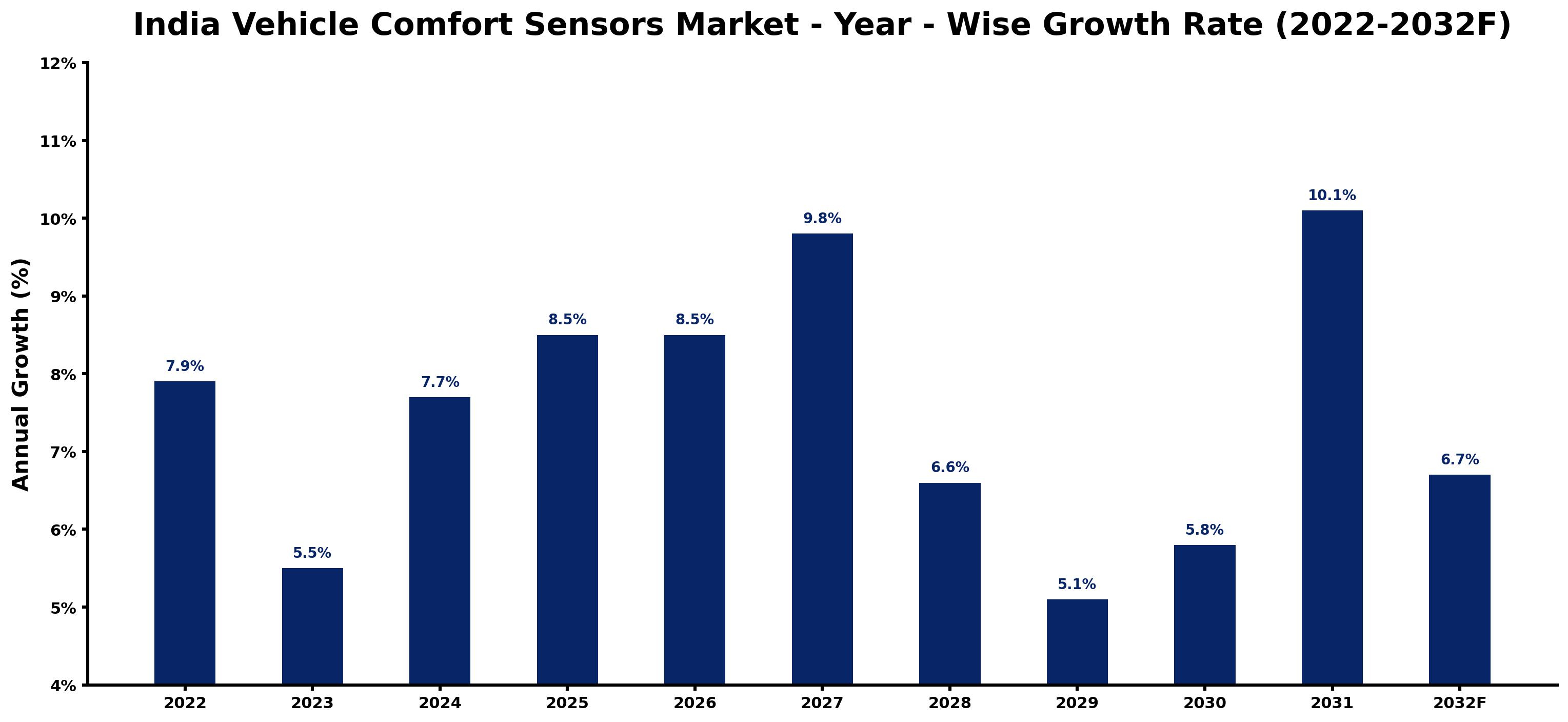
The table below sets out the estimated growth rate for each year and the main factor behind it.
| Year | Estimated Annual Growth (%) | Market Rationale |
| 2022 | 7.9 | The market experienced steady growth due to increasing vehicle registrations across the country. |
| 2023 | 5.5 | Growth slowed as the automotive sector faced supply chain challenges impacting sensor availability. |
| 2024 | 7.7 | Demand increased as manufacturers adopted advanced comfort features in new vehicle models. |
| 2025 | 8.5 | The peak growth year saw a surge in luxury vehicle production, driving sensor integration. |
| 2026 | 8.5 | Growth is expected to slow slightly as manufacturers adjust to changing consumer preferences. |
| 2027 | 9.8 | Demand is projected to rise as passenger comfort becomes a priority for vehicle OEMs. |
| 2028 | 6.6 | A slowdown is anticipated as market saturation begins to affect new sensor installations. |
| 2029 | 5.1 | Growth is expected to continue decelerating as competition intensifies among sensor suppliers. |
| 2030 | 5.8 | Demand is projected to pick up again as new vehicle models incorporate advanced comfort technologies. |
| 2031 | 10.1 | The market is expected to peak with increased investments in comfort features for luxury vehicles. |
| 2032 | 6.7 | Growth is projected to slow as the market stabilises, reflecting maturity in the sensor segment. |
Note: Market size estimations and growth projections presented in this report are based on 6Wresearch's proprietary forecasting methodology, utilizing the latest available industry data, government publications, and primary research inputs.
India Vehicle Comfort Sensors Market Synopsis
Vehicle Comfort Sensors in India are electronic devices designed to improve passenger comfort in vehicles. These sensors monitor seat occupancy, regulate cabin temperature, and adjust window tints. The India Vehicle Comfort Sensors Market is expanding due to rising vehicle registrations and increased investments in comfort technologies. The automotive sector is projected to attract $8 billion in foreign investments by 2025. The 'Automotive Mission Plan 2026' promotes sensor integration in vehicles, supporting this growth by enhancing safety and comfort features.
Market Dynamics Impact Analysis (2026–2032)
| Factor | Type | Impact | Primary Segment Affected |
| Rising vehicle registrations drive demand for comfort sensors in new models. | Driver | High | Cabin Temperature Sensors |
| Increasing focus on passenger comfort encourages manufacturers to adopt advanced sensors. | Driver | High | Presence Detection |
| The growing luxury vehicle segment presents opportunities for advanced comfort features. | Opportunity | High | Luxury Vehicle OEMs |
| The push for electric vehicles creates demand for integrated comfort technologies. | Opportunity | Medium | Interior System OEMs |
| High development costs can limit sensor innovation and affordability. | Restraint | High | Cabin Temperature Sensors |
| Stringent safety regulations may delay sensor approvals and market entry. | Restraint | Medium | Presence Detection |
| Supply chain disruptions can affect the availability of essential components. | Challenge | High | Cabin Temperature Sensors |
| Intense competition among suppliers may lead to pricing pressures. | Challenge | Medium | Luxury Vehicle OEMs |
Evaluation of Drivers in India Vehicle Comfort Sensors Market (2026–2032)
Below mentioned are some major drivers and their influence on market dynamics.
| Drivers | Primary Segment Affected | Why It Matters (Evidence) |
| Increasing vehicle registrations fuel demand for comfort sensors in new vehicles. | Cabin Temperature Sensors | With over 300 million registered vehicles, the need for advanced comfort features is rising. |
| Growing focus on passenger comfort drives OEMs to integrate advanced sensors. | Presence Detection | The shift towards luxury models requires sophisticated comfort technologies. |
| Foreign investments in the automotive sector boost sensor technology development. | Cabin Temperature Sensors | An expected $8 billion in investments by 2025 will enhance sensor capabilities. |
| The rise of electric vehicles necessitates advanced comfort systems. | Interior System OEMs | The 'FAME India Scheme' promotes electric vehicles, increasing demand for integrated sensors. |
| Technological advancements in semiconductor manufacturing improve sensor performance. | Thermal Regulation | Improved semiconductor technology leads to better performance and reliability of comfort sensors. |
The Vehicle Comfort Sensors market in India is growing on the back of rising vehicle registrations, increasing foreign investments, and a focus on passenger comfort. Over 300 million registered vehicles create a substantial demand for advanced comfort features, particularly in luxury models. The automotive sector is projected to attract $8 billion in foreign investments by 2025, boosting the development of sensor technologies. The push for electric vehicles under the 'FAME India Scheme' drives the integration of advanced comfort systems. These factors contribute to a strong demand for comfort sensors across various vehicle types.
Evaluation of Restraints in India Vehicle Comfort Sensors Market
The main factors holding the market back are set out below.
| Market Restraint | Primary Segment Affected | Why It Matters (Evidence) |
| High development costs can hinder sensor innovation and market entry. | Cabin Temperature Sensors | The need for advanced technology increases production costs, affecting affordability for manufacturers. |
| Stringent safety regulations delay sensor approvals, impacting market readiness. | Presence Detection | Compliance with updated safety standards can prolong the time to market for new sensors. |
| Supply chain disruptions affect the availability of essential components for sensors. | Thermal Regulation | Global supply chain issues can lead to delays in sensor production and delivery. |
| Intense competition among suppliers can lead to pricing pressures, affecting margins. | Luxury Vehicle OEMs | As more players enter the market, pricing strategies may become aggressive. |
| Limited consumer awareness of advanced comfort features may slow adoption. | Cabin Temperature Sensors | Consumers may not prioritise comfort technologies when purchasing vehicles. |
India Vehicle Comfort Sensors Market Challenges
The India Vehicle Comfort Sensors Market still has to solve a few problems, starting with supply chain inefficiencies that inflate costs for producers. Delays in sourcing semiconductor components can lead to production halts, costing manufacturers up to 15% in lost revenue. Next, competition from cheaper imports pressures local producers to lower prices, which can reduce profit margins by around 20%. Technological advancements in sensor integration are lagging, making it difficult for manufacturers to keep pace with global standards, potentially delaying product launches. A shortage of skilled technicians in sensor technology hampers innovation, risking a 10% decrease in market competitiveness for local firms.
Trends in the India Vehicle Comfort Sensors Market
Below mentioned are some of the trends shaping the India Vehicle Comfort Sensors Market growth.
- Shift towards Integrated Comfort Systems in Luxury Vehicles: The integration of comfort sensors into luxury vehicles is gaining traction in India, with a projected growth rate of 10% for Cabin Temperature Sensors by 2032. This shift is driven by consumer demand for improved driving experiences.
- Transition to Smart Vehicle Technologies: The automotive sector is moving towards smart vehicle technologies, with the 'Automotive Mission Plan 2026' promoting the integration of advanced comfort sensors. This initiative is set to improve safety and comfort features considerably.
- Emergence of Electric Vehicles with Advanced Comfort Features: The adoption of electric vehicles is increasing, supported by the 'FAME India Scheme'. This programme encourages the inclusion of advanced comfort sensors, leading to a projected rise in demand by 2025.
- Focus on Passenger Comfort in Vehicle Design: The emphasis on passenger comfort is reshaping vehicle design in India, particularly among Luxury Vehicle OEMs. This focus is projected to drive substantial investments in comfort sensor technologies.
Investment Opportunities in the India Vehicle Comfort Sensors Market
Some of the investment opportunities in the India Vehicle Comfort Sensors Market are mentioned below.
- Supply of Advanced Cabin Temperature Sensors: With the automotive electronics segment projected to grow at 10% annually, there is a strong opportunity to supply advanced Cabin Temperature Sensors to Luxury Vehicle OEMs, improving comfort features in new models.
- Investment in Integrated Comfort Solutions: The expected $8 billion in foreign investments by 2025 creates a prime opportunity to invest in integrated comfort solutions for the automotive sector, particularly targeting Interior System OEMs.
- Development of Smart Sensor Technologies: As the market for comfort sensors expands, there is a growing need for smart sensor technologies that improve passenger comfort. Collaborating with automotive manufacturers can facilitate entry into this emerging market.
- Expansion of Sensor Production Capabilities: The increasing demand for comfort sensors presents an opportunity to expand production capabilities. Establishing partnerships with local manufacturers can streamline entry into the Indian automotive market.
Government Initiatives in the India Vehicle Comfort Sensors Market
The 'Automotive Mission Plan 2026', launched by the Ministry of Heavy Industries in 2021, aims to improve vehicle safety and comfort features. This initiative promotes the integration of advanced sensors in vehicles, ensuring compliance with updated safety standards. The plan sets a target for increased sensor adoption in new vehicle models, driving innovation and development in the sector. It is set to significantly impact the production and integration of comfort sensors in the Indian automotive market.
The National Automotive Testing and R&D Infrastructure Project provides funding for research and development in automotive technologies, including comfort sensors, initiated in 2020. This project supports manufacturers in enhancing their sensor technology capabilities. The Bureau of Indian Standards oversees the implementation of updated vehicle safety standards, which include regulations for comfort sensors in new vehicle models. This agency ensures that manufacturers comply with safety requirements, facilitating the approval process for new sensor technologies.
Future Insight of the India Vehicle Comfort Sensors Market
The India Vehicle Comfort Sensors Market will see notable changes by 2032, primarily driven by the increasing demand for advanced sensor technologies. The National Automotive Testing and R&D Infrastructure Project will strengthen local capabilities, enabling producers to align with international standards. By 2025, the automotive sector is set to attract $8 billion in foreign investments, boosting the development of vehicle comfort sensors. The promotion of electric vehicles under the 'FAME India Scheme' will also encourage the integration of advanced features in new models.
Market Segmentation Analysis
The report offers a comprehensive study of the following market segments and their leading categories in the market.
By Sensor Type – Cabin Temperature Sensors Dominated and Is Expected to Record the Fastest Growth
According to Bhawna Singh, Assistant Manager at 6Wresearch, Cabin Temperature Sensors accounted for a 37% market share by sensor type in 2025. Cabin temperature sensors lead the India Vehicle Comfort Sensors Market as they are crucial for maintaining optimal cabin conditions, which directly improves passenger comfort. The extensive installed base of over 300 million registered vehicles in India drives strong demand for these sensors, particularly in luxury vehicles. Cabin Temperature Sensors are also forecast to expand faster than any other category, at a CAGR of 10.0% over 2026–2032. Cabin temperature sensors are also the fastest-growing segment, with the automotive electronics sector projected to grow at an average annual rate of 10% from 2023. This growth will likely widen their lead as more vehicles incorporate advanced comfort technologies. Suppliers should focus on advancing cabin temperature sensor technology to meet the rising demand from the automotive sector.
By Functionality – Presence Detection Dominated, Thermal Regulation Expected to Grow Fastest
The largest functionality category in 2025 was Presence Detection, with a 43% share of total revenue. Presence detection holds the largest market share as it is essential for airbag deployment systems, ensuring passenger safety in vehicles. Compliance with strict safety standards set by the Bureau of Indian Standards further drives demand for this functionality among manufacturers. The quickest growth will come from Thermal Regulation, forecast to expand at a CAGR of 10.0% between 2026 and 2032. Thermal regulation is the fastest-growing functionality, driven by an increasing emphasis on HVAC efficiency and overall passenger comfort in vehicles. As manufacturers enhance their systems, this segment is expected to see rapid adoption. Buyers should look for vehicles equipped with advanced presence detection technologies to ensure safety and compliance with industry standards.
By Integration Area – HVAC Dominated, Cabin Seating Expected to Grow Fastest
In 2025, HVAC led the integration area split with a 49% share. HVAC systems dominate the market share as they are vital for climate control in vehicles, significantly affecting passenger comfort. Support from the National Automotive Testing and R&D Infrastructure Project highlights their importance within the automotive sector. Cabin Seating is set to record the highest CAGR in this split, 9.6% over 2026–2032. Cabin seating is the fastest-growing integration area, reflecting a growing focus on comfort enhancement sensors in this critical aspect of vehicle design. As market preferences evolve, this segment is likely to attract more attention from manufacturers. Suppliers must innovate in cabin seating technologies to meet the increasing demand for enhanced comfort features in vehicles.
By End User – Luxury Vehicle OEMs Dominated, Interior System OEMs Expected to Grow Fastest
With a 32% revenue share in 2025, Luxury Vehicle OEMs was the largest end user category. Luxury vehicle OEMs capture the largest market share due to their high demand for advanced comfort features, catering to customers who prioritise passenger experience. The anticipated $8 billion in foreign investments by 2025 underscores the lucrative potential of this segment. Over 2026–2032, Interior System OEMs are expected to post the fastest growth, at a CAGR of 9.3%. Interior system OEMs represent the fastest-growing end user segment, being the primary manufacturers of comfort systems that enhance passenger experiences. This growth reflects a broader trend towards integrated comfort solutions in the automotive market. Manufacturers should align their strategies with the needs of luxury vehicle OEMs and interior system OEMs to capitalise on the expanding market for vehicle comfort sensors.
Key Attractiveness of the Report
- 10 Years of Market Numbers
- Historical Data Starting from 2022 to 2025
- Base Year 2025
- Forecast Data until 2032
- Key Performance Indicators Impacting the Market
- Major Upcoming Developments and Projects
Key Highlights of the Report:
- India Vehicle Comfort Sensors Market Outlook
- Market Size of India Vehicle Comfort Sensors Market, 2025
- Forecast of India Vehicle Comfort Sensors Market, 2032
- Historical Data and Forecast of India Vehicle Comfort Sensors Revenues & Volume for the Period 2022 - 2032F
- India Vehicle Comfort Sensors Market Trend Evolution
- India Vehicle Comfort Sensors Market Drivers and Challenges
- India Vehicle Comfort Sensors Price Trends
- India Vehicle Comfort Sensors Porter's Five Forces
- India Vehicle Comfort Sensors Industry Life Cycle
- Historical Data and Forecast of India Vehicle Comfort Sensors Market Revenues & Volume By Sensor Type for the Period 2022 - 2032F
- Historical Data and Forecast of India Vehicle Comfort Sensors Market Revenues & Volume By Seat Occupancy Sensors for the Period 2022 - 2032F
- Historical Data and Forecast of India Vehicle Comfort Sensors Market Revenues & Volume By Cabin Temperature Sensors for the Period 2022 - 2032F
- Historical Data and Forecast of India Vehicle Comfort Sensors Market Revenues & Volume By Humidity Sensors for the Period 2022 - 2032F
- Historical Data and Forecast of India Vehicle Comfort Sensors Market Revenues & Volume By Sunlight Sensors for the Period 2022 - 2032F
- Historical Data and Forecast of India Vehicle Comfort Sensors Market Revenues & Volume By Functionality for the Period 2022 - 2032F
- Historical Data and Forecast of India Vehicle Comfort Sensors Market Revenues & Volume By Presence Detection for the Period 2022 - 2032F
- Historical Data and Forecast of India Vehicle Comfort Sensors Market Revenues & Volume By Thermal Regulation for the Period 2022 - 2032F
- Historical Data and Forecast of India Vehicle Comfort Sensors Market Revenues & Volume By Fog Prevention for the Period 2022 - 2032F
- Historical Data and Forecast of India Vehicle Comfort Sensors Market Revenues & Volume By Auto Tint Adjustment for the Period 2022 - 2032F
- Historical Data and Forecast of India Vehicle Comfort Sensors Market Revenues & Volume By Integration Area for the Period 2022 - 2032F
- Historical Data and Forecast of India Vehicle Comfort Sensors Market Revenues & Volume By Cabin Seating for the Period 2022 - 2032F
- Historical Data and Forecast of India Vehicle Comfort Sensors Market Revenues & Volume By HVAC for the Period 2022 - 2032F
- Historical Data and Forecast of India Vehicle Comfort Sensors Market Revenues & Volume By Windshield Area for the Period 2022 - 2032F
- Historical Data and Forecast of India Vehicle Comfort Sensors Market Revenues & Volume By Side Windows for the Period 2022 - 2032F
- Historical Data and Forecast of India Vehicle Comfort Sensors Market Revenues & Volume By End User for the Period 2022 - 2032F
- Historical Data and Forecast of India Vehicle Comfort Sensors Market Revenues & Volume By Airbag System Suppliers for the Period 2022 - 2032F
- Historical Data and Forecast of India Vehicle Comfort Sensors Market Revenues & Volume By Interior System OEMs for the Period 2022 - 2032F
- Historical Data and Forecast of India Vehicle Comfort Sensors Market Revenues & Volume By Safety Component Integrators for the Period 2022 - 2032F
- Historical Data and Forecast of India Vehicle Comfort Sensors Market Revenues & Volume By Luxury Vehicle OEMs for the Period 2022 - 2032F
- India Vehicle Comfort Sensors Import Export Trade Statistics
- Market Opportunity Assessment By Sensor Type
- Market Opportunity Assessment By Functionality
- Market Opportunity Assessment By Integration Area
- Market Opportunity Assessment By End User
- India Vehicle Comfort Sensors Top Companies Market Share
- India Vehicle Comfort Sensors Competitive Benchmarking By Technical and Operational Parameters
- India Vehicle Comfort Sensors Company Profiles
- India Vehicle Comfort Sensors Key Strategic Recommendations
Market Covered
This report examines the market across the segments below.
By Sensor Type
- Seat Occupancy Sensors
- Cabin Temperature Sensors
- Humidity Sensors
- Sunlight Sensors
By Functionality
- Presence Detection
- Thermal Regulation
- Fog Prevention
- Auto Tint Adjustment
By Integration Area
- Cabin Seating
- HVAC
- Windshield Area
- Side Windows
By End User
- Airbag System Suppliers
- Interior System OEMs
- Safety Component Integrators
- Luxury Vehicle OEMs































