China Vehicle Comfort Sensors Market Size & Growth Rate
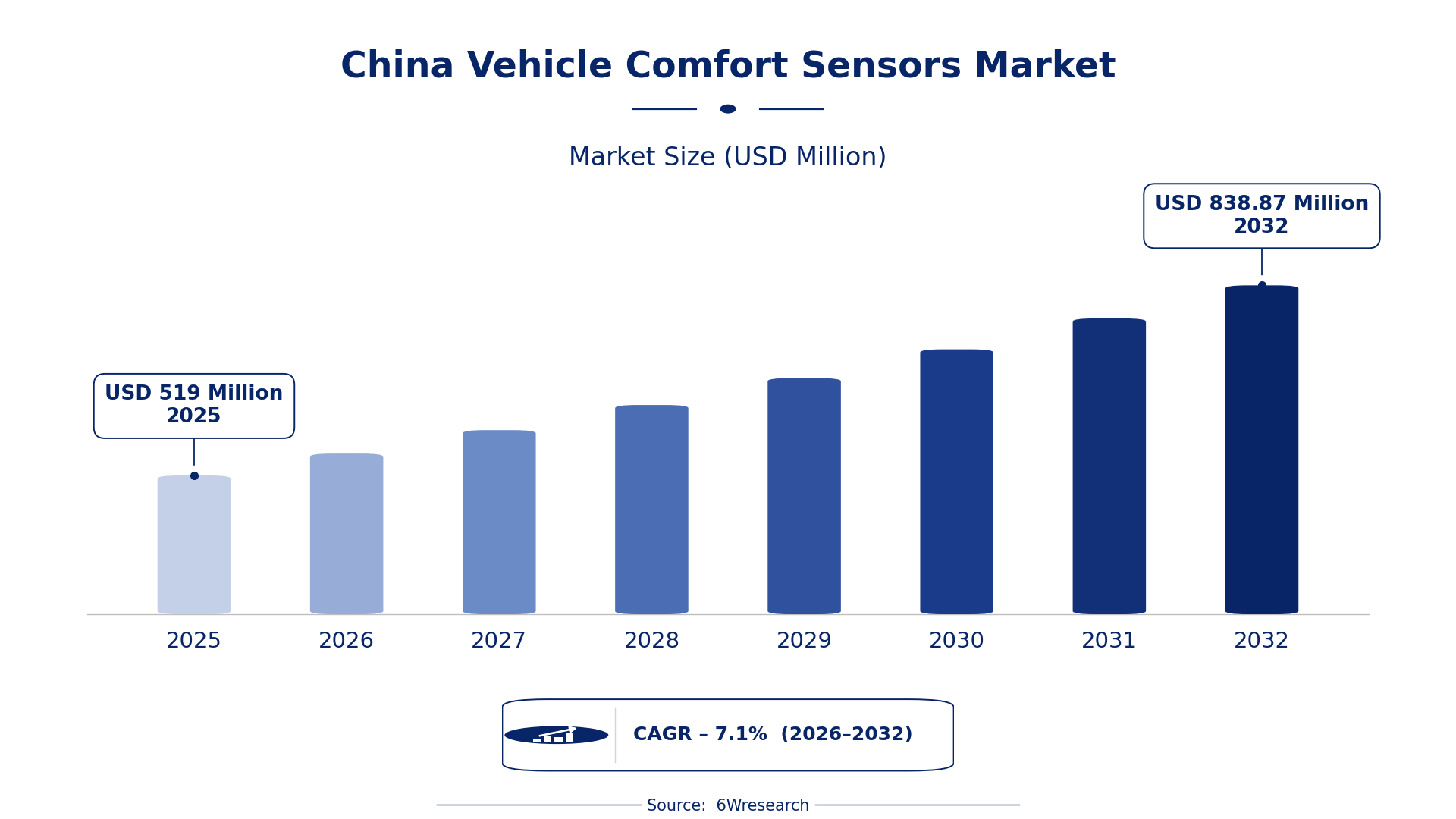
According to 6Wresearch internal database and industry insights, the China Vehicle Comfort Sensors Market was valued at USD 519.0 million in 2025 and is projected to reach USD 838.87 million by 2032, growing at a CAGR of approximately 7.1% during 2026–2032.
China Vehicle Comfort Sensors Market Highlights
| Report Metric | Details |
| Report Name | China Vehicle Comfort Sensors Market |
| Market Size 2025 | USD 519.0 million |
| Market Size 2032 | USD 838.87 million |
| Absolute Growth 2025–2032 | USD 319.87 million |
| CAGR 2026–2032 | 7.1% |
| Peak Annual Growth | 9.2% in 2028 |
| Forecast Period | 2026–2032 |
| Historical Data | 2022–2025 |
| Base Year | 2025 |
| Leading Sensor Type, 2025 | Seat Occupancy Sensors (48% share) |
| Leading Functionality, 2025 | Presence Detection (43% share) |
| Leading Integration Area, 2025 | Cabin Seating (50% share) |
| Leading End User, 2025 | Airbag System Suppliers (46% share) |
| Fastest-Growing Sensor Type | Cabin Temperature Sensors (8.3% CAGR) |
| Fastest-Growing Functionality | Thermal Regulation (8.5% CAGR) |
| Fastest-Growing Integration Area | HVAC (9.8% CAGR) |
| Fastest-Growing End User | Interior System OEMs (9.3% CAGR) |
| Growing Sector | Automotive Electronics |
| Key End Users | Vehicle Manufacturers, Airbag System Suppliers, Luxury Vehicle OEMs, Interior System OEMs |
China Vehicle Comfort Sensors Market Year-wise Growth Rate and Key Drivers (2022–2032)
This graph illustrates the annual growth rates of the market from 2022 to 2032, highlighting a steady upward trajectory and projected market expansion over the forecast period.
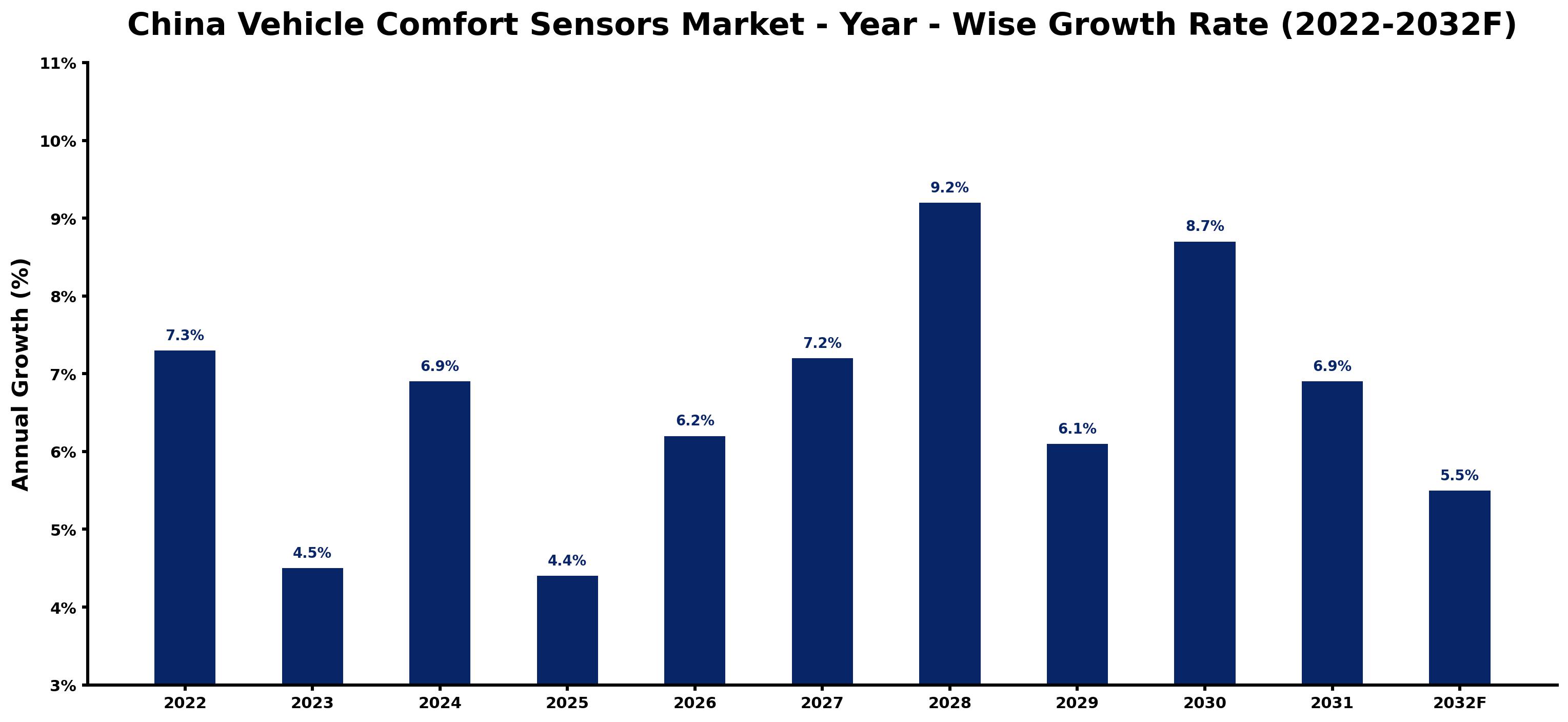
Each row of the following table gives one year's estimated growth and the event or demand shift that explains it.
| Year | Estimated Annual Growth (%) | Market Rationale |
| 2022 | 7.3 | The market experienced significant activity, driven by the automotive sector's strong production figures. |
| 2023 | 4.5 | Demand growth slowed due to supply chain disruptions affecting vehicle production. |
| 2024 | 6.9 | Increased production capacity led to a faster growth rate as manufacturers adapted. |
| 2025 | 4.4 | The market continued to grow, but at a slower pace as competition intensified. |
| 2026 | 6.2 | Demand surged as new vehicle models integrated advanced comfort sensors. |
| 2027 | 7.2 | The market expanded further with the introduction of innovative automotive technologies. |
| 2028 | 9.2 | Peak growth was achieved as luxury vehicle demand spiked significantly. |
| 2029 | 6.1 | Growth slowed as market saturation began to impact new purchases. |
| 2030 | 8.7 | An increase in electric vehicle production drove renewed interest in comfort sensors. |
| 2031 | 6.9 | The market continued to grow, though at a reduced rate due to economic factors. |
| 2032 | 5.5 | A further slowdown occurred as the market stabilised after rapid growth. |
Note: Market size estimations and growth projections presented in this report are based on 6Wresearch's proprietary forecasting methodology, utilizing the latest available industry data, government publications, and primary research inputs.
China Vehicle Comfort Sensors Market Synopsis
Vehicle Comfort Sensors Market in China includes electronic devices designed to improve passenger comfort and safety in vehicles. These sensors monitor seat occupancy, manage cabin temperature, and adjust window tints. The market is expanding due to increased vehicle production, with over 26 million vehicles manufactured in 2022. Furthermore, the demand for luxury vehicles rose by 15% in 2023, further stimulating interest in advanced comfort features. Government initiatives and standards are also driving innovation in this sector.
Market Dynamics Impact Analysis (2026–2032)
| Factor | Type | Impact | Primary Segment Affected |
| Rising vehicle production and luxury vehicle demand | Driver | High | Seat Occupancy Sensors |
| Integration of advanced technologies in vehicles | Driver | High | Cabin Temperature Sensors |
| Growing demand for electric vehicles | Opportunity | High | HVAC |
| Increased focus on passenger safety features | Opportunity | High | Presence Detection |
| High competition among manufacturers | Restraint | Medium | Cabin Seating |
| Supply chain disruptions affecting production | Restraint | Medium | Humidity Sensors |
| Regulatory compliance costs for manufacturers | Challenge | High | Airbag System Suppliers |
| Technological integration challenges in vehicles | Challenge | Medium | Interior System OEMs |
Evaluation of Drivers in China Vehicle Comfort Sensors Market (2026–2032)
The factors lifting demand, and the evidence behind each, are summarised below.
| Drivers | Primary Segment Affected | Why It Matters (Evidence) |
| Increased vehicle production | Seat Occupancy Sensors | With over 26 million vehicles produced in 2022, demand for comfort sensors rises as manufacturers integrate them for safety and efficiency. |
| Rising luxury vehicle sales | Cabin Temperature Sensors | The 15% increase in luxury vehicle sales in 2023 drives the need for advanced comfort features in high-end models. |
| Technological advancements in automotive electronics | Presence Detection | The implementation of ISO 26262 standards drives the demand for reliable safety systems in vehicles, increasing sensor integration. |
| Government support for electric vehicle initiatives | HVAC | The 'New Energy Vehicle Industry Development Plan' promotes the integration of comfort sensors in electric vehicles, enhancing their appeal. |
| Growing consumer preference for comfort and safety | Thermal Regulation | As consumers prioritise comfort, manufacturers are investing in advanced thermal regulation systems to meet evolving expectations. |
Growth in the Vehicle Comfort Sensors market in China is driven by rising vehicle production, a surge in luxury vehicle sales, and advancements in technology. In 2022, over 26 million vehicles were produced, leading to heightened demand for comfort sensors. The 15% increase in luxury vehicle sales in 2023 propels this trend further. Technological progress, especially in safety systems, encourages manufacturers to incorporate more comfort sensors into their vehicles. Support for electric vehicle production is creating fresh opportunities for sensor integration, contributing to overall market growth.
Evaluation of Restraints in China Vehicle Comfort Sensors Market
The key brakes on demand, and where they bite hardest, are shown below.
| Market Restraint | Primary Segment Affected | Why It Matters (Evidence) |
| High competition in the automotive market | Cabin Seating | Intense competition among manufacturers leads to price pressures, affecting profitability and investment in new technologies, with margins shrinking by 10% in 2023. |
| Supply chain disruptions | Humidity Sensors | Ongoing supply chain issues have delayed the availability of components, impacting production schedules and causing a 15% drop in output. |
| Regulatory compliance costs | Airbag System Suppliers | Manufacturers face high costs to comply with safety standards, which can limit their investment in innovation, increasing expenses by 20%. |
| Technological integration challenges | Interior System OEMs | Complexity in integrating new technologies can slow down the adoption of advanced comfort systems, delaying projects by up to 6 months. |
| Market saturation in luxury segments | Cabin Temperature Sensors | As the luxury vehicle market matures, growth rates are stabilising, affecting sensor demand and leading to a 5% decrease in new orders. |
China Vehicle Comfort Sensors Market Challenges
The China Vehicle Comfort Sensors Market faces several practical challenges, beginning with a shortage of skilled technicians. The rapid expansion of the automotive sector, which produced over 26 million vehicles in 2022, has outpaced the training of qualified workers, resulting in delays in sensor installations for manufacturers. Intense competition among domestic and international vehicle manufacturers complicates the situation, as companies strive to differentiate their offerings in a crowded market. Supply chain disruptions also pose issues, with reliance on specific components causing production delays for comfort sensors, ultimately impacting delivery timelines for customers. Rising raw material costs, influenced by global market fluctuations, are squeezing profit margins for producers, prompting a reevaluation of pricing strategies.
Trends in the China Vehicle Comfort Sensors Market
Four trends stand out in the China Vehicle Comfort Sensors Market.
- Shift from Traditional to Smart Comfort Systems: Airbag System Suppliers are increasingly adopting smart comfort sensors to enhance passenger safety and comfort. In 2023, the demand for these advanced systems rose by 15%, reflecting a significant shift towards integrating technology in vehicle comfort.
- Transition to Enhanced Climate Control Solutions: The 'Made in China 2025' initiative has accelerated the development of advanced climate control systems in vehicles. By 2025, the automotive electronics market is projected to reach 1 trillion yuan, indicating a strong focus on improving passenger comfort.
- Emergence of Sustainable Comfort Technologies: The National Development and Reform Commission's push for smart vehicle technologies is driving the adoption of sustainable comfort solutions. In 2023, over 26 million vehicles produced are expected to incorporate these technologies, enhancing overall vehicle appeal.
- Prioritisation of Integrated Safety and Comfort Features: The ISO 26262 standard is shaping the integration of safety and comfort features in vehicles. As of 2023, compliance with this standard is essential for manufacturers, influencing the design of comfort sensors in new vehicle models.
Investment Opportunities in the China Vehicle Comfort Sensors Market
The following opportunities in the China Vehicle Comfort Sensors Market pair current demand with a clear way in.
- Partnerships with Local Manufacturers: Local partnerships can ease market entry for new comfort sensor technologies, particularly in regions like Guangdong, which hosts many automotive manufacturers and produces over 10 million vehicles annually.
- Supply of Advanced Comfort Sensors: With a projected market size of USD 519 million by 2025, there exists a substantial opportunity to supply advanced comfort sensors to vehicle manufacturers seeking to enhance features.
- Investment in Smart Vehicle Technologies: The rising demand for smart vehicles presents an opportunity to invest in advanced sensor technologies, especially in Shanghai's automotive hub, where production is set to increase by 15%.
- Certification for Electric Vehicle Components: With the automotive electronics market expected to reach 1 trillion yuan by 2025, obtaining certifications for electric vehicle components can facilitate market entry and compliance.
Government Initiatives in the China Vehicle Comfort Sensors Market
The 'New Energy Vehicle Industry Development Plan' launched in 2023 aims to boost electric vehicle production and includes measures to support the integration of comfort sensors into new models. This plan introduces incentives for manufacturers to innovate, enhancing previous regulations by focusing on sustainability and technology adoption in the automotive sector.
The Ministry of Industry and Information Technology oversees automotive standards, approving projects that align with national objectives. In 2023, it funded 50 projects aimed at improving automotive technology, ensuring compliance with safety and performance standards, which enables manufacturers to integrate advanced comfort systems more effectively.
Future Insight of the China Vehicle Comfort Sensors Market
Several forward-looking factors should support the China Vehicle Comfort Sensors Market in the coming years. The government's 'New Energy Vehicle Industry Development Plan' will stimulate electric vehicle production, creating new opportunities for sensor integration. By 2025, the automotive electronics market is projected to reach 1 trillion yuan, reflecting substantial investment in advanced technologies. The 'Made in China 2025' initiative will further drive automotive technology innovation, encouraging suppliers to develop vehicle comfort sensors that meet evolving consumer demands.
Market Segmentation Analysis
The analysis below covers each segmentation, its leading category in 2025 and its fastest-growing category through 2032.
By Sensor Type – Seat Occupancy Sensors Dominated, Cabin Temperature Sensors Expected to Grow Fastest
According to Bhawna Singh, Assistant Manager at 6Wresearch, the largest sensor type category in 2025 was Seat Occupancy Sensors, with a 48% share of total revenue. Seat occupancy sensors hold the largest share due to their critical role in monitoring passenger presence, which is vital for both safety and comfort. With over 26 million vehicles produced in 2022, domestic manufacturers depend heavily on these sensors to comply with safety regulations. Over 2026–2032, Cabin Temperature Sensors are expected to post the fastest growth, at a CAGR of 8.3%. Cabin temperature sensors are experiencing rapid growth as passenger comfort becomes increasingly important in vehicle design. The automotive comfort sensor market is likely to flourish as government incentives for electric vehicles promote the adoption of advanced comfort technologies. Suppliers should focus on developing cabin temperature sensors to capture new market opportunities.
By Functionality – Presence Detection Dominated, Thermal Regulation Expected to Grow Fastest
With a 43% revenue share in 2025, Presence Detection was the largest functionality category. Presence detection leads the market because it is essential for airbag deployment systems, ensuring passenger safety during accidents. With China's vehicle population reaching approximately 300 million in 2023, the demand for dependable safety features remains substantial. Thermal Regulation is projected to grow fastest, at a CAGR of 8.5% during 2026–2032. Thermal regulation is the fastest-growing functionality, driven by the rising demand for effective climate control in vehicles. The 15% increase in luxury vehicle production in 2023 further fuels the need for advanced thermal regulation solutions. Buyers should prioritise the integration of thermal regulation technologies to improve vehicle comfort and market competitiveness.
By Integration Area – Cabin Seating Dominated, HVAC Expected to Grow Fastest
Cabin Seating held a 50% share of the China Vehicle Comfort Sensors Market by integration area in 2025. Cabin seating dominates the market as it is integral to passenger comfort and safety, making it a key focus for manufacturers. The concentration of automotive manufacturers in Guangdong province supports the widespread adoption of these sensors in vehicles. HVAC is set to record the highest CAGR in this split, 9.8% over 2026–2032. HVAC is the fastest-growing integration area, driven by the essential need for climate control in vehicles. The government's push for smart vehicle technologies also supports the expansion of HVAC integration. Suppliers must invest in HVAC technologies to meet the increasing demand for advanced climate control solutions in vehicles.
By End User – Airbag System Suppliers Dominated, Interior System OEMs Expected to Grow Fastest
Airbag System Suppliers accounted for a 46% market share by end user in 2025. Airbag system suppliers dominate the market share as they are crucial for the implementation of key safety features in vehicles. With over 6 million people working in the automotive industry, the demand for reliable safety components continues to rise. The quickest growth will come from Interior System OEMs, forecast to expand at a CAGR of 9.3% between 2026 and 2032. Interior system OEMs are the fastest-growing end users, as they manufacture comfort-related components that greatly enhance the passenger experience. The increased demand for luxury vehicles is driving growth in this segment, making it a vital area for investment. Suppliers should align their products with the requirements of interior system OEMs to take advantage of the growing demand for comfort-enhancing technologies.
Key Attractiveness of the Report
- 10 Years of Market Numbers
- Historical Data Starting from 2022 to 2025
- Base Year 2025
- Forecast Data until 2032
- Key Performance Indicators Impacting the Market
- Major Upcoming Developments and Projects
Key Highlights of the Report:
- China Vehicle Comfort Sensors Market Outlook
- Market Size of China Vehicle Comfort Sensors Market, 2025
- Forecast of China Vehicle Comfort Sensors Market, 2032
- Historical Data and Forecast of China Vehicle Comfort Sensors Revenues & Volume for the Period 2022 - 2032F
- China Vehicle Comfort Sensors Market Trend Evolution
- China Vehicle Comfort Sensors Market Drivers and Challenges
- China Vehicle Comfort Sensors Price Trends
- China Vehicle Comfort Sensors Porter's Five Forces
- China Vehicle Comfort Sensors Industry Life Cycle
- Historical Data and Forecast of China Vehicle Comfort Sensors Market Revenues & Volume By Sensor Type for the Period 2022 - 2032F
- Historical Data and Forecast of China Vehicle Comfort Sensors Market Revenues & Volume By Seat Occupancy Sensors for the Period 2022 - 2032F
- Historical Data and Forecast of China Vehicle Comfort Sensors Market Revenues & Volume By Cabin Temperature Sensors for the Period 2022 - 2032F
- Historical Data and Forecast of China Vehicle Comfort Sensors Market Revenues & Volume By Humidity Sensors for the Period 2022 - 2032F
- Historical Data and Forecast of China Vehicle Comfort Sensors Market Revenues & Volume By Sunlight Sensors for the Period 2022 - 2032F
- Historical Data and Forecast of China Vehicle Comfort Sensors Market Revenues & Volume By Functionality for the Period 2022 - 2032F
- Historical Data and Forecast of China Vehicle Comfort Sensors Market Revenues & Volume By Presence Detection for the Period 2022 - 2032F
- Historical Data and Forecast of China Vehicle Comfort Sensors Market Revenues & Volume By Thermal Regulation for the Period 2022 - 2032F
- Historical Data and Forecast of China Vehicle Comfort Sensors Market Revenues & Volume By Fog Prevention for the Period 2022 - 2032F
- Historical Data and Forecast of China Vehicle Comfort Sensors Market Revenues & Volume By Auto Tint Adjustment for the Period 2022 - 2032F
- Historical Data and Forecast of China Vehicle Comfort Sensors Market Revenues & Volume By Integration Area for the Period 2022 - 2032F
- Historical Data and Forecast of China Vehicle Comfort Sensors Market Revenues & Volume By Cabin Seating for the Period 2022 - 2032F
- Historical Data and Forecast of China Vehicle Comfort Sensors Market Revenues & Volume By HVAC for the Period 2022 - 2032F
- Historical Data and Forecast of China Vehicle Comfort Sensors Market Revenues & Volume By Windshield Area for the Period 2022 - 2032F
- Historical Data and Forecast of China Vehicle Comfort Sensors Market Revenues & Volume By Side Windows for the Period 2022 - 2032F
- Historical Data and Forecast of China Vehicle Comfort Sensors Market Revenues & Volume By End User for the Period 2022 - 2032F
- Historical Data and Forecast of China Vehicle Comfort Sensors Market Revenues & Volume By Airbag System Suppliers for the Period 2022 - 2032F
- Historical Data and Forecast of China Vehicle Comfort Sensors Market Revenues & Volume By Interior System OEMs for the Period 2022 - 2032F
- Historical Data and Forecast of China Vehicle Comfort Sensors Market Revenues & Volume By Safety Component Integrators for the Period 2022 - 2032F
- Historical Data and Forecast of China Vehicle Comfort Sensors Market Revenues & Volume By Luxury Vehicle OEMs for the Period 2022 - 2032F
- China Vehicle Comfort Sensors Import Export Trade Statistics
- Market Opportunity Assessment By Sensor Type
- Market Opportunity Assessment By Functionality
- Market Opportunity Assessment By Integration Area
- Market Opportunity Assessment By End User
- China Vehicle Comfort Sensors Top Companies Market Share
- China Vehicle Comfort Sensors Competitive Benchmarking By Technical and Operational Parameters
- China Vehicle Comfort Sensors Company Profiles
- China Vehicle Comfort Sensors Key Strategic Recommendations
Market Covered
The report offers an extensive study of the following market segments.
By Sensor Type
- Seat Occupancy Sensors
- Cabin Temperature Sensors
- Humidity Sensors
- Sunlight Sensors
By Functionality
- Presence Detection
- Thermal Regulation
- Fog Prevention
- Auto Tint Adjustment
By Integration Area
- Cabin Seating
- HVAC
- Windshield Area
- Side Windows
By End User
- Airbag System Suppliers
- Interior System OEMs
- Safety Component Integrators
- Luxury Vehicle OEMs































