India Vehicle Communication Infrastructure Market Size & Growth Rate
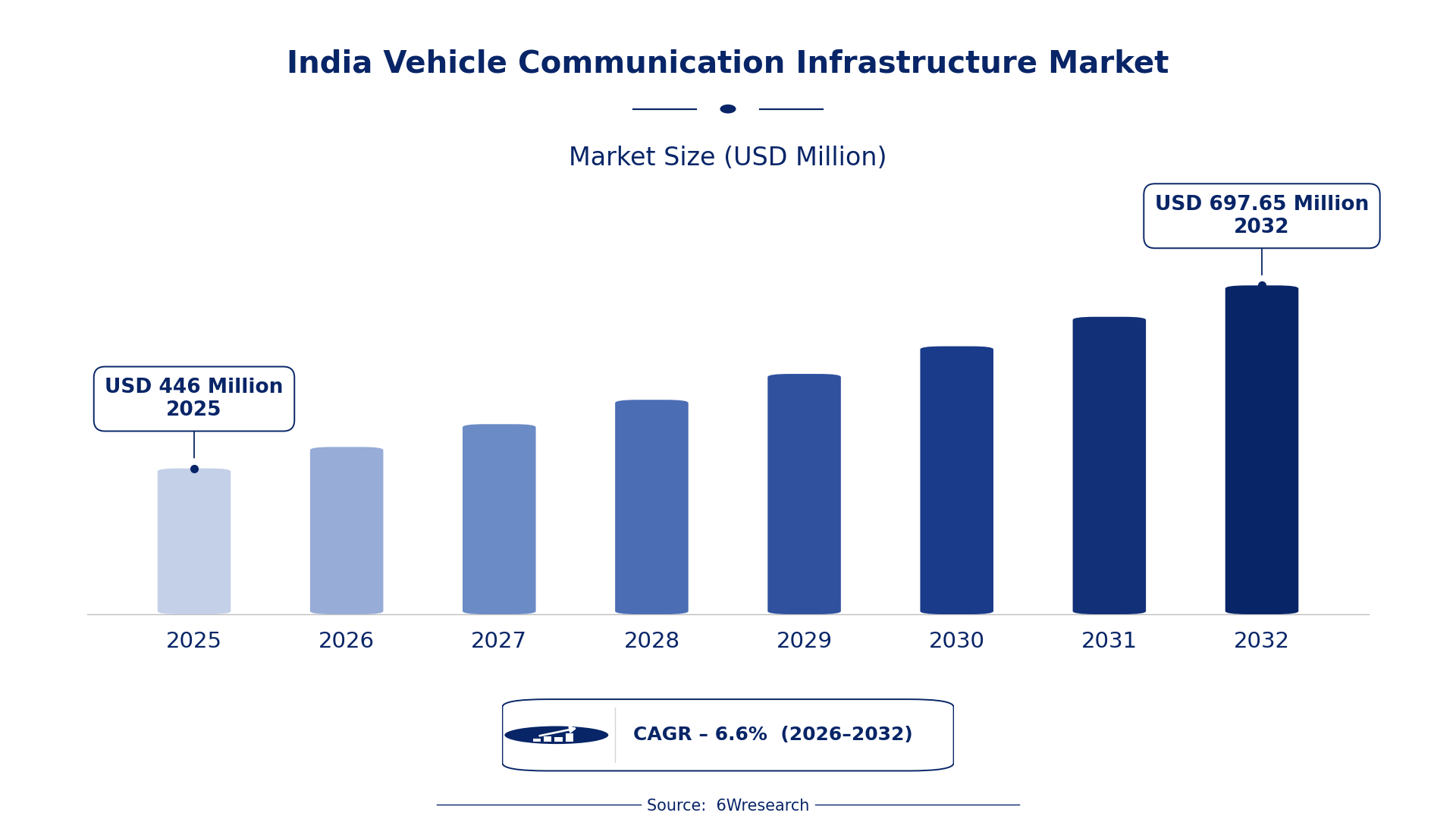
According to 6Wresearch internal database and industry insights, the India Vehicle Communication Infrastructure Market was valued at USD 446.0 million in 2025 and is projected to reach USD 697.65 million by 2032, growing at a CAGR of approximately 6.6% during 2026–2032.
India Vehicle Communication Infrastructure Market Highlights
| Report Metric | Details |
| Report Name | India Vehicle Communication Infrastructure Market |
| Market Size 2025 | USD 446.0 million |
| Market Size 2032 | USD 697.65 million |
| Absolute Growth 2025–2032 | USD 251.65 million |
| CAGR 2026–2032 | 6.6% |
| Peak Annual Growth | 9.0% in 2028 |
| Forecast Period | 2026–2032 |
| Historical Data | 2022–2025 |
| Base Year | 2025 |
| Leading Infrastructure Type, 2025 | C-V2X Roadside Units (50% share) |
| Leading Connectivity Mode, 2025 | Cellular-Based (47% share) |
| Leading Deployment Area, 2025 | Urban Intersections (35% share) |
| Leading End User, 2025 | Government Agencies (36% share) |
| Fastest-Growing Connectivity Mode | Short-Range Wireless (8.1% CAGR) |
| Fastest-Growing Deployment Area | Highways (8.7% CAGR) |
| Fastest-Growing End User | Mobility Solution Providers (8.6% CAGR) |
| Growing Sector | Smart Transportation |
| Key End Users | Government Agencies, Mobility Solution Providers, Smart City Planners |
India Vehicle Communication Infrastructure Market Year-wise Growth Rate and Key Drivers (2022–2032)
This graph illustrates the annual growth rates of the market from 2022 to 2032, highlighting a steady upward trajectory and projected market expansion over the forecast period.
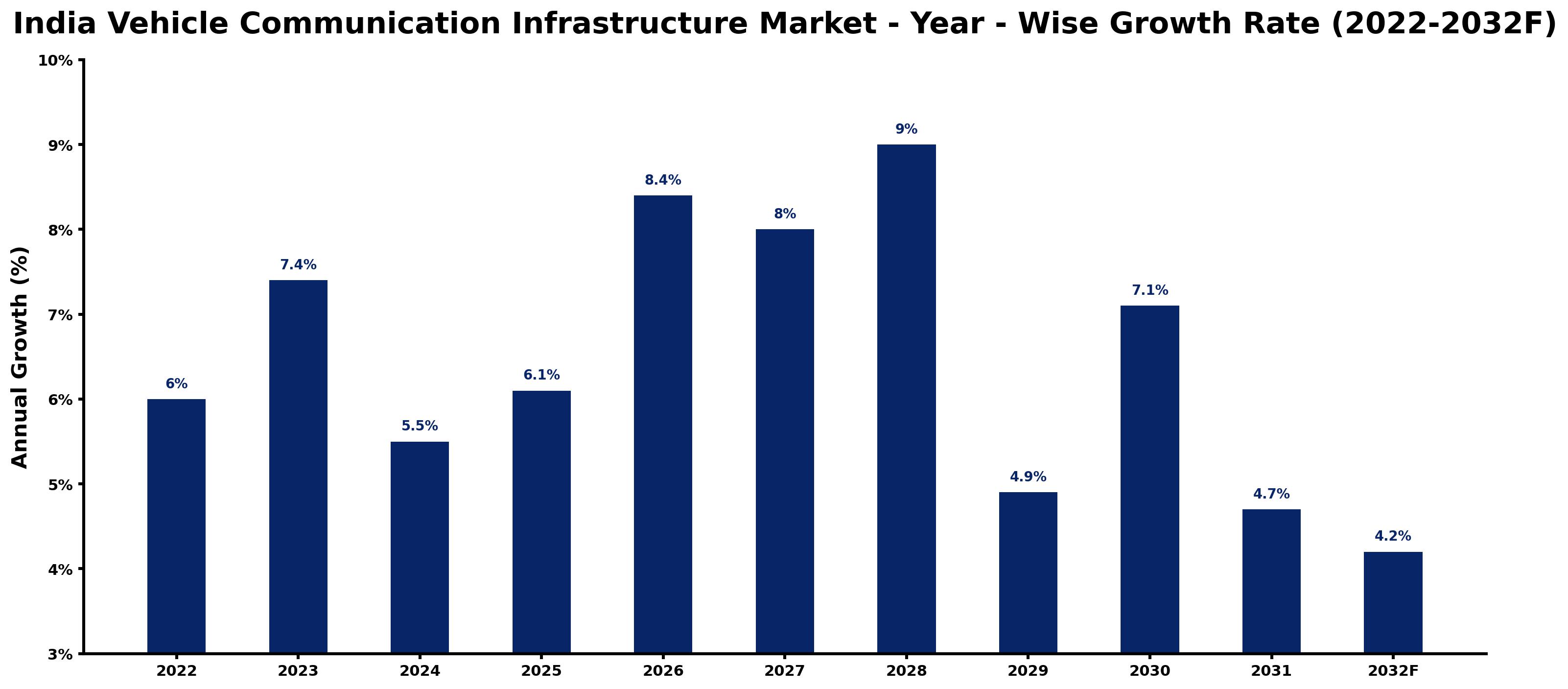
Annual growth estimates for each year appear below with the principal reason behind them, explaining the shifts that set the pace of the market.
| Year | Estimated Annual Growth (%) | Market Rationale |
| 2022 | 6.0 | The market experienced solid growth driven by urbanisation and initial government initiatives. |
| 2023 | 7.4 | Growth accelerated due to the launch of the National Intelligent Transportation Systems Policy. |
| 2024 | 5.5 | A slight slowdown occurred as projects faced implementation challenges in urban areas. |
| 2025 | 6.1 | Demand increased again as urban areas initiated smart traffic management projects under the Smart Cities Mission. |
| 2026 | 8.4 | Growth rebounded strongly with rising investments in vehicle communication technologies through the National Smart Mobility Mission. |
| 2027 | 8.0 | A minor slowdown was noted as market adjustments took place in urban deployments of C-V2X systems. |
| 2028 | 9.0 | The market peaked with advancements in C-V2X technology adoption, driven by government funding. |
| 2029 | 4.9 | Growth slowed as the market began to stabilise after rapid expansion in urban areas. |
| 2030 | 7.1 | Demand increased again as the population growth heightened the need for efficient communication systems in urban planning. |
| 2031 | 4.7 | A further slowdown occurred as the market adjusted to new standards and technologies under the Bureau of Indian Standards. |
| 2032 | 4.2 | The market continued to grow, albeit at a slower rate, due to ongoing urbanisation and government initiatives. |
Note: Market size estimations and growth projections presented in this report are based on 6Wresearch's proprietary forecasting methodology, utilizing the latest available industry data, government publications, and primary research inputs.
India Vehicle Communication Infrastructure Market Synopsis
The India Vehicle Communication Infrastructure Market includes technologies that enable communication between vehicles and infrastructure, such as Dedicated Short-Range Communications and Cellular Vehicle-to-Everything systems. This infrastructure plays a crucial role in developing smart transportation systems and improving road safety. The market is growing due to urbanisation and government initiatives, particularly the Smart Cities Mission, which aims to establish 100 smart cities by 2023. Anticipated government funding exceeding ₹1 trillion by 2025 is set to enhance infrastructure significantly. The National Intelligent Transportation Systems Policy encourages the integration of advanced communication technologies, further propelling market growth.
Market Dynamics Impact Analysis (2026–2032)
| Factor | Type | Impact | Primary Segment Affected |
| Urbanisation driving demand for smart traffic management solutions | Driver | High | Urban Intersections |
| Government funding for smart city initiatives | Driver | High | C-V2X Roadside Units |
| Investment opportunities in smart city projects | Opportunity | High | Government Agencies |
| Growing demand for efficient traffic management systems | Opportunity | High | Mobility Solution Providers |
| Implementation challenges in urban areas | Restraint | Medium | DSRC Road Units |
| Standards development is ongoing, causing delays | Restraint | Medium | C-V2X Roadside Units |
| Limited infrastructure in rural areas hampers growth | Challenge | High | Highways |
| Competition among technology providers may affect pricing | Challenge | Medium | Vehicular Edge Servers |
Evaluation of Drivers in India Vehicle Communication Infrastructure Market (2026–2032)
Key forces behind demand, with the segment each one moves most, are listed below.
| Drivers | Primary Segment Affected | Why It Matters (Evidence) |
| Urbanisation increases demand for smart traffic management solutions | Urban Intersections | As urban areas expand, the need for efficient traffic management solutions rises, leading to increased purchases of communication infrastructure. |
| Government funding for smart city initiatives supports infrastructure | C-V2X Roadside Units | Funding exceeding ₹1 trillion by 2025 promotes the deployment of advanced vehicle communication technologies. |
| Rising population necessitates efficient vehicle communication systems | DSRC Road Units | With a projected population of 1.5 billion by 2030, the demand for efficient communication systems is expected to surge. |
| Integration of C-V2X technology in public transport systems | Mobility Solution Providers | The National Smart Mobility Mission aims to incorporate C-V2X systems, increasing demand from mobility solution providers. |
| Smart city projects drive investment in vehicle communication | Government Agencies | The Smart Cities Mission encourages government agencies to invest in vehicle communication infrastructure for urban development. |
The Smart Cities Mission, with funding exceeding ₹1 trillion by 2025, is driving investments in smart traffic management systems. As urban areas grow, the need for efficient vehicle communication systems rises, prompting increased purchases of C-V2X technologies. Furthermore, the projected population increase to 1.5 billion by 2030 necessitates advanced infrastructure for effective traffic management.
Evaluation of Restraints in India Vehicle Communication Infrastructure Market
The main factors holding the market back are set out below.
| Market Restraint | Primary Segment Affected | Why It Matters (Evidence) |
| Implementation challenges in urban areas delay project completions | DSRC Road Units | Urban areas face logistical challenges that hinder the timely deployment of communication infrastructure. |
| Standards development is ongoing, causing delays in adoption | C-V2X Roadside Units | The Bureau of Indian Standards is still finalising guidelines, which delays market readiness. |
| Limited infrastructure in rural areas hampers overall growth | Highways | The lack of investment in rural communication infrastructure restricts market expansion. |
| Competition among technology providers may affect pricing | Vehicular Edge Servers | Intense competition can lead to price wars, impacting profitability for suppliers. |
| Technological integration issues can slow deployment | Urban Intersections | Complexities in integrating various communication technologies can delay project timelines. |
India Vehicle Communication Infrastructure Market Challenges
The India Vehicle Communication Infrastructure market encounters several practical challenges, with buyers often struggling to secure sufficient funding for projects. Many local governments lack budget allocations, despite government funding for smart city initiatives projected to exceed ₹1 trillion by 2025, which delays infrastructure development. Competition among suppliers is fierce, as numerous firms compete for contracts while only a few meet the stringent standards set by the Bureau of Indian Standards. This results in slower technology rollouts, hindering smart traffic management systems and impacting urban areas that urgently require upgrades. Supply chain issues arise from reliance on imported components, causing delays that affect project timelines for urban planners.
Trends in the India Vehicle Communication Infrastructure Market
Several trends are reshaping the India Vehicle Communication Infrastructure Market; the most important are set out below.
- Shift towards Smart City Infrastructure: Government initiatives like the Smart Cities Mission are driving a shift towards improved vehicle communication infrastructure. With over ₹500 crore allocated in 2023 for urban mobility solutions, this trend is reshaping urban planning.
- Transition from Traditional to Advanced Communication Technologies: The National Intelligent Transportation Systems Policy, launched in 2021, is promoting a transition from traditional communication methods to advanced C-V2X systems. This shift is projected to improve traffic management significantly.
- Urban Intersections Prioritised over Highways: Urban Intersections are becoming the focal point for deploying vehicle communication systems, with a projected 35% market share by 2025. This focus reflects the need for efficient urban traffic management.
- Increased Investment in Vehicle Communication Systems: With government funding for smart city projects exceeding ₹1 trillion by 2025, there is a notable increase in investments in vehicle communication systems. This funding is essential for modernising urban infrastructure.
Investment Opportunities in the India Vehicle Communication Infrastructure Market
Investors looking at the India Vehicle Communication Infrastructure Market should consider the following areas.
- Investment in C-V2X Roadside Units: The demand for C-V2X Roadside Units is increasing, driven by urbanisation and smart city initiatives. Government Agencies are key buyers, and partnerships with local firms can facilitate entry.
- Supply of DSRC Road Units for Urban Areas: There is a growing opportunity to supply DSRC Road Units, particularly in cities like Delhi and Bengaluru. Collaborating with local governments can improve market access.
- Development of Mobility Solutions for Smart Cities: The rise of smart cities presents an opportunity to develop integrated mobility solutions. Engaging with Mobility Solution Providers can open new avenues for investment.
- Focus on Urban Traffic Management Systems: The ongoing urbanisation creates a pressing need for efficient traffic management systems. Targeting urban areas with tailored solutions can yield substantial returns.
Government Initiatives in the India Vehicle Communication Infrastructure Market
The National Intelligent Transportation Systems (ITS) Policy, approved by the Ministry of Road Transport and Highways in 2021, aims to enhance vehicle communication technologies across urban areas. This policy sets the framework for implementing C-V2X systems and establishing standards for vehicle communication infrastructure. The Smart Cities Mission, initiated by the Ministry of Housing and Urban Affairs in 2015, includes funding for vehicle communication infrastructure projects, with a target of developing 100 smart cities by 2023. This initiative is expected to significantly improve urban mobility and traffic management systems in India.
In 2022, the Ministry of Urban Development launched the Urban Mobility Program to integrate vehicle communication technologies into public transport systems, enhancing efficiency and safety. The program allocates funding for smart traffic management solutions, with a focus on urban areas. The Bureau of Indian Standards is developing standards for vehicle communication technologies to ensure safety and interoperability, which will facilitate smoother implementation of these systems in cities. Additionally, the Automotive Research Association of India is working on standards for C-V2X communication technologies, further promoting the adoption of advanced vehicle communication systems.
Future Insight of the India Vehicle Communication Infrastructure Market
The Vehicle Communication Infrastructure market in India will evolve by 2032, driven by the government's commitment to smart city initiatives and urban mobility solutions. The National Smart Mobility Mission focuses on integrating advanced vehicle communication technologies into public transportation systems by 2025, improving efficiency and safety. Government funding for smart city projects, including vehicle communication, allocated ₹500 crore in 2023, will further stimulate development. The target of 30% electric vehicles by 2030 will necessitate robust vehicle communication systems, prompting suppliers to innovate and meet these growing demands.
Market Segmentation Analysis
Each segment group is reviewed below, with the leader by share and the fastest grower by CAGR.
By Infrastructure Type – C-V2X Roadside Units Dominated and Is Expected to Record the Fastest Growth
According to Bhawna Singh, Assistant Manager at 6Wresearch, C-V2X Roadside Units accounted for a 50% market share by infrastructure type in 2025. C-V2X Roadside Units hold the largest share due to their critical role in facilitating real-time data exchange, essential for effective traffic management. Their importance is particularly highlighted in urban centres like Delhi and Bengaluru, where government initiatives are actively promoting their deployment. C-V2X Roadside Units are also forecast to expand faster than any other category, at a CAGR of 8.0% over 2026–2032. The growth of C-V2X Roadside Units is propelled by rapid urbanisation and significant government investment, with over ₹1 trillion allocated for smart city projects by 2025. This segment's lead will continue to expand as the demand for efficient traffic management solutions rises. Suppliers should prioritise advancements in C-V2X technologies to meet the growing demands of urban traffic systems.
By Connectivity Mode – Cellular-Based Dominated, Short-Range Wireless Expected to Grow Fastest
With a 47% revenue share in 2025, Cellular-Based was the largest connectivity mode category. Cellular-Based connectivity leads in market share as it offers broader connectivity for vehicles, which is crucial for integrating various communication technologies. This mode is particularly vital in urban environments where extensive coverage is necessary for effective vehicle communication. Over 2026–2032, Short-Range Wireless is expected to post the fastest growth, at a CAGR of 8.1%. Short-Range Wireless is experiencing rapid growth due to its essential function in immediate vehicle communication, particularly in densely populated urban areas. As urban traffic demands increase, this segment is well-positioned for accelerated adoption. Buyers should invest in Short-Range Wireless solutions to enhance real-time communication capabilities.
By Deployment Area – Urban Intersections Dominated, Highways Expected to Grow Fastest
Urban Intersections took a 35% share of deployment area in 2025, more than any other category. Urban Intersections dominate market share as they are critical locations for implementing communication systems, enabling efficient traffic management in densely populated regions. Their strategic significance is underscored by ongoing initiatives aimed at improving urban mobility. Highways are set to record the highest CAGR in this split, 8.7% over 2026–2032. Highways represent the fastest-growing deployment area, essential for enhancing traffic flow and safety as vehicle numbers rise. This segment's growth is vital for improving long-distance travel efficiency and overall road safety. Suppliers must focus on solutions for highways to meet the increasing demand for improved traffic management.
By End User – Government Agencies Dominated, Mobility Solution Providers Expected to Grow Fastest
In 2025, Government Agencies led the end user split with a 36% share. Government Agencies lead in market share as they are the primary regulators and implementers of vehicle communication policies, driving infrastructure development. Their involvement is crucial for standardising technologies across urban areas and ensuring adherence to national standards. Mobility Solution Providers are projected to grow fastest, at a CAGR of 8.6% during 2026–2032. Mobility Solution Providers are the fastest-growing end users, acting as integrators of communication technologies that enhance urban mobility solutions. Their growth reflects the rising demand for smart transportation systems and innovative mobility solutions. Suppliers should align their offerings with the needs of Mobility Solution Providers to capitalise on emerging market opportunities.
Key Attractiveness of the Report
- 10 Years of Market Numbers
- Historical Data Starting from 2022 to 2025
- Base Year 2025
- Forecast Data until 2032
- Key Performance Indicators Impacting the Market
- Major Upcoming Developments and Projects
Key Highlights of the Report:
- India Vehicle Communication Infrastructure Market Outlook
- Market Size of India Vehicle Communication Infrastructure Market, 2025
- Forecast of India Vehicle Communication Infrastructure Market, 2032
- Historical Data and Forecast of India Vehicle Communication Infrastructure Revenues & Volume for the Period 2022 - 2032F
- India Vehicle Communication Infrastructure Market Trend Evolution
- India Vehicle Communication Infrastructure Market Drivers and Challenges
- India Vehicle Communication Infrastructure Price Trends
- India Vehicle Communication Infrastructure Porter's Five Forces
- India Vehicle Communication Infrastructure Industry Life Cycle
- Historical Data and Forecast of India Vehicle Communication Infrastructure Market Revenues & Volume By Infrastructure Type for the Period 2022 - 2032F
- Historical Data and Forecast of India Vehicle Communication Infrastructure Market Revenues & Volume By DSRC Road Units for the Period 2022 - 2032F
- Historical Data and Forecast of India Vehicle Communication Infrastructure Market Revenues & Volume By C-V2X Roadside Units for the Period 2022 - 2032F
- Historical Data and Forecast of India Vehicle Communication Infrastructure Market Revenues & Volume By Vehicular Edge Servers for the Period 2022 - 2032F
- Historical Data and Forecast of India Vehicle Communication Infrastructure Market Revenues & Volume By RSU-Gateway Hubs for the Period 2022 - 2032F
- Historical Data and Forecast of India Vehicle Communication Infrastructure Market Revenues & Volume By Connectivity Mode for the Period 2022 - 2032F
- Historical Data and Forecast of India Vehicle Communication Infrastructure Market Revenues & Volume By Short-Range Wireless for the Period 2022 - 2032F
- Historical Data and Forecast of India Vehicle Communication Infrastructure Market Revenues & Volume By Cellular-Based for the Period 2022 - 2032F
- Historical Data and Forecast of India Vehicle Communication Infrastructure Market Revenues & Volume By Cloud-Edge Sync for the Period 2022 - 2032F
- Historical Data and Forecast of India Vehicle Communication Infrastructure Market Revenues & Volume By Network Backbone for the Period 2022 - 2032F
- Historical Data and Forecast of India Vehicle Communication Infrastructure Market Revenues & Volume By Deployment Area for the Period 2022 - 2032F
- Historical Data and Forecast of India Vehicle Communication Infrastructure Market Revenues & Volume By Urban Intersections for the Period 2022 - 2032F
- Historical Data and Forecast of India Vehicle Communication Infrastructure Market Revenues & Volume By Highways for the Period 2022 - 2032F
- Historical Data and Forecast of India Vehicle Communication Infrastructure Market Revenues & Volume By Parking/Charging Zones for the Period 2022 - 2032F
- Historical Data and Forecast of India Vehicle Communication Infrastructure Market Revenues & Volume By Suburban Routes for the Period 2022 - 2032F
- Historical Data and Forecast of India Vehicle Communication Infrastructure Market Revenues & Volume By End User for the Period 2022 - 2032F
- Historical Data and Forecast of India Vehicle Communication Infrastructure Market Revenues & Volume By Smart City Planners for the Period 2022 - 2032F
- Historical Data and Forecast of India Vehicle Communication Infrastructure Market Revenues & Volume By Government Agencies for the Period 2022 - 2032F
- Historical Data and Forecast of India Vehicle Communication Infrastructure Market Revenues & Volume By Mobility Solution Providers for the Period 2022 - 2032F
- Historical Data and Forecast of India Vehicle Communication Infrastructure Market Revenues & Volume By Automotive IoT Companies for the Period 2022 - 2032F
- India Vehicle Communication Infrastructure Import Export Trade Statistics
- Market Opportunity Assessment By Infrastructure Type
- Market Opportunity Assessment By Connectivity Mode
- Market Opportunity Assessment By Deployment Area
- Market Opportunity Assessment By End User
- India Vehicle Communication Infrastructure Top Companies Market Share
- India Vehicle Communication Infrastructure Competitive Benchmarking By Technical and Operational Parameters
- India Vehicle Communication Infrastructure Company Profiles
- India Vehicle Communication Infrastructure Key Strategic Recommendations
Market Covered
Segments analysed in this report are listed below.
By Infrastructure Type
- DSRC Road Units
- C-V2X Roadside Units
- Vehicular Edge Servers
- RSU-Gateway Hubs
By Connectivity Mode
- Short-Range Wireless
- Cellular-Based
- Cloud-Edge Sync
- Network Backbone
By Deployment Area
- Urban Intersections
- Highways
- Parking/Charging Zones
- Suburban Routes
By End User
- Smart City Planners
- Government Agencies
- Mobility Solution Providers
- Automotive IoT Companies































