China Vehicle Communication Infrastructure Market Size & Growth Rate
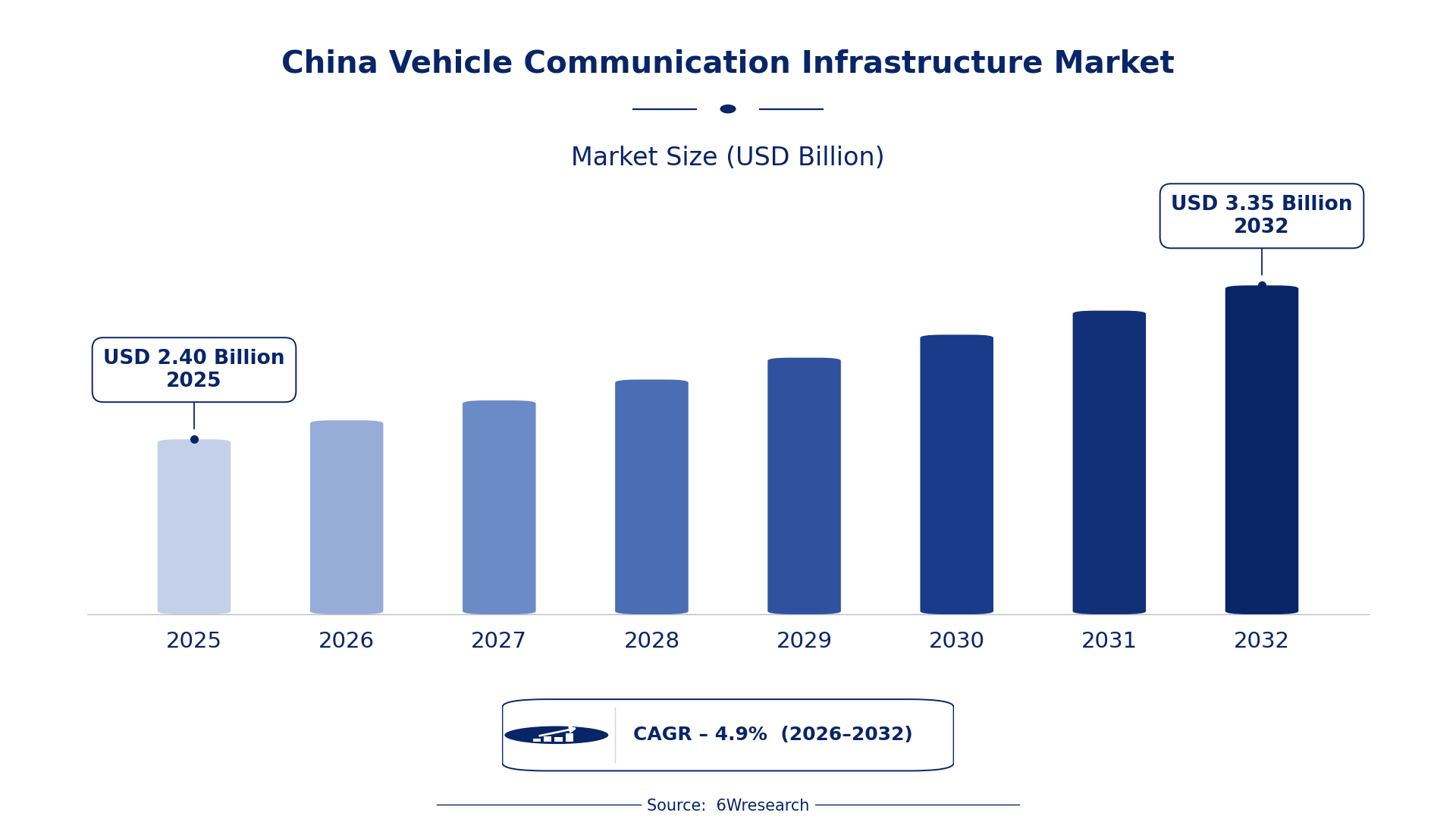
According to 6Wresearch internal database and industry insights, the China Vehicle Communication Infrastructure Market was valued at USD 2.40 billion in 2025 and is projected to reach USD 3.35 billion by 2032, growing at a CAGR of approximately 4.9% during 2026–2032.
China Vehicle Communication Infrastructure Market Highlights
| Report Metric | Details |
| Report Name | China Vehicle Communication Infrastructure Market |
| Market Size 2025 | USD 2.40 billion |
| Market Size 2032 | USD 3.35 billion |
| Absolute Growth 2025–2032 | USD 0.95 billion |
| CAGR 2026–2032 | 4.9% |
| Peak Annual Growth | 6.8% in 2030 |
| Forecast Period | 2026–2032 |
| Historical Data | 2022–2025 |
| Base Year | 2025 |
| Leading Infrastructure Type, 2025 | DSRC Road Units (39% share) |
| Leading Connectivity Mode, 2025 | Short-Range Wireless (40% share) |
| Leading Deployment Area, 2025 | Urban Intersections (43% share) |
| Leading End User, 2025 | Smart City Planners (41% share) |
| Fastest-Growing Infrastructure Type | C-V2X Roadside Units (6.3% CAGR) |
| Fastest-Growing Connectivity Mode | Cellular-Based (6.9% CAGR) |
| Fastest-Growing Deployment Area | Highways (7.4% CAGR) |
| Fastest-Growing End User | Government Agencies (6.1% CAGR) |
| Growing Sector | Government Agencies |
| Key End Users | Smart City Planners, Government Agencies, Mobility Solution Providers, Automotive IoT Companies |
China Vehicle Communication Infrastructure Market Year-wise Growth Rate and Key Drivers (2022–2032)
This graph illustrates the annual growth rates of the market from 2022 to 2032, highlighting a steady upward trajectory and projected market expansion over the forecast period.
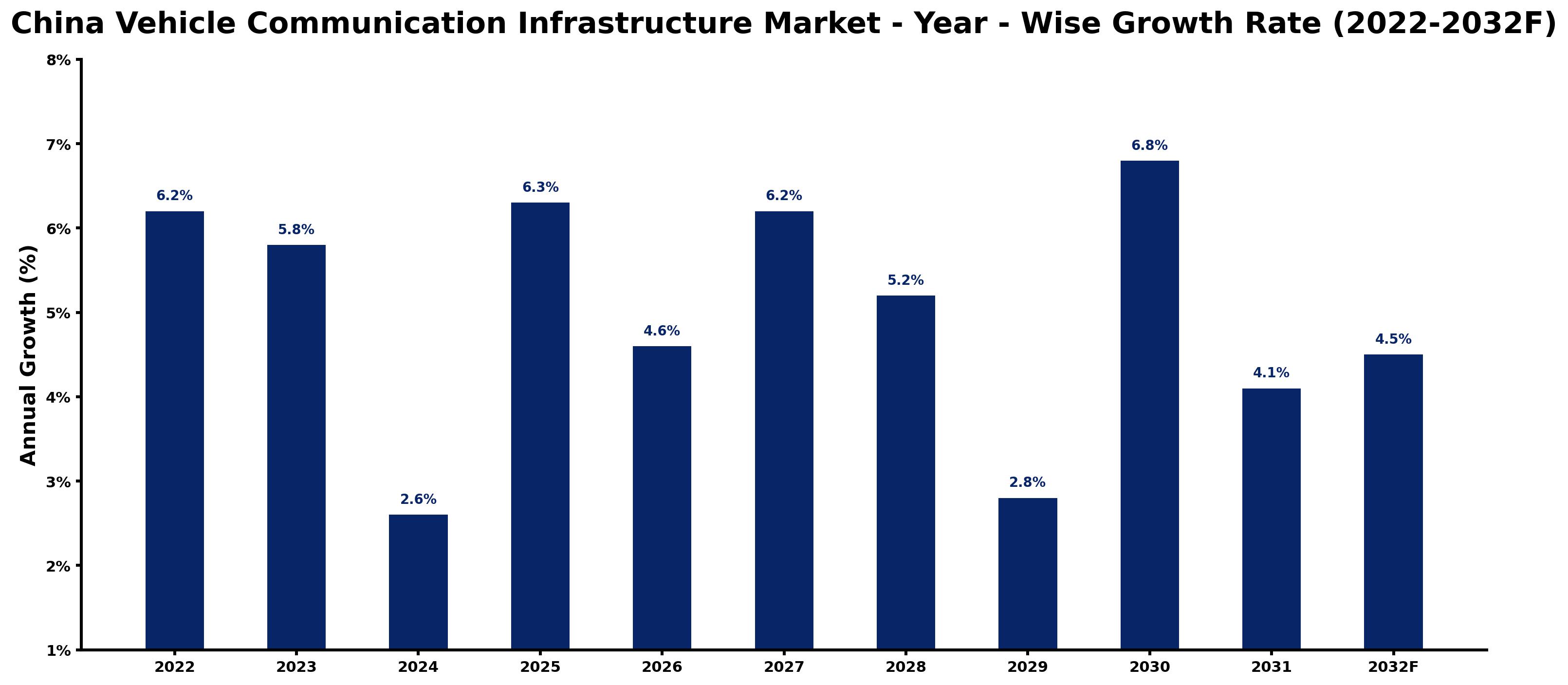
Each row of the following table gives one year's estimated growth and the event or demand shift that explains it.
| Year | Estimated Annual Growth (%) | Market Rationale |
| 2022 | 6.2 | The market experienced steady growth due to increased investments in smart city projects. |
| 2023 | 5.8 | Growth slowed as the integration of DSRC technology into traffic systems progressed. |
| 2024 | 2.6 | Demand continued to rise, albeit at a slower pace, as urban infrastructure improved. |
| 2025 | 6.3 | Growth accelerated with the implementation of advanced vehicle communication standards in urban areas. |
| 2026 | 4.6 | A slowdown occurred as the market adjusted following rapid expansion in previous years. |
| 2027 | 6.2 | Growth rebounded as government agencies adopted more vehicle communication technologies. |
| 2028 | 5.2 | A slight slowdown was noted as the market matured and competition intensified. |
| 2029 | 2.8 | Demand continued to grow, albeit slowly, as more vehicles became equipped with V2X capabilities. |
| 2030 | 6.8 | The market peaked with heightened investments in smart transportation systems and infrastructure. |
| 2031 | 4.1 | Growth slowed again as the market began to stabilise after rapid expansion. |
| 2032 | 4.5 | Demand increased as new technologies emerged, improving vehicle communication capabilities. |
Note: Market size estimations and growth projections presented in this report are based on 6Wresearch's proprietary forecasting methodology, utilizing the latest available industry data, government publications, and primary research inputs.
China Vehicle Communication Infrastructure Market Synopsis
Vehicle Communication Infrastructure in China encompasses technologies that enable communication between vehicles and infrastructure, primarily enhancing traffic management and safety. It includes advanced communication protocols and hardware, such as roadside units and vehicular edge servers. The China Vehicle Communication Infrastructure Market is growing due to robust investments in smart city initiatives and vehicle automation, with over 100 pilot projects currently underway. By 2023, more than 60% of new vehicles in urban areas are expected to be equipped with V2X capabilities, reflecting strong demand for these technologies.
Market Dynamics Impact Analysis (2026–2032)
| Factor | Type | Impact | Primary Segment Affected |
| Increased investment in smart city projects drives demand for vehicle communication infrastructure. | Driver | High | C-V2X Roadside Units |
| Growing urbanisation necessitates advanced traffic management solutions. | Driver | High | Urban Intersections |
| The integration of DSRC technology in traffic systems presents opportunities for suppliers. | Opportunity | High | DSRC Road Units |
| Government initiatives for smart transportation systems create demand for infrastructure. | Opportunity | Medium | Vehicular Edge Servers |
| High costs of implementing advanced technology can limit market growth. | Restraint | High | C-V2X Roadside Units |
| Regulatory challenges in standardisation may hinder rapid deployment. | Restraint | Medium | RSU-Gateway Hubs |
| The market faces challenges related to technology integration and compatibility. | Challenge | High | Short-Range Wireless |
| Limited public awareness of vehicle communication benefits can slow adoption. | Challenge | Medium | Smart City Planners |
Evaluation of Drivers in China Vehicle Communication Infrastructure Market (2026–2032)
The table below links each growth driver to the segment it affects and the evidence for it.
| Drivers | Primary Segment Affected | Why It Matters (Evidence) |
| Investment in smart city projects boosts demand for vehicle communication infrastructure. | C-V2X Roadside Units | In 2023, Shanghai implemented C-V2X technology in 50% of urban intersections, increasing demand for related infrastructure. |
| Urbanisation drives the need for advanced traffic management solutions. | Urban Intersections | China's population of approximately 1.4 billion necessitates efficient transportation solutions, leading to increased infrastructure investments. |
| The integration of DSRC technology into traffic management systems increases demand. | DSRC Road Units | In 2022, Beijing launched a program to integrate DSRC technology, improving communication capabilities. |
| Government support for smart transportation systems promotes market growth. | Vehicular Edge Servers | The National Development and Reform Commission allocated 10 billion yuan to develop smart transportation systems. |
| Rising vehicle automation increases the need for communication technologies. | Short-Range Wireless | By 2023, over 60% of new vehicles in urban areas are expected to be equipped with V2X capabilities. |
Market growth in China for Vehicle Communication Infrastructure rests on rising investments in smart city projects, urbanisation, and vehicle automation. The National Development and Reform Commission allocated 10 billion yuan to develop smart transportation systems, which boosts demand for related infrastructure. By 2023, over 60% of new vehicles in urban areas are expected to be equipped with V2X capabilities, indicating strong demand for these technologies. Urbanisation drives the need for advanced traffic management solutions, as China's population necessitates efficient transportation. The integration of DSRC technology into traffic management systems improves communication capabilities, further increasing infrastructure investments.
Evaluation of Restraints in China Vehicle Communication Infrastructure Market
The table below lists the restraints and the evidence behind each.
| Market Restraint | Primary Segment Affected | Why It Matters (Evidence) |
| Intense competition among suppliers drives down prices. | C-V2X Roadside Units | This competition limits profitability for producers, making it challenging to invest in technology advancements. |
| Inconsistent standards complicate integration for new vehicles. | DSRC Road Units | Since the Ministry of Transport set V2X communication standards only in 2021, many urban areas lack uniformity. |
| Supply chain issues arise from reliance on advanced hardware. | Vehicular Edge Servers | Delays in the delivery of roadside units can hinder the deployment of smart city initiatives. |
| Skills shortage in the workforce affects technology adoption. | Short-Range Wireless | The rapid development of vehicle communication technologies requires specialised training that is currently insufficient. |
| Limited funding for infrastructure projects slows development. | Urban Intersections | Budget constraints can delay the implementation of necessary vehicle communication systems. |
China Vehicle Communication Infrastructure Market Challenges
The China Vehicle Communication Infrastructure market faces a few practical problems, and the first is intense competition among suppliers. This competition drives down prices, which can limit profitability for producers and hinder their ability to invest in technology advancements. Buyers encounter inconsistent standards; since the Ministry of Transport set V2X communication standards only in 2021, many urban areas still lack uniformity, complicating integration for new vehicles. Supply chain issues arise from reliance on advanced hardware, as delays in the delivery of roadside units can stall deployment of smart city initiatives. A skills shortage also exists; the rapid development of vehicle communication technologies requires specialised training that is currently insufficient, making it challenging for training facilities to meet industry demands.
Trends in the China Vehicle Communication Infrastructure Market
Several trends are reshaping the China Vehicle Communication Infrastructure Market; the most important are set out below.
- Expansion of Smart City Projects: China's smart city initiatives include over 100 pilot projects focusing on vehicle communication infrastructure, improving urban mobility. These projects are expected to drive demand for advanced communication technologies.
- Increase in V2X Technology Adoption: By 2023, more than 60% of new vehicles in urban areas are expected to be equipped with V2X capabilities, reflecting a clear shift towards connected vehicles.
- Shift Towards C-V2X Technology: Shanghai has implemented C-V2X technology in 50% of its urban intersections, indicating a transition from traditional systems to more advanced communication methods.
- Government Investment in Smart Transportation: The National Development and Reform Commission's 10 billion yuan budget for smart transportation systems highlights the increasing governmental focus on developing vehicle communication infrastructure.
Investment Opportunities in the China Vehicle Communication Infrastructure Market
Investors looking at the China Vehicle Communication Infrastructure Market should consider the following areas.
- Investment in Vehicle Communication Technologies: With over 60% of new vehicles expected to adopt V2X capabilities by 2023, there is a strong opportunity for suppliers to invest in related technologies and infrastructure.
- Collaboration with Smart City Planners: Smart City Planners are actively seeking advanced vehicle communication solutions, creating a demand for partnerships and local collaborations to implement these technologies.
- Development of Advanced Traffic Management Systems: The need for efficient transportation solutions in urban areas presents an opportunity to supply innovative traffic management systems that integrate vehicle communication technologies.
- Expansion into Urban Intersections: Urban Intersections, accounting for 43% of deployment areas, represent a key opportunity for investment in vehicle communication infrastructure to improve traffic management.
Government Initiatives in the China Vehicle Communication Infrastructure Market
The 'Smart Transportation Development Plan' launched by the National Development and Reform Commission in 2021 aims to improve vehicle communication systems by 2025. This plan allocates significant resources for infrastructure improvements and technology adoption. The 'National Intelligent Transportation System Plan' (2022) from the Ministry of Transport further supports the deployment of C-V2X infrastructure across major cities, ensuring standardisation and integration of vehicle communication technologies.
In 2023, the Ministry of Industry and Information Technology introduced a subsidy program for local governments to implement vehicle communication technologies in urban areas. This initiative aims to enhance the adoption of advanced communication systems, facilitating smoother integration into existing infrastructure. The State Council's 'New Infrastructure Plan' (2020) also includes investments in smart transportation and vehicle communication systems, promoting overall development in this sector.
Future Insight of the China Vehicle Communication Infrastructure Market
The Vehicle Communication Infrastructure market in China will undergo substantial changes by 2032, primarily driven by advancements in V2X technologies. The government's initiative to integrate DSRC technology into traffic management systems will improve real-time traffic monitoring capabilities. As smart city initiatives expand, over 100 pilot projects will encourage further integration of vehicle communication systems across urban areas. Investments in vehicular edge servers will enhance traffic safety, creating a more efficient transportation network for buyers and suppliers.
Market Segmentation Analysis
The analysis below covers each segmentation, its leading category in 2025 and its fastest-growing category through 2032.
By Infrastructure Type – DSRC Road Units Dominated, C-V2X Roadside Units Expected to Grow Fastest
According to Bhawna Singh, Assistant Manager at 6Wresearch, DSRC Road Units accounted for a 39% market share by infrastructure type in 2025. DSRC Road Units maintain a leading share in China's Vehicle Communication Infrastructure market as they are integral for vehicle-to-infrastructure communication, particularly in urban settings. The successful integration of DSRC technology in Beijing's traffic management systems highlights its essential role in enhancing traffic flow and safety. Over 2026–2032, C-V2X Roadside Units are expected to post the fastest growth, at a CAGR of 6.3%. C-V2X Roadside Units are experiencing rapid growth due to their necessity for cellular-based vehicle communication, which is gaining traction in urban areas. The implementation of C-V2X technology in 50% of urban intersections in Shanghai indicates a strong momentum for this segment. Suppliers should focus on advancing their DSRC and C-V2X technologies to cater to the increasing demand from urban planners and traffic management authorities.
By Connectivity Mode – Short-Range Wireless Dominated, Cellular-Based Expected to Grow Fastest
Short-Range Wireless took a 40% share of connectivity mode in 2025, more than any other category. Short-Range Wireless holds a substantial market share as it effectively meets immediate vehicle communication needs, crucial for real-time traffic management. This mode is particularly important in densely populated urban areas where swift data exchange is vital for operational efficiency. Cellular-Based is set to record the highest CAGR in this split, 6.9% over 2026–2032. Cellular-Based connectivity is the fastest-growing segment, driven by the rising need for extensive communication networks that support vehicle connectivity. The trend towards integrating more connected vehicles into urban infrastructure significantly boosts this segment's growth potential. Buyers should consider investing in both Short-Range Wireless and Cellular-Based solutions to ensure comprehensive communication capabilities for their vehicle infrastructure projects.
By Deployment Area – Urban Intersections Dominated, Highways Expected to Grow Fastest
Urban Intersections held a 43% share of the China Vehicle Communication Infrastructure Market by deployment area in 2025. Urban Intersections dominate the market due to their critical function in implementing vehicle communication systems, where effective traffic management is essential. This focus aligns with national initiatives aimed at improving urban mobility and safety, reinforcing the importance of this deployment area. Highways are projected to grow fastest, at a CAGR of 7.4% during 2026–2032. Highways are the fastest-growing deployment area, as they are crucial for managing high-speed vehicle communications and enhancing overall traffic flow. The increasing number of vehicles on highways drives the demand for advanced communication solutions to ensure safety and efficiency. Suppliers must tailor their strategies to meet the specific needs of both Urban Intersections and Highways to seize opportunities in these vital deployment areas.
By End User – Smart City Planners Dominated, Government Agencies Expected to Grow Fastest
The largest end user category in 2025 was Smart City Planners, with a 41% share of total revenue. Smart City Planners represent the largest share of end users, as they are instrumental in integrating vehicle communication technologies into urban infrastructure projects. Their focus on smart city initiatives significantly drives the demand for advanced communication solutions across the sector. The quickest growth will come from Government Agencies, forecast to expand at a CAGR of 6.1% between 2026 and 2032. Government Agencies are the fastest-growing end user segment, as they play a key role in regulating and implementing vehicle communication standards. Their active engagement in promoting connected vehicle initiatives accelerates market growth and adoption. Vendors should collaborate with Smart City Planners and Government Agencies to ensure their offerings align with regulatory requirements and urban development objectives.
Key Attractiveness of the Report
- 10 Years of Market Numbers
- Historical Data Starting from 2022 to 2025
- Base Year 2025
- Forecast Data until 2032
- Key Performance Indicators Impacting the Market
- Major Upcoming Developments and Projects
Key Highlights of the Report:
- China Vehicle Communication Infrastructure Market Outlook
- Market Size of China Vehicle Communication Infrastructure Market, 2025
- Forecast of China Vehicle Communication Infrastructure Market, 2032
- Historical Data and Forecast of China Vehicle Communication Infrastructure Revenues & Volume for the Period 2022 - 2032F
- China Vehicle Communication Infrastructure Market Trend Evolution
- China Vehicle Communication Infrastructure Market Drivers and Challenges
- China Vehicle Communication Infrastructure Price Trends
- China Vehicle Communication Infrastructure Porter's Five Forces
- China Vehicle Communication Infrastructure Industry Life Cycle
- Historical Data and Forecast of China Vehicle Communication Infrastructure Market Revenues & Volume By Infrastructure Type for the Period 2022 - 2032F
- Historical Data and Forecast of China Vehicle Communication Infrastructure Market Revenues & Volume By DSRC Road Units for the Period 2022 - 2032F
- Historical Data and Forecast of China Vehicle Communication Infrastructure Market Revenues & Volume By C-V2X Roadside Units for the Period 2022 - 2032F
- Historical Data and Forecast of China Vehicle Communication Infrastructure Market Revenues & Volume By Vehicular Edge Servers for the Period 2022 - 2032F
- Historical Data and Forecast of China Vehicle Communication Infrastructure Market Revenues & Volume By RSU-Gateway Hubs for the Period 2022 - 2032F
- Historical Data and Forecast of China Vehicle Communication Infrastructure Market Revenues & Volume By Connectivity Mode for the Period 2022 - 2032F
- Historical Data and Forecast of China Vehicle Communication Infrastructure Market Revenues & Volume By Short-Range Wireless for the Period 2022 - 2032F
- Historical Data and Forecast of China Vehicle Communication Infrastructure Market Revenues & Volume By Cellular-Based for the Period 2022 - 2032F
- Historical Data and Forecast of China Vehicle Communication Infrastructure Market Revenues & Volume By Cloud-Edge Sync for the Period 2022 - 2032F
- Historical Data and Forecast of China Vehicle Communication Infrastructure Market Revenues & Volume By Network Backbone for the Period 2022 - 2032F
- Historical Data and Forecast of China Vehicle Communication Infrastructure Market Revenues & Volume By Deployment Area for the Period 2022 - 2032F
- Historical Data and Forecast of China Vehicle Communication Infrastructure Market Revenues & Volume By Urban Intersections for the Period 2022 - 2032F
- Historical Data and Forecast of China Vehicle Communication Infrastructure Market Revenues & Volume By Highways for the Period 2022 - 2032F
- Historical Data and Forecast of China Vehicle Communication Infrastructure Market Revenues & Volume By Parking/Charging Zones for the Period 2022 - 2032F
- Historical Data and Forecast of China Vehicle Communication Infrastructure Market Revenues & Volume By Suburban Routes for the Period 2022 - 2032F
- Historical Data and Forecast of China Vehicle Communication Infrastructure Market Revenues & Volume By End User for the Period 2022 - 2032F
- Historical Data and Forecast of China Vehicle Communication Infrastructure Market Revenues & Volume By Smart City Planners for the Period 2022 - 2032F
- Historical Data and Forecast of China Vehicle Communication Infrastructure Market Revenues & Volume By Government Agencies for the Period 2022 - 2032F
- Historical Data and Forecast of China Vehicle Communication Infrastructure Market Revenues & Volume By Mobility Solution Providers for the Period 2022 - 2032F
- Historical Data and Forecast of China Vehicle Communication Infrastructure Market Revenues & Volume By Automotive IoT Companies for the Period 2022 - 2032F
- China Vehicle Communication Infrastructure Import Export Trade Statistics
- Market Opportunity Assessment By Infrastructure Type
- Market Opportunity Assessment By Connectivity Mode
- Market Opportunity Assessment By Deployment Area
- Market Opportunity Assessment By End User
- China Vehicle Communication Infrastructure Top Companies Market Share
- China Vehicle Communication Infrastructure Competitive Benchmarking By Technical and Operational Parameters
- China Vehicle Communication Infrastructure Company Profiles
- China Vehicle Communication Infrastructure Key Strategic Recommendations
Market Covered
The report offers an extensive study of the following market segments.
By Infrastructure Type
- DSRC Road Units
- C-V2X Roadside Units
- Vehicular Edge Servers
- RSU-Gateway Hubs
By Connectivity Mode
- Short-Range Wireless
- Cellular-Based
- Cloud-Edge Sync
- Network Backbone
By Deployment Area
- Urban Intersections
- Highways
- Parking/Charging Zones
- Suburban Routes
By End User
- Smart City Planners
- Government Agencies
- Mobility Solution Providers
- Automotive IoT Companies































