India Vehicle Component Market Size & Growth Rate
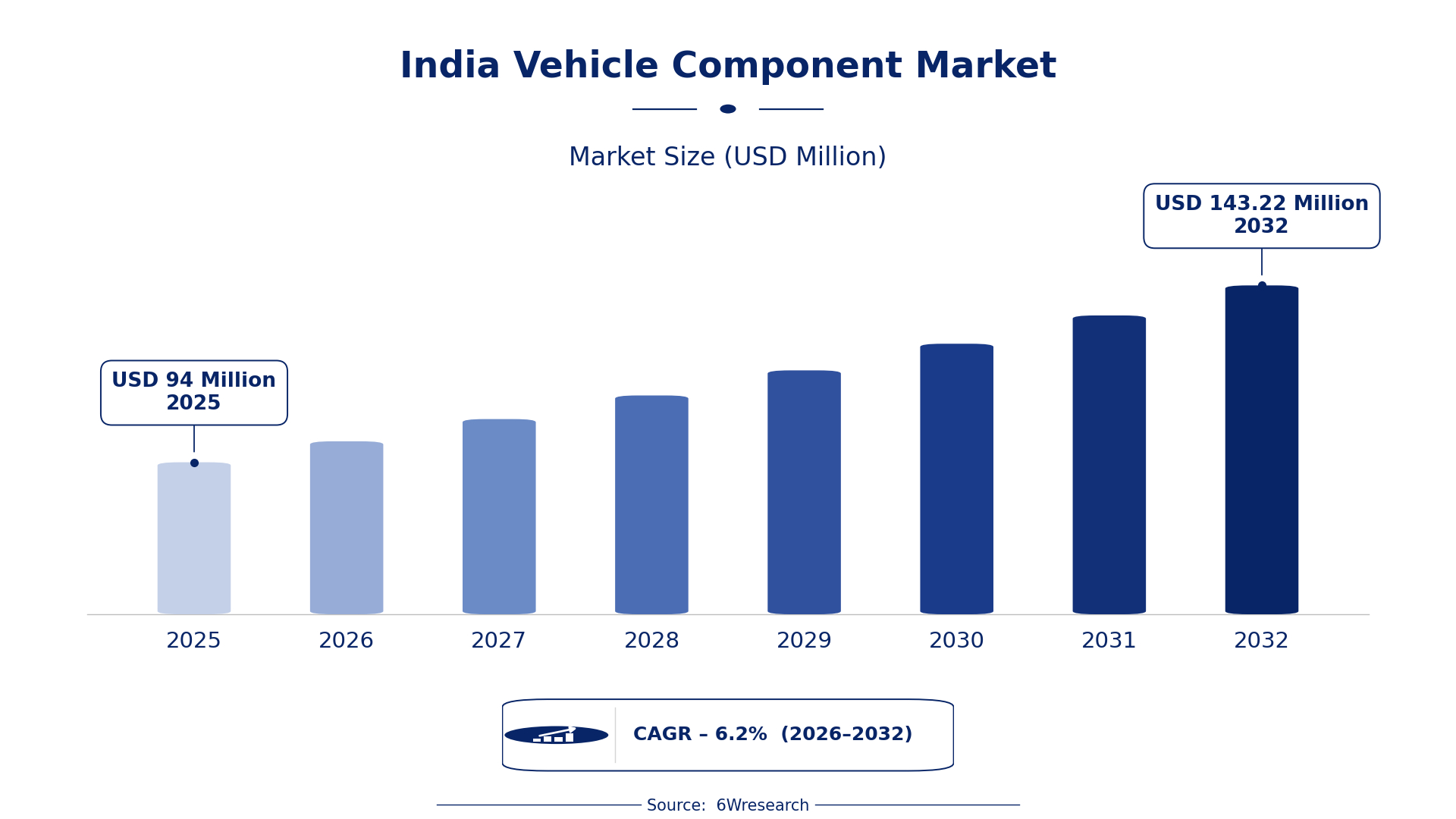
According to 6Wresearch internal database and industry insights, the India Vehicle Component Market was valued at USD 94.0 million in 2025 and is projected to reach USD 143.22 million by 2032, growing at a CAGR of approximately 6.2% during 2026–2032.
India Vehicle Component Market Highlights
| Report Metric | Details |
| Report Name | India Vehicle Component Market |
| Market Size 2025 | USD 94.0 million |
| Market Size 2032 | USD 143.22 million |
| Absolute Growth 2025–2032 | USD 49.22 million |
| CAGR 2026–2032 | 6.2% |
| Peak Annual Growth | 7.9% in 2028 |
| Forecast Period | 2026–2032 |
| Historical Data | 2022–2025 |
| Base Year | 2025 |
| Leading Component Type, 2025 | Engine Components (43% share) |
| Leading Application System, 2025 | Powertrain (45% share) |
| Leading Material Type, 2025 | Cast Iron/Steel (41% share) |
| Leading End User, 2025 | Vehicle OEMs (43% share) |
| Fastest-Growing Component Type | Infotainment Modules (8.1% CAGR) |
| Fastest-Growing Application System | Electronics (8.1% CAGR) |
| Fastest-Growing Material Type | Plastics/Electronics (8.0% CAGR) |
| Fastest-Growing End User | Connected Vehicle Providers (8.5% CAGR) |
| Growing Sector | Automotive aftermarket |
| Key End Users | Vehicle OEMs, Aftermarket Retailers, Connected Vehicle Providers |
India Vehicle Component Market Year-wise Growth Rate and Key Drivers (2022–2032)
This graph illustrates the annual growth rates of the market from 2022 to 2032, highlighting a steady upward trajectory and projected market expansion over the forecast period.
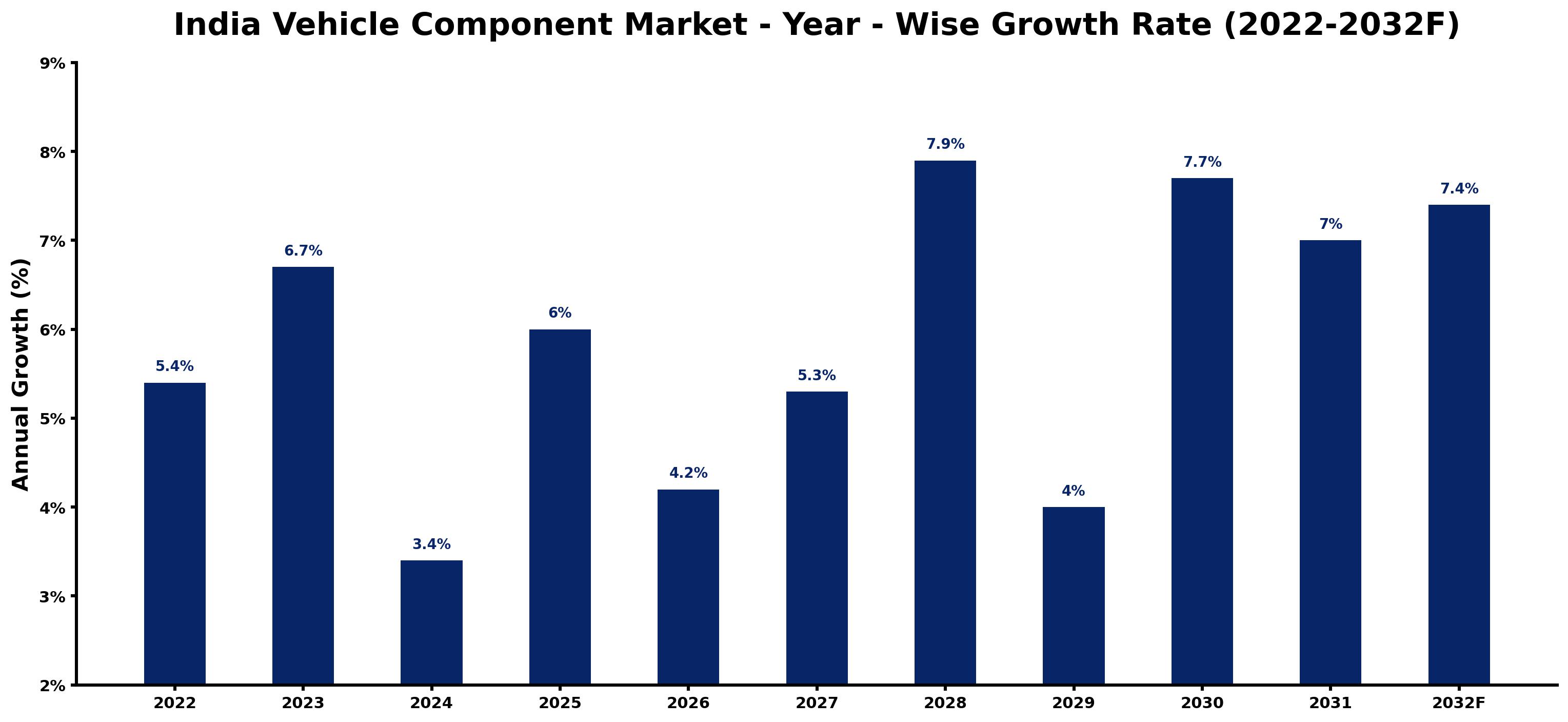
Below, each year's estimated growth is shown next to the factor that most influenced it.
| Year | Estimated Annual Growth (%) | Market Rationale |
| 2022 | 5.4 | Market growth was driven by strong domestic production and increasing vehicle ownership. |
| 2023 | 6.7 | Demand rose due to the Automotive Mission Plan 2026, which focused on industry development. |
| 2024 | 3.4 | Growth slowed as manufacturers adjusted to supply chain disruptions from global events. |
| 2025 | 6.0 | The market rebounded with rising vehicle sales and aftermarket services gaining traction. |
| 2026 | 4.2 | A slowdown occurred as the Production-Linked Incentive Scheme began to show effects. |
| 2027 | 5.3 | Demand increased as electric vehicle adoption accelerated, boosting component requirements. |
| 2028 | 7.9 | The peak growth phase was reached, driven by heightened investments in automotive technology. |
| 2029 | 4.0 | Growth slowed again as the market stabilised following rapid expansion in previous years. |
| 2030 | 7.7 | An upturn in demand was noted as vehicle production ramped up significantly. |
| 2031 | 7.0 | Growth moderated as the market adjusted to new standards and regulations. |
| 2032 | 7.4 | Demand is expected to rise again as the vehicle population continues to expand. |
Note: Market size estimations and growth projections presented in this report are based on 6Wresearch's proprietary forecasting methodology, utilizing the latest available industry data, government publications, and primary research inputs.
India Vehicle Component Market Synopsis
The Vehicle Component Market in India includes critical parts such as engines, brakes, and electronics, integral to vehicle functionality. These components are produced through various methods, including casting and assembly. The market is expanding, driven by increasing vehicle ownership and robust domestic production, which is valued at around $118 billion in 2023. The National Electric Mobility Mission Plan is also stimulating demand for electric vehicle components, further propelling market growth.
Market Dynamics Impact Analysis (2026–2032)
| Factor | Type | Impact | Primary Segment Affected |
| Rising vehicle ownership and production levels are increasing demand for vehicle components. | Driver | High | Engine Components |
| The growing aftermarket services sector is boosting demand for replacement parts. | Driver | High | Brake Assemblies |
| The shift towards electric vehicles presents opportunities for manufacturers to supply new components. | Opportunity | High | Infotainment Modules |
| Investment in automotive manufacturing facilities in Maharashtra is creating new supply channels. | Opportunity | Medium | Powertrain |
| Supply chain disruptions have led to delays in component availability for manufacturers. | Restraint | High | Suspension Parts |
| Stringent quality standards imposed by the Bureau of Indian Standards can hinder production. | Restraint | Medium | Electronics |
| High raw material costs are impacting the profitability of component manufacturers. | Challenge | High | Chassis |
| Technological advancements require continuous investment, straining smaller manufacturers' resources. | Challenge | Medium | Safety System |
Evaluation of Drivers in India Vehicle Component Market (2026–2032)
The table below links each growth driver to the segment it affects and the evidence for it.
| Drivers | Primary Segment Affected | Why It Matters (Evidence) |
| Increased vehicle production is driving demand for essential components. | Powertrain | India produces over 4.5 million vehicles annually, necessitating a steady supply of components. |
| The automotive aftermarket is expanding rapidly, increasing demand for replacement parts. | Brake Assemblies | This sector is projected to grow significantly, driven by rising vehicle ownership and service needs. |
| The push for electric vehicles is creating new demand for specialized components. | Infotainment Modules | The National Electric Mobility Mission Plan aims for 7 million electric vehicles by 2025, boosting component requirements. |
| Investment in manufacturing facilities is enhancing production capabilities. | Engine Components | Maharashtra is a major hub for automotive manufacturing, attracting significant investments to support growth. |
| Technological advancements in vehicles are increasing the need for modern components. | Electronics | The adoption of updated quality standards is pushing manufacturers to upgrade their quality systems. |
Growth in the Vehicle Component market in India is driven by rising vehicle production, expanding aftermarket services, and a shift towards electric vehicles. The country manufactures over 4.5 million vehicles each year, creating a consistent demand for essential components. The automotive aftermarket is set to grow significantly, fuelled by an increase in vehicle ownership and service needs. The transition to electric vehicles is generating demand for specialised components. Investments in manufacturing facilities in Maharashtra are enhancing production capabilities, while the adoption of updated quality standards is encouraging manufacturers to improve their quality systems.
Evaluation of Restraints in India Vehicle Component Market
The key brakes on demand, and where they bite hardest, are shown below.
| Market Restraint | Primary Segment Affected | Why It Matters (Evidence) |
| Supply chain disruptions have caused delays in component availability. | Suspension Parts | Manufacturers face challenges in sourcing materials, impacting production timelines. |
| Stringent quality standards can hinder production efficiency. | Electronics | Compliance with Bureau of Indian Standards can increase operational costs for manufacturers. |
| High raw material costs are affecting profit margins for component manufacturers. | Chassis | Fluctuations in material prices lead to increased production costs. |
| Technological advancements require continuous investment, straining smaller manufacturers. | Safety System | Smaller firms may struggle to keep up with rapid changes in technology. |
| Regulatory changes can impose additional compliance costs on manufacturers. | Engine Components | New standards may require significant investment in testing and certification. |
India Vehicle Component Market Challenges
India's vehicle component market faces supply chain disruptions, as over 70% of components are sourced locally, leading to production delays for manufacturers. Buyers are experiencing increased costs due to a 15% rise in raw material prices over the past year, which strains budgets. Regulatory challenges arise from stringent quality standards set by the Bureau of Indian Standards, causing compliance delays that can extend lead times for producers by up to three months. The shift towards electric vehicle components requires substantial investments, which can burden smaller manufacturers and affect their competitiveness in the market.
Trends in the India Vehicle Component Market
Below mentioned are some of the trends shaping the India Vehicle Component Market growth.
- Shift towards Electric Vehicle Components: The National Electric Mobility Mission Plan, updated in 2022, incentivises the manufacturing of electric vehicle components. This transition is expected to create demand for specialised parts, with projections of 7 million electric vehicles by 2025.
- Transition from Traditional to Smart Components: The automotive sector is increasingly integrating smart technologies into components, enhancing functionality and user experience. The rising focus on infotainment modules is reflected in an expected CAGR of 8.1% in this segment.
- Emergence of Advanced Safety Systems: The automotive industry is prioritising advanced safety systems, driven by regulatory changes and consumer demand. The establishment of the Automotive Industry Standards Committee in 2021 aims to elevate vehicle safety standards.
- Growth in Aftermarket Services: The automotive aftermarket in India is expanding rapidly, driven by rising vehicle ownership. This sector is anticipated to experience significant growth, with increasing demand for replacement parts and services.
Investment Opportunities in the India Vehicle Component Market
Some of the investment opportunities in the India Vehicle Component Market are mentioned below.
- Maharashtra Automotive Manufacturing Hub: Maharashtra is a key region for automotive manufacturing, presenting opportunities for investment in production facilities. The automotive sector is valued at approximately $118 billion, encouraging local partnerships for market entry.
- Electric Vehicle Component Supply: The push for electric vehicles creates opportunities for manufacturers to supply new components. Collaborating with vehicle OEMs can facilitate entry into this growing segment, especially with incentives from the National Electric Mobility Mission Plan.
- Investment in Quality Management Systems: The adoption of updated quality standards offers opportunities for manufacturers to improve quality and efficiency. This is particularly relevant for electronics producers aiming to meet stringent quality requirements.
- Aftermarket Retail Expansion: The growing automotive aftermarket presents opportunities for suppliers of replacement parts. Establishing joint ventures with local retailers can improve distribution and market reach.
Government Initiatives in the India Vehicle Component Market
The Automotive Mission Plan 2026, launched by the Ministry of Heavy Industries in 2021, aims to boost the automotive sector's contribution to GDP. This initiative sets ambitious targets for production and revenue, with a goal of achieving $300 billion by 2026. The plan encourages investments in manufacturing and innovation, promoting the development of advanced vehicle components. It also supports the growth of electric vehicles, aligning with global sustainability goals. With over 37 million people employed in the sector, this plan is vital for job creation and economic growth.
The Ministry of Heavy Industries oversees the implementation of various schemes, including the Production-Linked Incentive Scheme, which was introduced in 2020 to boost local manufacturing. This scheme provides financial incentives to manufacturers, encouraging them to increase production and invest in new technologies. Additionally, the Automotive Industry Standards Committee, established in 2021, develops and promotes standards for vehicle safety and emissions, ensuring compliance and improving product quality. These initiatives collectively support the growth of the vehicle component market in India.
Future Insight of the India Vehicle Component Market
Several forward-looking factors are set to support the vehicle component market in India in the coming years. The Automotive Mission Plan 2026 aims to generate $300 billion in revenue, which will enhance production capabilities across the sector. The National Electric Mobility Mission Plan is expected to improve infrastructure for electric vehicle components, creating new opportunities for suppliers. With India's vehicle population projected to reach 300 million, the demand for components will rise, driving growth for manufacturers and encouraging innovation in product offerings.
Market Segmentation Analysis
The report offers a comprehensive study of the following market segments and their leading categories in the market.
By Component Type – Engine Components Dominated, Infotainment Modules Expected to Grow Fastest
According to Bhawna Singh, Assistant Manager at 6Wresearch, in 2025, Engine Components led the component type split with a 43% share. Engine components are crucial for vehicle performance, making them a primary focus for manufacturers in India. The production of over 4.5 million vehicles annually underlines the strong demand for these essential parts. Infotainment Modules are set to record the highest CAGR in this split, 8.1% over 2026–2032. The rapid growth of infotainment modules is driven by consumers' increasing desire for enhanced user experiences in vehicles. With the automotive sector aiming for $300 billion in revenue by 2026, this segment is set for remarkable expansion. Suppliers should concentrate on developing advanced infotainment technologies to capture the growing market share.
By Application System – Powertrain Dominated, Electronics Expected to Grow Fastest
Powertrain accounted for a 45% market share by application system in 2025. Powertrain systems are fundamental to vehicle operation, ensuring efficient and reliable functionality. The employment of over 37 million people in the automotive sector highlights the importance of this core application system. The quickest growth will come from Electronics, forecast to expand at a CAGR of 8.1% between 2026 and 2032. Electronics are experiencing rapid growth as they become increasingly vital for modern vehicles, enhancing features like connectivity and safety. The shift towards electric vehicles further accelerates this trend, making electronics a key investment area. Buyers should prioritise sourcing high-quality electronic components to stay competitive in the evolving market.
By Material Type – Cast Iron/Steel Dominated, Plastics/Electronics Expected to Grow Fastest
Cast Iron/Steel held a 41% share of the India Vehicle Component Market by material type in 2025. Cast iron and steel are the primary materials in vehicle components, providing the durability necessary for long-lasting performance. Their widespread use in manufacturing highlights their essential role in the automotive supply chain. Plastics/Electronics is projected to grow fastest, at a CAGR of 8.0% during 2026–2032. The increasing use of plastics and electronics is driven by their application in non-structural parts, which are becoming popular for their lightweight and cost-effective advantages. As vehicle designs progress, the demand for these materials is expected to rise significantly. Suppliers must adapt to the growing use of plastics and electronics to remain competitive in the market.
By End User – Vehicle OEMs Dominated, Connected Vehicle Providers Expected to Grow Fastest
With a 43% revenue share in 2025, Vehicle OEMs was the largest end user category. Vehicle OEMs are the principal producers of vehicles, holding a substantial market share as they directly influence component demand. Their significant role in the automotive industry is evident in the concentrated manufacturing activities in regions like Maharashtra. Over 2026–2032, Connected Vehicle Providers are expected to post the fastest growth, at a CAGR of 8.5%. Connected vehicle providers are emerging rapidly as technology integration becomes essential for modern transportation solutions. The trend towards smart vehicles is driving growth in this segment, indicating a future focus on connectivity. Suppliers should seek partnerships with connected vehicle providers to capitalise on this expanding market segment.
Key Attractiveness of the Report
- 10 Years of Market Numbers
- Historical Data Starting from 2022 to 2025
- Base Year 2025
- Forecast Data until 2032
- Key Performance Indicators Impacting the Market
- Major Upcoming Developments and Projects
Key Highlights of the Report:
- India Vehicle Component Market Outlook
- Market Size of India Vehicle Component Market, 2025
- Forecast of India Vehicle Component Market, 2032
- Historical Data and Forecast of India Vehicle Component Revenues & Volume for the Period 2022 - 2032F
- India Vehicle Component Market Trend Evolution
- India Vehicle Component Market Drivers and Challenges
- India Vehicle Component Price Trends
- India Vehicle Component Porter's Five Forces
- India Vehicle Component Industry Life Cycle
- Historical Data and Forecast of India Vehicle Component Market Revenues & Volume By Component Type for the Period 2022 - 2032F
- Historical Data and Forecast of India Vehicle Component Market Revenues & Volume By Engine Components for the Period 2022 - 2032F
- Historical Data and Forecast of India Vehicle Component Market Revenues & Volume By Suspension Parts for the Period 2022 - 2032F
- Historical Data and Forecast of India Vehicle Component Market Revenues & Volume By Infotainment Modules for the Period 2022 - 2032F
- Historical Data and Forecast of India Vehicle Component Market Revenues & Volume By Brake Assemblies for the Period 2022 - 2032F
- Historical Data and Forecast of India Vehicle Component Market Revenues & Volume By Application System for the Period 2022 - 2032F
- Historical Data and Forecast of India Vehicle Component Market Revenues & Volume By Powertrain for the Period 2022 - 2032F
- Historical Data and Forecast of India Vehicle Component Market Revenues & Volume By Chassis for the Period 2022 - 2032F
- Historical Data and Forecast of India Vehicle Component Market Revenues & Volume By Electronics for the Period 2022 - 2032F
- Historical Data and Forecast of India Vehicle Component Market Revenues & Volume By Safety System for the Period 2022 - 2032F
- Historical Data and Forecast of India Vehicle Component Market Revenues & Volume By Material Type for the Period 2022 - 2032F
- Historical Data and Forecast of India Vehicle Component Market Revenues & Volume By Cast Iron/Steel for the Period 2022 - 2032F
- Historical Data and Forecast of India Vehicle Component Market Revenues & Volume By Forged Steel for the Period 2022 - 2032F
- Historical Data and Forecast of India Vehicle Component Market Revenues & Volume By Plastics/Electronics for the Period 2022 - 2032F
- Historical Data and Forecast of India Vehicle Component Market Revenues & Volume By Composite/Metal for the Period 2022 - 2032F
- Historical Data and Forecast of India Vehicle Component Market Revenues & Volume By End User for the Period 2022 - 2032F
- Historical Data and Forecast of India Vehicle Component Market Revenues & Volume By Internal Combustion OEMs for the Period 2022 - 2032F
- Historical Data and Forecast of India Vehicle Component Market Revenues & Volume By Aftermarket Retailers for the Period 2022 - 2032F
- Historical Data and Forecast of India Vehicle Component Market Revenues & Volume By Connected Vehicle Providers for the Period 2022 - 2032F
- Historical Data and Forecast of India Vehicle Component Market Revenues & Volume By Vehicle OEMs for the Period 2022 - 2032F
- India Vehicle Component Import Export Trade Statistics
- Market Opportunity Assessment By Component Type
- Market Opportunity Assessment By Application System
- Market Opportunity Assessment By Material Type
- Market Opportunity Assessment By End User
- India Vehicle Component Top Companies Market Share
- India Vehicle Component Competitive Benchmarking By Technical and Operational Parameters
- India Vehicle Component Company Profiles
- India Vehicle Component Key Strategic Recommendations
Market Covered
The report offers an extensive study of the following market segments.
By Component Type
- Engine Components
- Suspension Parts
- Infotainment Modules
- Brake Assemblies
By Application System
- Powertrain
- Chassis
- Electronics
- Safety System
By Material Type
- Cast Iron/Steel
- Forged Steel
- Plastics/Electronics
- Composite/Metal
By End User
- Internal Combustion OEMs
- Aftermarket Retailers
- Connected Vehicle Providers
- Vehicle OEMs































