India Vehicle Connectivity Market Size & Growth Rate
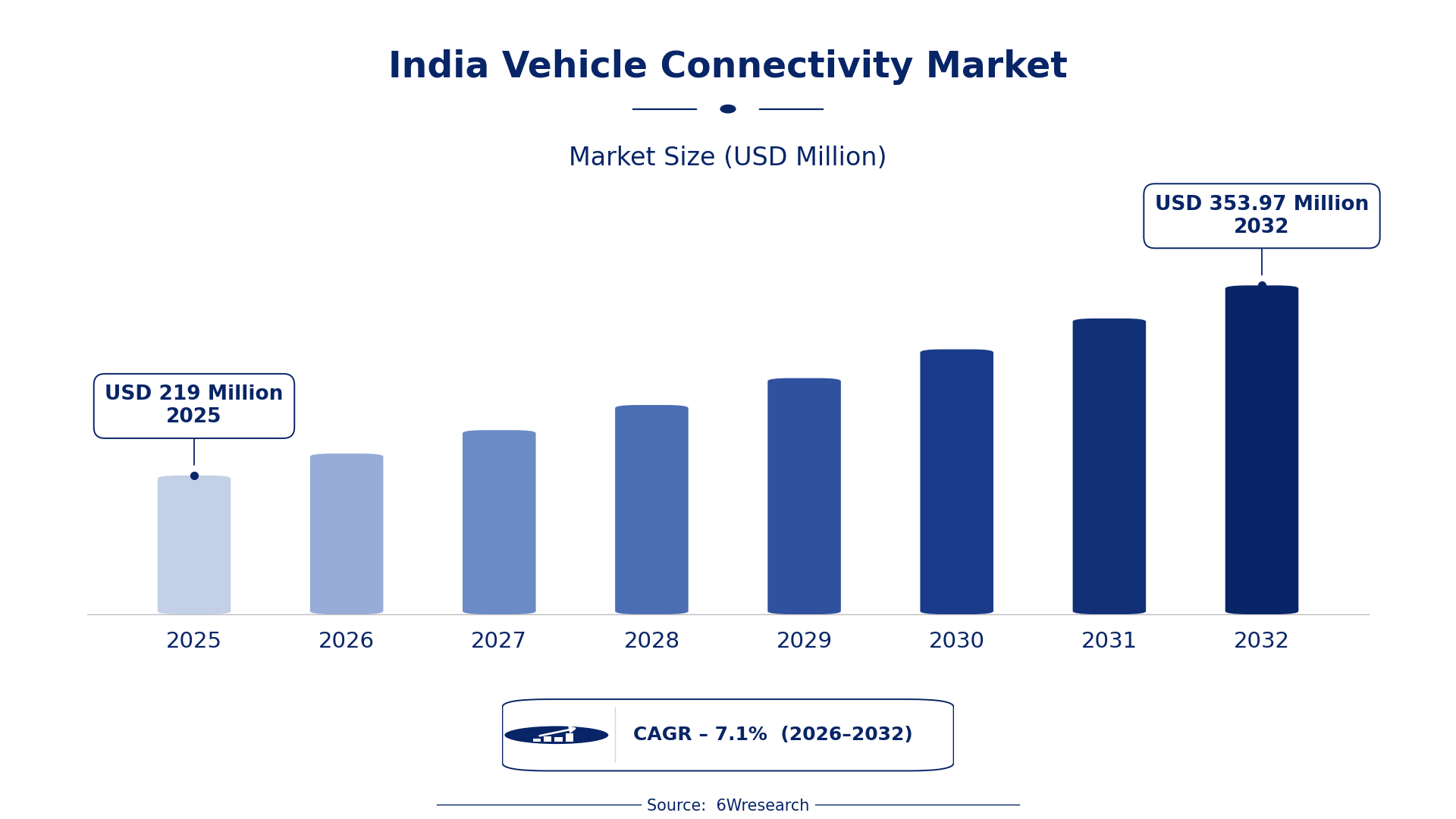
According to 6Wresearch internal database and industry insights, the India Vehicle Connectivity Market was valued at USD 219.0 million in 2025 and is projected to reach USD 353.97 million by 2032, growing at a CAGR of approximately 7.1% during 2026–2032.
India Vehicle Connectivity Market Highlights
| Report Metric | Details |
| Report Name | India Vehicle Connectivity Market |
| Market Size 2025 | USD 219.0 million |
| Market Size 2032 | USD 353.97 million |
| Absolute Growth 2025–2032 | USD 134.97 million |
| CAGR 2026–2032 | 7.1% |
| Peak Annual Growth | 8.4% in 2030 |
| Forecast Period | 2026–2032 |
| Historical Data | 2022–2025 |
| Base Year | 2025 |
| Leading Connectivity Type, 2025 | V2V (Vehicle-to-Vehicle) (36% share) |
| Leading Technology Used, 2025 | DSRC / C-V2X (45% share) |
| Leading Application Use, 2025 | Safety & Collision Avoidance (45% share) |
| Leading End User, 2025 | Smart Vehicle OEMs (38% share) |
| Fastest-Growing Connectivity Type | V2I (Vehicle-to-Infrastructure) (9.2% CAGR) |
| Fastest-Growing Technology Used | 5G / Cellular (9.0% CAGR) |
| Fastest-Growing Application Use | Traffic Optimization (9.7% CAGR) |
| Fastest-Growing End User | Government Transport Depts (8.5% CAGR) |
| Growing Sector | Smart Vehicle Technologies |
| Key End Users | Smart Vehicle OEMs, Government Transport Departments, Fleet Operators, Autonomous Tech Providers |
India Vehicle Connectivity Market Year-wise Growth Rate and Key Drivers (2022–2032)
This graph illustrates the annual growth rates of the market from 2022 to 2032, highlighting a steady upward trajectory and projected market expansion over the forecast period.
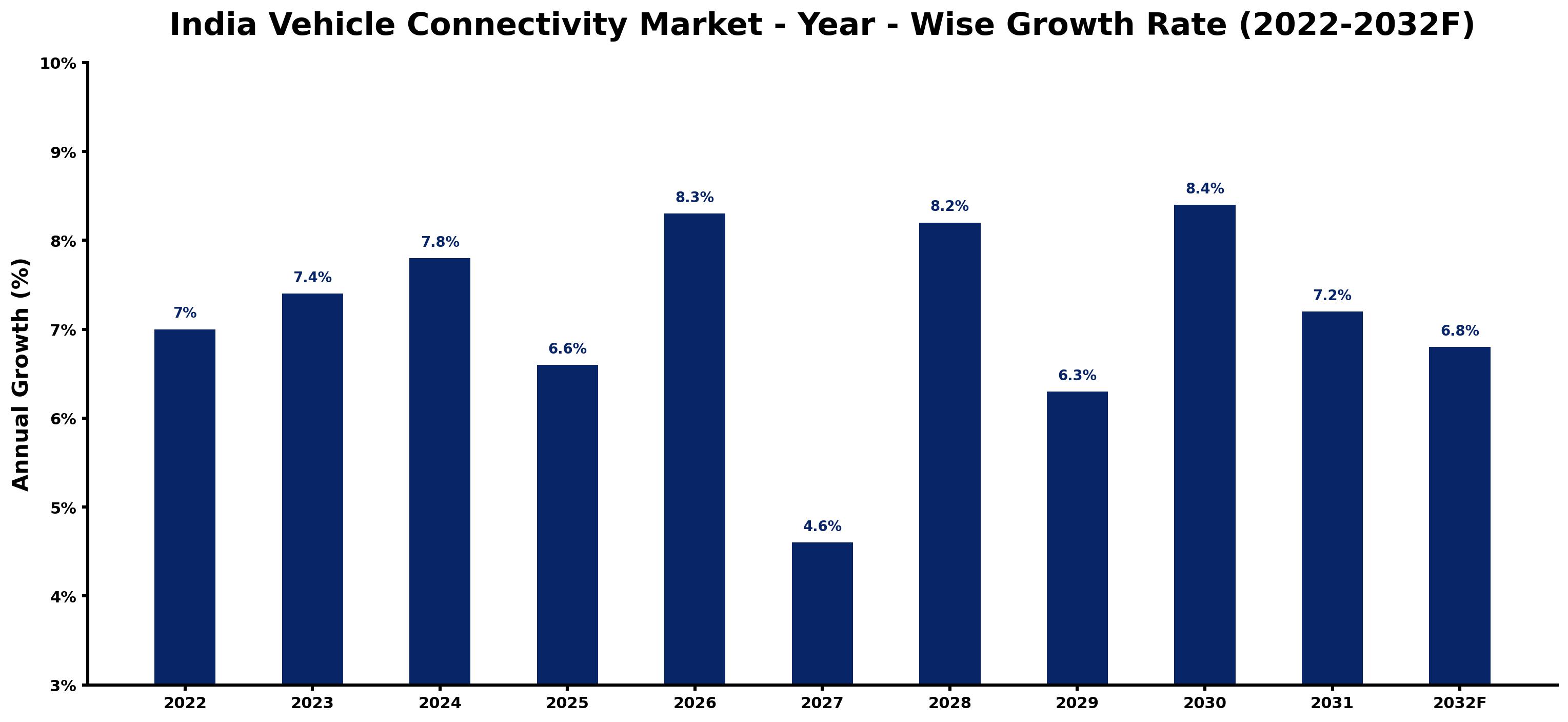
Each row of the following table gives one year's estimated growth and the event or demand shift that explains it.
| Year | Estimated Annual Growth (%) | Market Rationale |
| 2022 | 7.0 | The market showed steady growth due to increasing investments in smart vehicle technologies. |
| 2023 | 7.4 | Growth accelerated as over 1 million connected vehicles became operational in India. |
| 2024 | 7.8 | Demand surged with the implementation of the National Intelligent Transport System program. |
| 2025 | 6.6 | Growth slowed as the market adjusted to new technology standards and infrastructure needs. |
| 2026 | 8.3 | The market rebounded with rising investments in V2X communication technologies. |
| 2027 | 4.6 | Growth decelerated as the market faced challenges in infrastructure deployment. |
| 2028 | 8.2 | Demand increased with the ongoing rollout of 5G technology improving connectivity. |
| 2029 | 6.3 | The market matured as competition intensified and growth slowed. |
| 2030 | 8.4 | The market peaked with advancements in vehicle-to-everything communication technologies. |
| 2031 | 7.2 | Growth decelerated as the market began to stabilise after rapid expansion. |
| 2032 | 6.8 | The market continues to grow but at a slower pace as it reaches maturity. |
Note: Market size estimations and growth projections presented in this report are based on 6Wresearch's proprietary forecasting methodology, utilizing the latest available industry data, government publications, and primary research inputs.
India Vehicle Connectivity Market Synopsis
Vehicle Connectivity in India encompasses technologies enabling communication between vehicles and various entities, improving safety and efficiency. This includes advanced communication protocols and hardware integration. The India Vehicle Connectivity Market is expanding due to rising demand from smart vehicle OEMs and government initiatives. The National Intelligent Transport System program and the Smart Cities Mission are driving investments in infrastructure. With over 1 million connected vehicles operational, the market is set for continued growth as 5G technology improves vehicle communication capabilities.
Market Dynamics Impact Analysis (2026–2032)
| Factor | Type | Impact | Primary Segment Affected |
| Rising investments in smart vehicle technologies are driving demand for advanced connectivity solutions. | Driver | High | V2V (Vehicle-to-Vehicle) |
| The implementation of the National Intelligent Transport System program is enhancing infrastructure for vehicle connectivity. | Driver | High | V2I (Vehicle-to-Infrastructure) |
| Government transport departments are increasingly adopting connected vehicle technologies to improve safety and efficiency. | Opportunity | High | Government Transport Depts |
| The growing fleet operator segment is investing in connectivity solutions for better logistics management. | Opportunity | Medium | Fleet Operators |
| Infrastructure challenges hinder the widespread adoption of vehicle connectivity solutions. | Restraint | High | V2C (Vehicle-to-Cloud) |
| The slow rollout of 5G technology may delay the implementation of advanced connectivity features. | Restraint | Medium | 5G / Cellular |
| The market faces challenges in standardisation of communication protocols, impacting interoperability. | Challenge | High | DSRC / C-V2X |
| High costs associated with technology integration can deter smaller manufacturers from adopting vehicle connectivity solutions. | Challenge | Medium | Smart Vehicle OEMs |
Evaluation of Drivers in India Vehicle Connectivity Market (2026–2032)
The factors lifting demand, and the evidence behind each, are summarised below.
| Drivers | Primary Segment Affected | Why It Matters (Evidence) |
| Increased investment in smart vehicle technologies boosts demand for vehicle connectivity solutions. | Smart Vehicle OEMs | The National Electric Mobility Mission Plan allocates funds to support connected vehicle technologies. |
| The National Intelligent Transport System program improves infrastructure for vehicle connectivity. | V2I (Vehicle-to-Infrastructure) | The program aims to improve traffic management and safety through advanced communication. |
| The rise in connected vehicles among fleet operators drives demand for connectivity solutions. | Fleet Operators | Connected vehicle technology adoption increased by 30% in 2023, leading to more purchases. |
| The rollout of 5G technology is set to improve vehicle-to-everything communication. | 5G / Cellular | 5G is expected to enhance data transfer speeds, facilitating real-time applications. |
| Government initiatives are supporting the development of vehicle connectivity standards. | DSRC / C-V2X | The Bureau of Indian Standards is developing guidelines to ensure interoperability among systems. |
Expansion of the Vehicle Connectivity market in India is backed by increased investment in smart vehicle technologies, which drives demand for advanced connectivity solutions. The National Electric Mobility Mission Plan allocates INR 10,000 crores to support connected vehicle technologies, boosting purchasing among smart vehicle manufacturers. Adoption of connected vehicle technology among fleet operators rose by 30% in 2023, facilitating better logistics management. The rollout of 5G technology is expected to improve vehicle-to-everything communication, enhancing data transfer speeds and driving further investment in connectivity solutions.
Evaluation of Restraints in India Vehicle Connectivity Market
Below mentioned are some major restraints and their influence on market dynamics.
| Market Restraint | Primary Segment Affected | Why It Matters (Evidence) |
| Infrastructure challenges hinder the widespread adoption of vehicle connectivity solutions. | V2I (Vehicle-to-Infrastructure) | As of 2023, many regions lack the necessary infrastructure to support advanced connectivity. |
| The slow rollout of 5G technology may delay the implementation of advanced connectivity features. | 5G / Cellular | 5G rollout is expected to improve V2X communication by 2024, but delays could impact adoption. |
| High costs associated with technology integration can deter smaller manufacturers from adopting vehicle connectivity solutions. | Smart Vehicle OEMs | Smaller OEMs may struggle with the costs of integrating advanced connectivity technologies. |
| The lack of standardisation in communication protocols can impact interoperability. | DSRC / C-V2X | Inconsistent standards may create barriers for manufacturers trying to implement vehicle connectivity. |
| Regulatory hurdles can slow down the approval process for new vehicle connectivity technologies. | V2C (Vehicle-to-Cloud) | Delays in regulatory approvals can hinder the introduction of new connectivity solutions. |
India Vehicle Connectivity Market Challenges
The India Vehicle Connectivity Market faces practical challenges, starting with intense competition among technology providers. This competition drives prices down, which can compromise the quality of vehicle connectivity solutions for producers. Supply chain disruptions create additional hurdles, as delays in hardware delivery can hinder the rollout of connected vehicles, affecting buyers who rely on timely access to these technologies. Rising compliance costs with standards set by the Automotive Research Association of India can increase operational expenses for manufacturers, ultimately raising prices for consumers. Regulatory hurdles related to V2X communication implementation can slow the adoption of smart transport solutions, impacting overall market growth.
Trends in the India Vehicle Connectivity Market
Four trends stand out in the India Vehicle Connectivity Market.
- Shift from Traditional to Smart Vehicle Technologies: India is transitioning from traditional vehicle systems to smart technologies, driven by the National Intelligent Transport System program. By 2023, over 1 million connected vehicles are operational, indicating a market shift.
- Emergence of 5G in Vehicle Connectivity: The rollout of 5G technology is improving vehicle-to-everything communication capabilities. By 2024, 5G is expected to enhance data transfer speeds, facilitating real-time applications in smart vehicles.
- Government Transport Departments Prioritising Connectivity: Government transport departments are increasingly adopting connected vehicle technologies to improve safety. The Smart Cities Mission includes funding for vehicle connectivity infrastructure, supporting this trend.
- Fleet Operators Embracing Connectivity Solutions: Fleet operators are rapidly adopting vehicle connectivity solutions for improved logistics management. The connected vehicle technology adoption among fleet operators rose by 30% in 2023.
Investment Opportunities in the India Vehicle Connectivity Market
Investors looking at the India Vehicle Connectivity Market should consider the following areas.
- Government Transport Departments Seeking Advanced Solutions: Government transport departments are looking for advanced vehicle connectivity solutions to improve safety and efficiency. With a projected market size of USD 353.97 million by 2032, there is a clear opportunity for investment.
- Fleet Operators Investing in Connectivity: Fleet operators are increasingly investing in connectivity solutions for better logistics management. The rise in connected vehicles by 30% in 2023 presents a clear opportunity for suppliers in this sector.
- Smart Cities Mission Funding Connectivity Infrastructure: The Smart Cities Mission is funding vehicle connectivity infrastructure projects across India. With INR 10,000 crores allocated, suppliers can enter through partnerships or local approvals.
- 5G Rollout Enhancing Connectivity Solutions: The anticipated rollout of 5G technology is creating opportunities for connectivity solution providers. Suppliers can engage with government transport departments to align with upcoming infrastructure projects.
Government Initiatives in the India Vehicle Connectivity Market
The National Intelligent Transport System (NITS) program launched in 2021 integrates advanced vehicle connectivity technologies into existing frameworks. This initiative aims to improve traffic management and safety through better communication between vehicles and infrastructure. The program supports the development of smart transport solutions, ensuring that vehicle connectivity standards are met. Additionally, the National Policy on Electronics aims to boost automotive electronics manufacturing by 2025, further supporting the vehicle connectivity market.
Government transport departments are utilising the Smart Cities Mission to implement vehicle connectivity solutions in urban areas. This initiative funds projects that improve traffic management and safety through advanced communication technologies. The Automotive Research Association of India (ARAI) is involved in setting standards for these technologies, ensuring compliance. By 2025, the government aims to implement V2X communication in smart cities, improving overall urban transport efficiency.
Future Insight of the India Vehicle Connectivity Market
The India Vehicle Connectivity Market is set for transformative changes by 2032, driven by several pivotal factors. The National Intelligent Transport System program will enhance infrastructure, facilitating the integration of advanced vehicle connectivity technologies. The implementation of V2X communication in smart cities by 2025 will improve traffic management and safety. The anticipated rollout of 5G by 2024 will enable faster communication between vehicles and infrastructure. The government's investment of INR 10,000 crores in smart transportation systems will propel the development of connected vehicle solutions, benefiting both buyers and suppliers.
Market Segmentation Analysis
Each segment group is reviewed below, with the leader by share and the fastest grower by CAGR.
By Connectivity Type – V2V (Vehicle-to-Vehicle) Dominated, V2I (Vehicle-to-Infrastructure) Expected to Grow Fastest
According to Bhawna Singh, Assistant Manager at 6Wresearch, V2V (Vehicle-to-Vehicle) held a 36% share of the India Vehicle Connectivity Market by connectivity type in 2025. V2V holds the largest market share as it facilitates real-time communication between vehicles, essential for collision prevention in urban settings. With over 1 million connected vehicles operational in India, the demand for V2V technology is evident. V2I (Vehicle-to-Infrastructure) is projected to grow fastest, at a CAGR of 9.2% during 2026–2032. V2I is witnessing rapid growth due to initiatives like the National Intelligent Transport System, which aims to improve communication with traffic infrastructure. The government's target to implement V2X communication in smart cities by 2025 will further boost this segment's growth. Suppliers should focus on developing V2I solutions to cater to the increasing demand from urban infrastructure projects.
By Technology Used – DSRC / C-V2X Dominated, 5G / Cellular Expected to Grow Fastest
In 2025, DSRC / C-V2X led the technology used split with a 45% share. DSRC / C-V2X technology commands the largest market share as it is vital for low-latency communication in vehicle connectivity applications. Its established role in the automotive sector, backed by standards from the Automotive Research Association of India, underscores its importance. Over 2026–2032, 5G / Cellular is expected to post the fastest growth, at a CAGR of 9.0%. 5G / Cellular technology is rapidly advancing, driven by the imminent rollout of 5G networks that will significantly enhance data transfer speeds. This technological leap is crucial for real-time applications, making it a focal point for automotive connectivity solutions. Buyers should prepare for a shift towards 5G solutions, as these will be essential for future advancements in vehicle connectivity.
By Application Use – Safety & Collision Avoidance Dominated, Traffic Optimization Expected to Grow Fastest
The largest application use category in 2025 was Safety & Collision Avoidance, with a 45% share of total revenue. Safety & Collision Avoidance applications dominate the market share as they are critical for accident prevention through real-time data sharing among vehicles. The growing emphasis on road safety initiatives further reinforces this segment's significance. The quickest growth will come from Traffic Optimization, forecast to expand at a CAGR of 9.7% between 2026 and 2032. Traffic Optimization is experiencing rapid growth, propelled by the need for enhanced traffic management solutions in densely populated areas. Funding from the Smart Cities Mission for vehicle connectivity infrastructure is a major driver of this expansion. Suppliers must improve their offerings in traffic optimization technologies to meet the increasing demand for efficient urban transport solutions.
By End User – Smart Vehicle OEMs Dominated, Government Transport Depts Expected to Grow Fastest
With a 38% revenue share in 2025, Smart Vehicle OEMs was the largest end user category. Smart Vehicle OEMs lead the market share as they are the primary developers of connected vehicle technologies, addressing the rising consumer demand for smart vehicles. Their investments in advanced connectivity solutions are vital for maintaining competitiveness in the automotive sector. Government Transport Depts are set to record the highest CAGR in this split, 8.5% over 2026–2032. Government Transport Departments are the fastest-growing end users, driven by efforts to implement smart transport systems and policies that encourage vehicle connectivity. Their heightened focus on infrastructure development is expected to accelerate adoption. Suppliers should collaborate with government departments to align their products with emerging smart transport initiatives.
Key Attractiveness of the Report
- 10 Years of Market Numbers
- Historical Data Starting from 2022 to 2025
- Base Year 2025
- Forecast Data until 2032
- Key Performance Indicators Impacting the Market
- Major Upcoming Developments and Projects
Key Highlights of the Report:
- India Vehicle Connectivity Market Outlook
- Market Size of India Vehicle Connectivity Market, 2025
- Forecast of India Vehicle Connectivity Market, 2032
- Historical Data and Forecast of India Vehicle Connectivity Revenues & Volume for the Period 2022 - 2032F
- India Vehicle Connectivity Market Trend Evolution
- India Vehicle Connectivity Market Drivers and Challenges
- India Vehicle Connectivity Price Trends
- India Vehicle Connectivity Porter's Five Forces
- India Vehicle Connectivity Industry Life Cycle
- Historical Data and Forecast of India Vehicle Connectivity Market Revenues & Volume By Connectivity Type for the Period 2022 - 2032F
- Historical Data and Forecast of India Vehicle Connectivity Market Revenues & Volume By V2V (Vehicle-to-Vehicle) for the Period 2022 - 2032F
- Historical Data and Forecast of India Vehicle Connectivity Market Revenues & Volume By V2I (Vehicle-to-Infrastructure) for the Period 2022 - 2032F
- Historical Data and Forecast of India Vehicle Connectivity Market Revenues & Volume By V2C (Vehicle-to-Cloud) for the Period 2022 - 2032F
- Historical Data and Forecast of India Vehicle Connectivity Market Revenues & Volume By V2P (Vehicle-to-Pedestrian) for the Period 2022 - 2032F
- Historical Data and Forecast of India Vehicle Connectivity Market Revenues & Volume By Technology Used for the Period 2022 - 2032F
- Historical Data and Forecast of India Vehicle Connectivity Market Revenues & Volume By DSRC / C-V2X for the Period 2022 - 2032F
- Historical Data and Forecast of India Vehicle Connectivity Market Revenues & Volume By 5G / Cellular for the Period 2022 - 2032F
- Historical Data and Forecast of India Vehicle Connectivity Market Revenues & Volume By LTE / 5G / Wi-Fi for the Period 2022 - 2032F
- Historical Data and Forecast of India Vehicle Connectivity Market Revenues & Volume By BLE / NFC for the Period 2022 - 2032F
- Historical Data and Forecast of India Vehicle Connectivity Market Revenues & Volume By Application Use for the Period 2022 - 2032F
- Historical Data and Forecast of India Vehicle Connectivity Market Revenues & Volume By Safety & Collision Avoidance for the Period 2022 - 2032F
- Historical Data and Forecast of India Vehicle Connectivity Market Revenues & Volume By Traffic Optimization for the Period 2022 - 2032F
- Historical Data and Forecast of India Vehicle Connectivity Market Revenues & Volume By Remote Monitoring for the Period 2022 - 2032F
- Historical Data and Forecast of India Vehicle Connectivity Market Revenues & Volume By Urban Safety Integration for the Period 2022 - 2032F
- Historical Data and Forecast of India Vehicle Connectivity Market Revenues & Volume By End User for the Period 2022 - 2032F
- Historical Data and Forecast of India Vehicle Connectivity Market Revenues & Volume By Smart Vehicle OEMs for the Period 2022 - 2032F
- Historical Data and Forecast of India Vehicle Connectivity Market Revenues & Volume By Government Transport Depts for the Period 2022 - 2032F
- Historical Data and Forecast of India Vehicle Connectivity Market Revenues & Volume By Fleet Operators for the Period 2022 - 2032F
- Historical Data and Forecast of India Vehicle Connectivity Market Revenues & Volume By Autonomous Tech Providers for the Period 2022 - 2032F
- India Vehicle Connectivity Import Export Trade Statistics
- Market Opportunity Assessment By Connectivity Type
- Market Opportunity Assessment By Technology Used
- Market Opportunity Assessment By Application Use
- Market Opportunity Assessment By End User
- India Vehicle Connectivity Top Companies Market Share
- India Vehicle Connectivity Competitive Benchmarking By Technical and Operational Parameters
- India Vehicle Connectivity Company Profiles
- India Vehicle Connectivity Key Strategic Recommendations
Market Covered
This report examines the market across the segments below.
By Connectivity Type
- V2V (Vehicle-to-Vehicle)
- V2I (Vehicle-to-Infrastructure)
- V2C (Vehicle-to-Cloud)
- V2P (Vehicle-to-Pedestrian)
By Technology Used
- DSRC / C-V2X
- 5G / Cellular
- LTE / 5G / Wi-Fi
- BLE / NFC
By Application Use
- Safety & Collision Avoidance
- Traffic Optimization
- Remote Monitoring
- Urban Safety Integration
By End User
- Smart Vehicle OEMs
- Government Transport Depts
- Fleet Operators
- Autonomous Tech Providers































