China Vehicle Connectivity Market Size & Growth Rate
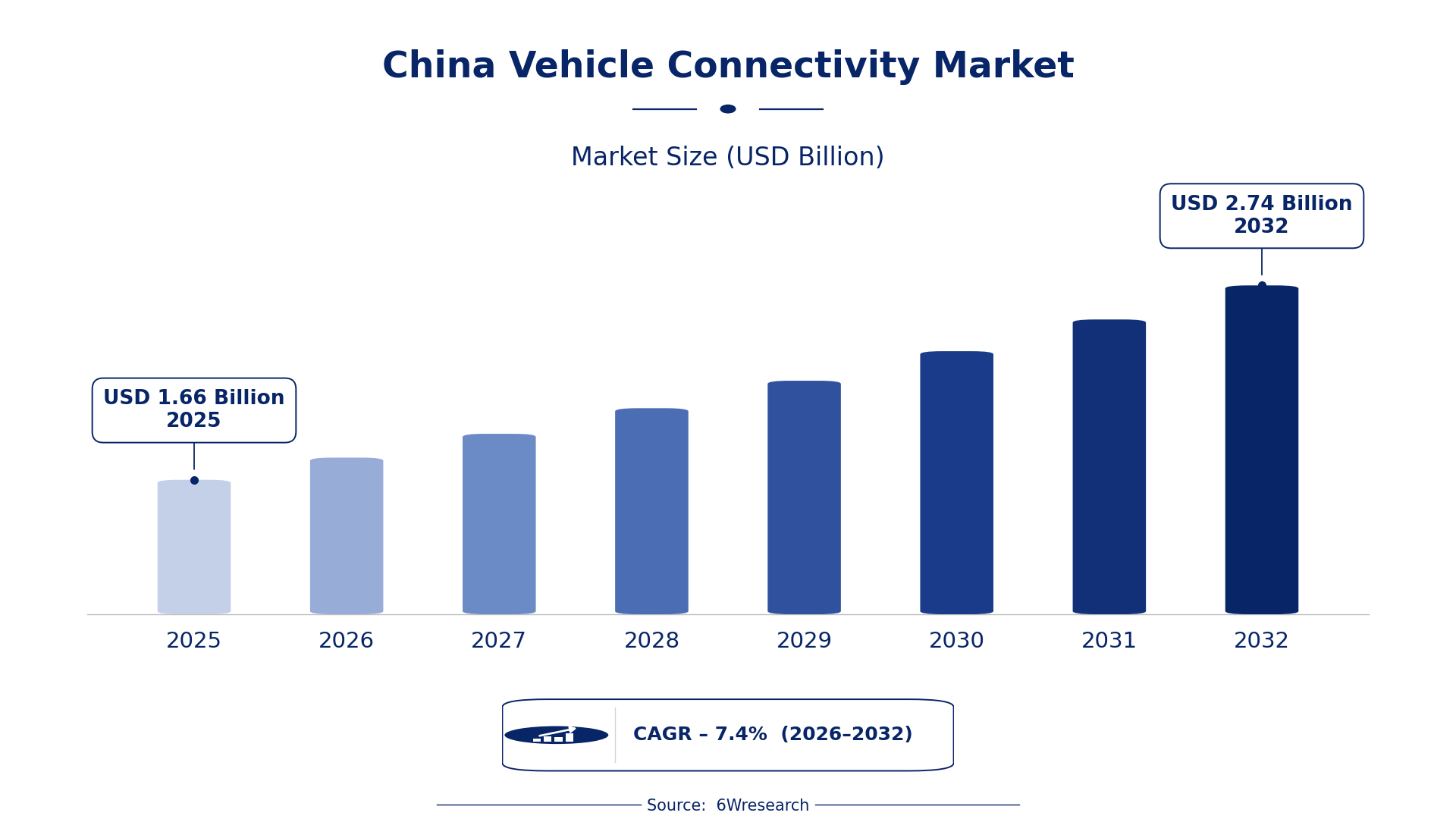
According to 6Wresearch internal database and industry insights, the China Vehicle Connectivity Market was valued at USD 1.66 billion in 2025 and is projected to reach USD 2.74 billion by 2032, growing at a CAGR of approximately 7.4% during 2026–2032.
China Vehicle Connectivity Market Highlights
| Report Metric | Details |
| Report Name | China Vehicle Connectivity Market |
| Market Size 2025 | USD 1.66 billion |
| Market Size 2032 | USD 2.74 billion |
| Absolute Growth 2025–2032 | USD 1.08 billion |
| CAGR 2026–2032 | 7.4% |
| Peak Annual Growth | 9.8% in 2029 |
| Forecast Period | 2026–2032 |
| Historical Data | 2022–2025 |
| Base Year | 2025 |
| Leading Connectivity Type, 2025 | V2I (Vehicle-to-Infrastructure) (46% share) |
| Leading Technology Used, 2025 | 5G / Cellular (45% share) |
| Leading Application Use, 2025 | Safety & Collision Avoidance (37% share) |
| Leading End User, 2025 | Smart Vehicle OEMs (44% share) |
| Fastest-Growing Connectivity Type | V2C (Vehicle-to-Cloud) (8.7% CAGR) |
| Fastest-Growing Application Use | Traffic Optimization (9.2% CAGR) |
| Fastest-Growing End User | Fleet Operators (9.5% CAGR) |
| Growing Sector | Traffic Optimization |
| Key End Users | Safety & Collision Avoidance, Traffic Optimization, Remote Monitoring, Urban Safety Integration |
China Vehicle Connectivity Market Year-wise Growth Rate and Key Drivers (2022–2032)
This graph illustrates the annual growth rates of the market from 2022 to 2032, highlighting a steady upward trajectory and projected market expansion over the forecast period.
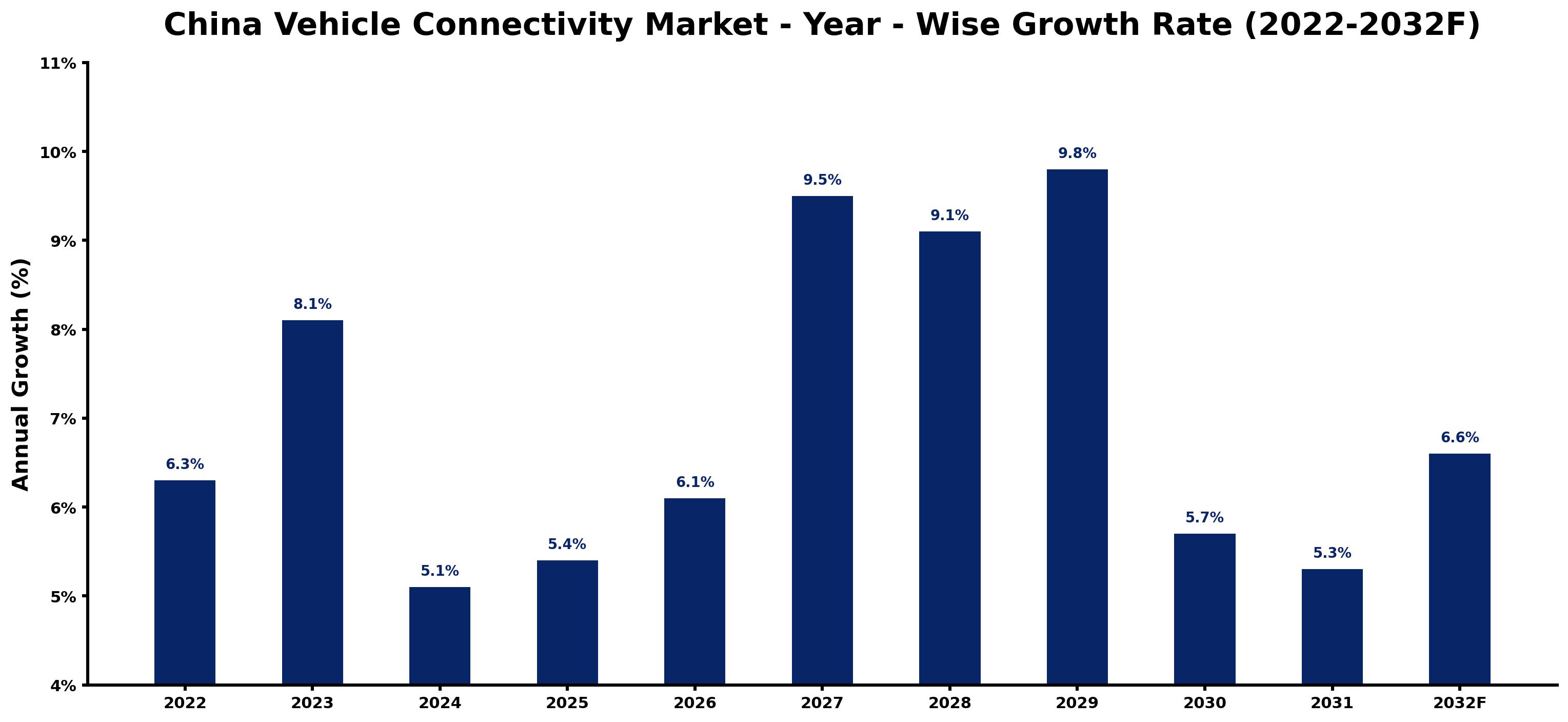
Each row of the following table gives one year's estimated growth and the event or demand shift that explains it.
| Year | Estimated Annual Growth (%) | Market Rationale |
| 2022 | 6.3 | The market experienced steady growth, driven by increasing vehicle connectivity adoption. |
| 2023 | 8.1 | Demand surged due to the launch of the Smart Vehicle Innovation and Development Strategy. |
| 2024 | 5.1 | Growth slowed as the market adjusted to new technology integration challenges. |
| 2025 | 5.4 | A slight increase in growth was observed with rising investments in connectivity technologies. |
| 2026 | 6.1 | Demand is expected to increase with improved 5G coverage facilitating better connectivity solutions. |
| 2027 | 9.5 | Rapid growth is projected as interest from smart vehicle OEMs in connectivity solutions rises. |
| 2028 | 9.1 | A slight slowdown is anticipated as the market matures and competition intensifies. |
| 2029 | 9.8 | The peak growth year will see heightened investments in vehicle-to-infrastructure technologies. |
| 2030 | 5.7 | Growth is expected to slow as market saturation begins to affect new adoption rates. |
| 2031 | 5.3 | A further slowdown is projected as the market stabilises with established technologies. |
| 2032 | 6.6 | Growth is expected to pick up again as new applications for connectivity emerge. |
Note: Market size estimations and growth projections presented in this report are based on 6Wresearch's proprietary forecasting methodology, utilizing the latest available industry data, government publications, and primary research inputs.
China Vehicle Connectivity Market Synopsis
Vehicle Connectivity in China integrates vehicles with communication technologies to improve safety and user experience. This includes advanced telecommunication technologies such as 5G and DSRC, primarily used for safety features and traffic management. The China Vehicle Connectivity Market is growing due to strong domestic demand from smart vehicle OEMs and supportive government initiatives. In 2023, more than 300 million vehicles featured basic connectivity, laying a robust foundation for future growth. The automotive sector plans to invest 50 billion CNY in connectivity technologies by 2025, further driving market expansion.
Market Dynamics Impact Analysis (2026–2032)
| Factor | Type | Impact | Primary Segment Affected |
| Increasing adoption of 5G technology enhances communication capabilities for vehicles. | Driver | High | 5G / Cellular |
| The demand for safety features drives investment in connectivity solutions. | Driver | High | Safety & Collision Avoidance |
| The rapid growth of fleet operators seeking efficient management solutions creates a significant opportunity. | Opportunity | High | Fleet Operators |
| The ongoing development of smart transportation infrastructure presents a chance for investment. | Opportunity | High | Government Transport Depts |
| High costs associated with implementing advanced connectivity technologies can limit adoption. | Restraint | High | V2I (Vehicle-to-Infrastructure) |
| The complexity of integrating various communication standards may hinder market growth. | Restraint | Medium | DSRC / C-V2X |
| Limited awareness of the benefits of vehicle connectivity slows market penetration. | Challenge | Medium | Smart Vehicle OEMs |
| Supply chain disruptions have delayed the rollout of connectivity technologies. | Challenge | High | V2C (Vehicle-to-Cloud) |
Evaluation of Drivers in China Vehicle Connectivity Market (2026–2032)
The main growth drivers and the segments they affect most are set out below.
| Drivers | Primary Segment Affected | Why It Matters (Evidence) |
| Rising investments in smart vehicle technologies are boosting demand for connectivity solutions. | Smart Vehicle OEMs | In 2023, the automotive sector is projected to invest 50 billion CNY in connectivity technologies. |
| Government initiatives promote the adoption of vehicle connectivity for safety improvements. | Government Transport Depts | The Smart Vehicle Innovation and Development Strategy aims to enhance vehicle connectivity across urban areas by 2025. |
| High 5G coverage in urban areas facilitates better connectivity for vehicles. | 5G / Cellular | As of 2022, 5G coverage in urban areas reached over 90%, improving communication capabilities. |
| Fleet operators increasingly rely on connectivity for efficient management and operations. | Fleet Operators | In 2023, there were 200,000 registered fleet operators utilizing connectivity solutions. |
| The need for traffic optimization drives demand for vehicle-to-infrastructure communication. | V2I (Vehicle-to-Infrastructure) | The National Standard GB/T 34657-2017 outlines requirements for vehicle-to-vehicle communication systems. |
In 2023, the automotive sector is expected to invest 50 billion CNY in connectivity technologies, which will improve communication capabilities. The Smart Vehicle Innovation and Development Strategy aims to boost connectivity across urban areas by 2025, further driving demand. As of 2022, 5G coverage in urban areas reached over 90%, facilitating better vehicle communication. Fleet operators increasingly rely on connectivity for efficient management and operations, propelling market growth.
Evaluation of Restraints in China Vehicle Connectivity Market
The table below lists the restraints and the evidence behind each.
| Market Restraint | Primary Segment Affected | Why It Matters (Evidence) |
| High costs associated with implementing advanced connectivity technologies limit adoption. | V2I (Vehicle-to-Infrastructure) | The automotive sector's projected investment of 50 billion CNY by 2025 may not cover all costs. |
| Integration complexity of various communication standards can hinder market growth. | DSRC / C-V2X | The National Standard for Vehicle-to-Everything Communication was updated in 2023, complicating integration. |
| Limited awareness of vehicle connectivity benefits slows market penetration. | Smart Vehicle OEMs | Many consumers remain unaware of the advantages offered by connectivity technologies. |
| Supply chain disruptions have delayed the rollout of connectivity technologies. | V2C (Vehicle-to-Cloud) | Global supply chain issues have affected the availability of necessary components. |
| Regulatory hurdles can slow the approval process for new connectivity solutions. | Fleet Operators | Compliance with the National Intelligent Vehicle Innovation and Development Strategy can be time-consuming. |
China Vehicle Connectivity Market Challenges
The China Vehicle Connectivity Market encounters a significant skills shortage, as educational institutions struggle to keep pace with rapid technological changes, causing delays for automotive manufacturers in project execution. Supply chain disruptions worsen this situation, leading to higher costs for vehicle producers who face challenges in sourcing essential components promptly. Technological integration presents difficulties due to inconsistent standards across regions, complicating implementation for fleet operators and resulting in inefficiencies. Compliance with the National Standard GB/T 34657-2017 necessitates substantial investments from suppliers, potentially hindering their ability to adapt to evolving market demands.
Trends in the China Vehicle Connectivity Market
Buyers and suppliers in the China Vehicle Connectivity Market are adjusting to the following trends.
- Growth in Traffic Optimization Technologies: The Beijing-Tianjin-Hebei region is prioritising traffic optimization technologies to improve urban mobility. The National Standard GB/T 34657-2017 specifies requirements for vehicle-to-vehicle communication systems, supporting this trend.
- Fleet Operators Increasingly Utilising Connectivity Solutions: Fleet operators are embracing connectivity solutions to enhance operational efficiency. In 2023, 200,000 registered fleet operators in China are leveraging these technologies to monitor vehicle performance.
- Expansion of 5G Infrastructure for Vehicles: Expanding 5G infrastructure is crucial for vehicle connectivity. By 2022, urban areas achieved over 90% coverage, enabling advanced communication capabilities.
- Shift Towards Enhanced Safety Features: Vehicle manufacturers are increasingly focusing on safety features. In 2023, the government allocated 1 billion CNY for smart transportation infrastructure, improving urban safety integration.
Investment Opportunities in the China Vehicle Connectivity Market
Below are the investment opportunities with the strongest case in the China Vehicle Connectivity Market.
- Investment in Smart Transportation Infrastructure Development: The Beijing-Tianjin-Hebei region is investing 1 billion CNY in smart transportation infrastructure. This creates opportunities for suppliers of connectivity solutions to engage with government transport departments.
- Supply of Advanced Vehicle-to-Cloud Solutions: With 200,000 fleet operators registered in 2023, there is a demand for advanced vehicle-to-cloud solutions. Suppliers can enter this market by forming partnerships with local fleet management companies.
- Development of Safety and Collision Avoidance Technologies: As safety features become a priority, the market for collision avoidance technologies is expanding. Smart vehicle OEMs are seeking effective solutions to improve vehicle safety systems.
- Expansion of 5G Connectivity Solutions: The ongoing expansion of 5G infrastructure presents an opportunity for connectivity solution providers. Collaborating with local telecommunications companies can facilitate market entry.
Government Initiatives in the China Vehicle Connectivity Market
The 'Smart Transportation Development Plan' issued by the Ministry of Transport in 2021 aims to enhance vehicle connectivity across urban areas by 2025. This initiative focuses on integrating advanced communication technologies into public transport systems, ensuring improved traffic management and safety. The plan outlines funding for infrastructure upgrades and the development of smart vehicle technologies, encouraging collaboration between government and industry stakeholders. In 2023, the government allocated 1 billion CNY for smart transportation infrastructure development, further supporting this initiative.
The Connected Vehicle Pilot Program initiated by the Ministry of Transport in 2021 tests vehicle connectivity solutions in major cities. This program provides funding for pilot projects that demonstrate the effectiveness of connectivity technologies in real-world scenarios. By participating in this program, government transport departments can assess the benefits of vehicle connectivity in enhancing public transport and infrastructure planning. The program aims to facilitate the adoption of innovative solutions that improve traffic management and safety, ultimately benefiting the end-users of these technologies.
Future Insight of the China Vehicle Connectivity Market
The China Vehicle Connectivity Market is expected to evolve significantly by 2032, driven by government initiatives and technological advancements. The 'Smart Vehicle Innovation and Development Strategy' aims for 20% of vehicles to be connected by 2025, creating a strong impetus for infrastructure development. An investment of 1 billion CNY for smart transportation infrastructure will bolster connectivity capabilities. Collaboration among over 100 industry associations is anticipated to promote standardisation and innovation, opening new opportunities for suppliers and enhancing the overall user experience.
Market Segmentation Analysis
The analysis below covers each segmentation, its leading category in 2025 and its fastest-growing category through 2032.
By Connectivity Type – V2I (Vehicle-to-Infrastructure) Dominated, V2C (Vehicle-to-Cloud) Expected to Grow Fastest
According to Bhawna Singh, Assistant Manager at 6Wresearch, in 2025, V2I (Vehicle-to-Infrastructure) led the connectivity type split with a 46% share. V2I holds the largest share as it directly facilitates interaction between vehicles and road infrastructure, crucial for effective traffic management. This is particularly evident in urban areas like the Beijing-Tianjin-Hebei region, where smart infrastructure is rapidly being developed. Over 2026–2032, V2C (Vehicle-to-Cloud) is expected to post the fastest growth, at a CAGR of 8.7%. The V2C segment is experiencing significant growth due to the increasing demand for data exchange between vehicles and cloud services, enhancing overall functionalities. The momentum for smart transportation solutions further accelerates the adoption of cloud connectivity, ensuring its rapid expansion. Suppliers should focus on developing advanced V2C solutions to meet the rising demand from urban infrastructure projects.
By Technology Used – 5G / Cellular Dominated and Is Expected to Record the Fastest Growth
The largest technology used category in 2025 was 5G / Cellular, with a 45% share of total revenue. 5G / Cellular technology leads the market as it enables high-speed communication essential for various vehicle connectivity applications. The widespread 5G coverage in urban areas, exceeding 90%, supports the growing adoption of this technology. The same category is also set to grow fastest, at a CAGR of 8.5% during 2026–2032. 5G / Cellular is also the fastest-growing segment, as its capabilities continue to expand with increasing investments in connectivity technologies. The automotive sector's projected investment of 50 billion CNY by 2025 will further accelerate its adoption. Buyers should prioritise 5G-enabled solutions to ensure they remain competitive in the rapidly advancing vehicle connectivity market.
By Application Use – Safety & Collision Avoidance Dominated, Traffic Optimization Expected to Grow Fastest
Safety & Collision Avoidance accounted for a 37% market share by application use in 2025. Safety & Collision Avoidance is the leading application, significantly enhancing vehicle safety systems, which are a top priority for manufacturers. This emphasis on safety features aligns with stringent government regulations and consumer expectations within the automotive sector. The quickest growth will come from Traffic Optimization, forecast to expand at a CAGR of 9.2% between 2026 and 2032. Traffic Optimization is the fastest-growing application, driven by the urgent need to improve traffic flow and alleviate congestion through real-time data. The rapid urbanisation in China necessitates effective traffic management solutions, propelling this segment's growth. Suppliers must innovate in traffic optimization technologies to effectively address the increasing demand from urban areas facing congestion challenges.
By End User – Smart Vehicle OEMs Dominated, Fleet Operators Expected to Grow Fastest
With a 44% revenue share in 2025, Smart Vehicle OEMs was the largest end user category. Smart Vehicle OEMs dominate the market as they are the primary users of vehicle connectivity technologies, enhancing their product offerings. Their commitment to integrating advanced connectivity features is evident in the automotive industry's robust growth and substantial investments. Fleet Operators are set to record the highest CAGR in this split, 9.5% over 2026–2032. Fleet Operators represent the fastest-growing end user segment, relying heavily on connectivity for efficient fleet management and operations. The number of registered fleet operators reached 200,000 in 2023, highlighting the rising demand for connectivity solutions. Suppliers should tailor their offerings to meet the specific needs of fleet operators, ensuring they provide effective connectivity solutions for streamlined operations.
Key Attractiveness of the Report
- 10 Years of Market Numbers
- Historical Data Starting from 2022 to 2025
- Base Year 2025
- Forecast Data until 2032
- Key Performance Indicators Impacting the Market
- Major Upcoming Developments and Projects
Key Highlights of the Report:
- China Vehicle Connectivity Market Outlook
- Market Size of China Vehicle Connectivity Market, 2025
- Forecast of China Vehicle Connectivity Market, 2032
- Historical Data and Forecast of China Vehicle Connectivity Revenues & Volume for the Period 2022 - 2032F
- China Vehicle Connectivity Market Trend Evolution
- China Vehicle Connectivity Market Drivers and Challenges
- China Vehicle Connectivity Price Trends
- China Vehicle Connectivity Porter's Five Forces
- China Vehicle Connectivity Industry Life Cycle
- Historical Data and Forecast of China Vehicle Connectivity Market Revenues & Volume By Connectivity Type for the Period 2022 - 2032F
- Historical Data and Forecast of China Vehicle Connectivity Market Revenues & Volume By V2V (Vehicle-to-Vehicle) for the Period 2022 - 2032F
- Historical Data and Forecast of China Vehicle Connectivity Market Revenues & Volume By V2I (Vehicle-to-Infrastructure) for the Period 2022 - 2032F
- Historical Data and Forecast of China Vehicle Connectivity Market Revenues & Volume By V2C (Vehicle-to-Cloud) for the Period 2022 - 2032F
- Historical Data and Forecast of China Vehicle Connectivity Market Revenues & Volume By V2P (Vehicle-to-Pedestrian) for the Period 2022 - 2032F
- Historical Data and Forecast of China Vehicle Connectivity Market Revenues & Volume By Technology Used for the Period 2022 - 2032F
- Historical Data and Forecast of China Vehicle Connectivity Market Revenues & Volume By DSRC / C-V2X for the Period 2022 - 2032F
- Historical Data and Forecast of China Vehicle Connectivity Market Revenues & Volume By 5G / Cellular for the Period 2022 - 2032F
- Historical Data and Forecast of China Vehicle Connectivity Market Revenues & Volume By LTE / 5G / Wi-Fi for the Period 2022 - 2032F
- Historical Data and Forecast of China Vehicle Connectivity Market Revenues & Volume By BLE / NFC for the Period 2022 - 2032F
- Historical Data and Forecast of China Vehicle Connectivity Market Revenues & Volume By Application Use for the Period 2022 - 2032F
- Historical Data and Forecast of China Vehicle Connectivity Market Revenues & Volume By Safety & Collision Avoidance for the Period 2022 - 2032F
- Historical Data and Forecast of China Vehicle Connectivity Market Revenues & Volume By Traffic Optimization for the Period 2022 - 2032F
- Historical Data and Forecast of China Vehicle Connectivity Market Revenues & Volume By Remote Monitoring for the Period 2022 - 2032F
- Historical Data and Forecast of China Vehicle Connectivity Market Revenues & Volume By Urban Safety Integration for the Period 2022 - 2032F
- Historical Data and Forecast of China Vehicle Connectivity Market Revenues & Volume By End User for the Period 2022 - 2032F
- Historical Data and Forecast of China Vehicle Connectivity Market Revenues & Volume By Smart Vehicle OEMs for the Period 2022 - 2032F
- Historical Data and Forecast of China Vehicle Connectivity Market Revenues & Volume By Government Transport Depts for the Period 2022 - 2032F
- Historical Data and Forecast of China Vehicle Connectivity Market Revenues & Volume By Fleet Operators for the Period 2022 - 2032F
- Historical Data and Forecast of China Vehicle Connectivity Market Revenues & Volume By Autonomous Tech Providers for the Period 2022 - 2032F
- China Vehicle Connectivity Import Export Trade Statistics
- Market Opportunity Assessment By Connectivity Type
- Market Opportunity Assessment By Technology Used
- Market Opportunity Assessment By Application Use
- Market Opportunity Assessment By End User
- China Vehicle Connectivity Top Companies Market Share
- China Vehicle Connectivity Competitive Benchmarking By Technical and Operational Parameters
- China Vehicle Connectivity Company Profiles
- China Vehicle Connectivity Key Strategic Recommendations
Market Covered
This report examines the market across the segments below.
By Connectivity Type
- V2V (Vehicle-to-Vehicle)
- V2I (Vehicle-to-Infrastructure)
- V2C (Vehicle-to-Cloud)
- V2P (Vehicle-to-Pedestrian)
By Technology Used
- DSRC / C-V2X
- 5G / Cellular
- LTE / 5G / Wi-Fi
- BLE / NFC
By Application Use
- Safety & Collision Avoidance
- Traffic Optimization
- Remote Monitoring
- Urban Safety Integration
By End User
- Smart Vehicle OEMs
- Government Transport Depts
- Fleet Operators
- Autonomous Tech Providers































