India Vehicle Control Components Market Size & Growth Rate
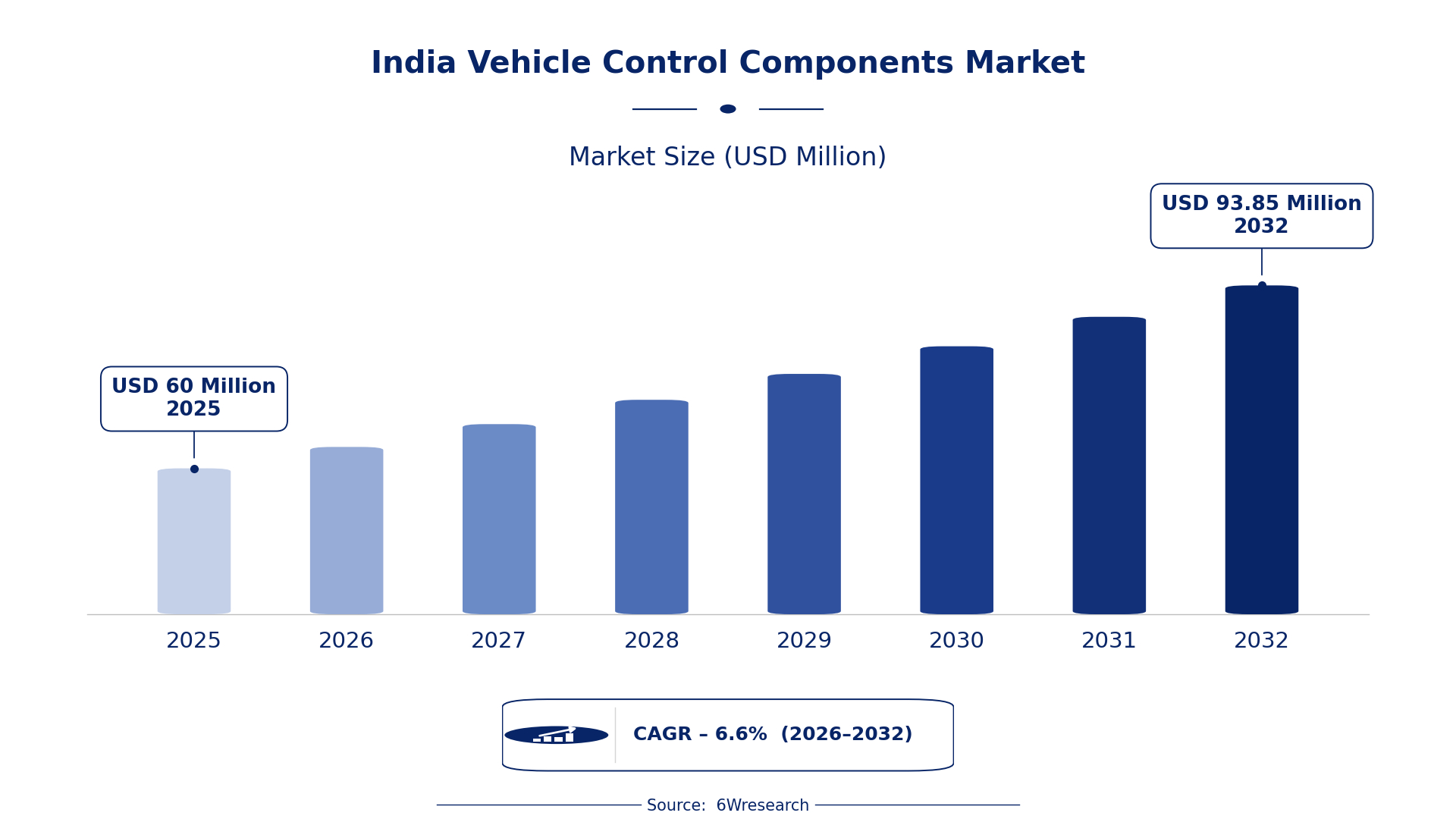
According to 6Wresearch internal database and industry insights, the India Vehicle Control Components Market was valued at USD 60.0 million in 2025 and is projected to reach USD 93.85 million by 2032, growing at a CAGR of approximately 6.6% during 2026–2032.
India Vehicle Control Components Market Highlights
| Report Metric | Details |
| Report Name | India Vehicle Control Components Market |
| Market Size 2025 | USD 60.0 million |
| Market Size 2032 | USD 93.85 million |
| Absolute Growth 2025–2032 | USD 33.85 million |
| CAGR 2026–2032 | 6.6% |
| Peak Annual Growth | 9.0% in 2031 |
| Forecast Period | 2026–2032 |
| Historical Data | 2022–2025 |
| Base Year | 2025 |
| Leading Component Type, 2025 | Pedal Assemblies (43% share) |
| Leading Control Function, 2025 | Driver Input (42% share) |
| Leading Integration Area, 2025 | Footwell Area (44% share) |
| Leading End User, 2025 | Automotive OEMs (47% share) |
| Fastest-Growing Component Type | Levers & Actuators (8.3% CAGR) |
| Fastest-Growing Control Function | Mechanic-to-Electronic (8.6% CAGR) |
| Fastest-Growing Integration Area | Transmission Interface (9.0% CAGR) |
| Fastest-Growing End User | Sports & Utility Vehicles (9.2% CAGR) |
| Growing Sector | Automotive Manufacturing |
| Key End Users | Automotive OEMs, Component Suppliers, Interior Designers |
India Vehicle Control Components Market Year-wise Growth Rate and Key Drivers (2022–2032)
This graph illustrates the annual growth rates of the market from 2022 to 2032, highlighting a steady upward trajectory and projected market expansion over the forecast period.
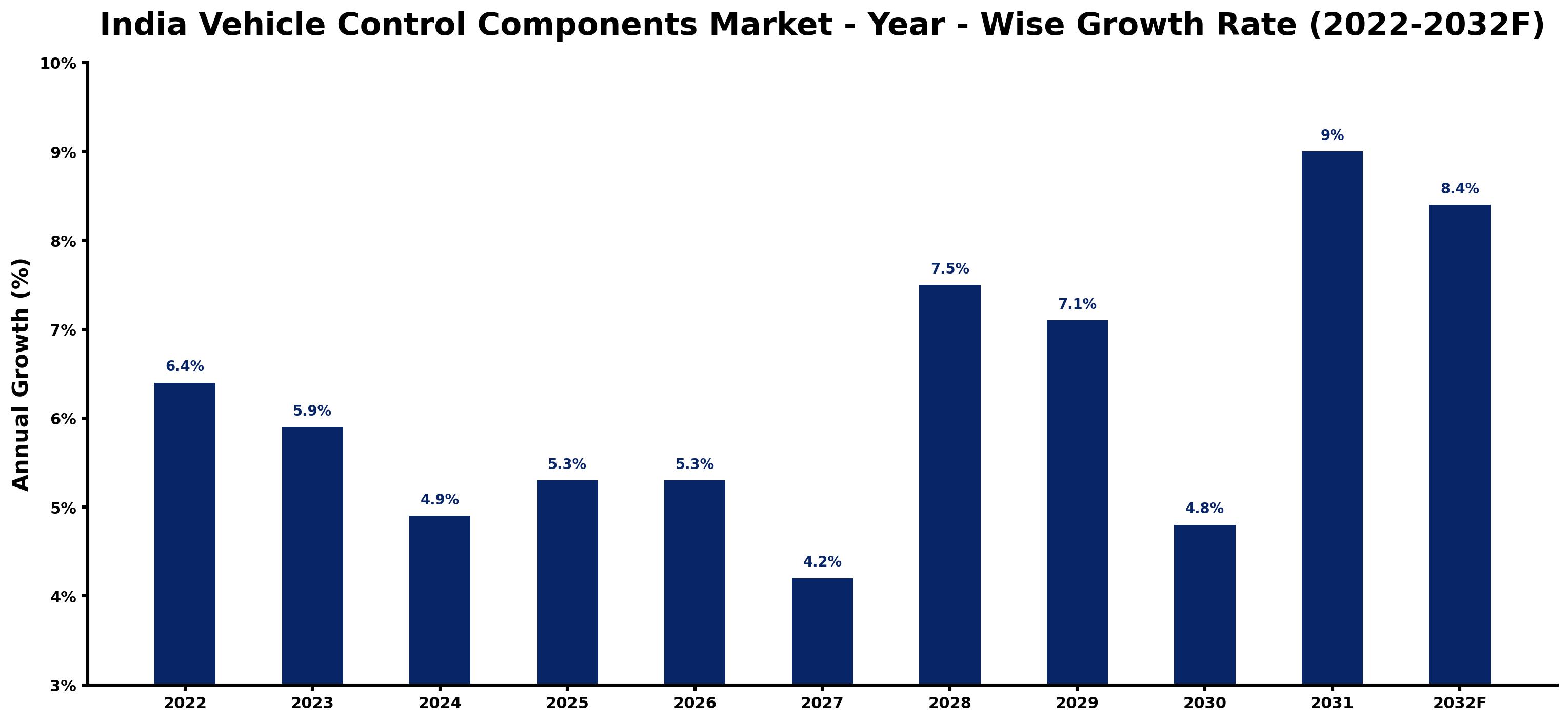
Year by year, the estimates below pair each growth rate with the development that shaped it.
| Year | Estimated Annual Growth (%) | Market Rationale |
| 2022 | 6.4 | The automotive industry produced over 4.4 million vehicles, driving demand for control components. |
| 2023 | 5.9 | A temporary dip in vehicle production in several states slowed growth in vehicle control components. |
| 2024 | 4.9 | Demand from domestic vehicle manufacturers continued to support growth in vehicle control components. |
| 2025 | 5.3 | Increased exports and production capabilities contributed to a faster growth rate in the market. |
| 2026 | 5.3 | Manufacturers are expected to adjust to new safety standards, leading to a slowdown in growth. |
| 2027 | 4.2 | A slowdown in foreign investment is projected to constrain growth in vehicle control components. |
| 2028 | 7.5 | Rising demand for electric vehicles is expected to create new opportunities for control components. |
| 2029 | 7.1 | The automotive sector's recovery is projected to boost production and demand for components. |
| 2030 | 4.8 | Manufacturers face challenges in meeting new safety standards, contributing to slower growth. |
| 2031 | 9.0 | The introduction of new vehicle technologies and features will drive peak growth in the market. |
| 2032 | 8.4 | Growth is projected to slow as the market stabilises, influenced by the new electric vehicle policy. |
Note: Market size estimations and growth projections presented in this report are based on 6Wresearch's proprietary forecasting methodology, utilizing the latest available industry data, government publications, and primary research inputs.
India Vehicle Control Components Market Synopsis
Vehicle Control Components in India comprise mechanical and electronic devices that manage functions such as acceleration, steering, and dashboard controls. These components are crafted from a blend of plastics, metals, and electronic circuitry, improving driver control and safety. The India Vehicle Control Components Market is expanding, propelled by the automotive industry's growth, which produced over 4.4 million vehicles in 2022 and is expected to reach $300 billion by 2026. Key drivers include increasing domestic vehicle production and rising exports, along with government initiatives like the Production Linked Incentive Scheme for the automotive sector.
Market Dynamics Impact Analysis (2026–2032)
| Factor | Type | Impact | Primary Segment Affected |
| Rising domestic vehicle production drives demand for control components. | Driver | High | Pedal Assemblies |
| Increased exports from India boost the need for vehicle control components. | Driver | High | Rotary Knobs & Switches |
| The gap in advanced control component supply presents investment opportunities. | Opportunity | High | Levers & Actuators |
| Growing demand for electric vehicles creates a need for innovative components. | Opportunity | High | Joysticks & Shifters |
| Challenges in meeting new safety standards can delay production. | Restraint | High | Driver Input |
| Increased competition in the automotive sector pressures pricing strategies. | Restraint | Medium | Dashboard Interface |
| The Vehicle Control Components Market faces regulatory compliance challenges. | Challenge | High | Footwell Area |
| Technological advancements require continuous investment in R&D. | Challenge | Medium | Instrument Panel |
Evaluation of Drivers in India Vehicle Control Components Market (2026–2032)
The table below links each growth driver to the segment it affects and the evidence for it.
| Drivers | Primary Segment Affected | Why It Matters (Evidence) |
| Increasing vehicle production in India fuels demand for control components. | Pedal Assemblies | In 2022, over 4.4 million vehicles were produced, requiring essential parts. |
| Export growth boosts the market for vehicle control components. | Rotary Knobs & Switches | The automotive sector's expansion has led to increased exports, driving demand. |
| The rise of electric vehicles necessitates advanced control technologies. | Levers & Actuators | The new electric vehicle policy aims for significant adoption by 2030, driving demand. |
| Government initiatives support the automotive sector's growth. | Joysticks & Shifters | The Production Linked Incentive Scheme allocates ₹25,938 crore to enhance manufacturing capabilities. |
| Technological advancements in vehicle design drive innovation in components. | Driver Input | ISO 26262 standard for safety in automotive electronics is increasingly adopted, prompting investments. |
Growth across the Vehicle Control Components market in India is anchored in rising domestic vehicle production, increased exports, and the adoption of advanced technologies. In 2022, over 4.4 million vehicles were produced, generating strong demand for essential components. The introduction of the Production Linked Incentive Scheme, with a budget of ₹25,938 crore, supports manufacturing capabilities. The adoption of ISO 26262 for safety standards prompts manufacturers to invest in high-quality components.
Evaluation of Restraints in India Vehicle Control Components Market
The key brakes on demand, and where they bite hardest, are shown below.
| Market Restraint | Primary Segment Affected | Why It Matters (Evidence) |
| Regulatory compliance challenges can hinder production timelines. | Footwell Area | New safety standards require manufacturers to adapt quickly, causing delays. |
| Increased competition pressures pricing strategies for manufacturers. | Dashboard Interface | Price competition can reduce profit margins for component suppliers. |
| Supply chain disruptions affect the availability of raw materials. | Driver Input | Global supply chain issues have led to shortages, impacting production. |
| Technological advancements require ongoing investment in R&D. | Instrument Panel | Manufacturers must continually innovate to meet evolving standards, increasing costs. |
| Market volatility can affect long-term investment decisions. | Levers & Actuators | Economic fluctuations may deter investment in new technologies, impacting growth. |
India Vehicle Control Components Market Challenges
The India Vehicle Control Components Market faces a pressing technology challenge, as many local manufacturers rely on outdated machinery, limiting their ability to incorporate advanced functionalities in vehicles. This situation stems from insufficient investment in modern production technologies, causing delays for producers in launching new products. Competing against international firms, domestic suppliers are under pressure to reduce prices, which directly affects their profit margins. Rising costs of raw materials, particularly metals and plastics, have increased production expenses, potentially leading to higher prices for buyers seeking vehicle control components.
Trends in the India Vehicle Control Components Market
Several trends are reshaping the India Vehicle Control Components Market; the most important are set out below.
- Shift towards Electric Vehicle Components: The National Electric Mobility Mission Plan aims for 30% electric vehicle penetration by 2030, driving demand for vehicle control components. In 2022, electric vehicle sales surged, reflecting a shift in consumer preference.
- Integration of Advanced Driver Assistance Systems: The automotive industry is increasingly adopting advanced driver assistance systems, enhancing safety features. In 2023, the government approved new standards to support this trend, highlighting a growing focus on vehicle safety.
- Growing Demand for Smart Vehicle Technologies: Automotive OEMs are prioritising smart vehicle technologies to improve user experience. In 2022, the market for connected vehicles expanded rapidly, with a notable increase in consumer interest.
- Expansion of Automotive Manufacturing Hubs: Maharashtra and Tamil Nadu are leading states in automotive manufacturing, hosting numerous production facilities. In 2022, India had 29 automotive manufacturing hubs, indicating a growing regional focus.
Investment Opportunities in the India Vehicle Control Components Market
The following opportunities in the India Vehicle Control Components Market pair current demand with a clear way in.
- Joint Ventures with Local Manufacturers: Forming joint ventures with local manufacturers can facilitate market entry, particularly in Maharashtra. Collaborating with automotive OEMs can enhance supply chain efficiency, with the market projected to grow significantly.
- Investment in Electric Vehicle Components: The push for electric vehicles creates a gap for advanced control components. Investing in the production of electric vehicle control systems in Tamil Nadu can address rising demand, expected to grow substantially.
- Supply of Advanced Safety Components: As safety regulations tighten, there is an increasing need for advanced safety components. Supplying ISO 26262 compliant parts to automotive OEMs can capture market share, with demand anticipated to rise significantly.
- Development of Smart Control Systems: The growing integration of smart technologies presents opportunities for new product development. Focusing on smart control systems for sports and utility vehicles can attract tech-savvy consumers, with projected market growth.
Government Initiatives in the India Vehicle Control Components Market
The Automotive Mission Plan 2026, launched by the Ministry of Heavy Industries in 2021, aims for the automotive industry to reach $300 billion by 2026. This plan encourages investments in manufacturing capabilities and innovation, benefiting vehicle control component producers. Additionally, the Production Linked Incentive Scheme for the Automotive Sector, initiated in 2021, allocates ₹25,938 crore to support the growth of vehicle control components by enhancing manufacturing capabilities.
The Ministry of Heavy Industries oversees various initiatives, including the National Automotive Testing and R&D Infrastructure Project, which aims to create world-class testing facilities with an investment of ₹2,000 crore. This initiative supports manufacturers by providing access to advanced testing capabilities, ensuring compliance with quality standards, and improving overall product quality.
Future Insight of the India Vehicle Control Components Market
Buyers and suppliers in the India Vehicle Control Components Market can expect substantial changes by 2032, driven by key government initiatives and technological advancements. The Production Linked Incentive Scheme will encourage local manufacturing and innovation, while the new electric vehicle policy will boost the adoption of electric and hybrid vehicles. The National Automotive Testing and R&D Infrastructure Project will improve testing capabilities, ensuring compliance with safety standards.
Market Segmentation Analysis
The report offers a comprehensive study of the following market segments and their leading categories in the market.
By Component Type – Pedal Assemblies Dominated, Levers & Actuators Expected to Grow Fastest
According to Bhawna Singh, Assistant Manager at 6Wresearch, Pedal Assemblies took a 43% share of component type in 2025, more than any other category. Pedal assemblies command the largest share as they are vital for vehicle acceleration and braking control, a necessity for every vehicle. The production of over 4.4 million vehicles in India in 2022 underscores the ongoing demand for these essential components. Levers & Actuators are projected to grow fastest, at a CAGR of 8.3% during 2026–2032. Levers and actuators are experiencing the fastest growth due to their importance in gear shifting and other mechanical functions, reflecting the industry's shift towards advanced vehicle technologies. This growth is further supported by the increasing production of vehicles that require sophisticated control systems. Suppliers should prioritise the production of levers and actuators to align with the rising demand in the automotive sector.
By Control Function – Driver Input Dominated, Mechanic-to-Electronic Expected to Grow Fastest
With a 42% revenue share in 2025, Driver Input was the largest control function category. Driver input systems command the largest market share due to their critical role in translating driver actions into vehicle responses, making them indispensable in modern vehicles. The extensive network of automotive manufacturing hubs in India underscores the industry's reliance on effective driver input systems for optimal vehicle performance. The quickest growth will come from Mechanic-to-Electronic, forecast to expand at a CAGR of 8.6% between 2026 and 2032. The mechanic-to-electronic segment is experiencing rapid growth as it supports the shift from traditional to electronic systems, aligning with governmental initiatives for advanced automotive technologies. This trend is particularly noticeable in the rising integration of electronic systems in newly launched vehicle models. Suppliers should focus on providing advanced driver input and mechanic-to-electronic solutions to stay competitive in the evolving vehicle control components market.
By Integration Area – Footwell Area Dominated, Transmission Interface Expected to Grow Fastest
The largest integration area category in 2025 was Footwell Area, with a 44% share of total revenue. The footwell area dominates the market as it serves as the primary location for pedal assemblies, which are essential for driving functionality. The substantial vehicle production in India highlights the need for durable and reliable components in this critical area of vehicle control. Transmission Interface is set to record the highest CAGR in this split, 9.0% over 2026–2032. The transmission interface is seeing the fastest growth as it plays a vital role in connecting the driver’s input to the transmission, reflecting the automotive industry's emphasis on enhancing vehicle performance. The increasing complexity of vehicle systems further drives demand for advanced transmission interfaces. Suppliers must prioritise the development of innovative solutions for the transmission interface to leverage this growth opportunity in the vehicle control components market.
By End User – Automotive OEMs Dominated, Sports & Utility Vehicles Expected to Grow Fastest
In 2025, Automotive OEMs led the end user split with a 47% share. Automotive OEMs represent the largest share of the market as they are the primary users of vehicle control components in manufacturing. Their substantial production volumes, exceeding 4.4 million vehicles in 2022, underscore their dominance in this segment. Over 2026–2032, Sports & Utility Vehicles are expected to post the fastest growth, at a CAGR of 9.2%. Sports and utility vehicles are the fastest-growing end user segment, driven by the increasing consumer preference for performance-oriented vehicles. The rise in demand for these vehicles aligns with the broader growth of the automotive market in India. Suppliers should tailor their offerings to meet the specific needs of sports and utility vehicle manufacturers to capture this fast-growing segment.
Key Attractiveness of the Report
- 10 Years of Market Numbers
- Historical Data Starting from 2022 to 2025
- Base Year 2025
- Forecast Data until 2032
- Key Performance Indicators Impacting the Market
- Major Upcoming Developments and Projects
Key Highlights of the Report:
- India Vehicle Control Components Market Outlook
- Market Size of India Vehicle Control Components Market, 2025
- Forecast of India Vehicle Control Components Market, 2032
- Historical Data and Forecast of India Vehicle Control Components Revenues & Volume for the Period 2022 - 2032F
- India Vehicle Control Components Market Trend Evolution
- India Vehicle Control Components Market Drivers and Challenges
- India Vehicle Control Components Price Trends
- India Vehicle Control Components Porter's Five Forces
- India Vehicle Control Components Industry Life Cycle
- Historical Data and Forecast of India Vehicle Control Components Market Revenues & Volume By Component Type for the Period 2022 - 2032F
- Historical Data and Forecast of India Vehicle Control Components Market Revenues & Volume By Pedal Assemblies for the Period 2022 - 2032F
- Historical Data and Forecast of India Vehicle Control Components Market Revenues & Volume By Rotary Knobs & Switches for the Period 2022 - 2032F
- Historical Data and Forecast of India Vehicle Control Components Market Revenues & Volume By Levers & Actuators for the Period 2022 - 2032F
- Historical Data and Forecast of India Vehicle Control Components Market Revenues & Volume By Joysticks & Shifters for the Period 2022 - 2032F
- Historical Data and Forecast of India Vehicle Control Components Market Revenues & Volume By Control Function for the Period 2022 - 2032F
- Historical Data and Forecast of India Vehicle Control Components Market Revenues & Volume By Driver Input for the Period 2022 - 2032F
- Historical Data and Forecast of India Vehicle Control Components Market Revenues & Volume By Dashboard Interface for the Period 2022 - 2032F
- Historical Data and Forecast of India Vehicle Control Components Market Revenues & Volume By Mechanic-to-Electronic for the Period 2022 - 2032F
- Historical Data and Forecast of India Vehicle Control Components Market Revenues & Volume By Directional Control for the Period 2022 - 2032F
- Historical Data and Forecast of India Vehicle Control Components Market Revenues & Volume By Integration Area for the Period 2022 - 2032F
- Historical Data and Forecast of India Vehicle Control Components Market Revenues & Volume By Footwell Area for the Period 2022 - 2032F
- Historical Data and Forecast of India Vehicle Control Components Market Revenues & Volume By Instrument Panel for the Period 2022 - 2032F
- Historical Data and Forecast of India Vehicle Control Components Market Revenues & Volume By Steering/Doors for the Period 2022 - 2032F
- Historical Data and Forecast of India Vehicle Control Components Market Revenues & Volume By Transmission Interface for the Period 2022 - 2032F
- Historical Data and Forecast of India Vehicle Control Components Market Revenues & Volume By End User for the Period 2022 - 2032F
- Historical Data and Forecast of India Vehicle Control Components Market Revenues & Volume By Automotive OEMs for the Period 2022 - 2032F
- Historical Data and Forecast of India Vehicle Control Components Market Revenues & Volume By Interior Designers for the Period 2022 - 2032F
- Historical Data and Forecast of India Vehicle Control Components Market Revenues & Volume By Component Suppliers for the Period 2022 - 2032F
- Historical Data and Forecast of India Vehicle Control Components Market Revenues & Volume By Sports & Utility Vehicles for the Period 2022 - 2032F
- India Vehicle Control Components Import Export Trade Statistics
- Market Opportunity Assessment By Component Type
- Market Opportunity Assessment By Control Function
- Market Opportunity Assessment By Integration Area
- Market Opportunity Assessment By End User
- India Vehicle Control Components Top Companies Market Share
- India Vehicle Control Components Competitive Benchmarking By Technical and Operational Parameters
- India Vehicle Control Components Company Profiles
- India Vehicle Control Components Key Strategic Recommendations
Market Covered
The report offers an extensive study of the following market segments.
By Component Type
- Pedal Assemblies
- Rotary Knobs & Switches
- Levers & Actuators
- Joysticks & Shifters
By Control Function
- Driver Input
- Dashboard Interface
- Mechanic-to-Electronic
- Directional Control
By Integration Area
- Footwell Area
- Instrument Panel
- Steering/Doors
- Transmission Interface
By End User
- Automotive OEMs
- Interior Designers
- Component Suppliers
- Sports & Utility Vehicles































