India Vehicle Control Sensor Market Size & Growth Rate
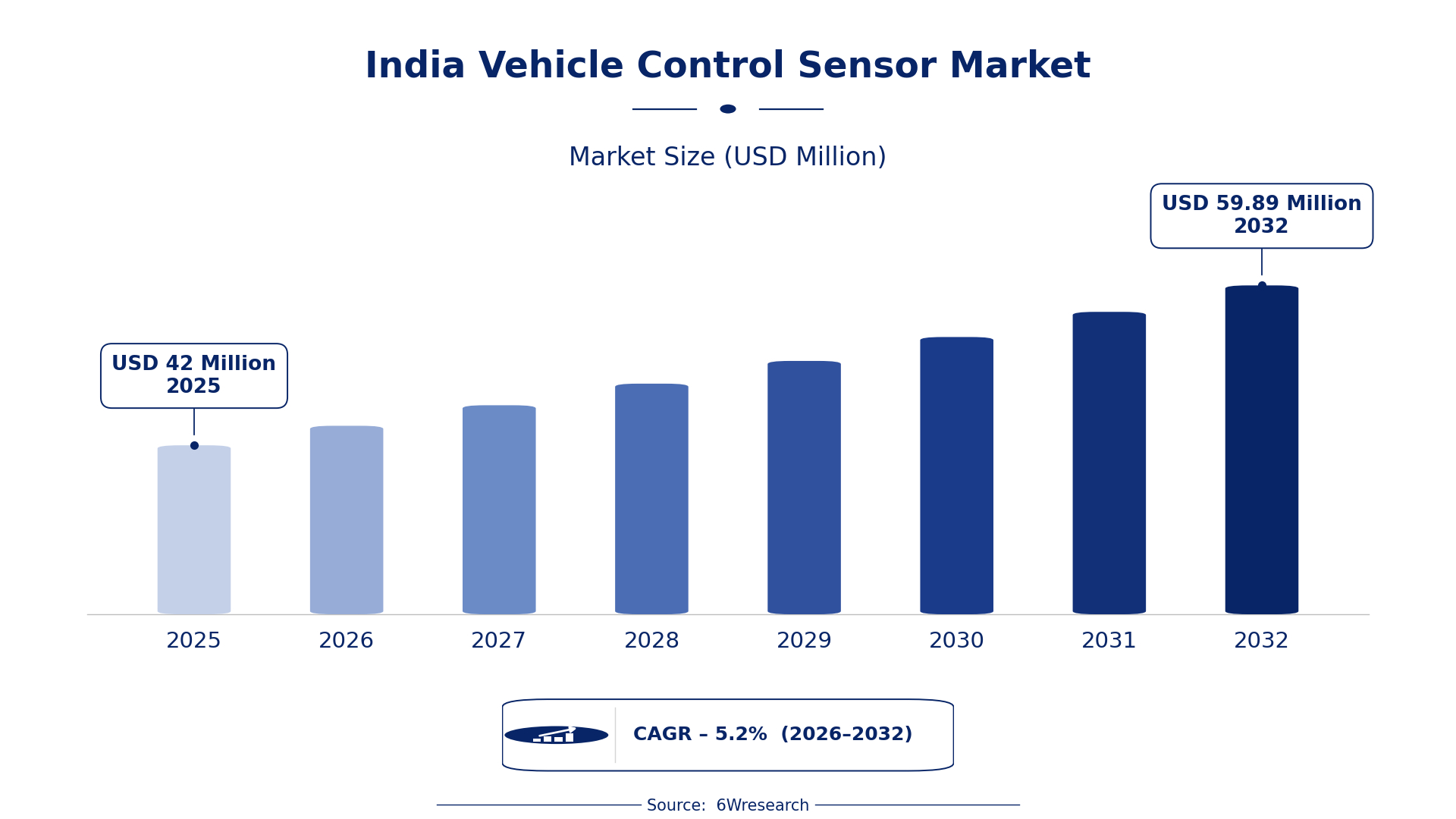
According to 6Wresearch internal database and industry insights, the India Vehicle Control Sensor Market was valued at USD 42.0 million in 2025 and is projected to reach USD 59.89 million by 2032, growing at a CAGR of approximately 5.2% during 2026–2032.
India Vehicle Control Sensor Market Highlights
| Report Metric | Details |
| Report Name | India Vehicle Control Sensor Market |
| Market Size 2025 | USD 42.0 million |
| Market Size 2032 | USD 59.89 million |
| Absolute Growth 2025–2032 | USD 17.89 million |
| CAGR 2026–2032 | 5.2% |
| Peak Annual Growth | 7.0% in 2031 |
| Forecast Period | 2026–2032 |
| Historical Data | 2022–2025 |
| Base Year | 2025 |
| Leading Sensor Type, 2025 | Brake Pedal Position Sensor (48% share) |
| Leading Detection Target, 2025 | Pressure/Position (38% share) |
| Leading Signal Output Type, 2025 | Analog/Digital (36% share) |
| Leading End User, 2025 | ABS System Manufacturers (54% share) |
| Fastest-Growing Sensor Type | Steering Angle Sensor (7.0% CAGR) |
| Fastest-Growing Detection Target | Rotation Input (6.4% CAGR) |
| Fastest-Growing Signal Output Type | CAN Output (6.7% CAGR) |
| Fastest-Growing End User | ADAS Integrators (6.2% CAGR) |
| Growing Sector | Electric Vehicles |
| Key End Users | ABS System Manufacturers, ADAS Integrators, Electric Car OEMs, ICE OEMs |
India Vehicle Control Sensor Market Year-wise Growth Rate and Key Drivers (2022–2032)
This graph illustrates the annual growth rates of the market from 2022 to 2032, highlighting a steady upward trajectory and projected market expansion over the forecast period.
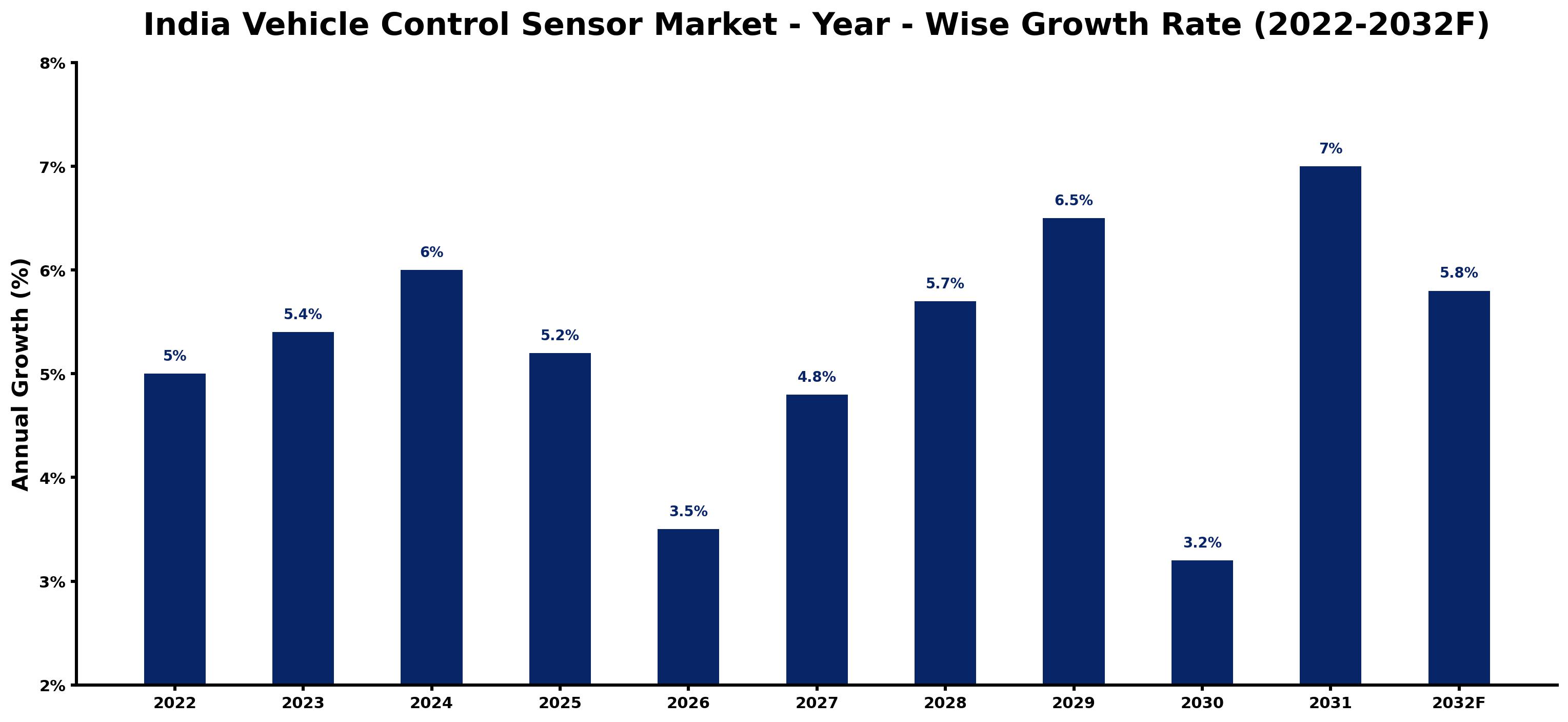
Each row of the following table gives one year's estimated growth and the event or demand shift that explains it.
| Year | Estimated Annual Growth (%) | Market Rationale |
| 2022 | 5.0 | The market experienced steady growth due to increased vehicle production and demand for safety features. |
| 2023 | 5.4 | Manufacturers adopted advanced driver-assistance systems to comply with safety standards, boosting growth. |
| 2024 | 6.0 | Implementation of Bharat Stage VI emission standards for new vehicles spurred continuous growth. |
| 2025 | 5.2 | A slowdown occurred as the market adjusted to the new emission regulations and production capabilities. |
| 2026 | 3.5 | Growth is expected to slow further as manufacturers face challenges integrating new sensor technologies. |
| 2027 | 4.8 | An increase in demand for electric vehicles is projected to boost growth as manufacturers seek advanced control systems. |
| 2028 | 5.7 | Growth is expected to pick up as more manufacturers adopt new sensor technologies for improved vehicle performance. |
| 2029 | 6.5 | Demand is projected to surge as the automotive sector expands, particularly in the electric vehicle segment. |
| 2030 | 3.2 | Growth is expected to slow again as the market stabilises amidst evolving consumer preferences and regulatory requirements. |
| 2031 | 7.0 | A peak in growth is projected as manufacturers ramp up production to meet rising demand for advanced safety features. |
| 2032 | 5.8 | The market growth rate is expected to normalise as manufacturers adapt to technological advancements and market saturation. |
Note: Market size estimations and growth projections presented in this report are based on 6Wresearch's proprietary forecasting methodology, utilizing the latest available industry data, government publications, and primary research inputs.
India Vehicle Control Sensor Market Synopsis
The Vehicle Control Sensor Market in India encompasses electronic devices that monitor and control critical functions in automobiles, ensuring safety and performance. These sensors are vital for applications such as braking and steering, and they are increasingly integrated into advanced driver-assistance systems. The India Vehicle Control Sensor Market is growing due to rising vehicle production, the adoption of electric vehicles, and regulatory compliance with emission standards.
Market Dynamics Impact Analysis (2026–2032)
| Factor | Type | Impact | Primary Segment Affected |
| Rising vehicle production and safety standards drive demand for vehicle control sensors. | Driver | High | Brake Pedal Position Sensor |
| Increasing adoption of electric vehicles necessitates advanced control systems. | Driver | High | Throttle Position Sensor |
| Emerging demand for advanced driver-assistance systems presents a lucrative opportunity. | Opportunity | High | ADAS Integrators |
| The growing electric vehicle market creates a need for innovative sensor solutions. | Opportunity | High | Electric Car OEMs |
| Challenges in integrating new technologies can hinder sensor adoption rates. | Restraint | Medium | Steering Angle Sensor |
| Compliance with stringent emission standards may increase production costs. | Restraint | Medium | Throttle Position Sensor |
| Supply chain disruptions can delay sensor production and delivery. | Challenge | High | Gear Selector Sensor |
| Technological advancements require continuous investment, impacting smaller manufacturers. | Challenge | Medium | ABS System Manufacturers |
Evaluation of Drivers in India Vehicle Control Sensor Market (2026–2032)
Below mentioned are some major drivers and their influence on market dynamics.
| Drivers | Primary Segment Affected | Why It Matters (Evidence) |
| Increased vehicle production drives the demand for vehicle control sensors. | Brake Pedal Position Sensor | India's automotive industry employs around 37 million people, leading to higher sensor purchases. |
| The shift towards electric vehicles necessitates advanced control systems. | Throttle Position Sensor | The National Electric Mobility Mission Plan aims for 6-7 million electric vehicles by 2030. |
| Growing safety regulations drive the need for advanced driver-assistance systems. | ADAS Integrators | Bharat Stage VI emission standards are mandatory for new vehicles since April 2020. |
| Rising consumer awareness about vehicle safety features boosts sensor demand. | Steering Angle Sensor | The automotive sector contributes approximately 7.1% to India's GDP, reflecting market potential. |
| Technological advancements in sensor technology improve vehicle performance. | Gear Selector Sensor | The Automotive Research Association of India (ARAI) sets standards for vehicle safety. |
Growth in the Vehicle Control Sensor market in India comes from rising vehicle production, increasing adoption of electric vehicles, and stringent safety standards. The automotive sector employs around 37 million people, which drives demand for vehicle control sensors. The National Electric Mobility Mission Plan aims for 6-7 million electric vehicles by 2030, propelling the need for advanced control systems. Compliance with Bharat Stage VI emission standards further supports the market's growth potential. The Automotive Research Association of India establishes essential safety standards, driving demand for new sensor technologies.
Evaluation of Restraints in India Vehicle Control Sensor Market
The table below lists the restraints and the evidence behind each.
| Market Restraint | Primary Segment Affected | Why It Matters (Evidence) |
| Integration challenges with new technologies can slow sensor adoption. | Steering Angle Sensor | Manufacturers face difficulties in adapting existing systems to new sensor technologies. |
| Compliance with emission standards may raise production costs. | Throttle Position Sensor | The implementation of Bharat Stage VI standards increases manufacturing expenses by up to 15%. |
| Supply chain disruptions can affect sensor availability and lead times. | Gear Selector Sensor | Global supply chain issues have caused delays in component sourcing for manufacturers. |
| Limited investment capacity among smaller manufacturers restricts technology adoption. | ABS System Manufacturers | Smaller firms may struggle to keep pace with technological advancements due to funding constraints. |
| Market saturation in certain segments may limit growth opportunities. | Brake Pedal Position Sensor | As the market matures, finding new customers becomes increasingly challenging. |
India Vehicle Control Sensor Market Challenges
Producers in the India Vehicle Control Sensor market encounter several challenges, starting with high compliance costs associated with Bharat Stage VI emission standards, potentially raising production expenses by up to 15%. Technological limitations in sensor capabilities can cause delays in implementing advanced driver-assistance systems, adversely affecting vehicle safety features and frustrating consumers. Supply chain disruptions, particularly regarding semiconductor availability, can halt production, resulting in potential sales losses of 4.5 million vehicles annually. A shortage of skilled workers in microfabrication processes complicates production efficiency, delaying product launches and hindering competitiveness for suppliers.
Trends in the India Vehicle Control Sensor Market
Four trends stand out in the India Vehicle Control Sensor Market.
- Shift Towards Advanced Driver-Assistance Systems: The automotive industry is increasingly integrating advanced driver-assistance systems into vehicles, with a notable rise in demand for vehicle control sensors. The market for these sensors is projected to reach USD 59.89 million by 2032, driven by safety regulations and consumer preferences.
- Transition to Electric Vehicles: Since 2020, the automotive sector has seen a shift towards electric vehicles, requiring advanced vehicle control sensors. The National Electric Mobility Mission Plan aims to achieve 6-7 million electric vehicles by 2030, further driving sensor demand.
- Growing Focus on Safety Standards: The implementation of Bharat Stage VI emission standards has heightened the focus on vehicle safety features. This shift has led to increased demand for vehicle control sensors, with the automotive sector employing around 37 million people.
- Emergence of Smart Vehicle Technologies: The adoption of smart vehicle technologies is reshaping the automotive sector, with a focus on connectivity and automation. The automotive sector's contribution of approximately 7.1% to India's GDP reflects the growing need for advanced vehicle control sensors.
Investment Opportunities in the India Vehicle Control Sensor Market
Several openings in the India Vehicle Control Sensor Market merit attention from investors.
- Market Gap in Electric Vehicle Sensors: With a target of 6-7 million electric vehicles by 2030, there is an opportunity to supply advanced vehicle control sensors. Electric Car OEMs are looking for solutions to improve performance and safety.
- Demand for Advanced Safety Features: The increasing focus on safety features presents an opportunity to supply vehicle control sensors. ABS System Manufacturers require high-quality sensors to meet stringent safety standards and improve vehicle performance.
- Growth in Automotive Component Manufacturing: The automotive component manufacturing sector is expanding, creating opportunities for sensor suppliers. Collaborating with automotive hubs like Tamil Nadu can facilitate market entry and growth.
- Rising Need for Performance Monitoring Sensors: As vehicle performance monitoring becomes essential, there is a growing demand for control sensors. Targeting manufacturers in Maharashtra can provide access to a thriving automotive market.
Government Initiatives in the India Vehicle Control Sensor Market
The Production Linked Incentive Scheme, launched in 2021, encourages manufacturers to boost production and investment in the automotive sector. This scheme supports the development of vehicle control sensors by promoting innovation and local manufacturing. Additionally, the Bureau of Indian Standards (BIS) regulates quality standards for automotive components, ensuring that vehicle control sensors meet safety and performance requirements. Compliance with these standards is vital for manufacturers to access the growing domestic market and export opportunities.
The Ministry of Heavy Industries and Public Enterprises oversees the implementation of automotive policies, including funding for research and development in vehicle technologies. The Automotive Research Association of India (ARAI) plays a key role in establishing safety and emission standards, approving new technologies and ensuring compliance. These agencies facilitate the growth of the vehicle control sensor market by assisting manufacturers in meeting regulatory requirements and enhancing product quality.
Future Insight of the India Vehicle Control Sensor Market
By 2032, the India Vehicle Control Sensor market is expected to undergo substantial evolution, driven by the National Electric Mobility Mission Plan targeting 6-7 million electric vehicles, which will heighten demand for advanced sensors. The Production Linked Incentive Scheme will promote local manufacturing, strengthening supply chain resilience and lowering costs for producers. The Automotive Research Association of India will uphold stringent safety and emission standards, compelling suppliers to innovate consistently. These developments will create new opportunities for buyers and suppliers to improve vehicle safety and performance.
Market Segmentation Analysis
Each segment group is reviewed below, with the leader by share and the fastest grower by CAGR.
By Sensor Type – Brake Pedal Position Sensor Dominated, Steering Angle Sensor Expected to Grow Fastest
According to Bhawna Singh, Assistant Manager at 6Wresearch, Brake Pedal Position Sensor took a 48% share of sensor type in 2025, more than any other category. The Brake Pedal Position Sensor holds the largest market share due to its essential role in the braking system, a critical component for vehicle safety. With a robust automotive manufacturing base in India, the demand for these sensors remains consistently high. Over 2026–2032, Steering Angle Sensor is expected to post the fastest growth, at a CAGR of 7.0%. The Steering Angle Sensor is experiencing rapid growth as it plays a vital role in vehicle stability control, which is increasingly prioritised in modern automotive safety. As the adoption of advanced driver-assistance systems rises, the demand for these sensors is set to increase significantly. Suppliers should focus on developing reliable steering angle sensors to capitalise on this expanding market opportunity.
By Detection Target – Pressure/Position Dominated, Rotation Input Expected to Grow Fastest
With a 38% revenue share in 2025, Pressure/Position was the largest detection target category. Pressure/Position sensors lead the market as they are widely used for various control applications in vehicles, making them indispensable for manufacturers. This extensive application ensures a steady demand from the automotive sector, significantly contributing to India's overall economic growth. Rotation Input is projected to grow fastest, at a CAGR of 6.4% during 2026–2032. The Rotation Input segment is witnessing the highest growth rate due to its crucial role in stability and control systems, which are becoming increasingly important in modern vehicles. The industry's focus on enhancing vehicle safety features is propelling this demand forward. Buyers should consider investing in rotation input sensors to enhance vehicle stability and safety capabilities.
By Signal Output Type – Analog/Digital Dominated, CAN Output Expected to Grow Fastest
The largest signal output type category in 2025 was Analog/Digital, with a 36% share of total revenue. Analog/Digital signal output types capture the largest market share as they are the common signal types used for a variety of vehicle sensors, ensuring compatibility across different systems. This widespread use among manufacturers solidifies their position in the market. The quickest growth will come from CAN Output, forecast to expand at a CAGR of 6.7% between 2026 and 2032. CAN Output is the fastest-growing signal output type due to its status as a standard communication protocol in vehicles, which facilitates efficient data exchange among various electronic components. As vehicle technology advances, the need for effective communication will drive this segment's growth. Suppliers must adapt to the increasing demand for CAN Output sensors to meet the evolving needs of the automotive market.
By End User – ABS System Manufacturers Dominated, ADAS Integrators Expected to Grow Fastest
ABS System Manufacturers held a 54% share of the India Vehicle Control Sensor Market by end user in 2025. ABS System Manufacturers command the largest market share as they are integral to the development of anti-lock braking systems, which are essential for vehicle safety. The sustained importance of these systems in vehicles ensures a continuous demand for related sensors. ADAS Integrators are set to record the highest CAGR in this split, 6.2% over 2026–2032. ADAS Integrators are experiencing the fastest growth as they are essential for integrating advanced safety features, which are increasingly sought after in new vehicle designs. The growing consumer focus on safety technologies is driving this segment's rapid expansion. Manufacturers should align their products with the needs of ADAS integrators to capture emerging market opportunities.
Key Attractiveness of the Report
- 10 Years of Market Numbers
- Historical Data Starting from 2022 to 2025
- Base Year 2025
- Forecast Data until 2032
- Key Performance Indicators Impacting the Market
- Major Upcoming Developments and Projects
Key Highlights of the Report:
- India Vehicle Control Sensor Market Outlook
- Market Size of India Vehicle Control Sensor Market, 2025
- Forecast of India Vehicle Control Sensor Market, 2032
- Historical Data and Forecast of India Vehicle Control Sensor Revenues & Volume for the Period 2022 - 2032F
- India Vehicle Control Sensor Market Trend Evolution
- India Vehicle Control Sensor Market Drivers and Challenges
- India Vehicle Control Sensor Price Trends
- India Vehicle Control Sensor Porter's Five Forces
- India Vehicle Control Sensor Industry Life Cycle
- Historical Data and Forecast of India Vehicle Control Sensor Market Revenues & Volume By Sensor Type for the Period 2022 - 2032F
- Historical Data and Forecast of India Vehicle Control Sensor Market Revenues & Volume By Brake Pedal Position Sensor for the Period 2022 - 2032F
- Historical Data and Forecast of India Vehicle Control Sensor Market Revenues & Volume By Steering Angle Sensor for the Period 2022 - 2032F
- Historical Data and Forecast of India Vehicle Control Sensor Market Revenues & Volume By Throttle Position Sensor for the Period 2022 - 2032F
- Historical Data and Forecast of India Vehicle Control Sensor Market Revenues & Volume By Gear Selector Sensor for the Period 2022 - 2032F
- Historical Data and Forecast of India Vehicle Control Sensor Market Revenues & Volume By Detection Target for the Period 2022 - 2032F
- Historical Data and Forecast of India Vehicle Control Sensor Market Revenues & Volume By Pressure/Position for the Period 2022 - 2032F
- Historical Data and Forecast of India Vehicle Control Sensor Market Revenues & Volume By Rotation Input for the Period 2022 - 2032F
- Historical Data and Forecast of India Vehicle Control Sensor Market Revenues & Volume By Acceleration Input for the Period 2022 - 2032F
- Historical Data and Forecast of India Vehicle Control Sensor Market Revenues & Volume By Gear State for the Period 2022 - 2032F
- Historical Data and Forecast of India Vehicle Control Sensor Market Revenues & Volume By Signal Output Type for the Period 2022 - 2032F
- Historical Data and Forecast of India Vehicle Control Sensor Market Revenues & Volume By Analog/Digital for the Period 2022 - 2032F
- Historical Data and Forecast of India Vehicle Control Sensor Market Revenues & Volume By CAN Output for the Period 2022 - 2032F
- Historical Data and Forecast of India Vehicle Control Sensor Market Revenues & Volume By Voltage Signal for the Period 2022 - 2032F
- Historical Data and Forecast of India Vehicle Control Sensor Market Revenues & Volume By Binary Data for the Period 2022 - 2032F
- Historical Data and Forecast of India Vehicle Control Sensor Market Revenues & Volume By End User for the Period 2022 - 2032F
- Historical Data and Forecast of India Vehicle Control Sensor Market Revenues & Volume By ABS System Manufacturers for the Period 2022 - 2032F
- Historical Data and Forecast of India Vehicle Control Sensor Market Revenues & Volume By ADAS Integrators for the Period 2022 - 2032F
- Historical Data and Forecast of India Vehicle Control Sensor Market Revenues & Volume By ICE OEMs for the Period 2022 - 2032F
- Historical Data and Forecast of India Vehicle Control Sensor Market Revenues & Volume By Electric Car OEMs for the Period 2022 - 2032F
- India Vehicle Control Sensor Import Export Trade Statistics
- Market Opportunity Assessment By Sensor Type
- Market Opportunity Assessment By Detection Target
- Market Opportunity Assessment By Signal Output Type
- Market Opportunity Assessment By End User
- India Vehicle Control Sensor Top Companies Market Share
- India Vehicle Control Sensor Competitive Benchmarking By Technical and Operational Parameters
- India Vehicle Control Sensor Company Profiles
- India Vehicle Control Sensor Key Strategic Recommendations
Market Covered
The report offers an extensive study of the following market segments.
By Sensor Type
- Brake Pedal Position Sensor
- Steering Angle Sensor
- Throttle Position Sensor
- Gear Selector Sensor
By Detection Target
- Pressure/Position
- Rotation Input
- Acceleration Input
- Gear State
By Signal Output Type
- Analog/Digital
- CAN Output
- Voltage Signal
- Binary Data
By End User
- ABS System Manufacturers
- ADAS Integrators
- ICE OEMs
- Electric Car OEMs































