India Vehicle Coolant Flow Control Market Size & Growth Rate
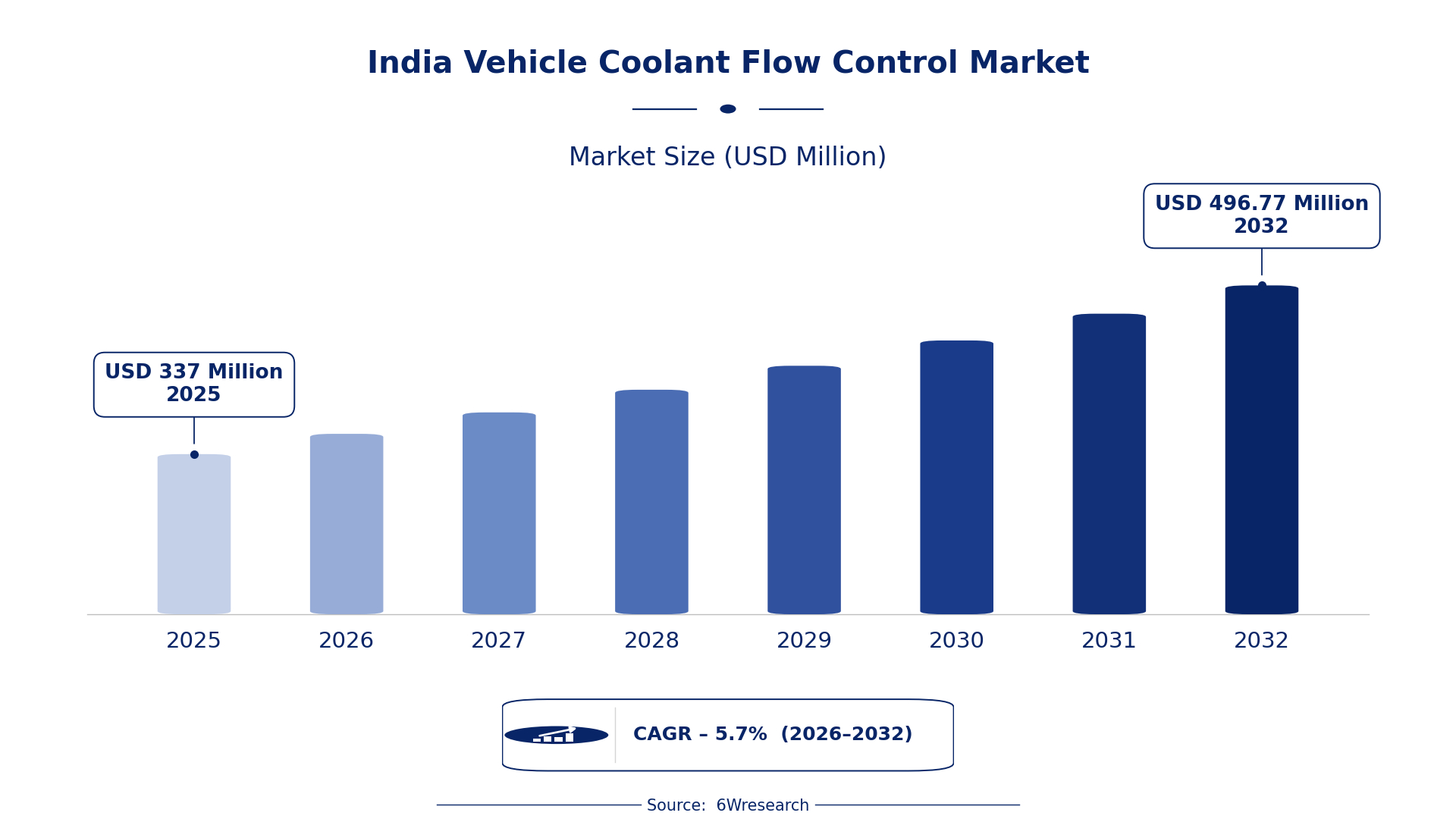
According to 6Wresearch internal database and industry insights, the India Vehicle Coolant Flow Control Market was valued at USD 337.0 million in 2025 and is projected to reach USD 496.77 million by 2032, growing at a CAGR of approximately 5.7% during 2026–2032.
India Vehicle Coolant Flow Control Market Highlights
| Report Metric | Details |
| Report Name | India Vehicle Coolant Flow Control Market |
| Market Size 2025 | USD 337.0 million |
| Market Size 2032 | USD 496.77 million |
| Absolute Growth 2025–2032 | USD 159.77 million |
| CAGR 2026–2032 | 5.7% |
| Peak Annual Growth | 7.8% in 2031 |
| Forecast Period | 2026–2032 |
| Historical Data | 2022–2025 |
| Base Year | 2025 |
| Leading Control Type, 2025 | Thermostatic Control Valves (43% share) |
| Leading Valve Technology, 2025 | Servo-Controlled (47% share) |
| Leading Integration Area, 2025 | Engine Cooling Circuit (45% share) |
| Leading End User, 2025 | Electric Car OEMs (36% share) |
| Fastest-Growing Control Type | Electronic Flow Controllers (8.2% CAGR) |
| Fastest-Growing Integration Area | EV Battery Cooling (7.4% CAGR) |
| Fastest-Growing End User | Hybrid Car Manufacturers (7.8% CAGR) |
| Growing Sector | Hybrid Car Manufacturers |
| Key End Users | Electric Car OEMs, Hybrid Car Manufacturers, Radiator Manufacturers, HVAC System Providers |
India Vehicle Coolant Flow Control Market Year-wise Growth Rate and Key Drivers (2022–2032)
This graph illustrates the annual growth rates of the market from 2022 to 2032, highlighting a steady upward trajectory and projected market expansion over the forecast period.
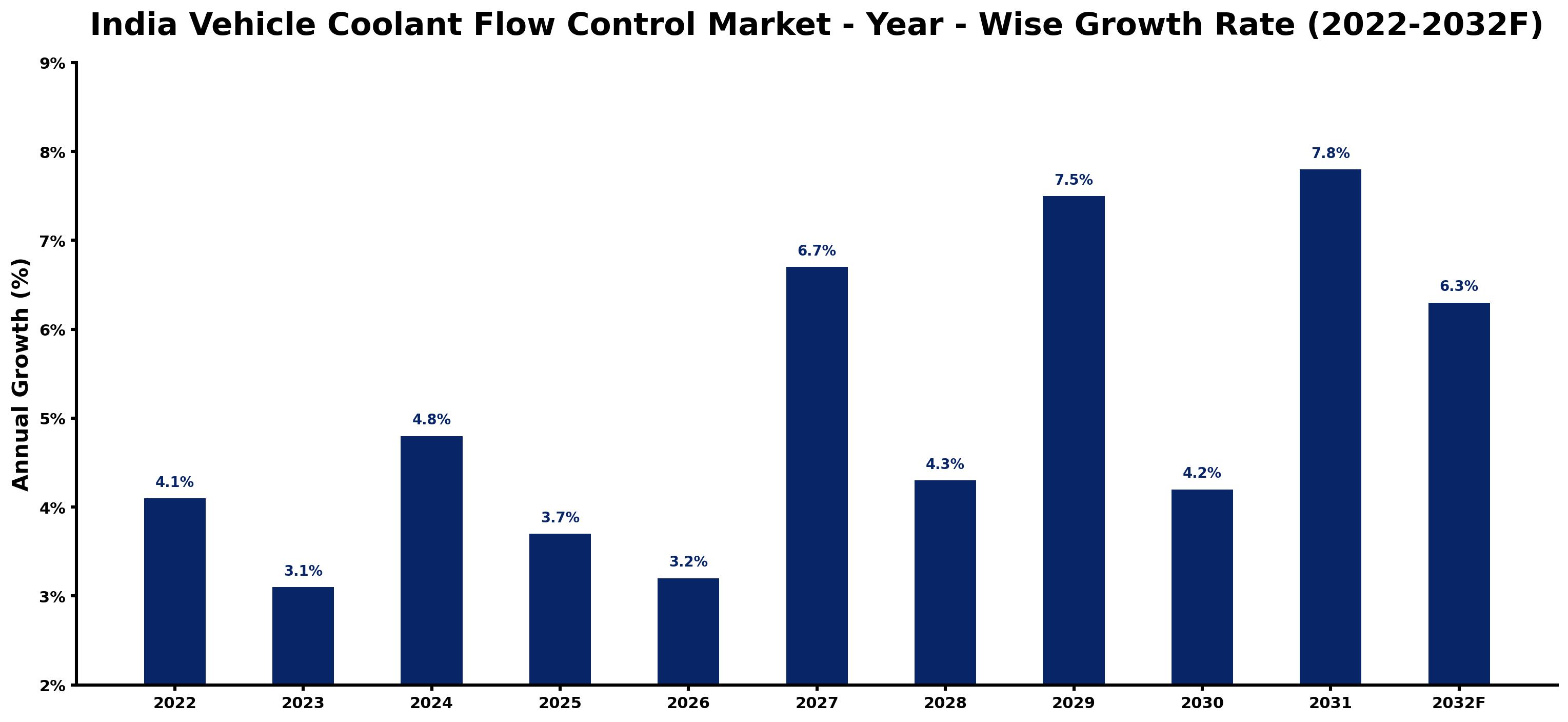
The table below sets out the estimated growth rate for each year and the main factor behind it.
| Year | Estimated Annual Growth (%) | Market Rationale |
| 2022 | 4.1 | The market showed steady growth, driven by the automotive industry's recovery and rising vehicle production. |
| 2023 | 3.1 | Growth slowed due to supply chain disruptions affecting component availability and production timelines. |
| 2024 | 4.8 | Demand increased as manufacturers ramped up production to meet the rising vehicle population. |
| 2025 | 3.7 | The market experienced slower growth as electric vehicle adoption began to stabilise. |
| 2026 | 3.2 | Demand growth slowed as the market adjusted to new regulatory standards. |
| 2027 | 6.7 | Growth accelerated with increased investments in electric vehicle infrastructure and technology. |
| 2028 | 4.3 | The market saw a slowdown as manufacturers faced challenges in sourcing raw materials. |
| 2029 | 7.5 | Demand surged as electric vehicle sales continued to rise, boosting component needs. |
| 2030 | 4.2 | Growth slowed as the market stabilised in response to evolving consumer preferences. |
| 2031 | 7.8 | The market peaked with heightened demand for advanced cooling technologies in electric vehicles. |
| 2032 | 6.3 | Growth slowed as the market matured, with established players consolidating their positions. |
Note: Market size estimations and growth projections presented in this report are based on 6Wresearch's proprietary forecasting methodology, utilizing the latest available industry data, government publications, and primary research inputs.
India Vehicle Coolant Flow Control Market Synopsis
Vehicle Coolant Flow Control products in India regulate coolant flow in automotive cooling systems, ensuring optimal engine temperatures. These components, made from materials like brass and aluminum, are vital for both engine and electric vehicle battery cooling. The India Vehicle Coolant Flow Control Market is expanding due to the automotive industry's growth, with over 4.5 million vehicles produced in 2022 and electric vehicle sales increasing by 200%. The National Electric Mobility Mission Plan and rising electric vehicle adoption are key factors driving this demand.
Market Dynamics Impact Analysis (2026–2032)
| Factor | Type | Impact | Primary Segment Affected |
| Increasing production of electric vehicles drives demand for efficient cooling systems. | Driver | High | Electric Car OEMs |
| The growing vehicle population necessitates improved engine cooling solutions. | Driver | High | Engine Cooling Circuit |
| Investment in electric vehicle infrastructure creates opportunities for new suppliers. | Opportunity | High | EV Battery Cooling |
| The rise of hybrid vehicles presents a market gap for specialized cooling solutions. | Opportunity | Medium | Hybrid Cooling |
| Supply chain disruptions hinder timely production of coolant flow control components. | Restraint | High | Electronic Flow Controllers |
| Regulatory changes may increase compliance costs for manufacturers. | Restraint | Medium | Thermostatic Control Valves |
| High competition among manufacturers can lead to pricing pressures. | Challenge | High | Servo-Controlled |
| Technological advancements require continuous investment to stay competitive. | Challenge | Medium | Bypass Valves |
Evaluation of Drivers in India Vehicle Coolant Flow Control Market (2026–2032)
The main growth drivers and the segments they affect most are set out below.
| Drivers | Primary Segment Affected | Why It Matters (Evidence) |
| Rising electric vehicle production increases demand for advanced cooling technologies. | EV Battery Cooling | The electric vehicle market in India is projected to reach 6 million units by 2025. |
| Growing vehicle population necessitates efficient engine cooling solutions. | Engine Cooling Circuit | India's vehicle population is expected to exceed 300 million by 2025. |
| Investment in automotive manufacturing boosts component production capacity. | Thermostatic Control Valves | The automotive sector is set to attract $8-10 billion in investments by 2025. |
| Increased focus on energy efficiency drives demand for electronic flow control systems. | Electronic Flow Controllers | Electric vehicle sales in India grew by 200% in 2022 compared to the previous year. |
| Government initiatives promote the adoption of electric vehicles and related technologies. | Hybrid Cooling | The National Electric Mobility Mission Plan aims for 30% electric vehicles by 2030. |
Growth in the Vehicle Coolant Flow Control market in India comes from rising electric vehicle production, which increases demand for advanced cooling technologies. The growing vehicle population, projected to exceed 300 million by 2025, necessitates efficient engine cooling solutions. Investment in automotive manufacturing is set to attract $8-10 billion by 2025, further boosting component production capacity.
Evaluation of Restraints in India Vehicle Coolant Flow Control Market
The key brakes on demand, and where they bite hardest, are shown below.
| Market Restraint | Primary Segment Affected | Why It Matters (Evidence) |
| Supply chain disruptions hinder timely production of components. | Electronic Flow Controllers | Manufacturers faced delays in sourcing materials, impacting production schedules. |
| Regulatory changes may increase compliance costs for manufacturers. | Thermostatic Control Valves | New standards require additional testing and certification, raising operational costs. |
| High competition among manufacturers can lead to pricing pressures. | Servo-Controlled | Increased competition forces companies to lower prices, affecting profit margins. |
| Technological advancements require continuous investment to stay competitive. | Bypass Valves | Keeping up with innovations demands R&D expenditure, straining budgets. |
| Market maturity may limit growth opportunities for new entrants. | Hybrid Cooling | Established players dominate the market, making it challenging for newcomers. |
India Vehicle Coolant Flow Control Market Challenges
Buyers in the India Vehicle Coolant Flow Control market face rising raw material costs, which can increase production expenses by up to 15%. Regulatory challenges emerge as the Bureau of Indian Standards enforces stringent compliance measures, leading to approval delays that can cost suppliers considerable revenue. Supply chain issues, particularly in sourcing key materials like brass and aluminium, create product availability challenges, hindering manufacturers’ ability to meet demand. Competition intensifies as new players enter the market, compelling established producers to lower prices, which can erode profit margins by approximately 10%.
Trends in the India Vehicle Coolant Flow Control Market
Below mentioned are some of the trends shaping the India Vehicle Coolant Flow Control Market growth.
- Shift from Conventional to Electric Vehicle Cooling Solutions: India is transitioning towards advanced electronic cooling solutions, driven by the increase in electric vehicles. The electric vehicle market is expected to reach 6 million units by 2025, prompting manufacturers to adapt their cooling technologies.
- Increasing Adoption of Servo-Controlled Valves: There is a growing preference for servo-controlled valves in vehicle cooling systems, reflecting advancements in technology. This segment is set to grow at a CAGR of 7.9% from 2026 to 2032, indicating a shift towards more precise control.
- Rise of Hybrid Vehicles in the Market: Hybrid vehicles are becoming more prevalent, creating demand for specialised cooling solutions. In 2022, hybrid vehicles accounted for 3% of total vehicle sales in India, highlighting the need for tailored components.
- Focus on Energy Efficiency in Automotive Cooling: The automotive industry is prioritising energy-efficient cooling solutions to meet regulatory standards. The Bureau of Indian Standards updated automotive standards in 2022, pushing manufacturers to innovate.
Investment Opportunities in the India Vehicle Coolant Flow Control Market
Investors looking at the India Vehicle Coolant Flow Control Market should consider the following areas.
- $60 billion Automotive Components Market: The automotive components market in India, valued at around $60 billion, presents opportunities for suppliers of coolant flow control products. Partnering with local manufacturers can facilitate market entry and growth.
- Investment in Electric Vehicle Infrastructure: With electric vehicle sales projected to reach 6 million units by 2025, there is an opportunity for suppliers to provide advanced cooling solutions. Collaborating with electric car OEMs can enhance market presence.
- Growing Demand from Electric Car OEMs: Electric Car OEMs are major consumers in the growing EV market, representing a key opportunity for coolant flow control suppliers. Establishing joint ventures can help tap into this expanding sector.
- Expansion of Hybrid Vehicle Production: As hybrid car manufacturers increase production, there is a demand for specialised cooling solutions. Engaging with these manufacturers can open new avenues for suppliers.
Government Initiatives in the India Vehicle Coolant Flow Control Market
The National Electric Mobility Mission Plan 2020, initiated by the Ministry of Heavy Industries, aims to promote electric vehicle adoption in India, targeting 30% electric vehicles by 2030. The Faster Adoption and Manufacturing of Hybrid and Electric Vehicles (FAME II) scheme, launched in 2021, allocates $1.4 billion in subsidies to support electric vehicle manufacturers. Additionally, the Automotive Mission Plan 2026, also from 2021, focuses on establishing India as a global hub for automotive manufacturing, particularly in electric vehicles. The Bureau of Indian Standards (BIS) updated automotive standards in 2022, introducing new regulations for electric vehicle components, which producers must comply with to ensure market access. These measures collectively enhance the framework for vehicle coolant flow control products, ensuring they meet evolving industry standards.
The Ministry of Heavy Industries oversees the implementation of various initiatives, including the FAME II scheme, which provides financial incentives for electric vehicle production. The Automotive Research Association of India (ARAI) plays a crucial role in developing standards for vehicle components, including coolant flow control products. The Production Linked Incentive (PLI) scheme, with a budget of $3 billion, encourages local manufacturing and innovation in the automotive sector. These agencies facilitate approvals and funding, ensuring that manufacturers can meet regulatory requirements and benefit from financial support, ultimately enhancing the competitiveness of the vehicle coolant flow control market in India.
Future Insight of the India Vehicle Coolant Flow Control Market
The India Vehicle Coolant Flow Control market will undergo notable changes by 2032, influenced by advancements in automotive technology and supportive government policies. The electric vehicle market is expected to expand rapidly, with sales projected to reach 6 million units by 2025. The National Automotive Testing and R&D Infrastructure Project will enhance testing capabilities, ensuring higher quality for suppliers. Continued support from the National Electric Mobility Mission Plan will encourage innovation, allowing buyers to access more efficient and reliable cooling solutions.
Market Segmentation Analysis
The report offers a comprehensive study of the following market segments and their leading categories in the market.
By Control Type – Thermostatic Control Valves Dominated, Electronic Flow Controllers Expected to Grow Fastest
According to Bhawna Singh, Assistant Manager at 6Wresearch, Thermostatic Control Valves held a 43% share of the India Vehicle Coolant Flow Control Market by control type in 2025. Thermostatic control valves dominate the market share as they are crucial for regulating engine temperatures in over 80% of conventional vehicles produced in India. Their essential role in maintaining optimal engine performance makes them a preferred choice among manufacturers. Electronic Flow Controllers are set to record the highest CAGR in this split, 8.2% over 2026–2032. The growth of electronic flow controllers is propelled by the rising demand for precise temperature management in modern cooling systems, which are increasingly adopted in new vehicle designs. As electric vehicle production ramps up, the need for these advanced control technologies will expand further. Suppliers should enhance their electronic flow controller offerings to align with the growing demand in the automotive market.
By Valve Technology – Servo-Controlled Dominated and Is Expected to Record the Fastest Growth
With a 47% revenue share in 2025, Servo-Controlled was the largest valve technology category. Servo-controlled valves hold the largest share as they are increasingly used in advanced vehicle cooling systems, providing superior control and efficiency. Their adoption aligns with the automotive industry's shift towards more sophisticated technologies. The same category is also set to grow fastest, at a CAGR of 7.9% during 2026–2032. The servo-controlled segment is also the fastest growing, benefiting from the same trends that drive their leadership in market share. As vehicles become more technologically advanced, the reliance on servo-controlled systems will only increase, widening their lead. Manufacturers must invest in servo-controlled technologies to stay competitive in a rapidly advancing automotive market.
By Integration Area – Engine Cooling Circuit Dominated, EV Battery Cooling Expected to Grow Fastest
In 2025, Engine Cooling Circuit led the integration area split with a 45% share. The engine cooling circuit leads the market because it is vital for maintaining engine performance across most vehicles. This segment's prominence is reinforced by the substantial production volume of conventional vehicles in India. The quickest growth will come from EV Battery Cooling, forecast to expand at a CAGR of 7.4% between 2026 and 2032. EV battery cooling is the fastest growing segment, driven by the surge in electric vehicle sales, expected to reach 6 million units by 2025. This growth underscores the urgent need for effective cooling solutions in electric vehicles to ensure efficiency and safety. Suppliers should focus on developing cooling solutions specifically designed for electric vehicles to capitalise on this expanding market.
By End User – Electric Car OEMs Dominated, Hybrid Car Manufacturers Expected to Grow Fastest
Electric Car OEMs accounted for a 36% market share by end user in 2025. Electric car OEMs account for the largest share of end users, primarily due to the booming electric vehicle market and their significant consumption of vehicle coolant flow control products. Their pivotal role in the automotive industry highlights the necessity of addressing their specific requirements. Over 2026–2032, Hybrid Car Manufacturers are expected to post the fastest growth, at a CAGR of 7.8%. Hybrid car manufacturers are the fastest growing segment, reflecting the increasing consumer interest in hybrid vehicles, which made up 3% of total vehicle sales in India in 2022. This trend indicates a shift towards versatile vehicle options that require advanced cooling technologies. Suppliers should adjust their strategies to meet the increasing demand from hybrid car manufacturers, ensuring they stay relevant in a diversifying market.
Key Attractiveness of the Report
- 10 Years of Market Numbers
- Historical Data Starting from 2022 to 2025
- Base Year 2025
- Forecast Data until 2032
- Key Performance Indicators Impacting the Market
- Major Upcoming Developments and Projects
Key Highlights of the Report:
- India Vehicle Coolant Flow Control Market Outlook
- Market Size of India Vehicle Coolant Flow Control Market, 2025
- Forecast of India Vehicle Coolant Flow Control Market, 2032
- Historical Data and Forecast of India Vehicle Coolant Flow Control Revenues & Volume for the Period 2022 - 2032F
- India Vehicle Coolant Flow Control Market Trend Evolution
- India Vehicle Coolant Flow Control Market Drivers and Challenges
- India Vehicle Coolant Flow Control Price Trends
- India Vehicle Coolant Flow Control Porter's Five Forces
- India Vehicle Coolant Flow Control Industry Life Cycle
- Historical Data and Forecast of India Vehicle Coolant Flow Control Market Revenues & Volume By Control Type for the Period 2022 - 2032F
- Historical Data and Forecast of India Vehicle Coolant Flow Control Market Revenues & Volume By Thermostatic Control Valves for the Period 2022 - 2032F
- Historical Data and Forecast of India Vehicle Coolant Flow Control Market Revenues & Volume By Electronic Flow Controllers for the Period 2022 - 2032F
- Historical Data and Forecast of India Vehicle Coolant Flow Control Market Revenues & Volume By Bypass Valves for the Period 2022 - 2032F
- Historical Data and Forecast of India Vehicle Coolant Flow Control Market Revenues & Volume By Dual-Mode Valves for the Period 2022 - 2032F
- Historical Data and Forecast of India Vehicle Coolant Flow Control Market Revenues & Volume By Valve Technology for the Period 2022 - 2032F
- Historical Data and Forecast of India Vehicle Coolant Flow Control Market Revenues & Volume By Wax-Pellet Driven for the Period 2022 - 2032F
- Historical Data and Forecast of India Vehicle Coolant Flow Control Market Revenues & Volume By Servo-Controlled for the Period 2022 - 2032F
- Historical Data and Forecast of India Vehicle Coolant Flow Control Market Revenues & Volume By Manual & Auto Switch for the Period 2022 - 2032F
- Historical Data and Forecast of India Vehicle Coolant Flow Control Market Revenues & Volume By Hybrid Cooling for the Period 2022 - 2032F
- Historical Data and Forecast of India Vehicle Coolant Flow Control Market Revenues & Volume By Integration Area for the Period 2022 - 2032F
- Historical Data and Forecast of India Vehicle Coolant Flow Control Market Revenues & Volume By Engine Cooling Circuit for the Period 2022 - 2032F
- Historical Data and Forecast of India Vehicle Coolant Flow Control Market Revenues & Volume By EV Battery Cooling for the Period 2022 - 2032F
- Historical Data and Forecast of India Vehicle Coolant Flow Control Market Revenues & Volume By Cabin Heating for the Period 2022 - 2032F
- Historical Data and Forecast of India Vehicle Coolant Flow Control Market Revenues & Volume By ICE-EV Platforms for the Period 2022 - 2032F
- Historical Data and Forecast of India Vehicle Coolant Flow Control Market Revenues & Volume By End User for the Period 2022 - 2032F
- Historical Data and Forecast of India Vehicle Coolant Flow Control Market Revenues & Volume By Radiator Manufacturers for the Period 2022 - 2032F
- Historical Data and Forecast of India Vehicle Coolant Flow Control Market Revenues & Volume By Electric Car OEMs for the Period 2022 - 2032F
- Historical Data and Forecast of India Vehicle Coolant Flow Control Market Revenues & Volume By HVAC System Providers for the Period 2022 - 2032F
- Historical Data and Forecast of India Vehicle Coolant Flow Control Market Revenues & Volume By Hybrid Car Manufacturers for the Period 2022 - 2032F
- India Vehicle Coolant Flow Control Import Export Trade Statistics
- Market Opportunity Assessment By Control Type
- Market Opportunity Assessment By Valve Technology
- Market Opportunity Assessment By Integration Area
- Market Opportunity Assessment By End User
- India Vehicle Coolant Flow Control Top Companies Market Share
- India Vehicle Coolant Flow Control Competitive Benchmarking By Technical and Operational Parameters
- India Vehicle Coolant Flow Control Company Profiles
- India Vehicle Coolant Flow Control Key Strategic Recommendations
Market Covered
The report offers an extensive study of the following market segments.
By Control Type
- Thermostatic Control Valves
- Electronic Flow Controllers
- Bypass Valves
- Dual-Mode Valves
By Valve Technology
- Wax-Pellet Driven
- Servo-Controlled
- Manual & Auto Switch
- Hybrid Cooling
By Integration Area
- Engine Cooling Circuit
- EV Battery Cooling
- Cabin Heating
- ICE-EV Platforms
By End User
- Radiator Manufacturers
- Electric Car OEMs
- HVAC System Providers
- Hybrid Car Manufacturers































