Iraq Apiculture Market Size, Share & Growth Rate
The Iraq Apiculture Market was estimated at USD 996 Million in 2025 and is projected to reach USD 1433 Million by 2032, growing at a CAGR of 5.3% from 2026 to 2032. This promising trajectory is driven by a heightened consumer awareness of the health benefits associated with honey and other bee products. Additionally, supportive government initiatives and a robust local flora conducive to beekeeping further bolster market expansion.
Iraq Apiculture Market Year-wise Growth Rate and Key Drivers
This graph highlights how the Iraq Apiculture Market has steadily grown over the years, supported by major growth factors.
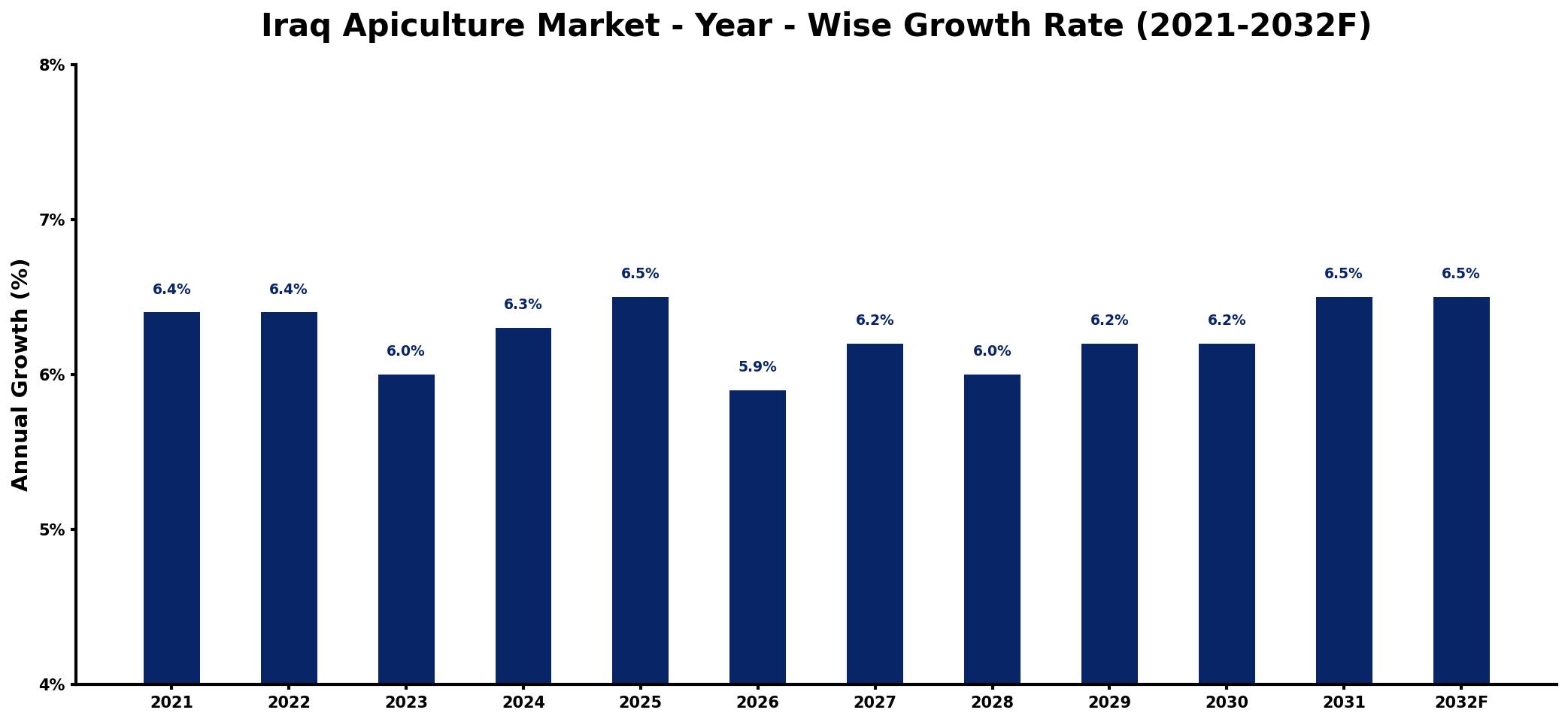
The table below presents the year‑wise growth rates along with the key drivers influencing the market
| Year | Growth Rate | Major Drivers |
| 2021 | 6.4% | Rising consumer health awareness |
| 2022 | 6.4% | Increased export opportunities emerging |
| 2023 | 6.0% | Growing organic product demand |
| 2024 | 6.3% | Investment in sustainable farming |
| 2025 | 6.5% | Technological advancements in beekeeping |
| 2026 | 5.9% | Strengthening local farmer cooperatives |
| 2027 | 6.2% | Enhanced distribution network efficiency |
| 2028 | 6.0% | Growing interest in natural remedies |
| 2029 | 6.2% | Expansion of urban agriculture initiatives |
| 2030 | 6.2% | Increased educational programs offered |
| 2031 | 6.5% | Supportive government policies introduced |
| 2032 | 6.5% | Rising tourism driving local products |
Note: Market size estimations and growth projections presented in this report are based on 6Wresearch's proprietary forecasting methodology, utilizing the latest available industry data, government publications, and primary research inputs.
Iraq Apiculture Market Synopsis
A surge in health consciousness among Iraqi consumers is driving the demand for high-quality honey products. Small-scale beekeepers dominate the market, focusing primarily on honey production, while emerging interest in value-added products like beeswax and royal jelly presents diversification opportunities.
The favorable climate and abundant floral resources create an ideal environment for beekeeping, positioning the Iraq Apiculture Market for potential growth. However, the sector faces challenges such as limited access to modern technology and equipment, which may impede the realization of its full potential.
Iraq Apiculture Market Key Takeaways
- Strong consumer demand for natural and organic honey is shaping market trends.
- Government policies are increasingly supporting beekeeping practices and improving production efficiency.
- Small-scale operations account for the majority of honey production, indicating opportunities for scaling up.
- Value-added bee products present lucrative avenues for diversification among local beekeepers.
- Investment in modern apiaries and processing facilities can significantly enhance market growth.
Evaluation of Restraints in Iraq Apiculture Market
The Iraq Apiculture Market faces substantial barriers, particularly in infrastructure and resource accessibility. Inadequate distribution channels hinder honey producers from reaching broader markets, while limited availability of modern beekeeping tools restricts efficiency. Furthermore, unreliable government support and fluctuating security conditions can significantly deter potential investors. Environmental challenges, including climate change, also pose threats to bee populations, impacting honey production and overall market health.
Iraq Apiculture Market Trends
The Iraq Apiculture Market is witnessing a shift toward premium honey products as consumers increasingly seek out locally sourced, organic options. Growing interest in sustainable agricultural practices encourages innovation in hive management and bee health strategies. Additionally, the trend towards health-oriented diets is resulting in higher demand for natural sweeteners and bee-derived health supplements, further driving market evolution.
Iraq Apiculture Market Opportunities
Investment opportunities abound in the Iraq Apiculture Market, particularly in establishing modern apiaries and enhancing local beekeepers skills through training programs. The growing interest in value-added products such as beeswax-based cosmetics and health supplements positions the market for further diversification. With a strategic focus on honey processing and packaging facilities, investors can capitalize on the burgeoning demand for high-quality, local products.
Government Initiatives in the Iraq Apiculture Market
The Iraqi government has initiated a series of supportive policies aimed at bolstering the apiculture market. These include financial incentives and subsidies for beekeepers, alongside efforts to promote research and development in beekeeping methodologies. The establishment of training programs and extension services is designed to enhance beekeepers' skills and knowledge, ultimately improving productivity and market competitiveness.
Future Insights of the Iraq Apiculture Market
Looking ahead to 2026-2032, the Iraq Apiculture Market appears well-positioned for growth. Increasing health awareness, combined with rising disposable incomes, is likely to escalate demand for honey and related products. However, addressing the challenges posed by climate change, limited infrastructure, and the need for modern practices will be critical to achieving sustainable growth. With the right investments and innovations, this market holds significant promise for beekeepers and businesses alike.
Iraq Apiculture Market Latest Developments (2025 - 2026)
Recent developments in the Iraq Apiculture Market reflect an increasing commitment to enhancing beekeeping practices. Training workshops and community outreach programs are gaining traction, aiming to educate local farmers on sustainable practices. Additionally, there is a growing collaboration among stakeholders to improve honey quality and ensure safe production methods, further solidifying the markets foundation.
Iraq Apiculture Market - Key Attractiveness of the Report
- 10 Years of Market Numbers
- Historical Data Starting from 2022 to 2025
- Base Year: 2025
- Forecast Data until 2032
- Key Performance Indicators Impacting the Market
- Major Upcoming Developments and Projects
Key Highlights of the Report:
- Iraq Apiculture Market Outlook
- Market Size of Iraq Apiculture Market, 2025
- Forecast of Iraq Apiculture Market, 2032
- Historical Data and Forecast of Iraq Apiculture Revenues & Volume for the Period 2022-2032F
- Iraq Apiculture Market Trend Evolution
- Iraq Apiculture Market Drivers and Challenges
- Iraq Apiculture Price Trends
- Iraq Apiculture Porter's Five Forces
- Iraq Apiculture Industry Life Cycle
- Historical Data and Forecast of Iraq Apiculture Market Revenues & Volume By Product Type for the Period 2022-2032F
- Historical Data and Forecast of Iraq Apiculture Market Revenues & Volume By Honey for the Period 2022-2032F
- Historical Data and Forecast of Iraq Apiculture Market Revenues & Volume By Beeswax for the Period 2022-2032F
- Historical Data and Forecast of Iraq Apiculture Market Revenues & Volume By Live-bees for the Period 2022-2032F
- Historical Data and Forecast of Iraq Apiculture Market Revenues & Volume By Others for the Period 2022-2032F
- Historical Data and Forecast of Iraq Apiculture Market Revenues & Volume By Application for the Period 2022-2032F
- Historical Data and Forecast of Iraq Apiculture Market Revenues & Volume By Medical for the Period 2022-2032F
- Historical Data and Forecast of Iraq Apiculture Market Revenues & Volume By Food Beverages for the Period 2022-2032F
- Historical Data and Forecast of Iraq Apiculture Market Revenues & Volume By Cosmetics for the Period 2022-2032F
- Historical Data and Forecast of Iraq Apiculture Market Revenues & Volume By Others for the Period 2022-2032F
- Iraq Apiculture Import Export Trade Statistics
- Market Opportunity Assessment By Product Type
- Market Opportunity Assessment By Application
- Iraq Apiculture Top Companies Market Share
- Iraq Apiculture Competitive Benchmarking By Technical and Operational Parameters
- Iraq Apiculture Company Profiles
- Iraq Apiculture Key Strategic Recommendations






































