Iraq Business Intelligence Market Size & Growth Rate (2026-2032)
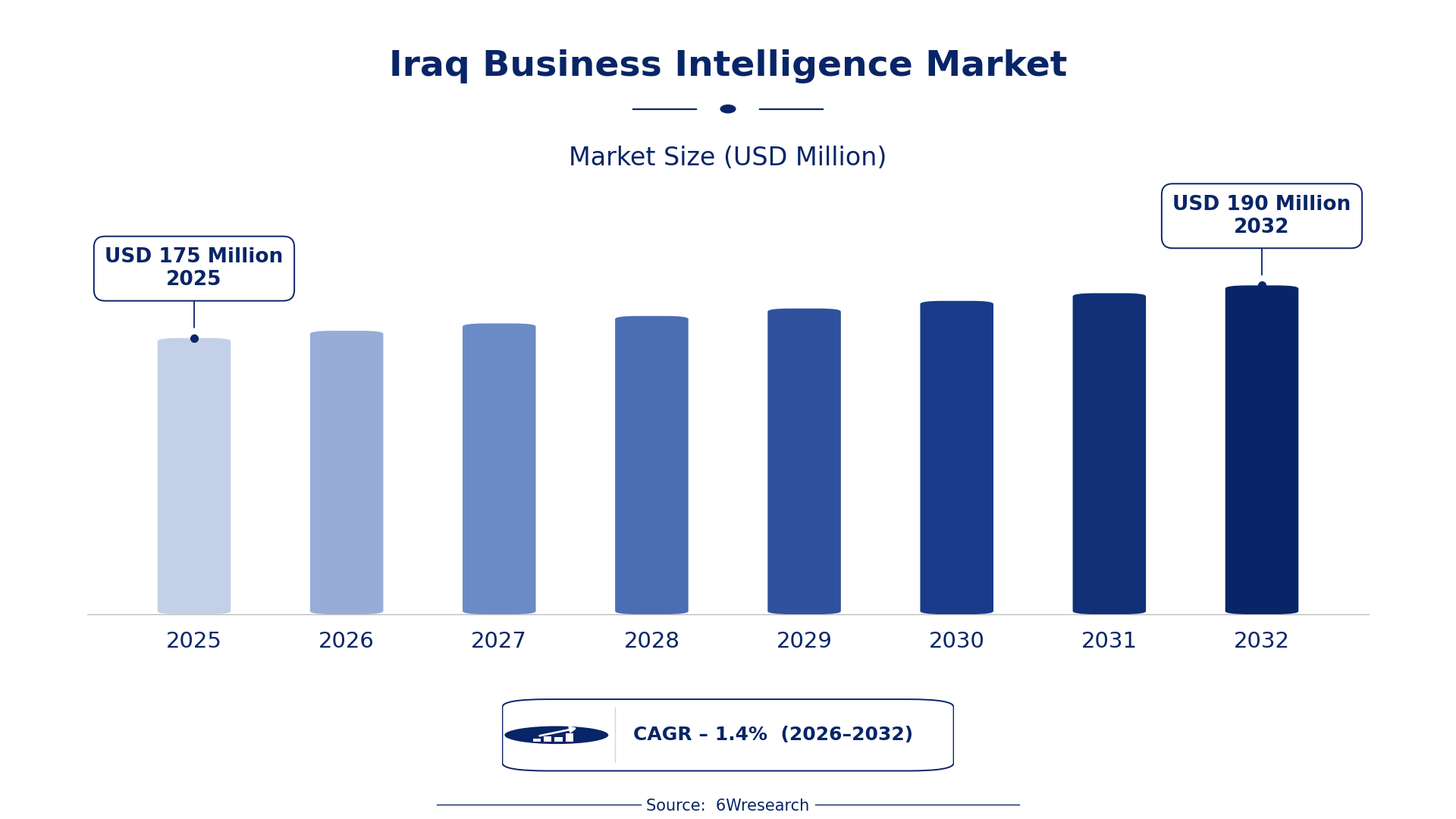
The Iraq Business Intelligence Market was estimated at USD 175 Million in 2025 and is projected to reach USD 190 Million by 2032, growing at a CAGR of 1.4% from 2026 to 2032.
Iraq Business Intelligence Market Synopsis
Demand for data-driven decision-making solutions is on the rise in Iraq, as businesses seek to enhance operational efficiency and improve strategic planning. The need for effective risk management and regulatory compliance is becoming increasingly critical in a market that is still navigating its complexities.
Local enterprises are beginning to recognize the importance of business intelligence tools to gain actionable insights. With the increasing digital transformation efforts across various sectors, the appetite for advanced analytics and reporting tools is growing, setting the stage for a competitive environment.
Iraq Business Intelligence Market Year-wise Growth Rate and Key Drivers
This graph illustrates the annual growth rates of the Iraq Business Intelligence Market from 2021 to 2032, highlighting a steady upward trajectory and projected expansion over the forecast period.
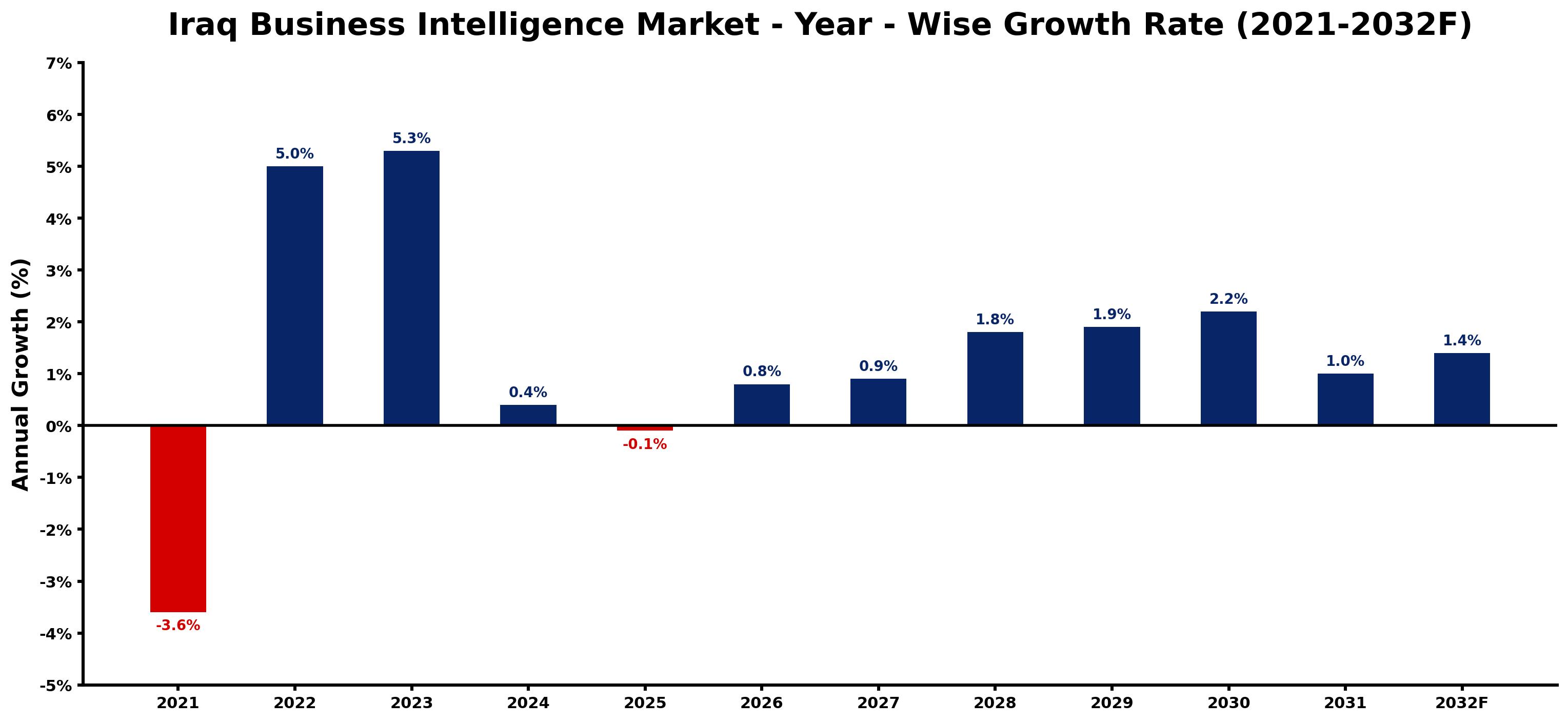
The table below presents the year‑wise growth rates along with the key drivers influencing the market
| Year | Growth Rate | Major Drivers |
| 2021 | -3.6% | Funding cuts by Iraqi government limited market access. |
| 2022 | 5.0% | Increased foreign investment due to eased regulations. |
| 2023 | 5.3% | Demand for data analytics rises among local enterprises. |
| 2024 | 0.4% | Initiatives from Iraqi Digital Transformation Office boost adoption. |
| 2025 | -0.1% | Emerging local tech firms disrupted existing business intelligence solutions. |
| 2026 | 0.8% | Growth in oil sector drives demand for intelligence tools. |
| 2027 | 0.9% | Rising need for market insights among SMEs in Iraq. |
| 2028 | 1.8% | Government transparency initiatives fuel business intelligence needs. |
| 2029 | 1.9% | Emergence of local data startups enhances market offerings. |
| 2030 | 2.2% | Increased IT infrastructure supports business intelligence technologies. |
| 2031 | 1.0% | Sector diversification leads to higher data-driven decision-making. |
| 2032 | 1.4% | Strong demand for risk management in volatile markets. |
Note: Market size estimations and growth projections presented in this report are based on 6Wresearch's proprietary forecasting methodology, utilizing the latest available industry data, government publications, and primary research inputs.
Iraq Business Intelligence Market Key Takeaways
Below are some of the specific key takeaways from the market, including:
- The market is transitioning towards cloud-based solutions to enhance flexibility and scalability.
- Integration of AI and machine learning technologies is gaining traction for predictive analytics.
- Real-time data analysis is becoming essential for businesses to maintain a competitive edge.
- Government initiatives are supporting digital transformation, creating a conducive environment for BI solutions.
- Custom solutions tailored to specific industry needs are increasingly in demand.
Evaluation of Restraints in Iraq Business Intelligence Market
The Iraq Business Intelligence Market faces several challenges that hinder its full potential. Political instability remains a significant concern, affecting the operational landscape and creating uncertainties for businesses. Security issues, including threats from terrorism and civil unrest, further complicate the gathering of reliable business intelligence. on top of that, the country's limited infrastructure often restricts access to timely and accurate data, making it difficult for organizations to implement effective BI strategies.
Iraq Business Intelligence Market Trends
Several key trends are shaping the Iraq Business Intelligence Market. The shift towards cloud-based BI tools is notable, as organizations seek greater flexibility in their operations. Additionally, the integration of artificial intelligence and machine learning is expected to enhance data analysis capabilities, enabling businesses to predict trends more accurately. Data security and compliance have also become focal points, as organizations strive to protect sensitive information while adhering to regulations.
Iraq Business Intelligence Market Opportunities
The market presents substantial growth opportunities, particularly for providers of tailored business intelligence solutions. Companies can capitalize on the increasing demand for real-time insights that cater to specific industries, such as oil and gas, healthcare, and finance. on top of that, offering training and consultancy services to improve data literacy among local businesses can create additional avenues for revenue generation. As digital transformation accelerates, those who innovate will likely thrive.
Government Initiatives in the Iraq Business Intelligence Market
Government policies in Iraq are actively shaping the business intelligence landscape. Recent reforms aimed at improving the business environment are encouraging foreign investment and fostering local entrepreneurship. With initiatives focused on economic diversification and modernization, the government is setting a solid foundation for business intelligence solutions to flourish.
- A national digital infrastructure upgrade program is currently underway to enhance data accessibility.
- Recently completed reforms have simplified business regulations, promoting transparency and efficiency.
- Ongoing efforts to diversify the economy away from oil dependency are creating opportunities for BI firms.
- A planned initiative expected to launch by 2027 aims to improve data security measures across industries.
- Public-private partnerships are being explored to expand access to business intelligence tools for local enterprises.
Future Insights of the Iraq Business Intelligence Market
Looking ahead, the Iraq Business Intelligence Market is set to benefit from the country's ongoing economic diversification and modernization efforts. As reconstruction efforts gain traction, demand for data-driven insights will intensify, particularly in industries such as oil and gas, construction, and telecommunications. The rising adoption of business intelligence tools will empower organizations to enhance operational efficiency and drive innovation, even amidst a challenging business environment.
Iraq Business Intelligence Market Latest Developments
In the past year, the Iraq Business Intelligence Market has witnessed a series of strategic developments that highlight the growing importance of data analytics in various sectors. Companies are increasingly investing in advanced technologies to harness insights that can inform their operations.
- A major technology vendor launched a new data analytics platform in late 2025 designed specifically for the oil and gas sector.
- A collaborative initiative began in early 2026 to promote data literacy among local businesses, focusing on training programs and workshops.
- Plans for a comprehensive data visualization tool tailored for the healthcare industry are expected to be rolled out by mid-2026.
- A partnership between local firms and international vendors was established in early 2025 to enhance BI capabilities across the financial sector.
- Current upgrades to existing BI systems are underway, aimed at improving compliance with new government regulations.
Iraq Business Intelligence Market - Key Attractiveness of the Report
- 10 Years of Market Numbers
- Historical Data Starting from 2022 to 2025
- Base Year: 2025
- Forecast Data until 2032
- Key Performance Indicators Impacting the Market
- Major Upcoming Developments and Projects
Key Highlights of the Report:
- Iraq Business Intelligence Market Outlook
- Market Size of Iraq Business Intelligence Market, 2025
- Forecast of Iraq Business Intelligence Market, 2032
- Historical Data and Forecast of Iraq Business Intelligence Revenues & Volume for the Period 2022-2032F
- Iraq Business Intelligence Market Trend Evolution
- Iraq Business Intelligence Market Drivers and Challenges
- Iraq Business Intelligence Price Trends
- Iraq Business Intelligence Porter's Five Forces
- Iraq Business Intelligence Industry Life Cycle
- Historical Data and Forecast of Iraq Business Intelligence Market Revenues & Volume By Component for the Period 2022-2032F
- Historical Data and Forecast of Iraq Business Intelligence Market Revenues & Volume By Solutions for the Period 2022-2032F
- Historical Data and Forecast of Iraq Business Intelligence Market Revenues & Volume By Services for the Period 2022-2032F
- Historical Data and Forecast of Iraq Business Intelligence Market Revenues & Volume By Business Function for the Period 2022-2032F
- Historical Data and Forecast of Iraq Business Intelligence Market Revenues & Volume By Human Resource for the Period 2022-2032F
- Historical Data and Forecast of Iraq Business Intelligence Market Revenues & Volume By Finance for the Period 2022-2032F
- Historical Data and Forecast of Iraq Business Intelligence Market Revenues & Volume By Operations for the Period 2022-2032F
- Historical Data and Forecast of Iraq Business Intelligence Market Revenues & Volume By Sales and Marketing for the Period 2022-2032F
- Historical Data and Forecast of Iraq Business Intelligence Market Revenues & Volume By Deployment Mode for the Period 2022-2032F
- Historical Data and Forecast of Iraq Business Intelligence Market Revenues & Volume By On-premises for the Period 2022-2032F
- Historical Data and Forecast of Iraq Business Intelligence Market Revenues & Volume By Cloud for the Period 2022-2032F
- Historical Data and Forecast of Iraq Business Intelligence Market Revenues & Volume By Organization Size for the Period 2022-2032F
- Historical Data and Forecast of Iraq Business Intelligence Market Revenues & Volume By SMEs for the Period 2022-2032F
- Historical Data and Forecast of Iraq Business Intelligence Market Revenues & Volume By Large Enterprises for the Period 2022-2032F
- Historical Data and Forecast of Iraq Business Intelligence Market Revenues & Volume By Vertical for the Period 2022-2032F
- Historical Data and Forecast of Iraq Business Intelligence Market Revenues & Volume By Retail for the Period 2022-2032F
- Historical Data and Forecast of Iraq Business Intelligence Market Revenues & Volume By Manufacturing for the Period 2022-2032F
- Historical Data and Forecast of Iraq Business Intelligence Market Revenues & Volume By Government and Public Services for the Period 2022-2032F
- Historical Data and Forecast of Iraq Business Intelligence Market Revenues & Volume By Media and Entertainment for the Period 2022-2032F
- Historical Data and Forecast of Iraq Business Intelligence Market Revenues & Volume By Transportation and Logistics for the Period 2022-2032F
- Historical Data and Forecast of Iraq Business Intelligence Market Revenues & Volume By BFSI for the Period 2022-2032F
- Historical Data and Forecast of Iraq Business Intelligence Market Revenues & Volume By Telecom and IT for the Period 2022-2032F
- Historical Data and Forecast of Iraq Business Intelligence Market Revenues & Volume By Healthcare and Life Sciences for the Period 2022-2032F
- Iraq Business Intelligence Import Export Trade Statistics
- Market Opportunity Assessment By Component
- Market Opportunity Assessment By Business Function
- Market Opportunity Assessment By Deployment Mode
- Market Opportunity Assessment By Organization Size
- Market Opportunity Assessment By Vertical
- Iraq Business Intelligence Top Companies Market Share
- Iraq Business Intelligence Competitive Benchmarking By Technical and Operational Parameters
- Iraq Business Intelligence Company Profiles
- Iraq Business Intelligence Key Strategic Recommendations






































