Iraq Halal Meat Market Size, Share & Growth Rate
The Iraq Halal Meat Market was estimated at USD 332 Million in 2025 and is projected to reach USD 466 Million by 2032, growing at a CAGR of 5.0% from 2026 to 2032. This growth trajectory is largely driven by the increasing awareness among consumers about halal dietary practices, bolstered by a rising Muslim population. As more Iraqi consumers prioritize halal-certified meat for both religious and health reasons, the market is responding with a diverse range of meat offerings that adhere to stringent halal standards.
Iraq Halal Meat Market Year-wise Growth Rate and Key Drivers
This graph highlights how the Iraq Halal Meat Market has steadily grown over the years, supported by major growth factors.
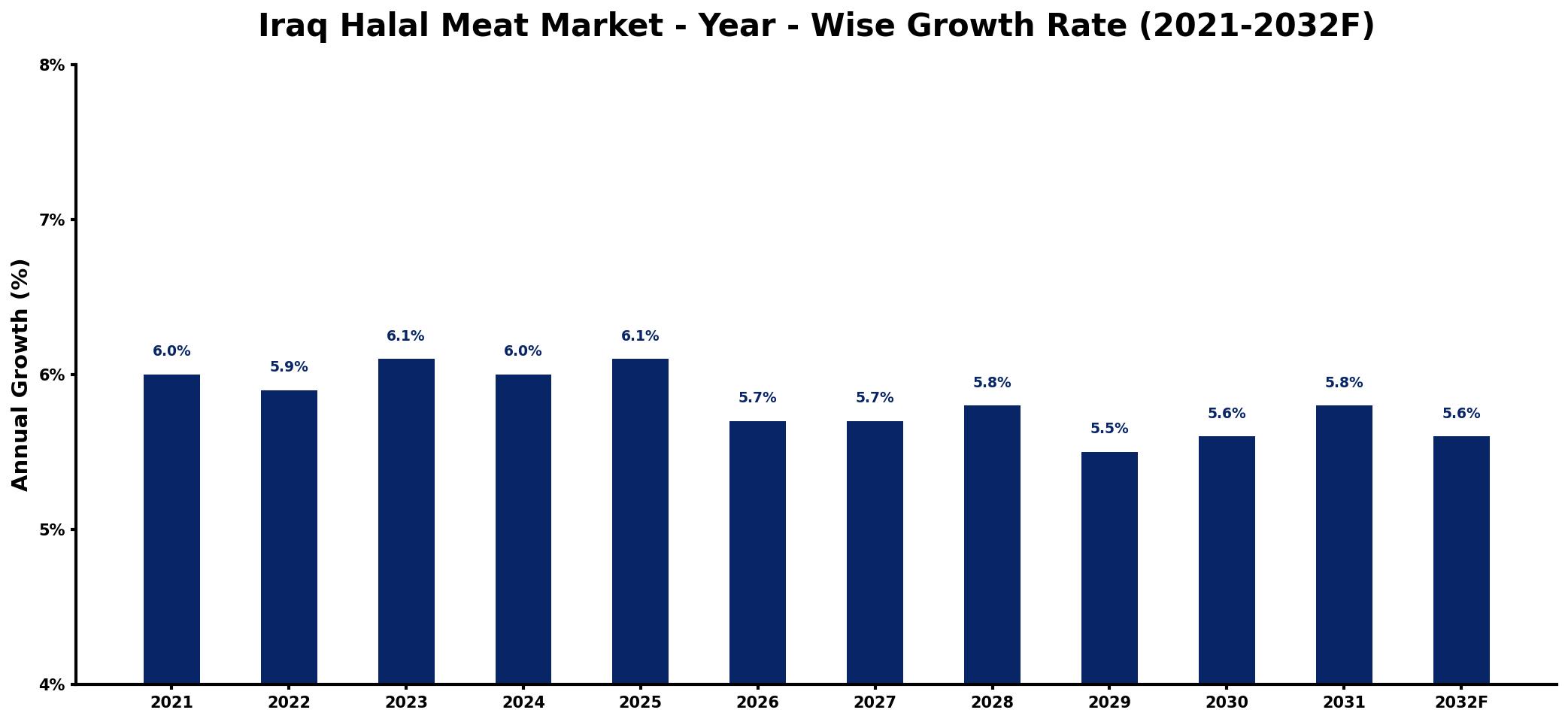
The table below presents the year‑wise growth rates along with the key drivers influencing the market
| Year | Growth Rate | Major Drivers |
| 2021 | 6.0% | Rising consumer health awareness |
| 2022 | 5.9% | Increased disposable income levels |
| 2023 | 6.1% | Growing population and urbanization |
| 2024 | 6.0% | Expansion of retail distribution channels |
| 2025 | 6.1% | Surge in online shopping platforms |
| 2026 | 5.7% | Investment in food safety standards |
| 2027 | 5.7% | Strengthening supply chain logistics |
| 2028 | 5.8% | Emergence of new market players |
| 2029 | 5.5% | Innovations in food processing technologies |
| 2030 | 5.6% | Growing interest in sustainable sourcing |
| 2031 | 5.8% | Rising demand for premium products |
| 2032 | 5.6% | Increased consumer education initiatives |
Note: Market size estimations and growth projections presented in this report are based on 6Wresearch's proprietary forecasting methodology, utilizing the latest available industry data, government publications, and primary research inputs.
Iraq Halal Meat Market Synopsis
The most significant force shaping the Iraq Halal Meat Market today is the escalating consumer demand for halal-certified products. This shift is not merely about compliance with religious practices; it also encompasses broader concerns regarding food quality, safety, and ethical sourcing. As consumers become increasingly discerning, the emphasis on product authenticity and quality assurance has never been more pronounced.
The growing population of Muslims in Iraq is a key driver behind the demand for halal meat. As this demographic continues to evolve, so too does the landscape of meat production and distribution. With government backing for halal initiatives and infrastructure improvements, the market is poised for sustained growth and improved consumer accessibility.
Iraq Halal Meat Market Key Takeaways
- The Iraq Halal Meat Market is witnessing robust growth, fueled by an increasing demand for halal-certified products.
- Government policies aimed at enhancing food safety and animal welfare are pivotal to market expansion.
- Consumer awareness regarding halal standards and health benefits is reshaping purchasing behaviors.
- Challenges in processing hygiene and certification pose risks but also highlight opportunities for improvement.
- Investment in infrastructure and quality control will be crucial in meeting evolving consumer expectations.
Evaluation of Restraints in Iraq Halal Meat Market
While the Iraq Halal Meat Market demonstrates promising growth, it faces several notable restraints. One significant limitation is the infrastructure challenges surrounding slaughterhouses and processing facilities, which impact meat quality and compliance with halal standards. Additionally, the complexities involved in maintaining stringent animal welfare and halal certification can deter potential market entrants. Coupled with these are the obstacles of establishing robust supply chains for both domestic and export markets, which require coordinated efforts between producers, regulators, and retailers.
Iraq Halal Meat Market Trends
Current trends indicate a shift towards greater transparency in the halal meat supply chain. Consumers are increasingly seeking detailed information about product sourcing and processing to ensure authenticity. Furthermore, the integration of technology in production and distribution is emerging, with digital platforms enhancing traceability and consumer engagement. This evolution not only aligns with global food safety standards but also caters to the growing demand for ethically sourced products.
Iraq Halal Meat Market Opportunities
Significant growth opportunities lie in the development of modern halal processing facilities and improvements in supply chain logistics. Investment in education around halal practices for both consumers and producers can enhance understanding and trust in halal certifications. Additionally, potential expansion into international markets presents lucrative avenues for Iraqi halal meat producers to capitalize on increasing global demand for halal products.
Government Initiatives in the Iraq Halal Meat Market
The Iraqi government has taken proactive steps to strengthen the halal meat market through a series of initiatives aimed at promoting animal welfare and food safety. These include investment in modern halal slaughterhouse infrastructure, as well as establishing regulatory frameworks to ensure compliance with Islamic dietary laws. Public-private partnerships are increasingly encouraged to enhance halal certification processes, aiming to foster a reliable and authentic meat supply that meets consumer demands.
Future Insights of the Iraq Halal Meat Market
Looking ahead to the 2026-2032 period, the Iraq Halal Meat Market is on a promising trajectory driven by sustained consumer demand and government support. The focus on quality assurance and ethical sourcing will shape market dynamics, compelling producers to adapt to consumer expectations. With an increasing emphasis on transparency and traceability, stakeholders who invest in these areas will likely experience significant benefits as the market continues to evolve.
Iraq Halal Meat Market Latest Developments (2025 - 2026)
Recent developments within the Iraq Halal Meat Market indicate a notable push towards improving processing hygiene and compliance with halal certifications. Key players are enhancing their operational efficiencies through technological advancements, aimed at bolstering product quality and consumer trust. Additionally, industry stakeholders are actively engaging in discussions about the future of halal certifications, underscoring the importance of maintaining integrity and authenticity in the supply chain.
Iraq Halal Meat Market - Key Attractiveness of the Report
- 10 Years of Market Numbers
- Historical Data Starting from 2022 to 2025
- Base Year: 2025
- Forecast Data until 2032
- Key Performance Indicators Impacting the Market
- Major Upcoming Developments and Projects
Key Highlights of the Report:
- Iraq Halal Meat Market Outlook
- Market Size of Iraq Halal Meat Market, 2025
- Forecast of Iraq Halal Meat Market, 2032
- Historical Data and Forecast of Iraq Halal Meat Revenues & Volume for the Period 2022-2032F
- Iraq Halal Meat Market Trend Evolution
- Iraq Halal Meat Market Drivers and Challenges
- Iraq Halal Meat Price Trends
- Iraq Halal Meat Porter's Five Forces
- Iraq Halal Meat Industry Life Cycle
- Historical Data and Forecast of Iraq Halal Meat Market Revenues & Volume By Product Type for the Period 2022-2032F
- Historical Data and Forecast of Iraq Halal Meat Market Revenues & Volume By Fresh Food for the Period 2022-2032F
- Historical Data and Forecast of Iraq Halal Meat Market Revenues & Volume By Processed Food for the Period 2022-2032F
- Iraq Halal Meat Import Export Trade Statistics
- Market Opportunity Assessment By Product Type
- Iraq Halal Meat Top Companies Market Share
- Iraq Halal Meat Competitive Benchmarking By Technical and Operational Parameters
- Iraq Halal Meat Company Profiles
- Iraq Halal Meat Key Strategic Recommendations






































