Iraq Home Appliances Market Summary
The iraq home appliances market was estimated at USD 352 Million in 2025 and is projected to reach USD 497 Million by 2032, growing at a CAGR of 6.1% from 2026 to 2032.
Iraq Home Appliances Market Year-wise Growth Rate and Key Drivers
This graph highlights how the Iraq Home Appliances Market has steadily grown over the past five years, supported by major growth factors.
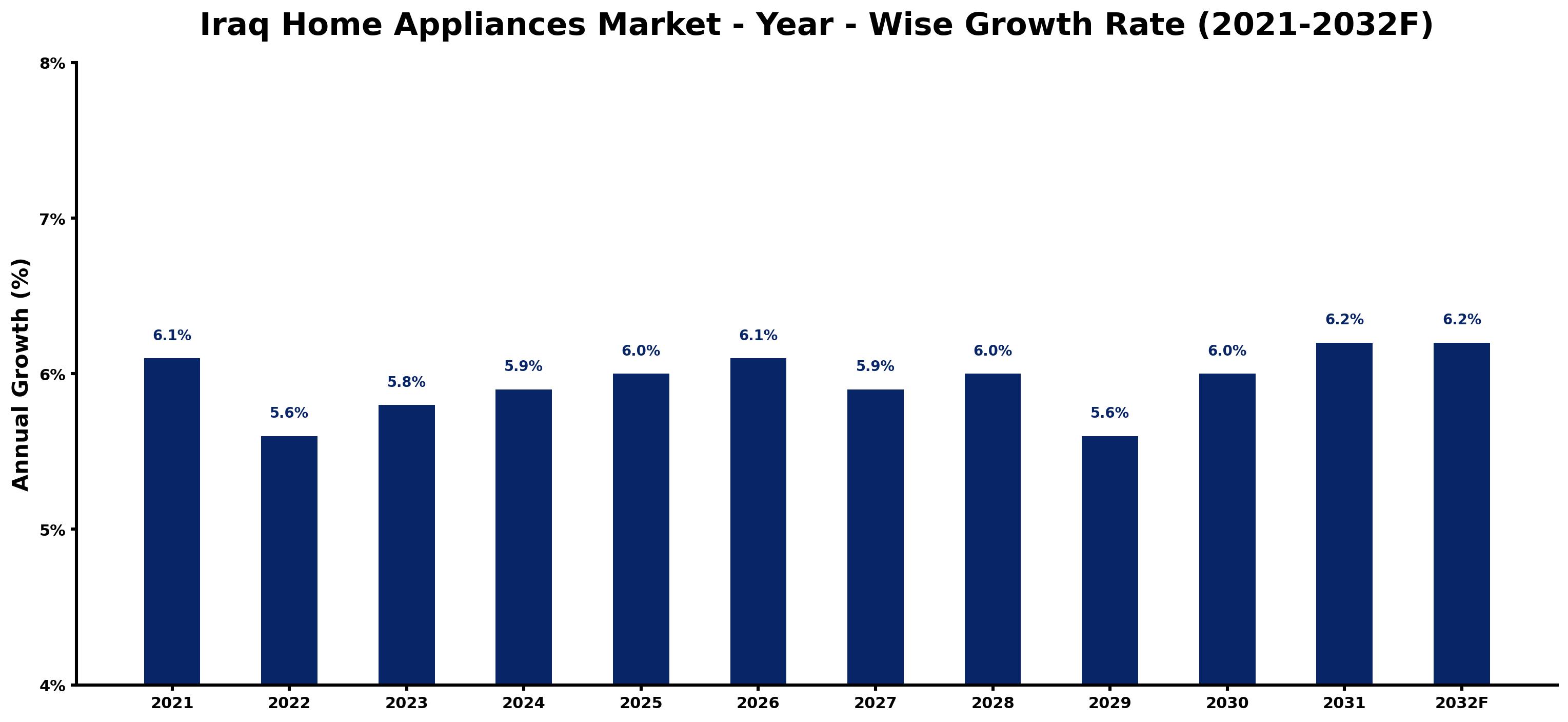
The table below presents the year wise growth rates along with the key drivers influencing the market
| Year | Growth Rate | Major Drivers |
| 2021 | 6.1% | Post-conflict recovery inspires renewed consumer interest in home appliance upgrades. |
| 2022 | 5.6% | Local manufacturing initiatives begin addressing supply chain vulnerabilities in key categories. |
| 2023 | 5.8% | Increased urbanization trends influence demand for compact and multifunctional appliances. |
| 2024 | 5.9% | Rising disposable incomes lead to enhanced consumer willingness to invest in durable goods. |
| 2025 | 6.0% | Integration of smart technology into appliances appeals to tech-savvy younger demographics. |
| 2026 | 6.1% | Expansion of retail infrastructures enables easier access to branded and imported products. |
| 2027 | 5.9% | Eco-conscious consumers push for energy-efficient appliances as utility costs soar. |
| 2028 | 6.0% | Government infrastructure projects boost housing developments, increasing appliance purchasing needs. |
| 2029 | 5.6% | Cultural shifts promote modern lifestyles, driving demand for diverse home appliance categories. |
| 2030 | 6.0% | Enhanced internet connectivity fosters e-commerce growth, reshaping traditional retail landscapes. |
| 2031 | 6.2% | Global market trends encourage local entrepreneurs to innovate and diversify appliance offerings. |
| 2032 | 6.2% | Investment in renewable energy sources further supports sustainability-focused appliance purchases. |
Note - Market size estimations and growth projections presented in this report are based on 6Wresearch's advanced forecasting approach, validated with industry datasets as of June 2026.
Iraq Home Appliances Market Synopsis
The Iraq Home Appliances Market is projected to reach 6.1% and witness significant growth during the forecast period (2026-2032). This dynamic market has experienced substantial expansion over the past decade, driven by a combination of increasing consumer demand, economic recovery, and a burgeoning population of approximately 40 million. The continuous influx of foreign investments has further galvanized sector growth, enhancing both the production and distribution capabilities within the industry. As consumer lifestyles evolve, a diverse array of home appliances—from refrigerators and washing machines to air conditioners—has become essential for modern households.
Iraq Home Appliances Market Growth Drivers
Several factors are propelling the growth of the Iraq home appliances market. Firstly, the nation's improving economic conditions post-conflict have stimulated consumer purchasing power, enabling households to invest in quality appliances. Secondly, an urbanizing population is leading to higher demand for modern conveniences, significantly influencing buying behaviors. Furthermore, a younger demographic increasingly values technology and innovation, shifting preferences towards appliances with advanced features such as energy efficiency and smart technology. Additionally, local manufacturing capabilities are expanding, allowing for more competitively priced products that meet local needs. Lastly, widespread infrastructural development supports better access to modern appliances, facilitating consumer purchases.
Iraq Home Appliances Market Trends and Opportunities
The Iraq home appliances market is witnessing several notable trends. A prominent trend is the increasing adoption of energy-efficient appliances, driven by rising utility costs and heightened environmental awareness among consumers. This shift not only offers cost savings but also aligns with global sustainability goals. Moreover, the demand for smart home appliances is on the rise, with consumers seeking connectivity and automation for added convenience. Additionally, the ongoing development of e-commerce platforms presents significant opportunities for market players, enabling them to reach a broader audience and offer enhanced customer experiences. Another critical trend is the resurgence of local manufacturers who are innovating to provide tailored products that cater to local tastes and purchasing power. Finally, strategic collaborations between international companies and local firms are likely to result in improved product offerings and market penetration.
Iraq Home Appliances Market Challenges and Restraints
Despite its growth potential, the Iraq home appliances market faces various challenges. A significant hurdle is the unstable political climate, which can hinder foreign investments and disrupt supply chains. Additionally, infrastructure deficiencies continue to pose challenges for distribution and logistics, affecting the timely availability of products. The high cost of imported appliances, exacerbated by fluctuating exchange rates, remains a critical concern for consumers. Furthermore, competition from low-cost alternatives may pressure established brands, impeding their market share and profitability. Finally, consumer trust in the quality of locally manufactured products can affect purchasing decisions, necessitating efforts to build confidence in domestic solutions.
Iraq Home Appliances Market Government Investment and Initiatives
The Iraqi government is keenly aware of the importance of the home appliances market for economic growth and employment. To this end, various initiatives have been launched to stimulate investment in this sector. Policies to encourage foreign direct investment include offering incentives and streamlined processes for international firms looking to establish manufacturing facilities in Iraq. Additionally, the government has prioritized modernization of infrastructure, which directly impacts the efficiency of production and distribution networks. Public spending in urban development projects further supports consumer access to appliances. Moreover, several development plans are focused on enhancing local manufacturing capabilities, thereby reducing dependency on imports and positioning Iraq as a competitive player in the home appliances market.
Iraq Home Appliances Market Latest Developments (May 2025 - June 2026)
In the period from May 2025 to June 2026, the Iraq home appliances market has seen a flurry of activity as both international and local players respond to emerging consumer demands. The introduction of new energy-efficient products has gained traction, with brands emphasizing sustainability as a core feature. Moreover, there has been an increased focus on enhancing online sales platforms to accommodate shifting consumer preferences towards e-commerce. Industry players have also been investing in consumer education campaigns to raise awareness about the benefits and features of modern appliances. Additionally, partnerships with local distributors have improved reach and product availability in underserved regions, marking a strategic shift towards localized distribution channels.
Iraq Home Appliances Market - Key Attractiveness of the Report
- 10 Years of Market Numbers
- Historical Data Starting from 2022 to 2025
- Base Year: 2025
- Forecast Data until 2032
- Key Performance Indicators Impacting the Market
- Major Upcoming Developments and Projects
Key Highlights of the Report:
- Iraq Home Appliances Market Outlook
- Market Size of Iraq Home Appliances Market, 2025
- Forecast of Iraq Home Appliances Market, 2032F
- Historical Data and Forecast of Iraq Home Appliances Revenues & Volume for the Period 2022-2032F
- Iraq Home Appliances Market Trend Evolution
- Iraq Home Appliances Market Drivers and Challenges
- Iraq Home Appliances Price Trends
- Iraq Home Appliances Porter's Five Forces
- Iraq Home Appliances Industry Life Cycle
- Historical Data and Forecast of Iraq Home Appliances Market Revenues & Volume By Product Types for the Period 2022-2032F
- Historical Data and Forecast of Iraq Home Appliances Market Revenues & Volume By Kitchen Appliances for the Period 2022-2032F
- Historical Data and Forecast of Iraq Home Appliances Market Revenues & Volume By Washing Appliances for the Period 2022-2032F
- Historical Data and Forecast of Iraq Home Appliances Market Revenues & Volume By Entertainment Appliances for the Period 2022-2032F
- Historical Data and Forecast of Iraq Home Appliances Market Revenues & Volume By Air Conditioner for the Period 2022-2032F
- Historical Data and Forecast of Iraq Home Appliances Market Revenues & Volume By Others for the Period 2022-2032F
- Historical Data and Forecast of Iraq Home Appliances Market Revenues & Volume By Technology for the Period 2022-2032F
- Historical Data and Forecast of Iraq Home Appliances Market Revenues & Volume By Wi-Fi for the Period 2022-2032F
- Historical Data and Forecast of Iraq Home Appliances Market Revenues & Volume By Bluetooth for the Period 2022-2032F
- Historical Data and Forecast of Iraq Home Appliances Market Revenues & Volume By ZigBee for the Period 2022-2032F
- Historical Data and Forecast of Iraq Home Appliances Market Revenues & Volume By Radio Frequency Identification for the Period 2022-2032F
- Historical Data and Forecast of Iraq Home Appliances Market Revenues & Volume By Cellular Technology for the Period 2022-2032F
- Historical Data and Forecast of Iraq Home Appliances Market Revenues & Volume By IoT for the Period 2022-2032F
- Historical Data and Forecast of Iraq Home Appliances Market Revenues & Volume By Distribution Channel for the Period 2022-2032F
- Historical Data and Forecast of Iraq Home Appliances Market Revenues & Volume By Retail for the Period 2022-2032F
- Historical Data and Forecast of Iraq Home Appliances Market Revenues & Volume By E-commerce for the Period 2022-2032F
- Historical Data and Forecast of Iraq Home Appliances Market Revenues & Volume By Others for the Period 2022-2032F
- Iraq Home Appliances Import Export Trade Statistics
- Market Opportunity Assessment By Product Types
- Market Opportunity Assessment By Technology
- Market Opportunity Assessment By Distribution Channel
- Iraq Home Appliances Top Companies Market Share
- Iraq Home Appliances Competitive Benchmarking By Technical and Operational Parameters
- Iraq Home Appliances Company Profiles
- Iraq Home Appliances Key Strategic Recommendations






































