Iraq Medical Tubing Market Size, Share & Growth Rate
The Iraq Medical Tubing Market was estimated at USD 162 Million in 2025 and is projected to reach USD 224 Million by 2032, growing at a CAGR of 4.7% from 2026 to 2032. This steady growth is fueled by significant healthcare investments, a burgeoning demand for medical devices, and continuous advancements in medical technology. As the healthcare infrastructure in Iraq expands, the demand for high-quality medical tubing solutions is set to increase, further propelling market dynamics.
Iraq Medical Tubing Market Year-wise Growth Rate and Key Drivers
This graph highlights how the Iraq Medical Tubing Market has steadily grown over the years, supported by major growth factors.
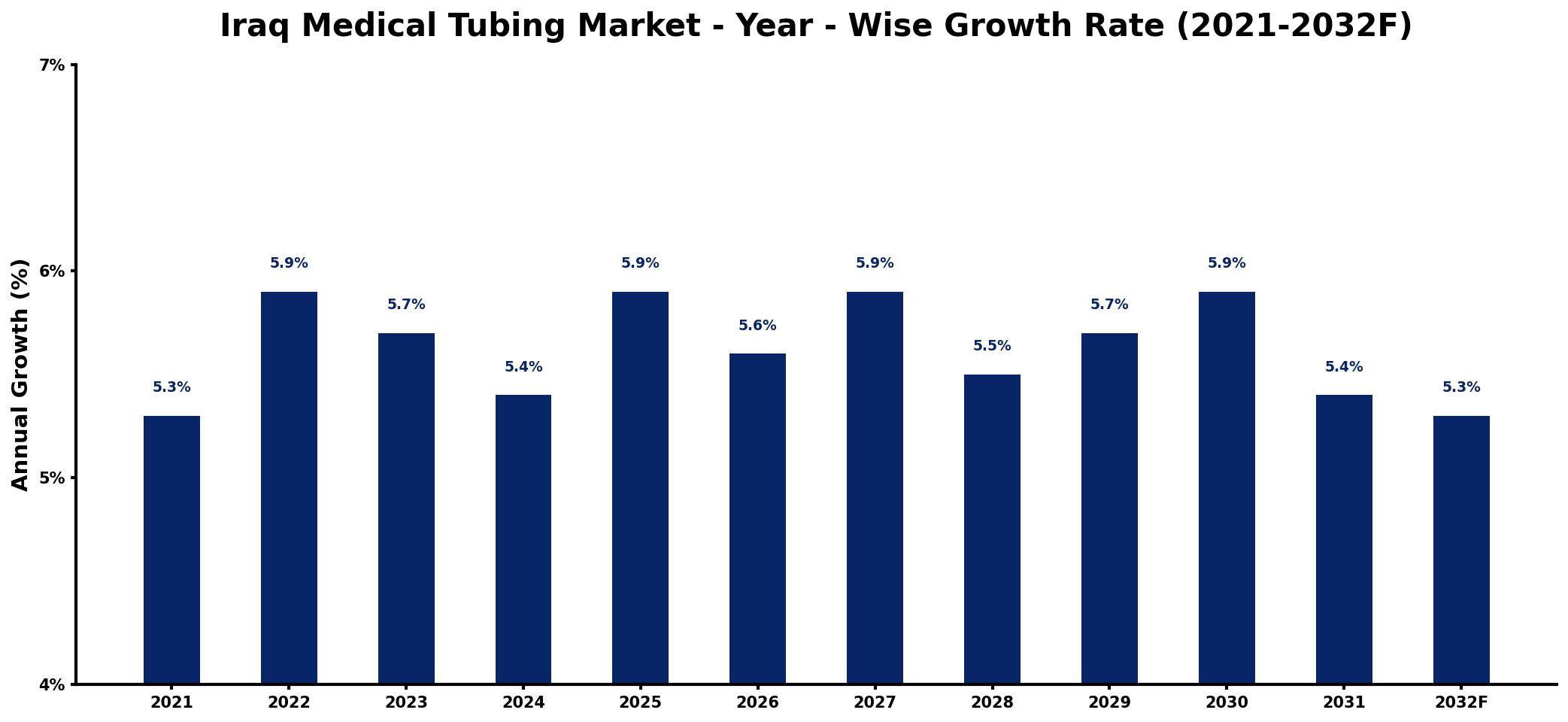
The table below presents the year‑wise growth rates along with the key drivers influencing the market
| Year | Growth Rate | Major Drivers |
| 2021 | 5.3% | Rising healthcare infrastructure investments |
| 2022 | 5.9% | Growing demand for surgical procedures |
| 2023 | 5.7% | Increased focus on patient safety |
| 2024 | 5.4% | Expansion of healthcare facilities |
| 2025 | 5.9% | Advancements in healthcare technology |
| 2026 | 5.6% | Surge in chronic disease prevalence |
| 2027 | 5.9% | Strengthening regulatory compliance standards |
| 2028 | 5.5% | Growth in telemedicine services |
| 2029 | 5.7% | Enhanced distribution networks established |
| 2030 | 5.9% | Rising awareness of hygiene practices |
| 2031 | 5.4% | Increased funding for health initiatives |
| 2032 | 5.3% | Emergence of innovative healthcare solutions |
Note: Market size estimations and growth projections presented in this report are based on 6Wresearch's proprietary forecasting methodology, utilizing the latest available industry data, government publications, and primary research inputs.
Iraq Medical Tubing Market Synopsis
In Iraq, the medical tubing market is prominently characterized by the strong preference for PVC tubing, appreciated for its cost-effectiveness and versatility across various medical applications. However, a notable shift is emerging towards silicone and polyurethane materials, driven by their superior biocompatibility and flexibility, aligning with global healthcare standards.
Amid a backdrop of rising chronic diseases, the demand for innovative medical devices has surged, leading to an uptick in the consumption of medical tubing products. This trend is complemented by a growing emphasis on patient safety and infection control, prompting manufacturers to develop tubing solutions with antimicrobial properties.
Iraq Medical Tubing Market Key Takeaways
- The Iraq Medical Tubing Market is primarily driven by increasing healthcare investments and rising demand for medical devices.
- Advancements in material technology are steering a transition towards silicone and polyurethane options for improved biocompatibility.
- The market is responding to the need for custom-made tubing solutions for specific medical applications.
- Disposable medical tubing is becoming increasingly popular to mitigate risks associated with cross-contamination.
- Regulatory initiatives are encouraging local manufacturing of medical tubing to enhance product quality and safety.
Evaluation of Restraints in Iraq Medical Tubing Market
While the Iraq Medical Tubing Market shows promising growth potential, several challenges persist. The country grapples with limited access to advanced technology and quality raw materials, hindering the production of high-grade medical tubing. Political instability further complicates the landscape, affecting supply chain operations and import-export activities. Additionally, the absence of a robust regulatory framework for medical devices creates barriers for companies aiming to establish credibility and ensure safety standards.
Iraq Medical Tubing Market Trends
The landscape of the Iraq Medical Tubing Market is evolving, shaped by trends such as a growing preference for advanced materials like silicone and thermoplastics, which offer improved biocompatibility and durability. Additionally, there is a rising focus on custom solutions tailored to specific medical applications. Enhanced attention to infection control measures is driving manufacturers to innovate antimicrobial tubing options. The shift towards disposable products reflects a broader effort to reduce the risks associated with cross-contamination and enhance operational efficiency in healthcare settings.
Iraq Medical Tubing Market Opportunities
The Iraq Medical Tubing Market is brimming with investment opportunities, particularly due to the increasing demand for medical devices fueled by a growing population and healthcare needs. Investors can capitalize on this by venturing into manufacturing and distributing high-quality medical tubing for applications such as IV delivery systems and catheters. The ongoing advancements in medical technology, coupled with the expansion of healthcare infrastructure, create fertile ground for growth and innovation.
Government Initiatives in the Iraq Medical Tubing Market
The Iraqi government has introduced various policies aimed at regulating the medical tubing market to ensure the safety and quality of healthcare products. These regulations align with international standards, such as ISO 13485, to govern manufacturing processes. To boost domestic production, the government is offering incentives and support programs, promoting local manufacturing capabilities and reducing reliance on imports. These initiatives are crucial for enhancing healthcare service quality in Iraq.
Future Insights of the Iraq Medical Tubing Market
Looking ahead to 2026-2032, the Iraq Medical Tubing Market is expected to maintain a trajectory of steady growth, propelled by increasing investments in healthcare infrastructure and a heightened focus on quality medical devices. The market stands to benefit significantly from advancements in technology, as well as ongoing government initiatives aimed at improving healthcare services. While challenges like regulatory constraints and economic uncertainties may impede progress, the overall outlook remains optimistic, with substantial growth opportunities in sight.
Iraq Medical Tubing Market Latest Developments (2025 - 2026)
Recent months have seen a notable shift towards the adoption of innovative materials and manufacturing processes in the Iraq Medical Tubing Market. Efforts to enhance biocompatibility and antimicrobial features have gained traction among manufacturers, aligning with global healthcare trends. Additionally, initiatives to foster local production capabilities are being encouraged, setting the stage for improved quality and competitiveness in the market.
Iraq Medical Tubing Market - Key Attractiveness of the Report
- 10 Years of Market Numbers
- Historical Data Starting from 2022 to 2025
- Base Year: 2025
- Forecast Data until 2032
- Key Performance Indicators Impacting the Market
- Major Upcoming Developments and Projects
Key Highlights of the Report:
- Iraq Medical Tubing Market Outlook
- Market Size of Iraq Medical Tubing Market, 2025
- Forecast of Iraq Medical Tubing Market, 2032
- Historical Data and Forecast of Iraq Medical Tubing Revenues & Volume for the Period 2022-2032F
- Iraq Medical Tubing Market Trend Evolution
- Iraq Medical Tubing Market Drivers and Challenges
- Iraq Medical Tubing Price Trends
- Iraq Medical Tubing Porter's Five Forces
- Iraq Medical Tubing Industry Life Cycle
- Historical Data and Forecast of Iraq Medical Tubing Market Revenues & Volume By Material for the Period 2022-2032F
- Historical Data and Forecast of Iraq Medical Tubing Market Revenues & Volume By Plastics for the Period 2022-2032F
- Historical Data and Forecast of Iraq Medical Tubing Market Revenues & Volume By Rubbers for the Period 2022-2032F
- Historical Data and Forecast of Iraq Medical Tubing Market Revenues & Volume By Specialty Polymers for the Period 2022-2032F
- Historical Data and Forecast of Iraq Medical Tubing Market Revenues & Volume By Structure for the Period 2022-2032F
- Historical Data and Forecast of Iraq Medical Tubing Market Revenues & Volume By Single-lumen for the Period 2022-2032F
- Historical Data and Forecast of Iraq Medical Tubing Market Revenues & Volume By Co-extruded for the Period 2022-2032F
- Historical Data and Forecast of Iraq Medical Tubing Market Revenues & Volume By Multi-lumen for the Period 2022-2032F
- Historical Data and Forecast of Iraq Medical Tubing Market Revenues & Volume By Tapered Or Bump Tubing for the Period 2022-2032F
- Historical Data and Forecast of Iraq Medical Tubing Market Revenues & Volume By Braided Tubing for the Period 2022-2032F
- Historical Data and Forecast of Iraq Medical Tubing Market Revenues & Volume By Application for the Period 2022-2032F
- Historical Data and Forecast of Iraq Medical Tubing Market Revenues & Volume By Bulk Disposable Tubing for the Period 2022-2032F
- Historical Data and Forecast of Iraq Medical Tubing Market Revenues & Volume By Catheters & Cannulas for the Period 2022-2032F
- Historical Data and Forecast of Iraq Medical Tubing Market Revenues & Volume By Drug Delivery System for the Period 2022-2032F
- Historical Data and Forecast of Iraq Medical Tubing Market Revenues & Volume By Special Applications for the Period 2022-2032F
- Iraq Medical Tubing Import Export Trade Statistics
- Market Opportunity Assessment By Material
- Market Opportunity Assessment By Structure
- Market Opportunity Assessment By Application
- Iraq Medical Tubing Top Companies Market Share
- Iraq Medical Tubing Competitive Benchmarking By Technical and Operational Parameters
- Iraq Medical Tubing Company Profiles
- Iraq Medical Tubing Key Strategic Recommendations






































