Iraq Oil And Gas Pipeline Market Size, Share & Growth Rate
The Iraq Oil And Gas Pipeline Market was estimated at USD 390 Million in 2025 and is projected to reach USD 534 Million by 2032, growing at a CAGR of 4.6% from 2026 to 2032. This growth trajectory is significantly driven by Iraq's ongoing investment in expanding its pipeline infrastructure, which aims to accommodate increasing crude oil and natural gas production. Additionally, initiatives to enhance security and efficiency of pipeline operations are further propelling the market forward.
Iraq Oil And Gas Pipeline Market Year-wise Growth Rate and Key Drivers
This graph highlights how the Iraq Oil And Gas Pipeline Market has steadily grown over the years, supported by major growth factors.
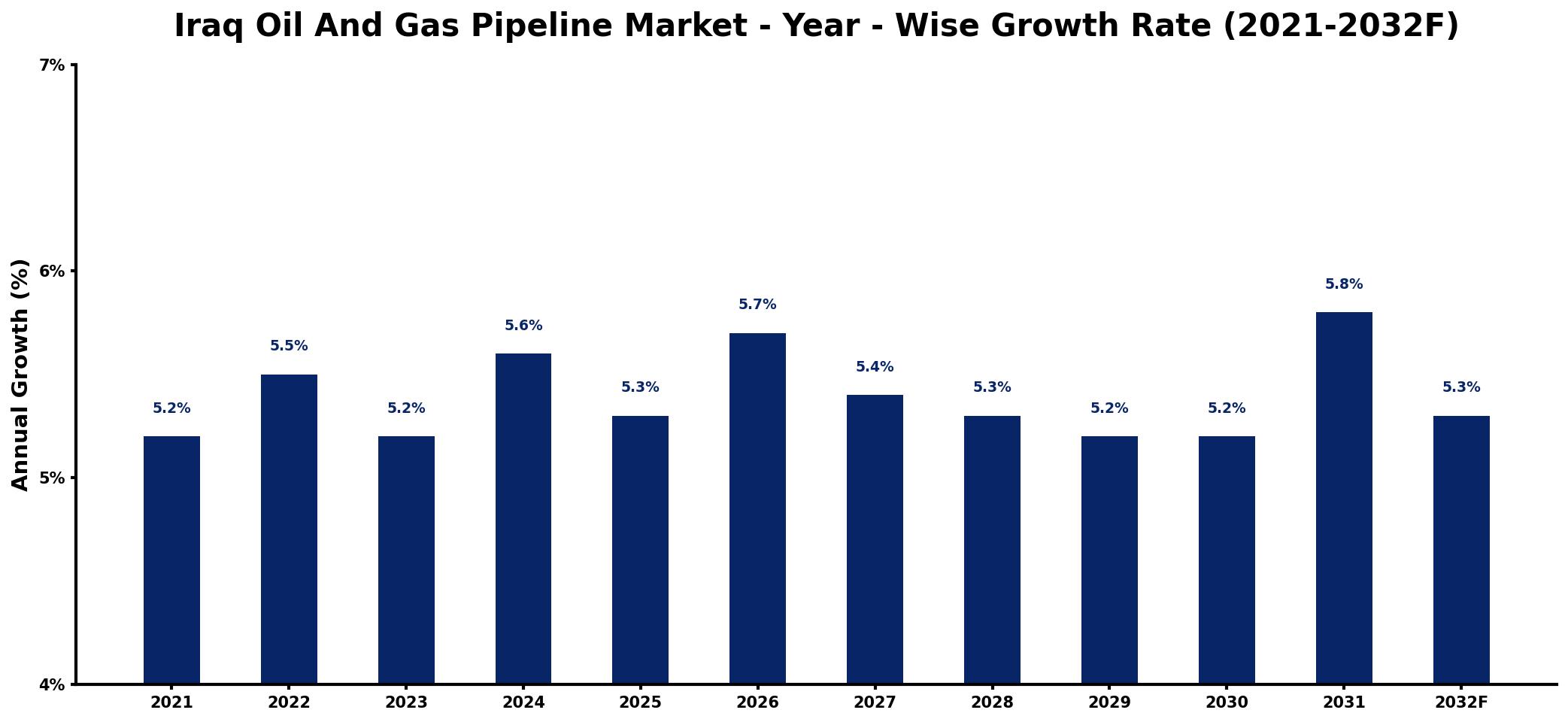
The table below presents the year‑wise growth rates along with the key drivers influencing the market
| Year | Growth Rate | Major Drivers |
| 2021 | 5.2% | Increased infrastructure investment projects |
| 2022 | 5.5% | Rising global energy demand trends |
| 2023 | 5.2% | Expansion of regional trade agreements |
| 2024 | 5.6% | Enhancements in logistics capabilities |
| 2025 | 5.3% | Growing foreign direct investments |
| 2026 | 5.7% | Development of renewable energy initiatives |
| 2027 | 5.4% | Strengthening of local manufacturing capabilities |
| 2028 | 5.3% | Advancements in technology integration |
| 2029 | 5.2% | Increased collaboration with international partners |
| 2030 | 5.2% | Emergence of new market players |
| 2031 | 5.8% | improved processing technologies adoption |
| 2032 | 5.3% | Growing focus on energy efficiency |
Note: Market size estimations and growth projections presented in this report are based on 6Wresearch's proprietary forecasting methodology, utilizing the latest available industry data, government publications, and primary research inputs.
Iraq Oil And Gas Pipeline Market Synopsis
Recent momentum in the Iraq oil and gas pipeline market highlights a proactive approach to energy infrastructure development despite existing challenges. With substantial oil reserves and strategic initiatives aimed at pipeline expansion, the sector is positioned for growth.
As Iraq continues to improve its pipeline systems, including projects like the Basra-Aqaba and Iraq-Jordan pipelines, the market is set for transformative changes. The commitment to modernizing infrastructure is vital for enhancing operational efficiency and ensuring the countrys role in the global energy landscape.
Iraq Oil And Gas Pipeline Market Key Takeaways
- The market is poised for substantial growth due to significant infrastructure investments.
- Enhanced security measures are being prioritized to mitigate operational risks.
- Advanced technologies are being adopted to optimize pipeline operations and maintenance.
- Diversification of export routes is crucial for reducing dependence on existing networks.
- The Iraqi government's policies are aimed at fostering transparency and attracting foreign investment.
Evaluation of Restraints in Iraq Oil And Gas Pipeline Market
The Iraq Oil and Gas Pipeline Market faces several restraints that could limit its potential. Security risks due to political instability continue to pose significant challenges, often resulting in operational disruptions and infrastructure delays. Furthermore, regulatory uncertainties and bureaucratic hurdles can impede investments and complicate project implementations. The reliance on outdated technologies further constrains the efficiency of transporting oil and gas resources, complicating efforts to optimize and modernize the existing pipeline network. These factors present ongoing challenges for stakeholders in the market.
Iraq Oil And Gas Pipeline Market Trends
The current trends within the Iraq Oil and Gas Pipeline Market reflect a landscape that is rapidly evolving. One of the most prominent trends is the aggressive expansion of pipeline infrastructure, necessitated by the country's increasing oil and gas production capabilities. This growth is accompanied by heightened security measures and improvements in the resilience of existing pipelines to combat disruptions. Moreover, the integration of advanced technology and automation solutions is gaining traction, aimed at enhancing operational efficiency and reducing maintenance costs. Lastly, a shift towards diversifying export routes and improving regional connectivity underscores the importance of expanding market access for Iraq's energy resources.
Iraq Oil And Gas Pipeline Market Opportunities
Investment opportunities in the Iraq Oil and Gas Pipeline Market are robust, fueled by the country's extensive oil reserves and favorable geographical position. Ongoing projects present considerable potential for the construction and rehabilitation of pipelines, appealing to investors interested in capitalizing on the energy sector. Moreover, partnerships with international firms can facilitate the introduction of modern technologies, further enhancing the safety and efficiency of pipeline operations. Despite prevalent security risks, the prospect of long-term returns in this market remains enticing for stakeholders looking to leverage Iraq's energy wealth.
Government Initiatives in the Iraq Oil And Gas Pipeline Market
The Iraqi government plays a pivotal role in shaping the Oil and Gas Pipeline Market through various initiatives aimed at bolstering production capacity and infrastructure development. Policies designed to promote transparency and efficiency focus on reducing corruption and fostering fair competition within the sector. Additionally, regulations emphasizing domestic consumption and equitable resource distribution reflect the governments commitment to both local and international stakeholders. The administration's efforts to establish strategic partnerships with foreign companies are integral to developing and expanding the pipeline network, thereby fostering sustainable growth.
Future Insights of the Iraq Oil And Gas Pipeline Market
The outlook for the Iraq Oil and Gas Pipeline Market from 2026 to 2032 is optimistic, characterized by an ongoing emphasis on infrastructure enhancement and production capacity growth. Iraq's strategic positioning within the global energy landscape, combined with rising energy demands, positions the country as a vital player in the sector. Investments in pipeline projects like the Basra-Aqaba and Iraq-Jordan pipelines are expected to not only bolster export capacity but also reinforce Iraq's status as a key oil exporter. However, navigating geopolitical tensions and regulatory complexities will be crucial for stakeholders aiming to realize the full potential of the market.
Iraq Oil And Gas Pipeline Market Latest Developments (2025 - 2026)
In recent months, the Iraq Oil and Gas Pipeline Market has seen significant industry direction towards enhancing the security and efficiency of existing pipeline infrastructure. Investment initiatives are gaining momentum, with public and private sector collaborations focusing on upgrading technology and implementing better safety measures. Furthermore, exploratory agreements with neighboring countries are being discussed to facilitate expanded regional energy collaborations, signifying a shift towards a more interconnected energy framework in the region.
Iraq Oil And Gas Pipeline Market - Key Attractiveness of the Report
- 10 Years of Market Numbers
- Historical Data Starting from 2022 to 2025
- Base Year: 2025
- Forecast Data until 2032
- Key Performance Indicators Impacting the Market
- Major Upcoming Developments and Projects
Key Highlights of the Report:
- Iraq Oil And Gas Pipeline Market Outlook
- Market Size of Iraq Oil And Gas Pipeline Market, 2025
- Forecast of Iraq Oil And Gas Pipeline Market, 2032
- Historical Data and Forecast of Iraq Oil And Gas Pipeline Revenues & Volume for the Period 2022-2032F
- Iraq Oil And Gas Pipeline Market Trend Evolution
- Iraq Oil And Gas Pipeline Market Drivers and Challenges
- Iraq Oil And Gas Pipeline Price Trends
- Iraq Oil And Gas Pipeline Porter's Five Forces
- Iraq Oil And Gas Pipeline Industry Life Cycle
- Historical Data and Forecast of Iraq Oil And Gas Pipeline Market Revenues & Volume By Location of Deployment for the Period 2022-2032F
- Historical Data and Forecast of Iraq Oil And Gas Pipeline Market Revenues & Volume By Onshore for the Period 2022-2032F
- Historical Data and Forecast of Iraq Oil And Gas Pipeline Market Revenues & Volume By Offshore for the Period 2022-2032F
- Historical Data and Forecast of Iraq Oil And Gas Pipeline Market Revenues & Volume By Type for the Period 2022-2032F
- Historical Data and Forecast of Iraq Oil And Gas Pipeline Market Revenues & Volume By Crude Oil Pipeline for the Period 2022-2032F
- Historical Data and Forecast of Iraq Oil And Gas Pipeline Market Revenues & Volume By Gas Pipeline for the Period 2022-2032F
- Iraq Oil And Gas Pipeline Import Export Trade Statistics
- Market Opportunity Assessment By Location of Deployment
- Market Opportunity Assessment By Type
- Iraq Oil And Gas Pipeline Top Companies Market Share
- Iraq Oil And Gas Pipeline Competitive Benchmarking By Technical and Operational Parameters
- Iraq Oil And Gas Pipeline Company Profiles
- Iraq Oil And Gas Pipeline Key Strategic Recommendations






































