Iraq Organic Chemicals Market Size, Share & Growth Rate
The Iraq Organic Chemicals Market was estimated at USD 466 Million in 2025 and is projected to reach USD 656 Million by 2032, growing at a CAGR of 5.0% from 2026 to 2032. This growth trajectory is fueled by increased industrial activities in pharmaceuticals, agriculture, and manufacturing. As awareness regarding environmental sustainability rises, industries are increasingly leaning towards organic chemicals that offer both ecological benefits and enhanced product quality.
Iraq Organic Chemicals Market Year-wise Growth Rate and Key Drivers
This graph highlights how the Iraq Organic Chemicals Market has steadily grown over the years, supported by major growth factors.
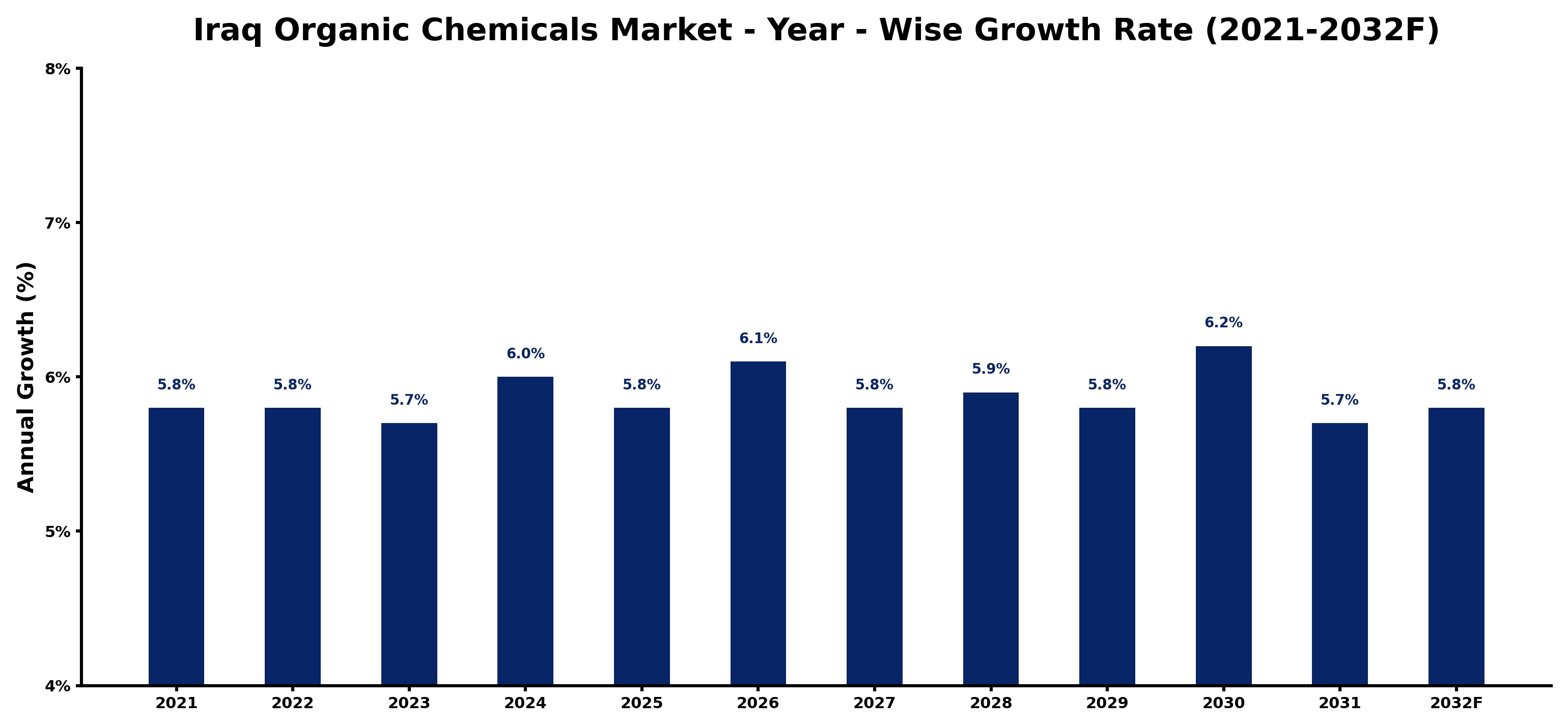
The table below presents the year‑wise growth rates along with the key drivers influencing the market
| Year | Growth Rate | Major Drivers |
| 2021 | 5.8% | Expansion of manufacturing activities |
| 2022 | 5.8% | Expansion of manufacturing activities |
| 2023 | 5.7% | Increasing industrial infrastructure investments |
| 2024 | 6.0% | Growing renewable energy integration projects |
| 2025 | 5.8% | Government infrastructure modernization initiatives |
| 2026 | 6.1% | Increasing industrial automation investments |
| 2027 | 5.8% | Increasing smart city development projects |
| 2028 | 5.9% | Increasing smart city development projects |
| 2029 | 5.8% | Increasing industrial infrastructure investments |
| 2030 | 6.2% | Increasing adoption of advanced technologies |
| 2031 | 5.7% | Increasing smart city development projects |
| 2032 | 5.8% | Increasing smart city development projects |
Note - Market size estimations and growth projections presented in this report are based on 6Wresearch's advanced forecasting approach, validated with industry datasets as of June 2026.
Iraq Organic Chemicals Market Synopsis
The Iraq Organic Chemicals Market has shown recent momentum fueled by a surge in demand across key sectors. However, while the immediate landscape presents opportunities, the market is on the brink of transformation as businesses strive for sustainable practices and innovative solutions. This shift suggests a strong potential for long-term growth driven by both local initiatives and international interest.
As industries grapple with environmental regulations and consumer preferences, the focus on eco-friendly organic chemicals is intensifying. Coupled with government support aimed at fostering domestic production, the market is poised to evolve rapidly, offering vast prospects for investments and strategic partnerships.
Iraq Organic Chemicals Market Key Takeaways
- The market is projected to grow from USD 466 Million in 2025 to USD 656 Million by 2032, with a CAGR of 5.0% from 2026 to 2032.
- Increasing demand in pharmaceuticals, agriculture, and manufacturing sectors is a major growth driver.
- Emergence of eco-friendly organic chemicals is reshaping consumer preferences and industry standards.
- Government initiatives are enhancing local production capabilities, thereby reducing import dependency.
- Investment opportunities abound, especially in sustainable production methods and innovative chemical applications.
Evaluation of Restraints in Iraq Organic Chemicals Market
Despite the promising outlook, several factors restrain growth in the Iraq Organic Chemicals Market. Limited infrastructure hampers the efficient production and distribution of organic chemicals. Additionally, ongoing political instability and security concerns create uncertainties, deterring potential investors. Regulatory challenges further complicate the landscape, as companies navigate complex compliance requirements. These obstacles necessitate a strategic approach for businesses looking to capitalize on the market's growth potential.
Iraq Organic Chemicals Market Trends
Current trends indicate a significant shift toward sustainable practices within the organic chemicals sector. An increasing number of companies are investing in research and development to produce eco-friendly and bio-based chemicals that minimize environmental impact. The focus is not only on meeting regulatory demands but also on aligning with consumer expectations for environmentally responsible products. Furthermore, advancements in technology are leading to innovative chemical formulations that offer superior performance and functionality, thereby enhancing their appeal across diverse industries.
Iraq Organic Chemicals Market Opportunities
The Iraq Organic Chemicals Market is ripe with investment opportunities, particularly given the country's rich natural resource base. Key growth areas include organic chemicals tailored for agriculture, pharmaceuticals, cosmetics, and food processing. The government's ongoing efforts to diversify the economy provide an encouraging backdrop for potential investors. Additionally, collaborative ventures with local manufacturers can leverage Iraq's strategic location to enhance supply chain efficiency and market reach, further catalyzing growth in this sector.
Government Initiatives in the Iraq Organic Chemicals Market
Government policies are increasingly focused on bolstering local manufacturing in the organic chemicals space. Initiatives include tax incentives, subsidies, and support for investments aimed at reducing import reliance. Furthermore, regulatory frameworks are being established to ensure safety and environmental compliance in chemical production. By promoting research and development, the Iraqi government seeks to enhance the competitiveness of its domestic chemical industry, ultimately contributing to broader economic growth and self-sufficiency.
Future Insights of the Iraq Organic Chemicals Market
Looking ahead to the 2026-2032 period, the Iraq Organic Chemicals Market is expected to continue its upward trajectory. The ongoing industrialization and increasing demand from various sectors will play a crucial role in driving market expansion. As consumers and businesses prioritize environmental sustainability, the market for organic chemicals is likely to gain momentum. However, sustained efforts to address infrastructure and political challenges will be essential to fully realize the market's potential.
Iraq Organic Chemicals Market Latest Developments (May 2025 - June 2026)
Recent developments in the Iraq Organic Chemicals Market indicate a growing focus on eco-friendly practices and innovative product offerings. Investment in technology aimed at enhancing production efficiency has gained traction among local manufacturers. Additionally, international collaborations are becoming more common, with entities seeking to establish a foothold in the burgeoning market. As the landscape continues to evolve, staying abreast of these changes will be crucial for stakeholders looking to capitalize on emerging opportunities.
Iraq Organic Chemicals Market - Key Attractiveness of the Report
- 10 Years of Market Numbers
- Historical Data Starting from 2022 to 2025
- Base Year: 2025
- Forecast Data until 2032
- Key Performance Indicators Impacting the Market
- Major Upcoming Developments and Projects
Key Highlights of the Report:
- Iraq Organic Chemicals Market Outlook
- Market Size of Iraq Organic Chemicals Market, 2025
- Forecast of Iraq Organic Chemicals Market, 2032
- Historical Data and Forecast of Iraq Organic Chemicals Revenues & Volume for the Period 2022-2032F
- Iraq Organic Chemicals Market Trend Evolution
- Iraq Organic Chemicals Market Drivers and Challenges
- Iraq Organic Chemicals Price Trends
- Iraq Organic Chemicals Porter's Five Forces
- Iraq Organic Chemicals Industry Life Cycle
- Historical Data and Forecast of Iraq Organic Chemicals Market Revenues & Volume By Source for the Period 2022-2032F
- Historical Data and Forecast of Iraq Organic Chemicals Market Revenues & Volume By Natural for the Period 2022-2032F
- Historical Data and Forecast of Iraq Organic Chemicals Market Revenues & Volume By Synthetic for the Period 2022-2032F
- Historical Data and Forecast of Iraq Organic Chemicals Market Revenues & Volume By Product Type for the Period 2022-2032F
- Historical Data and Forecast of Iraq Organic Chemicals Market Revenues & Volume By Acetic acid for the Period 2022-2032F
- Historical Data and Forecast of Iraq Organic Chemicals Market Revenues & Volume By Ethyl alcohol for the Period 2022-2032F
- Historical Data and Forecast of Iraq Organic Chemicals Market Revenues & Volume By Methanol for the Period 2022-2032F
- Historical Data and Forecast of Iraq Organic Chemicals Market Revenues & Volume By Formaldehyde for the Period 2022-2032F
- Historical Data and Forecast of Iraq Organic Chemicals Market Revenues & Volume By Aldehydes for the Period 2022-2032F
- Historical Data and Forecast of Iraq Organic Chemicals Market Revenues & Volume By Citric acid for the Period 2022-2032F
- Historical Data and Forecast of Iraq Organic Chemicals Market Revenues & Volume By Ketones for the Period 2022-2032F
- Historical Data and Forecast of Iraq Organic Chemicals Market Revenues & Volume By Others for the Period 2022-2032F
- Historical Data and Forecast of Iraq Organic Chemicals Market Revenues & Volume By End-use for the Period 2022-2032F
- Historical Data and Forecast of Iraq Organic Chemicals Market Revenues & Volume By Pharmaceuticals for the Period 2022-2032F
- Historical Data and Forecast of Iraq Organic Chemicals Market Revenues & Volume By Pesticides for the Period 2022-2032F
- Historical Data and Forecast of Iraq Organic Chemicals Market Revenues & Volume By Agrochemicals for the Period 2022-2032F
- Historical Data and Forecast of Iraq Organic Chemicals Market Revenues & Volume By Plastics and polymers for the Period 2022-2032F
- Historical Data and Forecast of Iraq Organic Chemicals Market Revenues & Volume By Cosmetics for the Period 2022-2032F
- Historical Data and Forecast of Iraq Organic Chemicals Market Revenues & Volume By Food & Beverages for the Period 2022-2032F
- Historical Data and Forecast of Iraq Organic Chemicals Market Revenues & Volume By Others for the Period 2022-2032F
- Iraq Organic Chemicals Import Export Trade Statistics
- Market Opportunity Assessment By Source
- Market Opportunity Assessment By Product Type
- Market Opportunity Assessment By End-use
- Iraq Organic Chemicals Top Companies Market Share
- Iraq Organic Chemicals Competitive Benchmarking By Technical and Operational Parameters
- Iraq Organic Chemicals Company Profiles
- Iraq Organic Chemicals Key Strategic Recommendations






































