Iraq Retail Market Size, Share & Growth Rate
The Iraq Retail Market was estimated at USD 486 Million in 2025 and is projected to reach USD 879 Million by 2032, growing at a CAGR of 8.8% from 2026 to 2032. This robust growth trajectory is being driven by a youthful population increasingly drawn to modern shopping experiences and the convenience offered by e-commerce platforms. As urbanization continues to rise, a growing appetite for international brands and diverse product ranges is evident among consumers.
Iraq Retail Market Year-wise Growth Rate and Key Drivers
This graph highlights how the Iraq Retail Market has steadily grown over the years, supported by major growth factors.
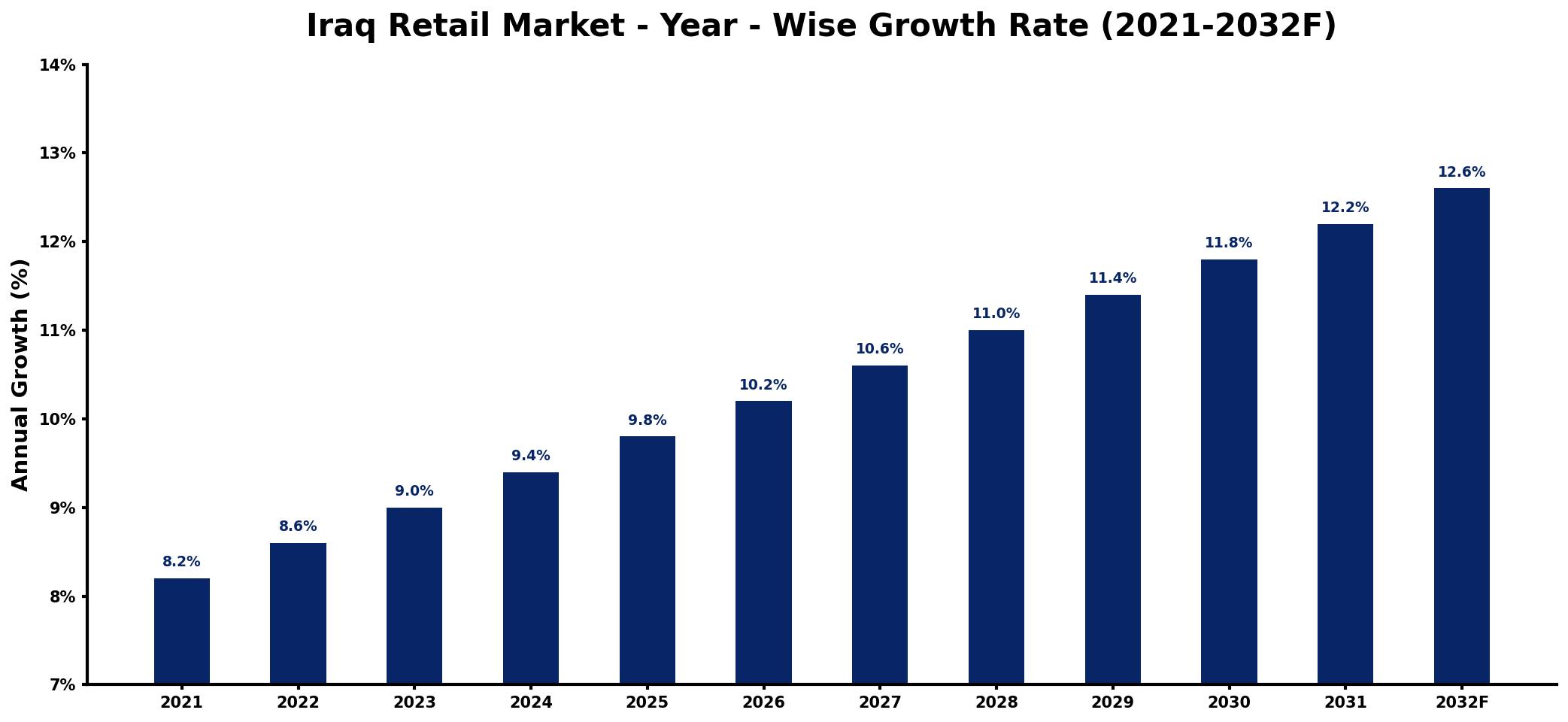
The table below presents the year‑wise growth rates along with the key drivers influencing the market
| Year | Growth Rate | Major Drivers |
| 2021 | 8.2% | Rising consumer spending power |
| 2022 | 8.6% | Expansion of e-commerce platforms |
| 2023 | 9.0% | Increased foreign direct investment |
| 2024 | 9.4% | Growth in middle-class population |
| 2025 | 9.8% | Enhanced logistics and infrastructure |
| 2026 | 10.2% | Diversification of local businesses |
| 2027 | 10.6% | Boost in tourism and hospitality |
| 2028 | 11.0% | Improved digital payment systems |
| 2029 | 11.4% | Surge in brand awareness campaigns |
| 2030 | 11.8% | Development of urban shopping centers |
| 2031 | 12.2% | Strengthened local supply chains |
| 2032 | 12.6% | Rising demand for sustainable products |
Note: Market size estimations and growth projections presented in this report are based on 6Wresearch's proprietary forecasting methodology, utilizing the latest available industry data, government publications, and primary research inputs.
Iraq Retail Market Synopsis
The Iraq retail landscape is rapidly evolving, characterized by a unique blend of traditional markets and emerging modern retail formats. As the population grows and urban centers expand, consumers are seeking more organized retail environments that provide a wider selection of goods and services.
Current trends reflect a significant shift toward digitalization, with a marked increase in online shopping preferences. Retailers are responding by enhancing their omnichannel strategies, merging the in-store and online experiences to meet the demands of the modern Iraqi consumer.
Iraq Retail Market Key Takeaways
- The retail sector is expanding rapidly due to urbanization and a growing, younger consumer base.
- Online shopping is becoming increasingly popular as technology adoption rises in the country.
- International brands are entering the market, stimulating competition and diversifying product offerings.
- Political stability and improved infrastructure will be essential for sustained market growth.
- Retail investment opportunities exist primarily in food & beverage, fashion, electronics, and e-commerce.
Evaluation of Restraints in Iraq Retail Market
Despite its potential, the Iraq retail market grapples with significant restraints. Political instability continues to undermine consumer confidence, while security threats pose risks to both physical retail locations and online operations. Additionally, the lack of robust infrastructure—marked by inadequate transportation networks and inconsistent electricity supply—restricts logistics efficiency and accessibility. These factors collectively impede the market's ability to fully realize its growth potential, although the prospects for improvement remain on the horizon.
Iraq Retail Market Trends
Key trends shaping the Iraq retail market include a growing inclination towards e-commerce, driven by improved internet penetration and increasing smartphone usage. Consumers are increasingly seeking convenience, prompting retailers to embrace technology. Innovations in payment methods and logistics are also transforming the shopping experience, with many traditional retailers adopting digital tools to remain competitive.
Moreover, a notable interest in international brands has emerged, providing consumers access to a broader range of high-quality products. This evolving retail landscape is characterized by heightened competition as local retailers adapt to meet changing consumer expectations.
Iraq Retail Market Opportunities
The Iraq retail market is ripe with investment opportunities. The burgeoning middle class, along with rising disposable incomes, is leading to increased demand for diverse consumer products and services. Key sectors such as food and beverage, fashion, and electronics present considerable potential for growth. Retailers that successfully tailor their offerings to local preferences while leveraging digital platforms will likely capitalize on the evolving market dynamics, positioning themselves for significant returns.
Government Initiatives in the Iraq Retail Market
The Iraqi government has initiated several policies aimed at bolstering the retail sector. These include measures to protect local businesses through import tariffs and incentives for small and medium-sized enterprises. Furthermore, the government is actively working on improving infrastructure to facilitate the movement of goods and enhance consumer protection initiatives. Such initiatives aim to foster a conducive environment for retailers while encouraging fair competition.
Future Insights of the Iraq Retail Market
Looking ahead to the period between 2026 and 2032, the Iraq retail market is expected to experience robust expansion, propelled by demographic trends and increased foreign investment. The rising adoption of e-commerce platforms will create further avenues for growth, enabling retailers to reach wider audiences. As the economy stabilizes and consumer confidence gradually returns, both local and international businesses have the chance to thrive in this dynamic retail landscape.
Iraq Retail Market Latest Developments (2025 - 2026)
Recent developments in the Iraq retail market indicate a significant shift towards enhanced digital engagement and innovative retail strategies. Many local businesses are increasingly adopting technology to create seamless omnichannel experiences. Additionally, the presence of international brands is likely to expand, further enriching the market. Infrastructure improvements are also in progress, aiming to boost logistics capabilities and support the growing retail sector.
Iraq Retail Market - Key Attractiveness of the Report
- 10 Years of Market Numbers
- Historical Data Starting from 2022 to 2025
- Base Year: 2025
- Forecast Data until 2032
- Key Performance Indicators Impacting the Market
- Major Upcoming Developments and Projects
Key Highlights of the Report:
- Iraq Retail Market Outlook
- Market Size of Iraq Retail Market, 2025
- Forecast of Iraq Retail Market, 2032
- Historical Data and Forecast of Iraq Retail Revenues & Volume for the Period 2022-2032F
- Iraq Retail Market Trend Evolution
- Iraq Retail Market Drivers and Challenges
- Iraq Retail Price Trends
- Iraq Retail Porter's Five Forces
- Iraq Retail Industry Life Cycle
- Historical Data and Forecast of Iraq Retail Market Revenues & Volume By Product for the Period 2022-2032F
- Historical Data and Forecast of Iraq Retail Market Revenues & Volume By Food and Beverages for the Period 2022-2032F
- Historical Data and Forecast of Iraq Retail Market Revenues & Volume By Personal and Household Care for the Period 2022-2032F
- Historical Data and Forecast of Iraq Retail Market Revenues & Volume By Apparel for the Period 2022-2032F
- Historical Data and Forecast of Iraq Retail Market Revenues & Volume By Footwear and Accessories for the Period 2022-2032F
- Historical Data and Forecast of Iraq Retail Market Revenues & Volume By Furniture for the Period 2022-2032F
- Historical Data and Forecast of Iraq Retail Market Revenues & Volume By Toys for the Period 2022-2032F
- Historical Data and Forecast of Iraq Retail Market Revenues & Volume By Electronic and Household Appliances for the Period 2022-2032F
- Historical Data and Forecast of Iraq Food and Beverages Retail Market Revenues & Volume By Other Products for the Period 2022-2032F
- Historical Data and Forecast of Iraq Retail Market Revenues & Volume By Distribution Channel for the Period 2022-2032F
- Historical Data and Forecast of Iraq Retail Market Revenues & Volume By Supermarkets/Hypermarkets for the Period 2022-2032F
- Historical Data and Forecast of Iraq Retail Market Revenues & Volume By Convenience Stores for the Period 2022-2032F
- Historical Data and Forecast of Iraq Retail Market Revenues & Volume By Department Stores for the Period 2022-2032F
- Historical Data and Forecast of Iraq Retail Market Revenues & Volume By Specialty Stores for the Period 2022-2032F
- Historical Data and Forecast of Iraq Retail Market Revenues & Volume By Online for the Period 2022-2032F
- Historical Data and Forecast of Iraq Retail Market Revenues & Volume By Other Distribution Channels for the Period 2022-2032F
- Iraq Retail Import Export Trade Statistics
- Market Opportunity Assessment By Product
- Market Opportunity Assessment By Distribution Channel
- Iraq Retail Top Companies Market Share
- Iraq Retail Competitive Benchmarking By Technical and Operational Parameters
- Iraq Retail Company Profiles
- Iraq Retail Key Strategic Recommendations






































