Iraq Sodium chloride Market Size, Share & Growth Rate
The Iraq Sodium chloride Market was estimated at USD 308 Million in 2025 and is projected to reach USD 406 Million by 2032, growing at a CAGR of 4.0% from 2026 to 2032. This growth trajectory is fueled by a combination of increasing industrial activities, particularly in the food processing and chemical sectors, alongside rising demand for pharmaceuticals. Additionally, the government's initiatives to bolster local production and reduce import reliance are set to further enhance market prospects.
Iraq Sodium chloride Market Year-wise Growth Rate and Key Drivers
This graph highlights how the Iraq Sodium chloride Market has steadily grown over the years, supported by major growth factors.
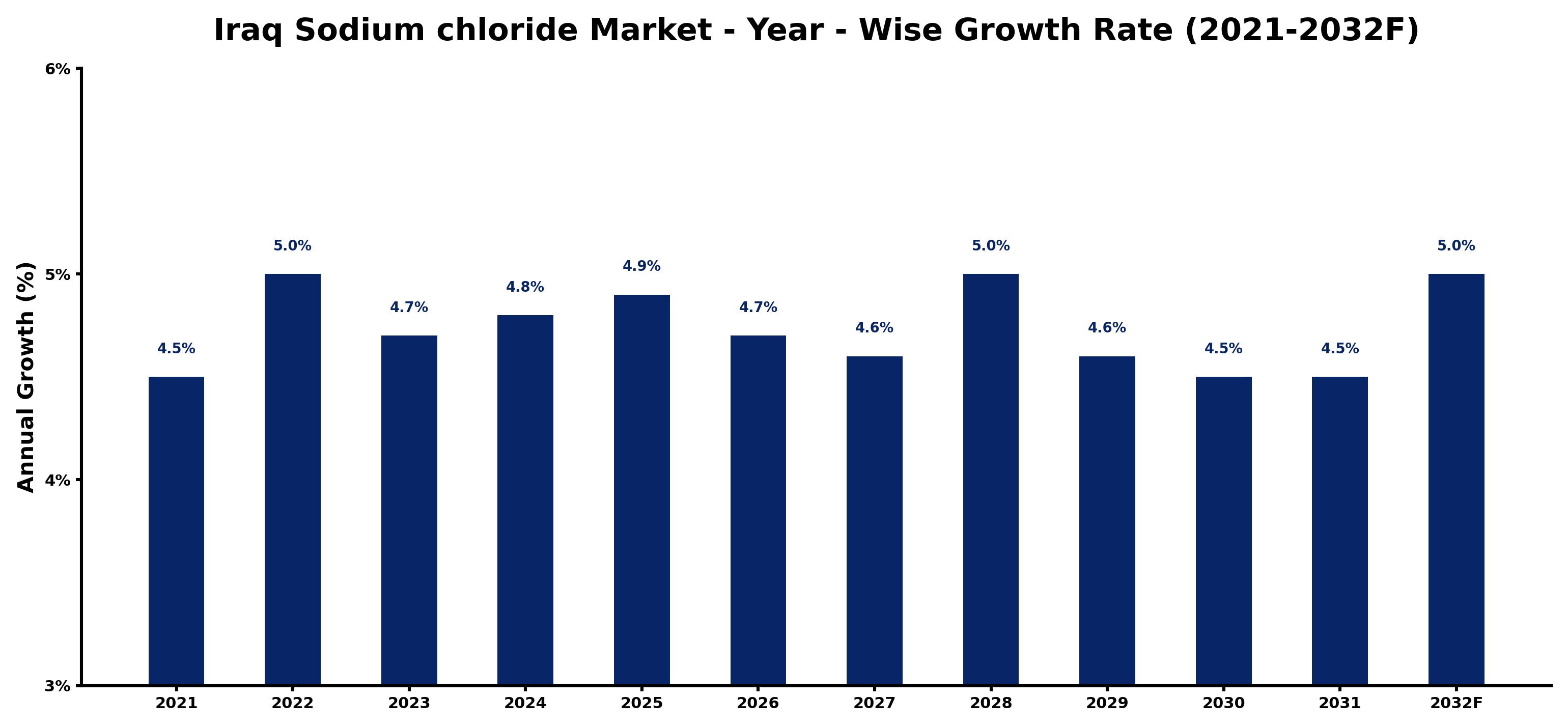
The table below presents the year‑wise growth rates along with the key drivers influencing the market
| Year | Growth Rate | Major Drivers |
| 2021 | 4.5% | Improved transportation infrastructure boosts sodium chloride export capabilities |
| 2022 | 5.0% | Local production enhancements boost sodium chloride processing efficiency |
| 2023 | 4.7% | Modernized extraction techniques boost local sodium chloride production efficiency |
| 2024 | 4.8% | Improved chemical processing capabilities boosted local sodium chloride production |
| 2025 | 4.9% | Domestic investment in brine extraction technologies boosts production capacity |
| 2026 | 4.7% | Production recovery in construction sectors boosts sodium chloride demand |
| 2027 | 4.6% | Modernized extraction techniques boost sodium chloride production efficiency |
| 2028 | 5.0% | Higher evaporation pond investments boosted sodium chloride output efficiency |
| 2029 | 4.6% | Advanced processing technologies enhance sodium chloride production efficiency |
| 2030 | 4.5% | Domestic chemical sector investment boosted sodium chloride production capabilities |
| 2031 | 4.5% | Local salt mine investments boosted sodium chloride production capacity |
| 2032 | 5.0% | Manufacturing investments in logistics enhanced sodium chloride supply chains |
Note - Market size estimations and growth projections presented in this report are based on 6Wresearch's advanced forecasting approach, validated with industry datasets as of June 2026.
Iraq Sodium chloride Market Synopsis
The Iraqi sodium chloride market is thriving, driven by robust demand across diverse industries such as food processing, pharmaceuticals, and oil and gas. The country's rich natural salt resources create a solid foundation for growth, enabling local production to cater to domestic needs effectively.
As the population continues to grow and industrialization accelerates, sodium chloride's versatility as a key ingredient in numerous applications becomes increasingly critical. A focus on product quality and sustainability also shapes market dynamics, with manufacturers innovating to meet both consumer demands and regulatory requirements.
Iraq Sodium chloride Market Key Takeaways
- Consistent demand from multiple sectors including food, pharmaceuticals, and chemicals is a significant driver of growth.
- The Iraqi government's support for local production aims to reduce dependency on imports and enhance market competitiveness.
- Growing awareness about the health benefits associated with high-quality sodium chloride is influencing consumer preferences.
- Manufacturers are prioritizing product innovation and expanding distribution channels to adapt to evolving market needs.
- Challenges such as fluctuating raw material prices and regulatory compliance impact operational efficiency and profitability.
Evaluation of Restraints in Iraq Sodium chloride Market
Despite the positive outlook, the Iraq Sodium chloride market faces several restraints that could limit its growth. Fluctuating prices due to shifting supply and demand dynamics pose significant risks to manufacturers and distributors. Political instability can also create an unpredictable business environment, hampering investment and operational decisions. Furthermore, logistical challenges stemming from inadequate infrastructure may hinder the efficient distribution of sodium chloride, while compliance with evolving regulatory frameworks can strain resources for local producers. Navigating these complexities requires strategic foresight and adaptive measures from market participants.
Iraq Sodium chloride Market Trends
The current trends in the Iraq Sodium chloride market highlight a growing emphasis on product quality and sustainability. Manufacturers are increasingly adopting eco-friendly practices and innovations to meet stringent health and safety standards. Furthermore, there is a notable shift toward value-added sodium chloride products, catering to niche applications in the pharmaceutical and specialty chemical sectors. Additionally, as consumer awareness regarding the benefits of high-quality salt rises, the demand for premium-grade sodium chloride continues to grow, influencing market strategies.
Iraq Sodium chloride Market Opportunities
Investment opportunities abound in the Iraq Sodium chloride market due to the nation's vast reserves and escalating industrial demand. The government's ongoing efforts to diversify the economy and attract foreign investment signal a favorable environment for establishing sodium chloride production facilities and distribution networks. Collaborations with local stakeholders, along with insights into market dynamics, will be essential for successful investment ventures. Overall, the market presents an attractive proposition for investors looking to leverage Iraq's natural resource advantages.
Government Initiatives in the Iraq Sodium chloride Market
The Iraqi government has implemented several initiatives aimed at fostering the domestic sodium chloride market. These policies focus on enhancing local production capabilities, thereby reducing reliance on imports. The government also enforces regulations to ensure the quality of domestically produced sodium chloride meets health and safety standards. To bolster competitiveness, various subsidies and incentives are available to support local salt producers, further enhancing market stability and growth potential.
Future Insights of the Iraq Sodium chloride Market
The future of the Iraq Sodium chloride market appears robust, with anticipated growth driven by industrial advancements and increasing demands in food processing and pharmaceuticals. The country's strategic position as a major salt producer positions it to capitalize on regional opportunities, particularly as infrastructure projects and urbanization progress. While potential challenges such as political uncertainties and global market fluctuations remain, the overall landscape indicates a trajectory of steady growth, presenting ample opportunities for market participants.
Iraq Sodium chloride Market Latest Developments (May 2025 - June 2026)
Recent developments in the Iraq Sodium chloride market reflect a concerted push towards enhancing local production capabilities and improving distribution networks. Efforts to modernize mining techniques and infrastructure have been reported, aiming to streamline operations. Additionally, collaborations between local producers and international entities are becoming increasingly common as stakeholders seek to innovate and elevate product standards. Overall, the industry is witnessing a transformative phase as it adapts to both domestic and global market demands.
Iraq Sodium chloride Market - Key Attractiveness of the Report
- 10 Years of Market Numbers
- Historical Data Starting from 2022 to 2025
- Base Year: 2025
- Forecast Data until 2032
- Key Performance Indicators Impacting the Market
- Major Upcoming Developments and Projects
Key Highlights of the Report:
- Iraq Sodium chloride Market Outlook
- Market Size of Iraq Sodium chloride Market, 2025
- Forecast of Iraq Sodium chloride Market, 2032
- Historical Data and Forecast of Iraq Sodium chloride Revenues & Volume for the Period 2022-2032F
- Iraq Sodium chloride Market Trend Evolution
- Iraq Sodium chloride Market Drivers and Challenges
- Iraq Sodium chloride Price Trends
- Iraq Sodium chloride Porter's Five Forces
- Iraq Sodium chloride Industry Life Cycle
- Historical Data and Forecast of Iraq Sodium chloride Market Revenues & Volume By Source for the Period 2022-2032F
- Historical Data and Forecast of Iraq Sodium chloride Market Revenues & Volume By Sea Water for the Period 2022-2032F
- Historical Data and Forecast of Iraq Sodium chloride Market Revenues & Volume By Rock Salt for the Period 2022-2032F
- Historical Data and Forecast of Iraq Sodium chloride Market Revenues & Volume By Others for the Period 2022-2032F
- Historical Data and Forecast of Iraq Sodium chloride Market Revenues & Volume By End-use for the Period 2022-2032F
- Historical Data and Forecast of Iraq Sodium chloride Market Revenues & Volume By Chemical Industry for the Period 2022-2032F
- Historical Data and Forecast of Iraq Sodium chloride Market Revenues & Volume By Food Grade Salt for the Period 2022-2032F
- Historical Data and Forecast of Iraq Sodium chloride Market Revenues & Volume By Road De-icing for the Period 2022-2032F
- Historical Data and Forecast of Iraq Sodium chloride Market Revenues & Volume By Others for the Period 2022-2032F
- Iraq Sodium chloride Import Export Trade Statistics
- Market Opportunity Assessment By Source
- Market Opportunity Assessment By End-use
- Iraq Sodium chloride Top Companies Market Share
- Iraq Sodium chloride Competitive Benchmarking By Technical and Operational Parameters
- Iraq Sodium chloride Company Profiles
- Iraq Sodium chloride Key Strategic Recommendations






































