Israel Packaged Water Market Top 5 Importing Countries and Market Competition (HHI) Analysis
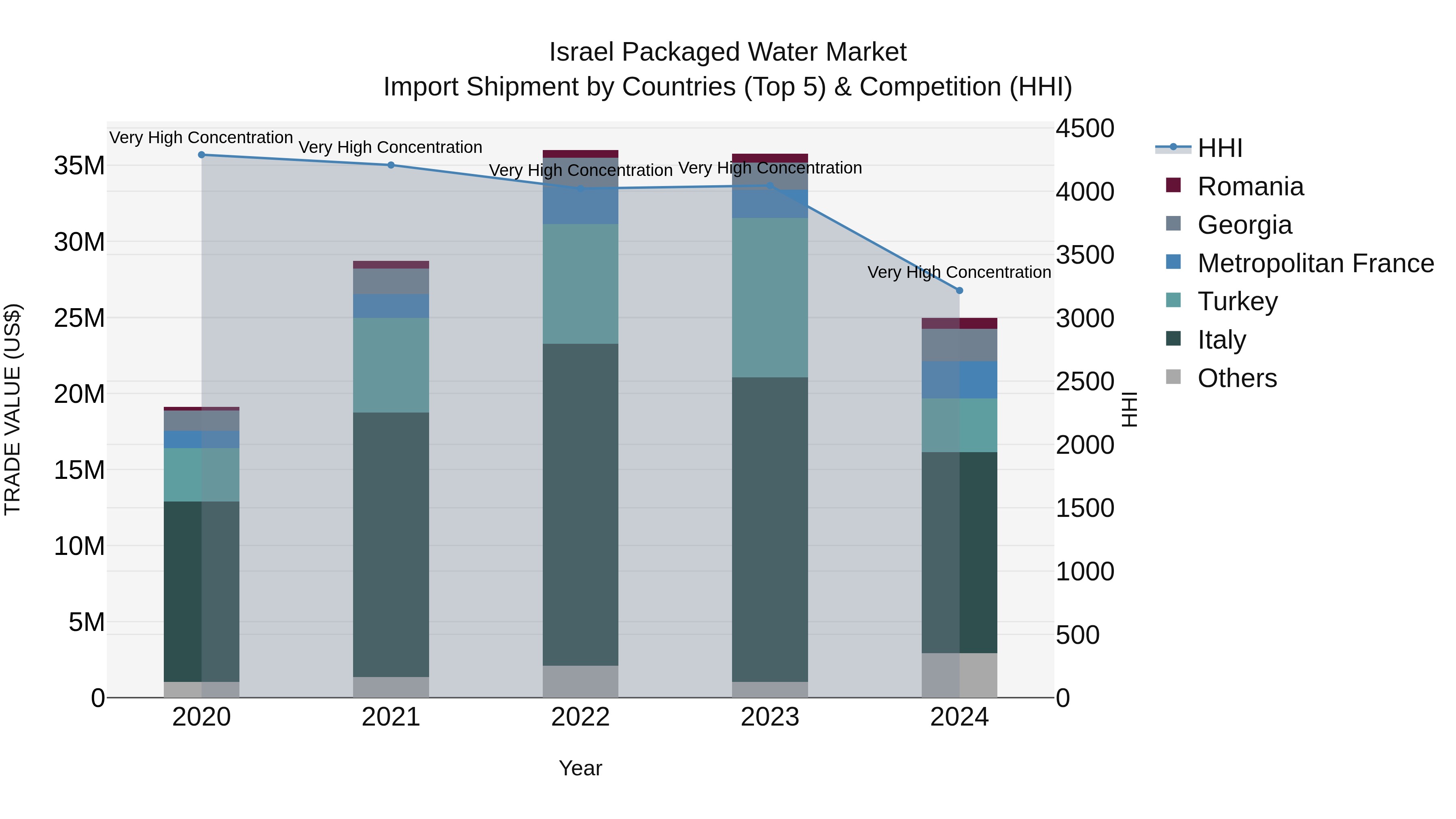
In 2024, Israel continued to rely significantly on imported packaged water, with Italy, Turkey, Metropolitan France, Georgia, and Bulgaria emerging as the top exporting countries. Despite a high concentration level indicated by the Herfindahl-Hirschman Index (HHI), the industry maintained a healthy Compound Annual Growth Rate (CAGR) of 6.91% from 2020 to 2024. However, there was a notable decline in growth rate from 2023 to 2024, with a decrease of -30.2%. This data suggests a competitive market landscape with potential challenges and opportunities for stakeholders in the packaged water import sector in Israel.
Israel Packaged water Market Overview
The Israel packaged water market is witnessing steady growth driven by increasing health consciousness among consumers, growing preference for convenience, and concerns regarding water quality. With a strong focus on hydration and wellness, consumers are turning to packaged water as a convenient and safe option for staying hydrated on-the-go. The market is characterized by the presence of both domestic and international players offering a variety of products such as mineral water, flavored water, and functional water. Key trends in the market include the rising popularity of eco-friendly packaging solutions and the introduction of innovative flavors and formulations to cater to evolving consumer preferences. As the market continues to expand, companies are likely to focus on sustainability initiatives and product differentiation strategies to stay competitive in this dynamic sector.
Israel Packaged water Market Trends and Opportunities
The Israel Packaged water market is experiencing a shift towards premium and functional water products, driven by health-conscious consumers seeking innovative and added-value hydration options. There is a growing demand for flavored, vitamin-enhanced, and alkaline water products, as well as eco-friendly packaging solutions to appeal to the environmentally conscious segment of the market. Opportunities exist for companies to leverage technological advancements in water purification and bottling processes to enhance product quality and sustainability credentials. Additionally, the rise of e-commerce platforms provides a convenient distribution channel for reaching a wider consumer base. Overall, the Israel Packaged water market presents opportunities for companies to differentiate their offerings through product innovation, sustainability practices, and strategic marketing initiatives to capture a larger share of the evolving consumer preferences.
Israel Packaged water Market Challenges
In the Israel Packaged water market, some key challenges include intense competition among numerous brands, fluctuating raw material costs, and increasing environmental concerns related to plastic packaging. The market is highly saturated, with numerous local and international players vying for market share, which can make it challenging for new entrants to establish themselves. Additionally, the fluctuating costs of raw materials such as plastic bottles and packaging can impact profit margins for companies operating in this sector. Moreover, as consumers become more environmentally conscious, there is a growing demand for sustainable packaging solutions, which puts pressure on companies to innovate and adopt eco-friendly practices to remain competitive in the market.
Israel Packaged water Market Drivers
The Israel packaged water market is primarily driven by the growing health consciousness among consumers, leading to an increasing preference for convenient and safe drinking water options. Rising concerns over water contamination and the impact of plastic pollution on the environment have also fueled the demand for packaged water as a reliable and portable hydration solution. Additionally, the influence of urbanization, changing lifestyles, and the convenience factor of on-the-go consumption have further boosted the market growth. Innovations in packaging materials, such as eco-friendly and recyclable options, are also playing a significant role in shaping consumer preferences and driving the market forward. Overall, the Israel packaged water market is expected to continue its growth trajectory driven by these key factors.
Israel Packaged water Market Government Policy
Government policies related to the Israel Packaged water Market focus on ensuring the safety and quality of packaged water products. The Ministry of Health in Israel regulates the industry through strict standards and guidelines to safeguard public health. These regulations include monitoring water sources, production processes, packaging materials, and labeling requirements to provide consumers with accurate information. Additionally, the government promotes sustainability practices within the industry to minimize environmental impact and reduce plastic waste. The Israeli government also encourages innovation and investment in the packaged water sector to foster growth and competitiveness in the market while prioritizing consumer safety and environmental responsibility.
Israel Packaged water Market Future Outlook
The Israel packaged water market is expected to continue growing steadily in the coming years, driven by factors such as increasing health consciousness among consumers, rising disposable incomes, and the convenience and portability offered by packaged water products. The market is also likely to benefit from the growing trend towards on-the-go consumption and the shift away from sugary beverages towards healthier alternatives. Furthermore, innovations in packaging design and sustainability efforts are expected to play a key role in shaping the market`s future trajectory. Overall, the Israel packaged water market is projected to see sustained growth as consumers prioritize hydration and wellness, presenting opportunities for both local and international brands to expand their presence and product offerings in the market.
Key Highlights of the Report:
- Israel Packaged water Market Outlook
- Market Size of Israel Packaged water Market, 2024
- Forecast of Israel Packaged water Market, 2031
- Historical Data and Forecast of Israel Packaged water Revenues & Volume for the Period 2021- 2031
- Israel Packaged water Market Trend Evolution
- Israel Packaged water Market Drivers and Challenges
- Israel Packaged water Price Trends
- Israel Packaged water Porter's Five Forces
- Israel Packaged water Industry Life Cycle
- Historical Data and Forecast of Israel Packaged water Market Revenues & Volume By Product for the Period 2021- 2031
- Historical Data and Forecast of Israel Packaged water Market Revenues & Volume By Still for the Period 2021- 2031
- Historical Data and Forecast of Israel Packaged water Market Revenues & Volume By Carbonated for the Period 2021- 2031
- Historical Data and Forecast of Israel Packaged water Market Revenues & Volume By Flavored for the Period 2021- 2031
- Historical Data and Forecast of Israel Packaged water Market Revenues & Volume By Functional for the Period 2021- 2031
- Israel Packaged water Import Export Trade Statistics
- Market Opportunity Assessment By Product
- Israel Packaged water Top Companies Market Share
- Israel Packaged water Competitive Benchmarking By Technical and Operational Parameters
- Israel Packaged water Company Profiles
- Israel Packaged water Key Strategic Recommendations






































