Japan 1-Hexene Market (2026-2032) | Outlook, Value, Analysis, Growth, Trends, Size & Revenue, Competitive Landscape, Companies, Industry, Segmentation, Share, Forecast
Market Forecast By End User (Paper Industry, Consumer Goods, Chemical Industry, Automotive Industry, Packaging Industry, Cosmetics & Pharmaceuticals Industry), By Application (Polyethylene Production, Heptanol Production, Flavors, Perfumes, Dyes, Resins) And Competitive Landscape
| Product Code: ETC7730409 | Publication Date: Sep 2024 | Updated Date: Jun 2026 | Product Type: Market Research Report | |
| Publisher: 6Wresearch | Author: Bhawna Singh | No. of Pages: 70 | No. of Figures: 35 | No. of Tables: 5 |
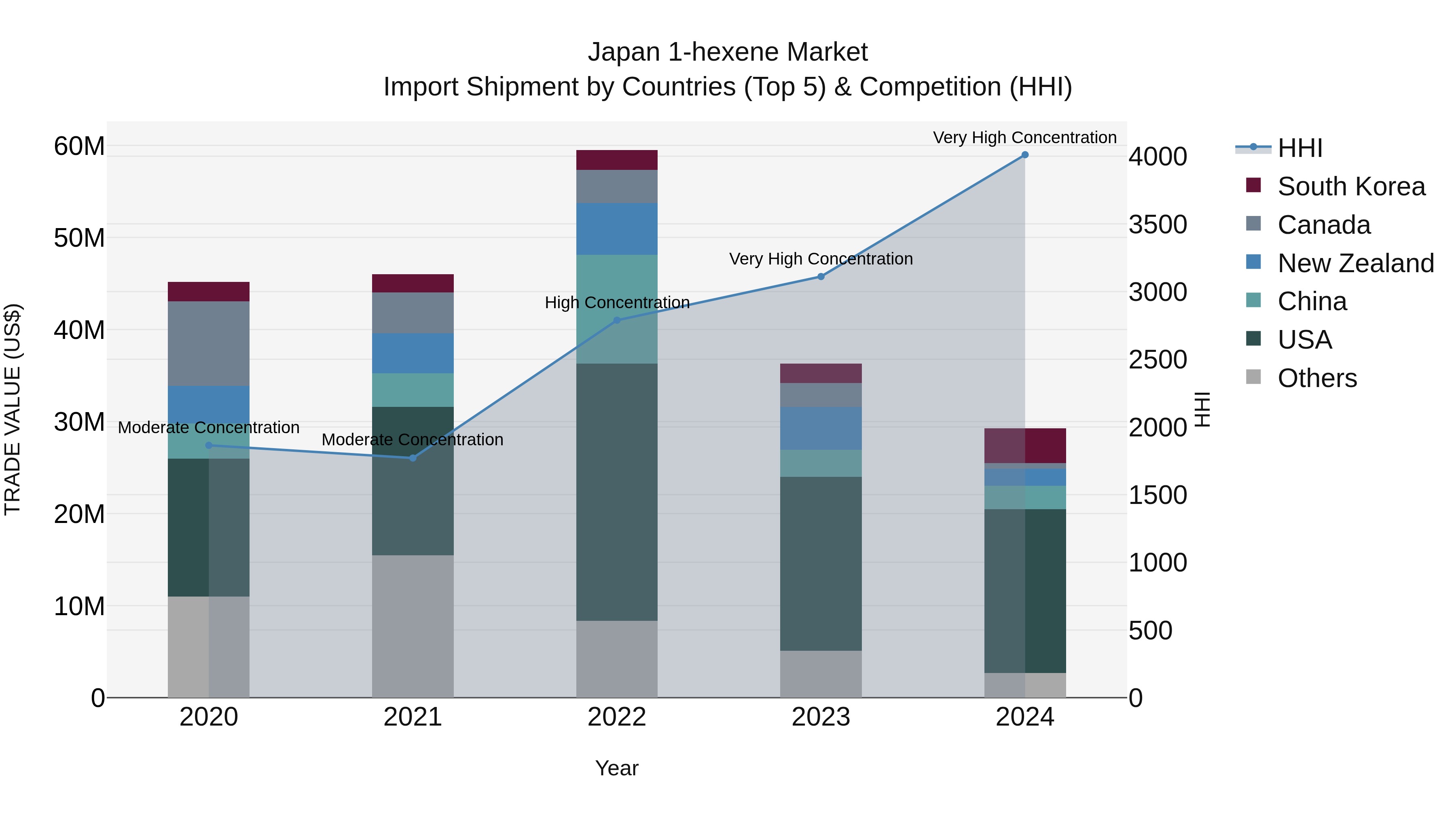
Japan 1-hexene Market Import Shipment by Countries (Top 5) & Competition (HHI)
Japan's 1-hexene import market in 2024 saw significant contributions from the USA, South Korea, China, New Zealand, and Chile. Despite the high Herfindahl-Hirschman Index indicating market concentration, the sector experienced a negative compound annual growth rate of -10.3% from 2020 to 2024. The growth rate declined even further by -19.37% from 2023 to 2024. These figures suggest a challenging landscape for 1-hexene imports into Japan, potentially influenced by various economic and regulatory factors impacting the market dynamics.
Japan 1-Hexene Market Growth Rate
According to 6Wresearch internal database and industry insights, the Japan 1-Hexene Market is growing at a compound annual growth rate (CAGR) of 5.6% during the forecast period (2026-2032).
Topics Covered in the Japan 1-Hexene Market Report
Japan 1-Hexene Market report thoroughly covers the market by end user and application. The market report provides an unbiased and detailed analysis of ongoing market trends, opportunities/high growth areas, and market drivers, which would help stakeholders devise and align their market strategies according to the current and future market dynamics.
Japan 1-Hexene Market Highlights
| Report Name | Japan 1-Hexene Market |
| Forecast period | 2026-2032 |
| CAGR | 5.6% |
| Growing Sector | Packaging Industry |
Japan 1-Hexene Market Synopsis
The Japan 1-Hexene Market witness a steady growth fueled by increasing demand from polyethylene production, automotive lightweight components, and specialty chemical manufacturing. Japan’s strong petrochemical base and advanced polymer processing technologies are encouraging market expansion. With the rise in consumption of packaging, cosmetics, and industrial chemical applications are further strengthening demand. The continuous innovation in catalyst technologies and high-performance polymers is also accelerating market’s adoption throughout end-use industries.
Evaluation of Growth Drivers in the Japan 1-Hexene Market (2026-2032)
Below mentioned some growth drivers and their impact on market dynamics:
| Drivers | Primary Segments Affected | Why It Matters |
| Growth in Polyethylene Demand | Chemical Industry, Packaging Industry | Supports large-scale polymer production and strengthens global polyethylene supply chains. |
| Expansion of Automotive Lightweight Materials | Automotive Industry | Improves fuel efficiency, lowers emissions, and enhances overall vehicle performance. |
| Rising Packaging Industry Growth | Packaging Industry, Consumer Goods | Raises demand for flexible and high-performance polymer-based packaging solutions. |
| Technological Advancements in Petrochemicals | Chemical Industry | Increases production efficiency, product purity, and cost reduction in different plants. |
| Growing Cosmetics & Pharma Applications | Cosmetics & Pharmaceuticals Industry | Boosts demand for high-purity intermediates used in advanced formulations and specialty products. |
The Japan 1-Hexene Market is projected to grow steadily with a CAGR of 5.6% during 2026–2032 forecast period. That is supported by increasing demand for polyethylene production and advanced polymer applications. The rise in automotive lightweight materials and packaging innovations are significantly expanding consumption in this particular area. Japan’s strong focus on high-performance petrochemicals and sustainable manufacturing practices is further enhancing production efficiency. Additionally, rising demand from cosmetics and pharmaceutical intermediates is expected to strengthen long-term market growth.
Evaluation of Restraints in the Japan 1-Hexene Market
Below mentioned are some major restraints and their influence on market dynamics:
| Restraints | Primary Segments Affected | What This Means |
| Volatile Crude Oil Prices | Chemical Industry | Increases production cost uncertainty, impacting margins and long-term pricing stability across manufacturers. |
| Strict Environmental Regulations | All Segments | Raises compliance burden, increasing operational costs and slowing approvals for new chemical production facilities. |
| High Capital Investment Requirements | Industrial Production | Lowers new market entrants owing to a high setup costs and premium infrastructure requirements. |
| Substitute Olefin Availability | Packaging Industry | Lowers demand share as an alternative material which offers competitive performance and cost advantages. |
| Supply Chain Disruptions | Automotive Industry | Impacts raw material availability which causes production delays and inconsistent supply to downstream industries. |
Japan 1-Hexene Market Challenges
The Japan 1-Hexene Market faces challenges owing to shifts in feedstock prices and strict environmental adherence requirements. High production costs and capital-intensive framework limits small-scale participation. Besides, the increasing competition from alternative olefin-based materials and global supply chain disruptions impacts production stability and market pricing, further constraining profitability and investment scalability across industry participants.
Japan 1-Hexene Market Trends
Some major trends contributing to the Japan 1-Hexene Market Growth are:
- Expansion in Automotive Applications: Expansion in the usage of lightweight vehicle components and fuel-efficient materials that enhances performance, durability, and overall automotive efficiency globally.
- High-Purity Olefin Production: Rising focus on producing ultra-high-purity 1-hexene for premium polymer and chemical applications that meets strict industrial and electronics-grade quality standards.
- Sustainable Petrochemical Manufacturing: In the adoption of a low-cost and energy-efficient production technologies supports regulatory adherence and lowers environmental impact across petrochemical operations.
Investment Opportunities in the Japan 1-Hexene Market
Below mentioned are some investment opportunities in the Japan 1-Hexene Industry:
- Development of Advanced Polyethylene: The investments in high-performance polymer production offers a strong growth potential, propelled by rising demand for durable, lightweight industrial and packaging materials worldwide.
- Sustainable Petrochemical Projects: Some eco-friendly production technologies attracts green investment initiatives that aligns with environmental regulations and long-term sustainability goals in petrochemical industries.
- Expansion of Specialty Chemical Units: Increase in capacity for chemical intermediates supports industrial demand growth, while enabling stronger supply chains and enhanced downstream manufacturing efficiency across all areas.
Top 5 Leading Players in the Japan 1-Hexene Market
Here are some top companies contributing to Japan 1-Hexene Market Share:
1. Mitsui Chemicals, Inc.
| Company Name | Mitsui Chemicals, Inc. |
|---|---|
| Established Year | 1997 |
| Headquarters | Tokyo, Japan |
| Website | Click Here |
Mitsui Chemicals is a leading producer of petrochemical and polymer materials, including 1-hexene derivatives used in polyethylene production and specialty chemicals.
2. Idemitsu Kosan Co., Ltd.
| Company Name | Idemitsu Kosan Co., Ltd. |
|---|---|
| Established Year | 1911 |
| Headquarters | Tokyo, Japan |
| Website | Click Here |
Idemitsu Kosan is a major petrochemical company involved in olefin production including 1-hexene for lubricants, polymers, and industrial applications. The company emphasizes energy-efficient production and advanced refining technologies.
3. Sumitomo Chemical Co., Ltd.
| Company Name | Sumitomo Chemical Co., Ltd. |
|---|---|
| Established Year | 1913 |
| Headquarters | Tokyo, Japan |
| Website | Click Here |
Sumitomo Chemical produces a wide range of petrochemical products including alpha olefins used in packaging, automotive, and chemical industries. The company invests heavily in R&D and high-performance materials development.
4. INEOS Oligomers (INEOS Group)
| Company Name | INEOS Oligomers (INEOS Group) |
|---|---|
| Established Year | 1998 |
| Headquarters | Rolle, Switzerland |
| Website | Click Here |
INEOS Oligomers is a global leader in alpha olefins including 1-hexene used in polyethylene production, lubricants, and specialty chemicals. The company focuses on large-scale production efficiency and global supply chain strength.
5. Tokyo Chemical Industry (TCI)
| Company Name | Tokyo Chemical Industry (TCI) |
|---|---|
| Established Year | 1946 |
| Headquarters | Tokyo, Japan |
| Website | Click Here |
Tokyo Chemical Industry (TCI) is a leading supplier of high-purity chemicals and research reagents, including 1-hexene for laboratory and industrial applications.
Government Regulations Introduced in the Japan 1-Hexene Market
According to the Japanese Government data, the concerned authorities took initiative to strengthen the Japan 1-Hexene Market through strict chemical safety regulations and industrial innovation programs. These programs focuses on ensuring safe production and utilization of industrial chemicals while promoting low-cost manufacturing methods. The Chemical Substances Control Law (CSCL) is a key regulatory framework that governs chemical safety standards to protect human health and the environment. Additionally, Japan’s Green Growth Strategy encourages companies to adopt sustainable, low-emission petrochemical technologies, while the Ministry of Economy, Trade and Industry (METI) supports advanced chemical innovation programs to enhance domestic production capacity and global competitiveness.
Future Insights of the Japan 1-Hexene Market
The Japan 1-Hexene Market, upcoming years are expected to grow steadily due to rising demand for polyethylene production, automotive lightweight materials, and advanced packaging solutions. With an increasing investment in sustainable petrochemical technologies and high-purity olefin production will further improve market’s expansion. Growing applications in cosmetics, pharmaceuticals, and specialty chemicals are expected to create new opportunities. Continuous innovation in catalyst systems and polymer chemistry will strengthen Japan’s position in the global 1-hexene market.
Market Segmentation Analysis
The report offers a comprehensive study of the subsequent market segments and their leading categories.
Chemical Industry to Dominate the Market - By End User
According to Kanak Phartiyal, Senior Research Analyst at 6Wresearch, the chemical industry captured 41.28% of the Japan 1-Hexene market share in 2025, while cosmetics & pharmaceuticals are projected to grow fastest at a 6.8% CAGR during 2026–2032, driven by high-purity intermediates demand and specialty formulation expansion.
Polyethylene Production to Dominate the Market – By Application
Polyethylene production dominated with 46.73% share in 2025, while resins are projected to grow at a 6.7% CAGR during 2026–2032, supported by rising demand for high-performance polymers in packaging, automotive components, and industrial manufacturing applications.
Note: Market size and growth projections are calculated using 6Wresearch’s advanced research and forecasting methodology.
Key attractiveness of the report
- 10 Years Market Numbers.
- Historical Data Starting from 2022 to 2025.
- Base Year: 2025
- Forecast Data until 2032.
- Key Performance Indicators Impacting the Market.
- Major Upcoming Developments and Projects.
Key Highlights of the Report:
- Japan 1-Hexene Market Outlook
- Market Size of Japan 1-Hexene Market, 2025
- Forecast of Japan 1-Hexene Market, 2032
- Historical Data and Forecast of Japan 1-Hexene Revenues & Volume for the Period 2022- 2032
- Japan 1-Hexene Market Trend Evolution
- Japan 1-Hexene Market Drivers and Challenges
- Japan 1-Hexene Price Trends
- Japan 1-Hexene Porter's Five Forces
- Japan 1-Hexene Industry Life Cycle
- Historical Data and Forecast of Japan 1-Hexene Market Revenues & Volume By End User for the Period 2022- 2032
- Historical Data and Forecast of Japan 1-Hexene Market Revenues & Volume By Paper Industry for the Period 2022- 2032
- Historical Data and Forecast of Japan 1-Hexene Market Revenues & Volume By Consumer Goods for the Period 2022- 2032
- Historical Data and Forecast of Japan 1-Hexene Market Revenues & Volume By Chemical Industry for the Period 2022- 2032
- Historical Data and Forecast of Japan 1-Hexene Market Revenues & Volume By Automotive Industry for the Period 2022- 2032
- Historical Data and Forecast of Japan 1-Hexene Market Revenues & Volume By Packaging Industry for the Period 2022- 2032
- Historical Data and Forecast of Japan 1-Hexene Market Revenues & Volume By Cosmetics & Pharmaceuticals Industry for the Period 2022- 2032
- Historical Data and Forecast of Japan 1-Hexene Market Revenues & Volume By Application for the Period 2022- 2032
- Historical Data and Forecast of Japan 1-Hexene Market Revenues & Volume By Polyethylene Production for the Period 2022- 2032
- Historical Data and Forecast of Japan 1-Hexene Market Revenues & Volume By Heptanol Production for the Period 2022- 2032
- Historical Data and Forecast of Japan 1-Hexene Market Revenues & Volume By Flavors for the Period 2022- 2032
- Historical Data and Forecast of Japan 1-Hexene Market Revenues & Volume By Perfumes for the Period 2022- 2032
- Historical Data and Forecast of Japan 1-Hexene Market Revenues & Volume By Dyes for the Period 2022- 2032
- Historical Data and Forecast of Japan 1-Hexene Market Revenues & Volume By Resins for the Period 2022- 2032
- Japan 1-Hexene Import Export Trade Statistics
- Market Opportunity Assessment By End User
- Market Opportunity Assessment By Application
- Japan 1-Hexene Top Companies Market Share
- Japan 1-Hexene Competitive Benchmarking By Technical and Operational Parameters
- Japan 1-Hexene Company Profiles
- Japan 1-Hexene Key Strategic Recommendations
Market covered
The report subsequently covers the market by following segments and subsegments.
By End User
- Paper Industry
- Consumer Goods
- Chemical Industry
- Automotive Industry
- Packaging Industry
- Cosmetics & Pharmaceuticals Industry
By Application
- Polyethylene Production
- Heptanol Production
- Flavors
- Perfumes
- Dyes
- Resins
Japan 1-Hexene Market (2026-2032): FAQs
The Japan 1-Hexene Market is projected to grow at a CAGR of 5.6% during 2026–2032.
The major applications are as polyethylene production, resins, heptanol production, and specialty chemical intermediates.
Growth is driven by rising polyethylene demand, automotive lightweight materials, and packaging industry expansion.
The chemical industry dominates due to high demand in polymer production and petrochemical processing.
6Wresearch actively monitors the Japan 1-Hexene Market and publishes its comprehensive annual report, highlighting emerging trends, growth drivers, revenue analysis, and forecast outlook. Our insights help businesses to make data-backed strategic decisions with ongoing market dynamics. Our analysts track relevent industries related to the Japan 1-Hexene Market, allowing our clients with actionable intelligence and reliable forecasts tailored to emerging regional needs.
Yes, we provide customisation as per your requirements. To learn more, feel free to contact us on sales@6wresearch.com
| 1 Executive Summary |
| 2 Introduction |
| 2.1 Key Highlights of the Report |
| 2.2 Report Description |
| 2.3 Market Scope & Segmentation |
| 2.4 Research Methodology |
| 2.5 Assumptions |
| 3 Japan 1-Hexene Market Overview |
| 3.1 Japan Country Macro Economic Indicators |
| 3.2 Japan 1-Hexene Market Revenues & Volume, 2022 & 2032F |
| 3.3 Japan 1-Hexene Market - Industry Life Cycle |
| 3.4 Japan 1-Hexene Market - Porter's Five Forces |
| 3.5 Japan 1-Hexene Market Revenues & Volume Share, By End User, 2022 & 2032F |
| 3.6 Japan 1-Hexene Market Revenues & Volume Share, By Application, 2022 & 2032F |
| 4 Japan 1-Hexene Market Dynamics |
| 4.1 Impact Analysis |
| 4.2 Market Drivers |
| 4.2.1 Growing demand for 1-hexene as a key raw material in the production of polyethylene and synthetic lubricants. |
| 4.2.2 Increasing focus on research and development for the development of high-performance polymers and chemicals. |
| 4.2.3 Favorable government regulations and policies supporting the growth of the petrochemical industry in Japan. |
| 4.3 Market Restraints |
| 4.3.1 Fluctuating prices of crude oil impacting the production cost of 1-hexene. |
| 4.3.2 Environmental concerns and regulations related to the production and usage of petrochemicals. |
| 4.3.3 Intense competition from other regions in Asia in the production and export of 1-hexene. |
| 5 Japan 1-Hexene Market Trends |
| 6 Japan 1-Hexene Market, By Types |
| 6.1 Japan 1-Hexene Market, By End User |
| 6.1.1 Overview and Analysis |
| 6.1.2 Japan 1-Hexene Market Revenues & Volume, By End User, 2022- 2032F |
| 6.1.3 Japan 1-Hexene Market Revenues & Volume, By Paper Industry, 2022- 2032F |
| 6.1.4 Japan 1-Hexene Market Revenues & Volume, By Consumer Goods, 2022- 2032F |
| 6.1.5 Japan 1-Hexene Market Revenues & Volume, By Chemical Industry, 2022- 2032F |
| 6.1.6 Japan 1-Hexene Market Revenues & Volume, By Automotive Industry, 2022- 2032F |
| 6.1.7 Japan 1-Hexene Market Revenues & Volume, By Packaging Industry, 2022- 2032F |
| 6.1.8 Japan 1-Hexene Market Revenues & Volume, By Cosmetics & Pharmaceuticals Industry, 2022- 2032F |
| 6.2 Japan 1-Hexene Market, By Application |
| 6.2.1 Overview and Analysis |
| 6.2.2 Japan 1-Hexene Market Revenues & Volume, By Polyethylene Production, 2022- 2032F |
| 6.2.3 Japan 1-Hexene Market Revenues & Volume, By Heptanol Production, 2022- 2032F |
| 6.2.4 Japan 1-Hexene Market Revenues & Volume, By Flavors, 2022- 2032F |
| 6.2.5 Japan 1-Hexene Market Revenues & Volume, By Perfumes, 2022- 2032F |
| 6.2.6 Japan 1-Hexene Market Revenues & Volume, By Dyes, 2022- 2032F |
| 6.2.7 Japan 1-Hexene Market Revenues & Volume, By Resins, 2022- 2032F |
| 7 Japan 1-Hexene Market Import-Export Trade Statistics |
| 7.1 Japan 1-Hexene Market Export to Major Countries |
| 7.2 Japan 1-Hexene Market Imports from Major Countries |
| 8 Japan 1-Hexene Market Key Performance Indicators |
| 8.1 Research and development investment in new 1-hexene applications. |
| 8.2 Capacity utilization rates of 1-hexene production facilities in Japan. |
| 8.3 Adoption rate of advanced technologies for 1-hexene production. |
| 8.4 Compliance with environmental regulations and sustainability initiatives in the 1-hexene manufacturing process. |
| 8.5 Percentage of market share captured in key end-use industries for 1-hexene products. |
| 9 Japan 1-Hexene Market - Opportunity Assessment |
| 9.1 Japan 1-Hexene Market Opportunity Assessment, By End User, 2022 & 2032F |
| 9.2 Japan 1-Hexene Market Opportunity Assessment, By Application, 2022 & 2032F |
| 10 Japan 1-Hexene Market - Competitive Landscape |
| 10.1 Japan 1-Hexene Market Revenue Share, By Companies, 2025 |
| 10.2 Japan 1-Hexene Market Competitive Benchmarking, By Operating and Technical Parameters |
| 11 Company Profiles |
| 12 Recommendations |
| 13 Disclaimer |
Global Go To Market Strategy - 2030
Export potential enables firms to identify high-growth global markets with greater confidence by combining advanced trade intelligence with a structured quantitative methodology. The framework analyzes emerging demand trends and country-level import patterns while integrating macroeconomic and trade datasets such as GDP and population forecasts, bilateral import–export flows, tariff structures, elasticity differentials between developed and developing economies, geographic distance, and import demand projections. Using weighted trade values from 2020–2024 as the base period to project country-to-country export potential for 2030, these inputs are operationalized through calculated drivers such as gravity model parameters, tariff impact factors, and projected GDP per-capita growth. Through an analysis of hidden potentials, demand hotspots, and market conditions that are most favorable to success, this method enables firms to focus on target countries, maximize returns, and global expansion with data, backed by accuracy.
By factoring in the projected importer demand gap that is currently unmet and could be potential opportunity, it identifies the potential for the Exporter (Country) among 190 countries, against the general trade analysis, which identifies the biggest importer or exporter.
To discover high-growth global markets and optimize your business strategy:
Click Here
Pricing
- Single User License$ 1,995
- Department License$ 2,400
- Site License$ 3,120
- Global License$ 3,795

Leadership Perspectives from Industry Events
Search
Thought Leadership and Analyst Meet





Our Clients








6WResearch In News
- Doha a strategic location for EV manufacturing hub: IPA Qatar
- Demand for luxury TVs surging in the GCC, says Samsung
- Empowering Growth: The Thriving Journey of Bangladesh’s Cable Industry
- Demand for luxury TVs surging in the GCC, says Samsung
- Video call with a traditional healer? Once unthinkable, it’s now common in South Africa
- Intelligent Buildings To Smooth GCC’s Path To Net Zero
Latest Reports
- Cape Verde Portable Hand-Thrown Extinguisher Market (2026-2032)
- Canada Portable Hand-Thrown Extinguisher Market (2026-2032)
- Cameroon Portable Hand-Thrown Extinguisher Market (2026-2032)
- Burundi Portable Hand-Thrown Extinguisher Market (2026-2032)
- Burkina Faso Portable Hand-Thrown Extinguisher Market (2026-2032)
- Bulgaria Portable Hand-Thrown Extinguisher Market (2026-2032)
- Brunei Portable Hand-Thrown Extinguisher Market (2026-2032)
- Botswana Portable Hand-Thrown Extinguisher Market (2026-2032)
- Bosnia and Herzegovina Portable Hand-Thrown Extinguisher Market (2026-2032)
- Bolivia Portable Hand-Thrown Extinguisher Market (2026-2032)
Industry Events and Analyst Meet

HIMTEX 2026

India Refining Summit 2026

India EV Show 2026

EV tech India Expo 2026

Auto Tech Asia 2026
Whitepaper
- Middle East & Africa Commercial Security Market Click here to view more.
- Middle East & Africa Fire Safety Systems & Equipment Market Click here to view more.
- GCC Drone Market Click here to view more.
- Middle East Lighting Fixture Market Click here to view more.
- GCC Physical & Perimeter Security Market Click here to view more.


