Japan 3D Semiconductor Market Size & Growth Rate
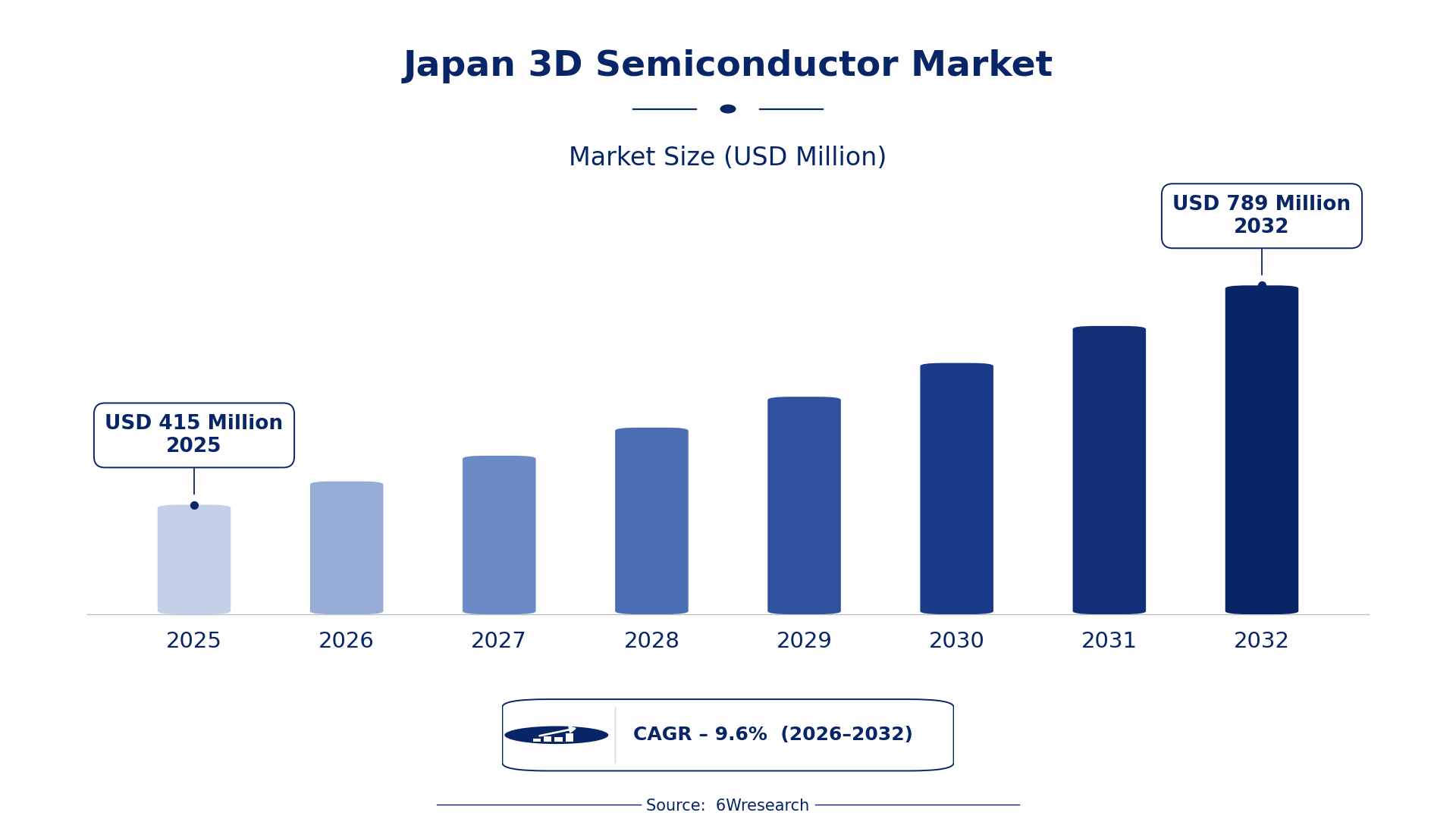
According to 6Wresearch internal database and industry insights, the Japan 3D Semiconductor Market was valued at USD 415 Million in 2025 and is projected to reach USD 789 Million by 2032, growing at a CAGR of approximately 9.6% during 2026–2032.
Japan 3D Semiconductor Market Highlights
| Report Metric | Details |
| Report Name | Japan 3D Semiconductor Market (2026-2032) |
| Market Size 2025 | USD 415 Million |
| Market Size 2032 | USD 789 Million |
| Absolute Growth 2025–2032 | USD 374 Million |
| CAGR 2026–2032 | 9.6% |
| Peak Annual Growth | 11.2% in 2032 |
| Forecast Period | 2026–2032 |
| Historical Data | 2022–2025 |
| Base Year | 2025 |
| Leading Technology Type, 2025 | 3D TSV (46% share) |
| Leading Packaging Type, 2025 | Chip-Stacking (38% share) |
| Leading Wafer Type, 2025 | Silicon-On-Insulator (42% share) |
| Leading Distribution Channel, 2025 | Direct Sales (39% share) |
| Leading End User Industry, 2025 | Data Centers (43% share) |
| Fastest-Growing Technology Type | Monolithic 3D IC (14.1% CAGR) |
| Fastest-Growing Packaging Type | Wire Bonded (13.6% CAGR) |
| Fastest-Growing Wafer Type | Silicon Wafer (13.7% CAGR) |
| Fastest-Growing Distribution Channel | Online Distributors (12.9% CAGR) |
| Fastest-Growing End User Industry | Consumer Electronics (13.0% CAGR) |
| Growing Sector | semiconductors |
| Key End Users | automotive, consumer electronics, data centers, IoT device manufacturers |
Japan 3D Semiconductor Market Year-wise Growth Rate and Key Drivers (2022–2032)
This graph illustrates the annual growth rates of the market from 2022 to 2032, highlighting a steady upward trajectory and projected market expansion over the forecast period.
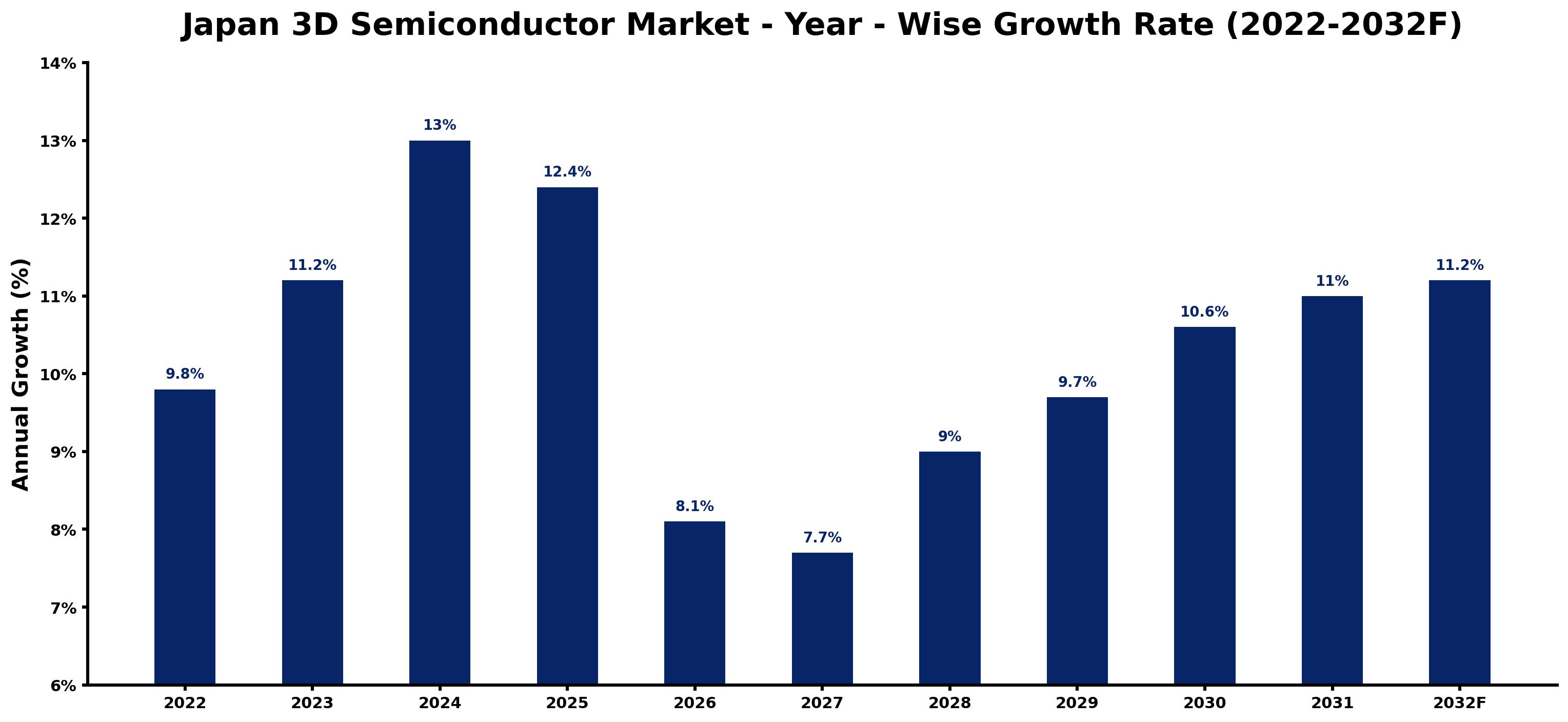
Annual growth estimates for each year appear below with the principal reason behind them, explaining the shifts that set the pace of the market.
| Year | Estimated Annual Growth (%) | Market Rationale |
| 2022 | 9.8 | The market was characterised by steady demand from the automotive sector and consumer electronics. |
| 2023 | 11.2 | Growth accelerated as manufacturers increased production to meet semiconductor needs. |
| 2024 | 13.0 | The peak growth stemmed from investments in advanced semiconductor technologies. |
| 2025 | 12.4 | Demand continued to rise, but growth slowed slightly due to market saturation in certain areas. |
| 2026 | 8.1 | The market is expected to experience a slowdown as competition intensifies and prices stabilise. |
| 2027 | 7.7 | Growth is projected to remain steady, supported by ongoing investments in computing technologies. |
| 2028 | 9.0 | A rebound in demand is expected as new applications for 3D semiconductors emerge. |
| 2029 | 9.7 | The market will see further growth as consumer electronics demand strengthens. |
| 2030 | 10.6 | Continued advancements in technology will spur increased purchases from key sectors. |
| 2031 | 11.0 | The market is projected to maintain positive growth, driven by expanding automotive applications. |
| 2032 | 11.2 | A peak in growth is expected as new applications drive demand for 3D semiconductors. |
Note: Market size estimations and growth projections presented in this report are based on 6Wresearch's proprietary forecasting methodology, utilizing the latest available industry data, government publications, and primary research inputs.
Japan 3D Semiconductor Market Synopsis
3D semiconductors are advanced electronic components that utilise three-dimensional structures to improve performance and efficiency. The Japan 3D Semiconductor Market is growing, driven by robust demand from the automotive sector, which accounted for 30% of semiconductor needs in 2023. The expanding IoT device market, along with substantial government investments in research, fuels this growth and reflects the increasing integration of advanced technologies in various applications.
Market Dynamics Impact Analysis (2026–2032)
| Factor | Type | Impact | Primary Segment Affected |
| Rising demand for high-performance computing applications | Driver | High | 3D TSV |
| Increased integration of 3D semiconductors in automotive electronics | Driver | High | Hybrid Bonding |
| Growing IoT device market necessitating advanced semiconductor solutions | Opportunity | High | Silicon-On-Insulator |
| Expansion of data centers requiring efficient semiconductor solutions | Opportunity | High | Monolithic 3D IC |
| Intense competition leading to price pressures | Restraint | Medium | Chip-Stacking |
| Supply chain disruptions affecting raw material availability | Restraint | High | Fan-Out Packaging |
| High capital investment required for advanced manufacturing facilities | Challenge | High | 3D TSV |
| Technological complexities in 3D semiconductor design and production | Challenge | Medium | Hybrid Bonding |
Evaluation of Drivers in Japan 3D Semiconductor Market (2026–2032)
The main growth drivers and the segments they affect most are set out below.
| Drivers | Primary Segment Affected | Why It Matters (Evidence) |
| Growing demand for high-performance computing applications | 3D TSV | This technology enables high-density interconnections, essential for next-generation data centers, which are expanding rapidly. |
| Increased integration of 3D semiconductors in automotive electronics | Hybrid Bonding | Automotive manufacturers are adopting advanced chip designs to improve vehicle performance, with the automotive sector accounting for 30% of semiconductor demand. |
| Expansion of data centers requiring efficient semiconductor solutions | Monolithic 3D IC | Data centers are increasingly utilising these chips for improved processing power, driven by the rise in cloud computing. |
| Rising IoT device market necessitating advanced semiconductor solutions | Silicon-On-Insulator | The IoT device market is expanding, driving demand for high-performance semiconductors. |
| Growing consumer electronics sector demanding advanced technologies | Chip-Stacking | Consumer electronics manufacturers are adopting chip-stacking techniques to improve device performance and reduce size. |
Volumes grow on the back of the automotive sector's demand for advanced semiconductor technologies, which accounted for 30% of total semiconductor needs in 2023. The IoT device market is expanding, driving the need for high-performance chips. Data centers are increasingly adopting 3D TSV technology for improved processing capabilities, reflecting a broader trend in high-performance computing. The consumer electronics sector is also expanding, with manufacturers seeking solutions to improve device efficiency. These factors contribute to rising demand for 3D semiconductors across various applications.
Evaluation of Restraints in Japan 3D Semiconductor Market
Several factors work against faster growth; the main ones are summarised below.
| Market Restraint | Primary Segment Affected | Why It Matters (Evidence) |
| Intense competition leading to price pressures | Chip-Stacking | As more players enter the market, aggressive pricing strategies are impacting profit margins for manufacturers. |
| Supply chain disruptions affecting raw material availability | Fan-Out Packaging | Recent global supply chain issues have led to shortages of critical materials, delaying production timelines. |
| High capital investment required for advanced manufacturing facilities | 3D TSV | Establishing state-of-the-art manufacturing plants requires substantial financial resources, limiting entry for new players. |
| Technological complexities in 3D semiconductor design and production | Hybrid Bonding | The intricate processes involved in 3D semiconductor manufacturing can lead to increased production costs and longer lead times. |
| Regulatory compliance challenges for manufacturers | Silicon-On-Insulator | Manufacturers must navigate complex regulations, which can slow down product development and market entry. |
Japan 3D Semiconductor Market Challenges
Producers face high costs stemming from intense competition in international markets, which pressures profit margins and restricts R&D investment for advanced technologies. Importers encounter supply chain disruptions, particularly for essential semiconductor materials, resulting in production delays for local manufacturers. High expenses associated with adopting new technologies limit producers' ability to innovate, potentially causing a 15% lag in meeting market demands. Buyers are dealing with rising prices for high-performance semiconductors, with costs increasing approximately 15% in 2023, straining their production budgets and pricing strategies.
Trends in the Japan 3D Semiconductor Market
Four trends stand out in the Japan 3D Semiconductor Market.
- Shift from Traditional to Advanced Packaging Techniques: The Fan-Out Packaging technology is increasingly adopted in consumer electronics, improving thermal performance and reducing size. In 2023, approximately 25% of new consumer electronics utilised this technology.
- Emergence of Monolithic 3D IC: Monolithic 3D IC technology is gaining traction in Japan, with a projected CAGR of 14.1% from 2026 to 2032. This shift is driven by the need for more compact and efficient chip designs.
- Growing Demand for Silicon-On-Insulator Wafers: The Silicon-On-Insulator market is expanding due to its application in high-performance devices. In 2023, this segment accounted for 42% of the wafer market share, reflecting its importance.
- Increased Focus on Automotive Electronics Integration: The automotive industry is prioritising semiconductor integration to improve vehicle functionalities. By 2025, it is expected that 40% of new vehicles will feature advanced semiconductor technologies.
Investment Opportunities in the Japan 3D Semiconductor Market
Where to invest in the Japan 3D Semiconductor Market: the main openings are set out below.
- Data Centers Seeking Advanced Semiconductor Solutions: Data centers are increasingly looking for high-performance 3D semiconductors to improve processing capabilities. With a projected growth of 30% in data center investments by 2025, suppliers can target this sector effectively.
- Consumer Electronics Manufacturers Adopting Advanced Technologies: Consumer electronics manufacturers are investing in advanced semiconductor technologies to meet rising consumer expectations. With the market expected to grow by 10% annually, partnerships with local firms can facilitate entry.
- Automotive Sector's Demand for Advanced Chips: The automotive sector is rapidly integrating advanced semiconductor technologies, creating a significant opportunity for suppliers. With 30% of semiconductor demand coming from this sector, collaboration with automotive manufacturers is essential.
- Expansion of IoT Device Market: The growing IoT device market presents opportunities for suppliers of 3D semiconductors. With projections of reaching 10 million units by 2025, establishing partnerships with IoT device manufacturers can be beneficial.
Government Initiatives in the Japan 3D Semiconductor Market
The Semiconductor and Digital Industry Strategy, enacted by the Ministry of Economy, Trade and Industry in June 2021, aims to secure domestic manufacturing capabilities. This strategy includes measures to increase research and development funding, which is vital for advancing technologies. The Economic Security Promotion Act of 2022 supports supply-chain resilience for critical products, ensuring that manufacturers can maintain production levels amid global disruptions.
In 2023, the government allocated 500 billion yen to semiconductor research, administered by the Ministry of Economy, Trade and Industry. This funding supports various projects aimed at improving manufacturing capabilities and promoting innovation in the sector. The GX Promotion Act, introduced in 2023, establishes a legal framework for promoting green technologies in production, further aligning the industry with sustainability goals.
Future Insight of the Japan 3D Semiconductor Market
By 2032, Japan's semiconductor market will evolve as government policies encourage local production and innovation, strengthening supply chains. The allocation of 500 billion yen for semiconductor research will enhance manufacturing techniques and operational efficiency for suppliers. Adoption of standards like JIS Q 7001 will simplify processes and improve product quality. The automotive sector, which accounted for 30% of semiconductor demand in 2023, will create new opportunities for buyers to integrate advanced semiconductors into vehicles.
Market Segmentation Analysis
Japan 3D Semiconductor Market report covers a detailed analysis of the following market segments:
By Technology Type – 3D TSV Leads, Monolithic 3D IC Expected to Grow Fastest
According to Saurav Kr Singh, Senior Research Analyst at 6Wresearch, the largest technology type category in 2025 was 3D TSV, at 46% of revenue. 3D TSV technology commands the largest share in Japan due to its essential function in creating high-density interconnections, particularly in data centres. Its widespread use in advanced chip designs across various applications reinforces its leading position in the market. Over 2026–2032, Monolithic 3D IC is expected to post the fastest growth, at a CAGR of 14.1%. Monolithic 3D IC is witnessing rapid growth as it facilitates the integration of multiple functions within a single chip, catering to the increasing demand for compact and efficient solutions. This trend is particularly pronounced in sectors where space and performance are critical, ensuring its competitive edge. Suppliers should focus on enhancing 3D TSV capabilities while also investing in Monolithic 3D IC development to capitalise on market opportunities.
By Packaging Type – Chip-Stacking Leads, Wire Bonded Expected to Grow Fastest
Chip-Stacking held 38% of the Japan 3D Semiconductor Market by packaging type in 2025. Chip-Stacking holds the largest share as it facilitates vertical integration of chips, which is vital for improving performance in complex semiconductor devices. This technique is especially valued in high-performance computing applications, reinforcing its leading position. Wire Bonded is projected to grow fastest, at a CAGR of 13.6% during 2026–2032. Wire Bonded packaging is growing rapidly due to its continued importance in legacy applications, where cost-effective solutions are necessary. The persistent demand for reliable packaging in established markets supports this upward trend. Buyers should consider both Chip-Stacking and Wire Bonded options to optimise their semiconductor solutions.
By Wafer Type – Silicon-On-Insulator Leads, Silicon Wafer Expected to Grow Fastest
In 2025, Silicon-On-Insulator led the wafer type split with a 42% share. Silicon-On-Insulator wafers hold the largest market share due to their performance advantages in high-speed applications, making them a preferred choice for manufacturers. Their ability to reduce parasitic capacitance is a key factor in their widespread adoption across various semiconductor applications. The quickest growth will come from Silicon Wafer, forecast to expand at a CAGR of 13.7% between 2026 and 2032. Silicon Wafer is projected to grow rapidly as it serves as the foundational substrate for semiconductor manufacturing, essential for a wide range of applications. The anticipated increase in silicon wafer production highlights the ongoing growth of the semiconductor market. Suppliers need to secure a consistent supply of Silicon-On-Insulator wafers while gearing up for the anticipated rise in demand for Silicon Wafers.
By Distribution Channel – Direct Sales Leads, Online Distributors Expected to Grow Fastest
Direct Sales accounted for 39% of the market by distribution channel in 2025. Direct Sales is the main channel for semiconductor sales, enabling manufacturers to build strong relationships with buyers and provide tailored solutions. This method is particularly effective in the technical semiconductor market, where expertise is essential. Online Distributors are set to record the highest CAGR in this split, 12.9% over 2026–2032. Online Distributors are rapidly gaining popularity, offering an additional channel that improves accessibility for customers seeking semiconductor products. The shift towards digital purchasing reflects changing preferences among buyers in the industry. Suppliers should invest in online distribution strategies to expand their reach to a wider customer base.
By End User Industry – Data Centers Lead, Consumer Electronics Expected to Grow Fastest
Data Centers took 43% of end user industry revenue in 2025, more than any other category. Data Centers are the leading end user of 3D semiconductors, driven by their critical role in meeting high-performance computing needs. The increasing demand for data processing capabilities further solidifies this segment's dominance. Over 2026–2032, Consumer Electronics is expected to post the fastest growth, at a CAGR of 13.0%. Consumer Electronics is the fastest-growing segment, reflecting the surge in demand for advanced electronic devices that utilise 3D semiconductor technology. The projected growth in this sector highlights the need for suppliers to innovate. Suppliers should prioritise their offerings for Data Centers while also adapting to the rapid changes in Consumer Electronics.
Key Attractiveness of the Report
- 10 Years of Market Numbers
- Historical Data Starting from 2022 to 2025
- Base Year 2025
- Forecast Data until 2032
- Key Performance Indicators Impacting the Market
- Major Upcoming Developments and Projects
Key Highlights of the Report:
- Japan 3D Semiconductor Market Outlook
- Market Size of Japan 3D Semiconductor Market, 2025
- Forecast of Japan 3D Semiconductor Market, 2032
- Historical Data and Forecast of Japan 3D Semiconductor Revenues & Volume for the Period 2022-2032F
- Japan 3D Semiconductor Market Trend Evolution
- Japan 3D Semiconductor Market Drivers and Challenges
- Japan 3D Semiconductor Price Trends
- Japan 3D Semiconductor Porter's Five Forces
- Japan 3D Semiconductor Industry Life Cycle
- Historical Data and Forecast of Japan 3D Semiconductor Market Revenues & Volume By Technology Type for the Period 2022-2032F
- Historical Data and Forecast of Japan 3D Semiconductor Market Revenues & Volume By 3D TSV for the Period 2022-2032F
- Historical Data and Forecast of Japan 3D Semiconductor Market Revenues & Volume By Monolithic 3D IC for the Period 2022-2032F
- Historical Data and Forecast of Japan 3D Semiconductor Market Revenues & Volume By Hybrid Bonding for the Period 2022-2032F
- Historical Data and Forecast of Japan 3D Semiconductor Market Revenues & Volume By Fan-Out Packaging for the Period 2022-2032F
- Historical Data and Forecast of Japan 3D Semiconductor Market Revenues & Volume By Packaging Type for the Period 2022-2032F
- Historical Data and Forecast of Japan 3D Semiconductor Market Revenues & Volume By Chip-Stacking for the Period 2022-2032F
- Historical Data and Forecast of Japan 3D Semiconductor Market Revenues & Volume By Wire Bonded for the Period 2022-2032F
- Historical Data and Forecast of Japan 3D Semiconductor Market Revenues & Volume By Flip-Chip for the Period 2022-2032F
- Historical Data and Forecast of Japan 3D Semiconductor Market Revenues & Volume By Package-on-Package for the Period 2022-2032F
- Historical Data and Forecast of Japan 3D Semiconductor Market Revenues & Volume By Wafer Type for the Period 2022-2032F
- Historical Data and Forecast of Japan 3D Semiconductor Market Revenues & Volume By Silicon-On-Insulator for the Period 2022-2032F
- Historical Data and Forecast of Japan 3D Semiconductor Market Revenues & Volume By Silicon Wafer for the Period 2022-2032F
- Historical Data and Forecast of Japan 3D Semiconductor Market Revenues & Volume By Bulk Silicon for the Period 2022-2032F
- Historical Data and Forecast of Japan 3D Semiconductor Market Revenues & Volume By Epitaxial Wafer for the Period 2022-2032F
- Historical Data and Forecast of Japan 3D Semiconductor Market Revenues & Volume By Distribution Channel for the Period 2022-2032F
- Historical Data and Forecast of Japan 3D Semiconductor Market Revenues & Volume By Direct Sales for the Period 2022-2032F
- Historical Data and Forecast of Japan 3D Semiconductor Market Revenues & Volume By Online Distributors for the Period 2022-2032F
- Historical Data and Forecast of Japan 3D Semiconductor Market Revenues & Volume By Contract Manufacturing for the Period 2022-2032F
- Historical Data and Forecast of Japan 3D Semiconductor Market Revenues & Volume By Semiconductor Suppliers for the Period 2022-2032F
- Historical Data and Forecast of Japan 3D Semiconductor Market Revenues & Volume By End User Industry for the Period 2022-2032F
- Historical Data and Forecast of Japan 3D Semiconductor Market Revenues & Volume By Data Centers for the Period 2022-2032F
- Historical Data and Forecast of Japan 3D Semiconductor Market Revenues & Volume By Consumer Electronics for the Period 2022-2032F
- Historical Data and Forecast of Japan 3D Semiconductor Market Revenues & Volume By IoT Devices for the Period 2022-2032F
- Historical Data and Forecast of Japan 3D Semiconductor Market Revenues & Volume By Automotive Electronics for the Period 2022-2032F
- Japan 3D Semiconductor Import Export Trade Statistics
- Market Opportunity Assessment By Technology Type
- Market Opportunity Assessment By Packaging Type
- Market Opportunity Assessment By Wafer Type
- Market Opportunity Assessment By Distribution Channel
- Market Opportunity Assessment By End User Industry
- Japan 3D Semiconductor Top Companies Market Share
- Japan 3D Semiconductor Competitive Benchmarking By Technical and Operational Parameters
- Japan 3D Semiconductor Company Profiles
- Japan 3D Semiconductor Key Strategic Recommendations
Market Covered
The following segment groups are covered in the report.
By Technology Type
- 3D TSV
- Monolithic 3D IC
- Hybrid Bonding
- Fan-Out Packaging
By Packaging Type
- Chip-Stacking
- Wire Bonded
- Flip-Chip
- Package-on-Package
By Wafer Type
- Silicon-On-Insulator
- Silicon Wafer
- Bulk Silicon
- Epitaxial Wafer
By Distribution Channel
- Direct Sales
- Online Distributors
- Contract Manufacturing
- Semiconductor Suppliers
By End User Industry
- Data Centers
- Consumer Electronics
- IoT Devices
- Automotive Electronics































