Japan 3D Stacked IC Market Size & Growth Rate
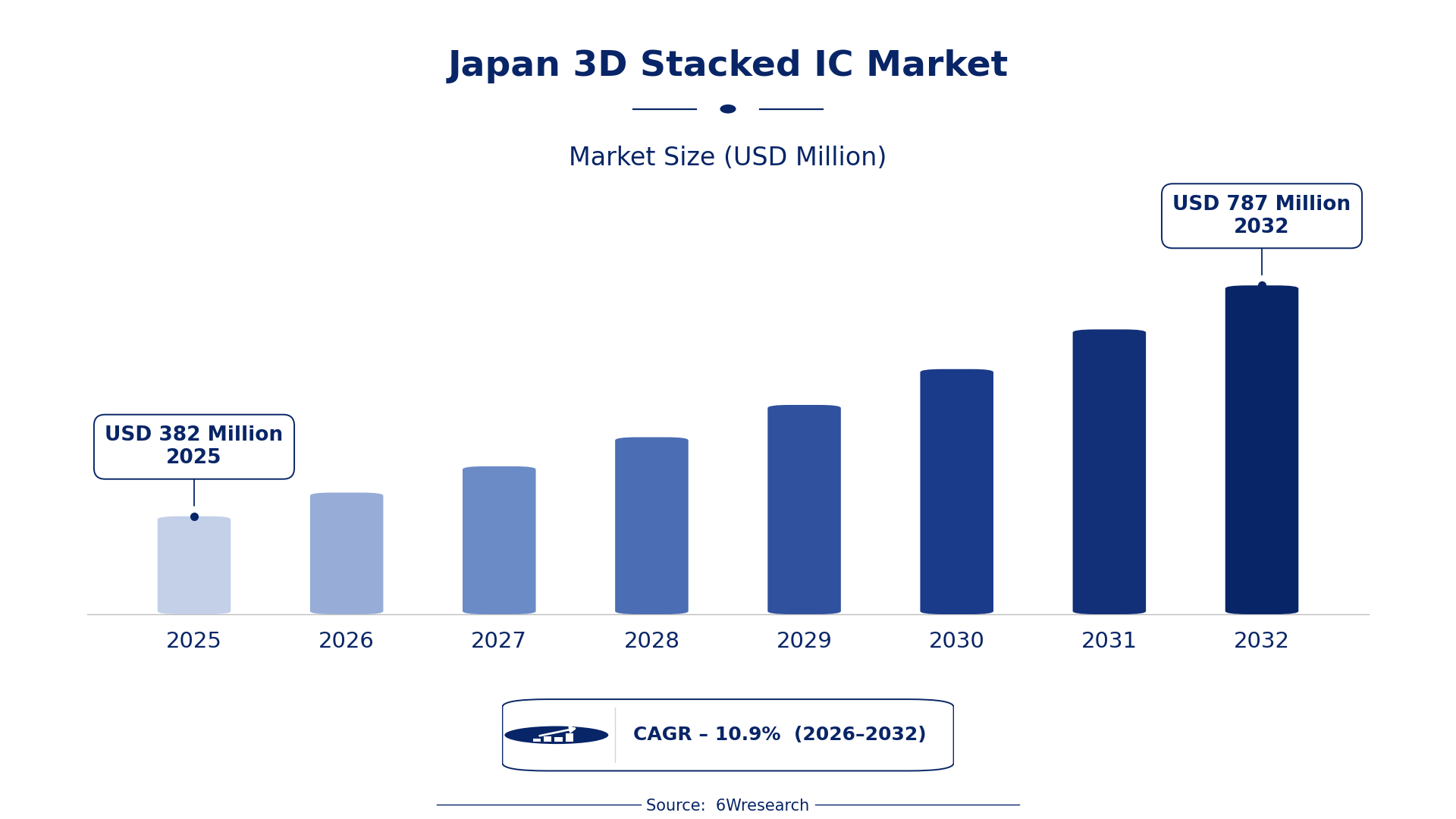
According to 6Wresearch internal database and industry insights, the Japan 3D Stacked IC Market was valued at USD 382 Million in 2025 and is projected to reach USD 787 Million by 2032, growing at a CAGR of approximately 10.9% during 2026–2032.
Japan 3D Stacked IC Market Highlights
| Report Metric | Details |
| Report Name | Japan 3D Stacked IC Market (2026-2032) |
| Market Size 2025 | USD 382 Million |
| Market Size 2032 | USD 787 Million |
| Absolute Growth 2025–2032 | USD 405 Million |
| CAGR 2026–2032 | 10.9% |
| Peak Annual Growth | 13.5% in 2032 |
| Forecast Period | 2026–2032 |
| Historical Data | 2022–2025 |
| Base Year | 2025 |
| Leading Packaging Technology, 2025 | Through Silicon Via (39% share) |
| Leading Integration Level, 2025 | Heterogeneous (39% share) |
| Leading Memory Type, 2025 | DRAM (37% share) |
| Leading Distribution Channel, 2025 | Semiconductor Distributors (49% share) |
| Leading End User Industry, 2025 | Mobile Devices (46% share) |
| Fastest-Growing Packaging Technology | Wafer-on-Wafer (15.4% CAGR) |
| Fastest-Growing Integration Level | Homogeneous (14.7% CAGR) |
| Fastest-Growing Memory Type | NAND Flash (15.7% CAGR) |
| Fastest-Growing Distribution Channel | Online Platforms (14.3% CAGR) |
| Fastest-Growing End User Industry | Cloud Computing (14.6% CAGR) |
| Growing Sector | Semiconductors |
| Key End Users | Mobile Device Manufacturers, Telecom Providers, Cloud Service Providers |
Japan 3D Stacked IC Market Year-wise Growth Rate and Key Drivers (2022–2032)
This graph illustrates the annual growth rates of the market from 2022 to 2032, highlighting a steady upward trajectory and projected market expansion over the forecast period.
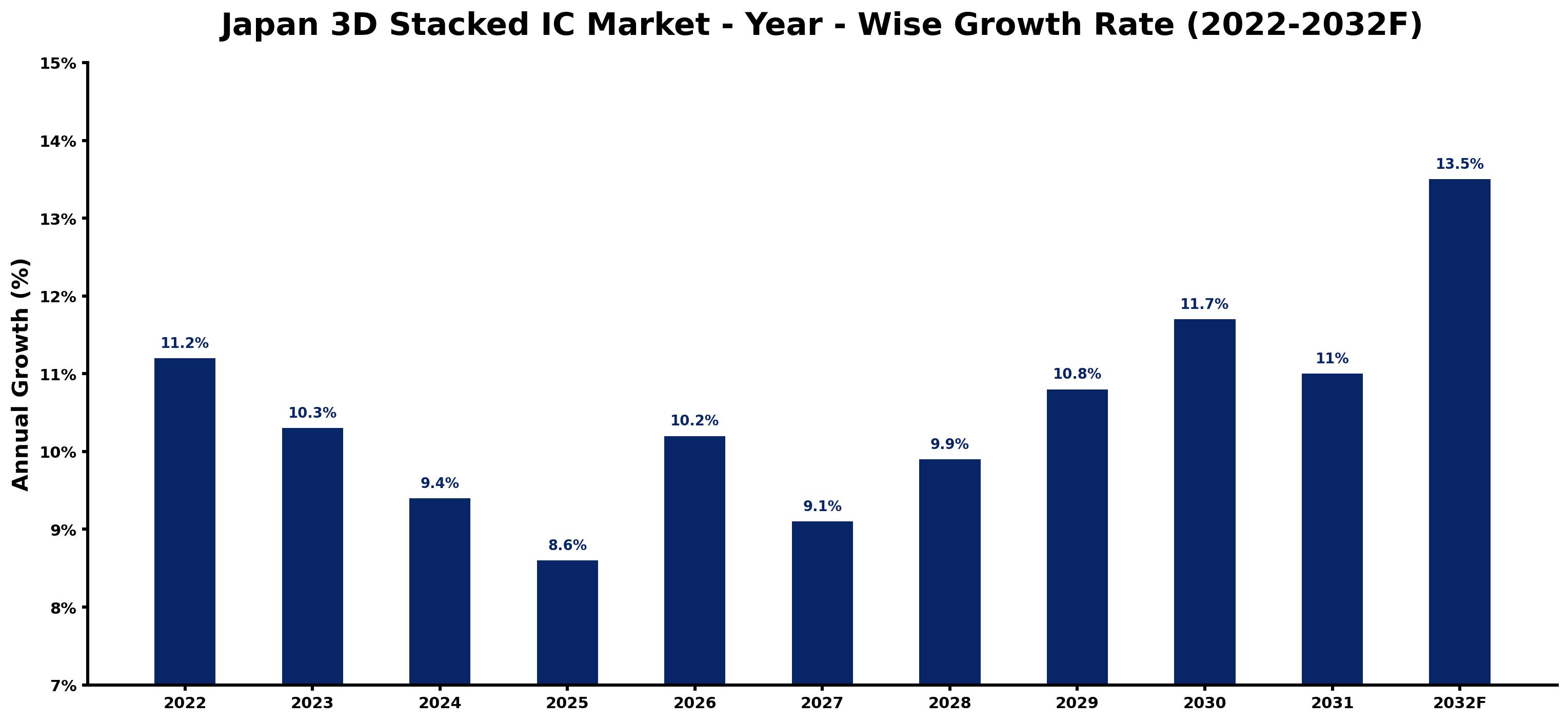
For each year, the table pairs the estimated growth rate with the leading influence on demand, showing how the drivers changed across the period.
| Year | Estimated Annual Growth (%) | Market Rationale |
| 2022 | 11.2 | The market experienced strong demand from mobile devices and telecom infrastructure. |
| 2023 | 10.3 | Growth slowed as the market adjusted to supply chain challenges and production capacities. |
| 2024 | 9.4 | Demand continued to moderate, reflecting a normalisation after the previous peak. |
| 2025 | 8.6 | Growth slowed further as competition intensified and market saturation approached. |
| 2026 | 10.2 | Investment in semiconductor innovation is projected to drive renewed growth in the market. |
| 2027 | 9.1 | Growth is expected to slow as supply chain issues persist and competition remains fierce. |
| 2028 | 9.9 | Demand is anticipated to rise as new applications in telecom and cloud computing emerge. |
| 2029 | 10.8 | The market is likely to benefit from increased mobile device adoption and 5G infrastructure. |
| 2030 | 11.7 | Growth is expected to accelerate as technological advancements improve product offerings. |
| 2031 | 11.0 | Market expansion is projected to slow slightly as saturation in certain segments occurs. |
| 2032 | 13.5 | The market is set to peak with strong demand driven by advanced telecom applications. |
Note: Market size estimations and growth projections presented in this report are based on 6Wresearch's proprietary forecasting methodology, utilizing the latest available industry data, government publications, and primary research inputs.
Japan 3D Stacked IC Market Synopsis
3D Stacked ICs are advanced semiconductor devices that integrate multiple layers of circuits to improve performance in mobile devices, cloud computing, and telecom infrastructure. The Japan 3D Stacked IC Market is expanding due to rising demand from mobile devices, which accounted for 46% of the market in 2025, and substantial investments in semiconductor innovation, supported by government initiatives. The Tokyo region remains a hub for semiconductor manufacturing, with a strong emphasis on improving production capabilities.
Market Dynamics Impact Analysis (2026–2032)
| Factor | Type | Impact | Primary Segment Affected |
| Rising demand for mobile devices drives the need for advanced semiconductor solutions. | Driver | High | Mobile Devices |
| Government investment in semiconductor innovation boosts production capabilities. | Driver | High | Semiconductor Distributors |
| Growing adoption of cloud computing creates opportunities for high-performance ICs. | Opportunity | High | Cloud Computing |
| Increasing demand for telecom infrastructure upgrades presents new market avenues. | Opportunity | High | Telecom Infrastructure |
| Intense competition among manufacturers limits pricing flexibility. | Restraint | Medium | DRAM |
| Supply chain disruptions impact production timelines and availability. | Restraint | High | Wafer-on-Wafer |
| High production costs for advanced technologies challenge profitability. | Challenge | High | Heterogeneous |
| Rapid technological changes require constant investment in R&D. | Challenge | Medium | 2.5D Stacking |
Evaluation of Drivers in Japan 3D Stacked IC Market (2026–2032)
The following drivers explain most of the expected growth.
| Drivers | Primary Segment Affected | Why It Matters (Evidence) |
| Growing demand for mobile devices | Mobile Devices | The installed base of mobile devices in Japan exceeds 100 million units, driving the need for advanced semiconductor solutions. |
| Investment in semiconductor innovation | Cloud Computing | The Semiconductor and Digital Industry Strategy allocates funding to enhance domestic manufacturing capabilities, supporting growth in high-performance ICs. |
| Increasing use of NAND Flash technology | NAND Flash | NAND Flash is becoming essential for mobile devices, enhancing storage options and contributing to market expansion. |
| Upgrades in telecom infrastructure | Telecom Infrastructure | 5G applications require advanced integration solutions, prompting investments in 3D Stacked ICs for improved network performance. |
| Focus on advanced packaging techniques | Wafer-on-Wafer | Research from the Tokyo University of Science promotes innovative packaging methods, enhancing production efficiency and market competitiveness. |
Several shifts outside the market lift sales. In 2023, the installed base of mobile devices in Japan exceeded 100 million units, significantly increasing demand for advanced semiconductor solutions. The Semiconductor and Digital Industry Strategy aims to secure domestic manufacturing capabilities, further boosting production. Growth in cloud computing necessitates high-performance ICs for data centres, while telecom infrastructure upgrades require integration solutions for 5G applications. The increasing use of NAND Flash technology in mobile devices enhances storage options, contributing to overall market growth.
Evaluation of Restraints in Japan 3D Stacked IC Market
The key brakes on demand, and where they bite hardest, are shown below.
| Market Restraint | Primary Segment Affected | Why It Matters (Evidence) |
| Intense competition among manufacturers limits pricing flexibility. | DRAM | In 2023, the market faced pricing pressures due to numerous competitors vying for market share. |
| Supply chain disruptions impact production timelines and availability. | Wafer-on-Wafer | Supply chain challenges have delayed the delivery of critical components, affecting production schedules. |
| High production costs for advanced technologies challenge profitability. | Heterogeneous | The cost of implementing advanced manufacturing techniques has increased, squeezing margins. |
| Limited access to skilled workforce hampers growth potential. | 2.5D Stacking | The semiconductor industry faces a shortage of skilled workers, affecting production capabilities. |
| Regulatory compliance adds complexity to manufacturing processes. | High-Density | Manufacturers must adhere to stringent JIS standards, increasing operational costs. |
Japan 3D Stacked IC Market Challenges
Buyers in Japan's semiconductor market encounter a skills gap, as the Tokyo region lacks sufficient trained personnel to meet the increasing need for 3D Stacked ICs, resulting in project delays of up to six months for manufacturers. Regulatory hurdles arise from adherence to JIS standards, which can decelerate production processes and prolong time-to-market for suppliers. Competition from other semiconductor-producing nations intensifies, forcing local suppliers to lower prices, which can shrink profit margins by approximately 15%. Rising raw material expenses burden producers, leading to higher prices for buyers and a potential 10% increase in end-product costs.
Trends in the Japan 3D Stacked IC Market
These developments are changing demand patterns in the Japan 3D Stacked IC Market.
- Shift from Traditional to Advanced Packaging Techniques: The Tokyo region is experiencing a shift towards advanced packaging techniques in semiconductor manufacturing. In 2023, Japan launched a program to improve semiconductor manufacturing capabilities, which is anticipated to drive innovation.
- Transition from DRAM to NAND Flash in Mobile Devices: NAND Flash technology is increasingly being adopted in mobile devices, replacing traditional storage solutions. In 2023, approximately 40% of the 3D Stacked IC market was driven by NAND Flash applications, reflecting changing consumer preferences.
- Emergence of Cloud Computing as a Key Driver: Cloud computing is becoming a major demand driver for 3D Stacked ICs, particularly in data centres. The growth in this sector is projected to reach a CAGR of 14.6% from 2026 to 2032, highlighting its importance.
- Focus on Heterogeneous Integration: Heterogeneous integration is prioritised in Japan's semiconductor sector, facilitating the combination of diverse technologies. This focus is clear as Japanese firms aim to improve performance in complex applications, with a target of 30% production increase by 2025.
Investment Opportunities in the Japan 3D Stacked IC Market
Investors looking at the Japan 3D Stacked IC Market should consider the following areas.
- Mobile Device Manufacturers Seeking Advanced Solutions: Mobile device manufacturers are increasingly looking for advanced semiconductor solutions to improve performance. With over 100 million units installed in Japan, this presents a notable opportunity for suppliers to meet rising demands.
- Surge in Cloud Computing Solutions: The current surge in cloud computing creates a timely opportunity for suppliers to invest in high-performance 3D Stacked ICs. Data centres are expanding rapidly, necessitating advanced solutions to support increased workloads.
- Telecom Infrastructure Upgrades: Telecom providers are investing in infrastructure upgrades to support 5G technology. This presents an opportunity for suppliers to provide high-density integration solutions, particularly in urban areas like Tokyo.
- Focus on Advanced Packaging Technologies: The semiconductor sector's focus on advanced packaging technologies creates a demand for innovative solutions. Suppliers can enter this market by partnering with research institutions like the Tokyo University of Science.
Government Initiatives in the Japan 3D Stacked IC Market
The Semiconductor and Digital Industry Strategy, initiated in June 2021, aims to secure domestic semiconductor manufacturing by providing funding and support for innovation. This measure builds on previous laws by promoting collaboration between industry and academia, ensuring that producers meet the evolving demands of the market. The strategy aims to increase production capabilities by 30% by 2025, benefiting the entire semiconductor sector.
The Ministry of Economy, Trade and Industry (METI) oversees the implementation of semiconductor policies and funds various initiatives to strengthen manufacturing capabilities. METI's support includes approving projects that focus on advanced packaging techniques and promoting research collaborations. In 2023, METI allocated approximately $1 billion to support semiconductor innovation, ensuring that Japan remains competitive in the global market.
Future Insight of the Japan 3D Stacked IC Market
By 2032, Japan's semiconductor sector will transform due to policy-driven initiatives aimed at boosting production capabilities, with a goal of a 30% increase by 2025. Suppliers will adopt advanced packaging techniques, influenced by research from institutions like the Tokyo University of Science, to improve operational efficiency. New standards will streamline production processes, benefiting both buyers and suppliers. As Japan's semiconductor market, valued at around $40 billion in 2023, continues to expand, demand for high-performance 3D Stacked ICs will grow, driving innovation across the industry.
Market Segmentation Analysis
Japan 3D Stacked IC Market report covers a detailed analysis of the following market segments:
By Packaging Technology – Through Silicon Via Leads, Wafer-on-Wafer Expected to Grow Fastest
According to Saurav Kr Singh, Senior Research Analyst at 6Wresearch, with 39% of packaging technology revenue in 2025, Through Silicon Via was the largest category. Through Silicon Via technology holds the largest share due to its essential role in creating high-density connections, particularly for advanced semiconductor applications. Its widespread use in mobile devices and telecom infrastructure underscores its market leadership. Wafer-on-Wafer is projected to grow fastest, at a CAGR of 15.4% during 2026–2032. Wafer-on-Wafer is witnessing rapid growth as it is increasingly adopted for advanced packaging solutions, which address the rising complexity of semiconductor designs. This method's efficiency in integrating multiple layers is attracting more manufacturers. Suppliers should focus on enhancing their capabilities in Wafer-on-Wafer technology to meet the growing demand.
By Integration Level – Heterogeneous Leads, Homogeneous Expected to Grow Fastest
Heterogeneous took 39% of integration level revenue in 2025, more than any other category. Heterogeneous integration leads the market as it is crucial for combining diverse technologies, essential for modern semiconductor applications. Its application in various advanced devices solidifies its position as the preferred choice among manufacturers. Homogeneous is set to record the highest CAGR in this split, 14.7% over 2026–2032. Homogeneous integration is the fastest-growing segment, driven by its suitability for uniform chip designs that are increasingly sought after in the industry. The demand for streamlined production processes is propelling its growth. Buyers may benefit from seeking suppliers that specialise in homogeneous integration to optimise their production efficiency.
By Memory Type – DRAM Leads, NAND Flash Expected to Grow Fastest
In 2025, DRAM led the memory type split with a 37% share. DRAM dominates the memory type segment as it serves as a key memory solution for high-speed applications, especially in mobile devices and computing systems. Its established presence in the market ensures a steady demand from various sectors. The quickest growth will come from NAND Flash, forecast to expand at a CAGR of 15.7% between 2026 and 2032. NAND Flash technology is rapidly gaining traction, primarily due to its vital role in storage solutions for mobile devices and cloud applications. The increasing reliance on data storage is significantly boosting its growth rate. Suppliers should consider expanding their NAND Flash offerings to capitalise on the growing storage needs.
By Distribution Channel – Semiconductor Distributors Lead, Online Platforms Expected to Grow Fastest
The largest distribution channel category in 2025 was Semiconductor Distributors, at 49% of revenue. Semiconductor Distributors are the primary channel for market access, facilitating the distribution of 3D Stacked ICs to various end users across Japan. Their established networks and expertise in the semiconductor field reinforce their leading position. Over 2026–2032, Online Platforms are expected to post the fastest growth, at a CAGR of 14.3%. Online Platforms are emerging as the fastest-growing distribution channel, reflecting the shift towards digital sales strategies in the semiconductor industry. The convenience and reach of online platforms are appealing to a broader customer base. Suppliers should enhance their online presence to tap into the expanding market through digital channels.
By End User Industry – Mobile Devices Lead, Cloud Computing Expected to Grow Fastest
Mobile Devices accounted for 46% of the market by end user industry in 2025. Mobile Devices represent the largest end user segment, driven by the high installed base of over 100 million units in Japan. The continuous demand for advanced features in smartphones and tablets ensures the segment's dominance. Cloud Computing is projected to grow fastest, at a CAGR of 14.6% during 2026–2032. Cloud Computing is the fastest-growing end user industry, propelled by the increasing demand for data centres and cloud services. This trend is expected to accelerate as more businesses transition to cloud-based solutions. Suppliers should align their strategies to cater to the growing needs of the cloud computing sector.
Key Attractiveness of the Report
- 10 Years of Market Numbers
- Historical Data Starting from 2022 to 2025
- Base Year 2025
- Forecast Data until 2032
- Key Performance Indicators Impacting the Market
- Major Upcoming Developments and Projects
Key Highlights of the Report:
- Japan 3D Stacked IC Market Outlook
- Market Size of Japan 3D Stacked IC Market, 2025
- Forecast of Japan 3D Stacked IC Market, 2032
- Historical Data and Forecast of Japan 3D Stacked IC Revenues & Volume for the Period 2022-2032F
- Japan 3D Stacked IC Market Trend Evolution
- Japan 3D Stacked IC Market Drivers and Challenges
- Japan 3D Stacked IC Price Trends
- Japan 3D Stacked IC Porter's Five Forces
- Japan 3D Stacked IC Industry Life Cycle
- Historical Data and Forecast of Japan 3D Stacked IC Market Revenues & Volume By Packaging Technology for the Period 2022-2032F
- Historical Data and Forecast of Japan 3D Stacked IC Market Revenues & Volume By Through Silicon Via for the Period 2022-2032F
- Historical Data and Forecast of Japan 3D Stacked IC Market Revenues & Volume By Wafer-on-Wafer for the Period 2022-2032F
- Historical Data and Forecast of Japan 3D Stacked IC Market Revenues & Volume By Die-on-Die for the Period 2022-2032F
- Historical Data and Forecast of Japan 3D Stacked IC Market Revenues & Volume By 2.5D Stacking for the Period 2022-2032F
- Historical Data and Forecast of Japan 3D Stacked IC Market Revenues & Volume By Integration Level for the Period 2022-2032F
- Historical Data and Forecast of Japan 3D Stacked IC Market Revenues & Volume By Heterogeneous for the Period 2022-2032F
- Historical Data and Forecast of Japan 3D Stacked IC Market Revenues & Volume By Homogeneous for the Period 2022-2032F
- Historical Data and Forecast of Japan 3D Stacked IC Market Revenues & Volume By High-Density for the Period 2022-2032F
- Historical Data and Forecast of Japan 3D Stacked IC Market Revenues & Volume By Moderate Density for the Period 2022-2032F
- Historical Data and Forecast of Japan 3D Stacked IC Market Revenues & Volume By Memory Type for the Period 2022-2032F
- Historical Data and Forecast of Japan 3D Stacked IC Market Revenues & Volume By DRAM for the Period 2022-2032F
- Historical Data and Forecast of Japan 3D Stacked IC Market Revenues & Volume By NAND Flash for the Period 2022-2032F
- Historical Data and Forecast of Japan 3D Stacked IC Market Revenues & Volume By SRAM for the Period 2022-2032F
- Historical Data and Forecast of Japan 3D Stacked IC Market Revenues & Volume By eMMC for the Period 2022-2032F
- Historical Data and Forecast of Japan 3D Stacked IC Market Revenues & Volume By Distribution Channel for the Period 2022-2032F
- Historical Data and Forecast of Japan 3D Stacked IC Market Revenues & Volume By Semiconductor Distributors for the Period 2022-2032F
- Historical Data and Forecast of Japan 3D Stacked IC Market Revenues & Volume By Online Platforms for the Period 2022-2032F
- Historical Data and Forecast of Japan 3D Stacked IC Market Revenues & Volume By Direct Sales for the Period 2022-2032F
- Historical Data and Forecast of Japan 3D Stacked IC Market Revenues & Volume By OEM Partners for the Period 2022-2032F
- Historical Data and Forecast of Japan 3D Stacked IC Market Revenues & Volume By End User Industry for the Period 2022-2032F
- Historical Data and Forecast of Japan 3D Stacked IC Market Revenues & Volume By Mobile Devices for the Period 2022-2032F
- Historical Data and Forecast of Japan 3D Stacked IC Market Revenues & Volume By Cloud Computing for the Period 2022-2032F
- Historical Data and Forecast of Japan 3D Stacked IC Market Revenues & Volume By Telecom Infrastructure for the Period 2022-2032F
- Historical Data and Forecast of Japan 3D Stacked IC Market Revenues & Volume By Networking Equipment for the Period 2022-2032F
- Japan 3D Stacked IC Import Export Trade Statistics
- Market Opportunity Assessment By Packaging Technology
- Market Opportunity Assessment By Integration Level
- Market Opportunity Assessment By Memory Type
- Market Opportunity Assessment By Distribution Channel
- Market Opportunity Assessment By End User Industry
- Japan 3D Stacked IC Top Companies Market Share
- Japan 3D Stacked IC Competitive Benchmarking By Technical and Operational Parameters
- Japan 3D Stacked IC Company Profiles
- Japan 3D Stacked IC Key Strategic Recommendations
Market Covered
The report covers the following segments.
By Packaging Technology
- Through Silicon Via
- Wafer-on-Wafer
- Die-on-Die
- 2.5D Stacking
By Integration Level
- Heterogeneous
- Homogeneous
- High-Density
- Moderate Density
By Memory Type
- DRAM
- NAND Flash
- SRAM
- eMMC
By Distribution Channel
- Semiconductor Distributors
- Online Platforms
- Direct Sales
- OEM Partners
By End User Industry
- Mobile Devices
- Cloud Computing
- Telecom Infrastructure
- Networking Equipment































