Japan 3D Vision Systems Market Size & Growth Rate
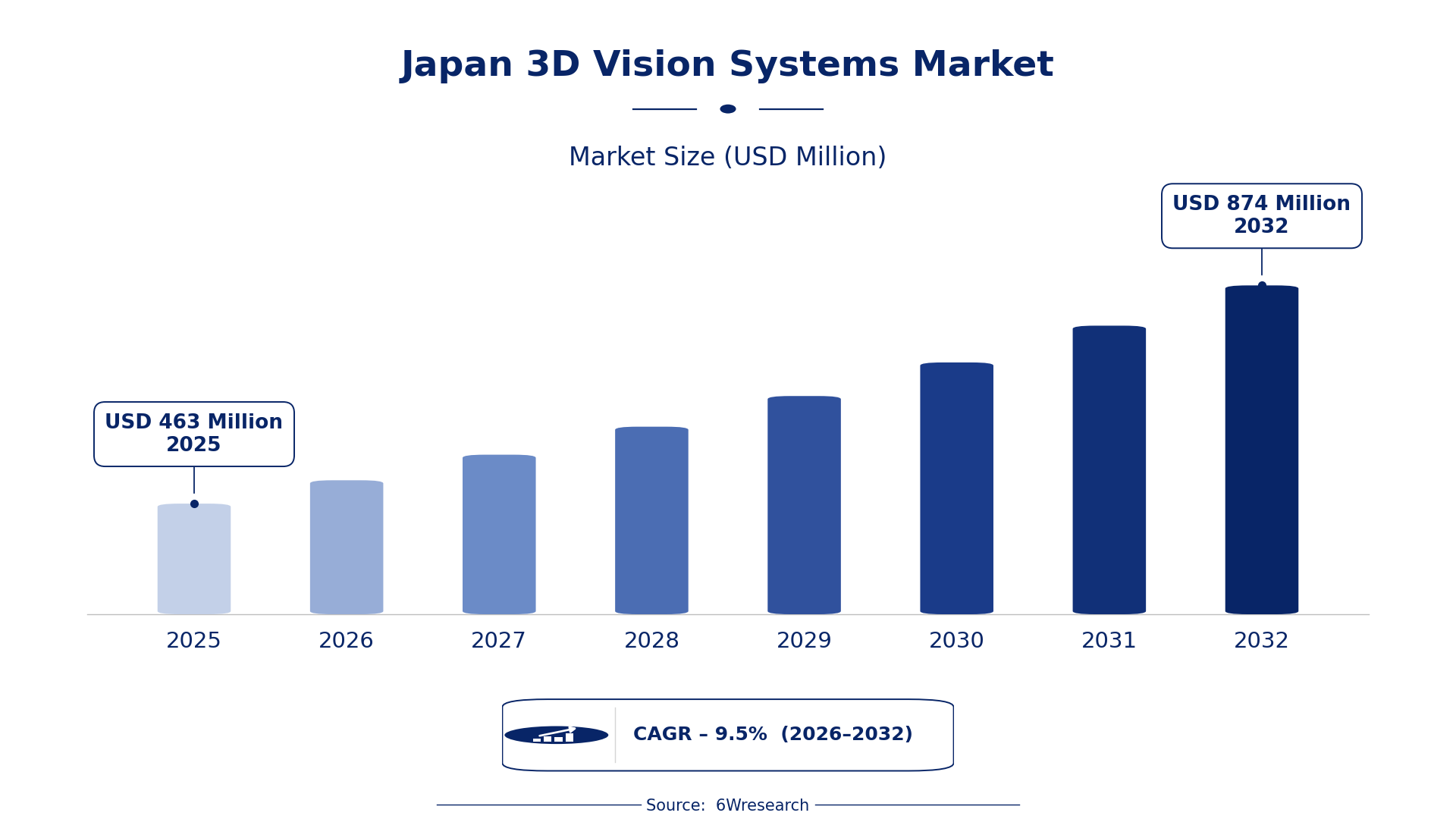
According to 6Wresearch internal database and industry insights, the Japan 3D Vision Systems Market was valued at USD 463 Million in 2025 and is projected to reach USD 874 Million by 2032, growing at a CAGR of approximately 9.5% during 2026–2032.
Japan 3D Vision Systems Market Highlights
| Report Metric | Details |
| Report Name | Japan 3D Vision Systems Market (2026-2032) |
| Market Size 2025 | USD 463 Million |
| Market Size 2032 | USD 874 Million |
| Absolute Growth 2025–2032 | USD 411 Million |
| CAGR 2026–2032 | 9.5% |
| Peak Annual Growth | 10.9% in 2028 |
| Forecast Period | 2026–2032 |
| Historical Data | 2022–2025 |
| Base Year | 2025 |
| Leading Component Type, 2025 | Hardware (42% share) |
| Leading Technology Type, 2025 | Stereoscopic Vision (49% share) |
| Leading Sensing Type, 2025 | Passive Sensing (45% share) |
| Leading Distribution Channel, 2025 | Online Platforms (43% share) |
| Leading End User Industry, 2025 | Industrial Automation (50% share) |
| Fastest-Growing Component Type | Software (13.3% CAGR) |
| Fastest-Growing Technology Type | Time-of-Flight (12.9% CAGR) |
| Fastest-Growing Sensing Type | Active Sensing (13.1% CAGR) |
| Fastest-Growing Distribution Channel | System Integrators (11.8% CAGR) |
| Fastest-Growing End User Industry | Robotics Industry (12.2% CAGR) |
| Growing Sector | Industrial Automation |
| Key End Users | Manufacturers, Robotics Industry, Automotive Assembly, System Integrators |
Japan 3D Vision Systems Market Year-wise Growth Rate and Key Drivers (2022–2032)
This graph illustrates the annual growth rates of the market from 2022 to 2032, highlighting a steady upward trajectory and projected market expansion over the forecast period.
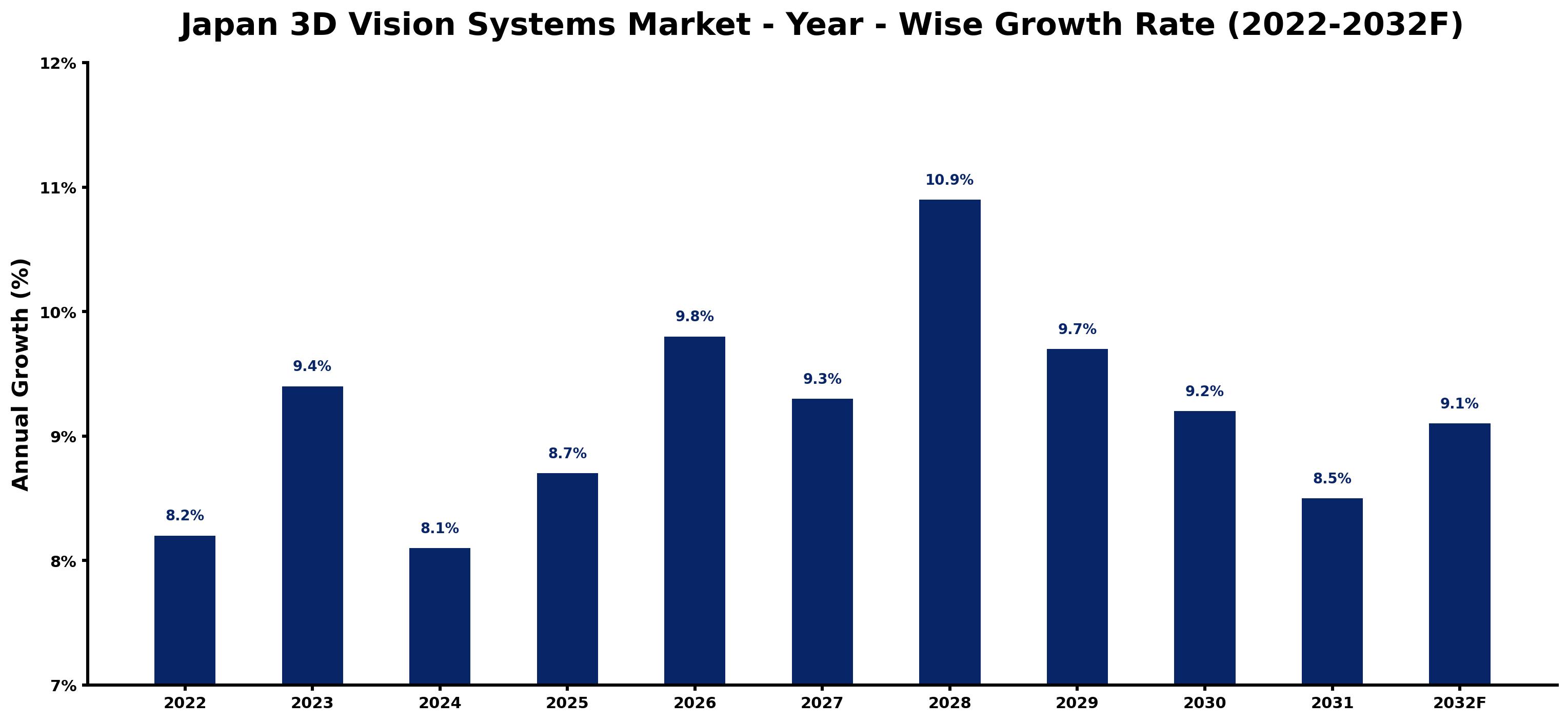
Each row of the following table gives one year's estimated growth and the event or demand shift that explains it.
| Year | Estimated Annual Growth (%) | Market Rationale |
| 2022 | 8.2 | The market experienced steady growth, driven by increasing automation in various sectors. |
| 2023 | 9.4 | Demand surged as the automotive sector produced over 9 million vehicles, boosting technology adoption. |
| 2024 | 8.1 | Growth slowed due to market saturation in some industrial applications, yet demand remained strong. |
| 2025 | 8.7 | A renewed interest in automation technologies led to faster growth as companies invested more. |
| 2026 | 9.8 | Investment in advanced manufacturing technologies is expected to drive demand for 3D vision systems. |
| 2027 | 9.3 | Growth is expected to slow slightly as companies adjust to new technologies and market conditions. |
| 2028 | 10.9 | The market peaks as major investments in robotics and automation technologies are realised. |
| 2029 | 9.7 | A slight slowdown is anticipated as the market stabilises after rapid growth in previous years. |
| 2030 | 9.2 | Demand continues to grow, albeit at a slower pace, as industries refine their automation strategies. |
| 2031 | 8.5 | The market is projected to experience another slowdown as companies focus on optimising existing systems. |
| 2032 | 9.1 | Growth is expected to pick up again as new applications for 3D vision systems emerge in various sectors. |
Note: Market size estimations and growth projections presented in this report are based on 6Wresearch's proprietary forecasting methodology, utilizing the latest available industry data, government publications, and primary research inputs.
Japan 3D Vision Systems Market Synopsis
3D Vision Systems are advanced imaging technologies that capture three-dimensional information about objects using methods like stereoscopic vision and time-of-flight. These systems find key applications in automation for manufacturing, quality control, and robotics. The Japan 3D Vision Systems Market is expanding due to strong demand from the automotive sector, which produced over 9 million vehicles in 2022, and substantial investments in advanced manufacturing technologies. The Robotics Industry, valued at over 1 trillion yen, continues to drive demand for these systems, particularly in industrial automation, as companies seek to improve operational efficiency.
Market Dynamics Impact Analysis (2026–2032)
| Factor | Type | Impact | Primary Segment Affected |
| Strong automotive production drives demand for 3D vision systems in assembly lines. | Driver | High | Automotive Assembly |
| Growing investment in robotics enhances the need for precise 3D vision technologies. | Driver | High | Robotics Industry |
| Increased automation in manufacturing creates opportunities for system integrators to expand. | Opportunity | High | System Integrators |
| The launch of advanced manufacturing programmes opens new markets for 3D vision systems. | Opportunity | High | Industrial Automation |
| High initial costs of 3D vision systems can deter smaller manufacturers from adoption. | Restraint | Medium | Hardware |
| Limited awareness of 3D vision system benefits restricts market growth in certain sectors. | Restraint | Medium | Software |
| Compliance with evolving standards can complicate system integration for manufacturers. | Challenge | High | Integrated Systems |
| Capacity constraints in production may delay the rollout of new 3D vision technologies. | Challenge | Medium | Stereoscopic Vision |
Evaluation of Drivers in Japan 3D Vision Systems Market (2026–2032)
Key forces behind demand, with the segment each one moves most, are listed below.
| Drivers | Primary Segment Affected | Why It Matters (Evidence) |
| Strong automotive production levels drive demand for 3D vision systems in assembly lines. | Automotive Assembly | The automotive sector produced over 9 million vehicles in 2022, increasing the need for automation. |
| Growing investments in robotics enhance the need for precise 3D vision technologies. | Robotics Industry | The Robotics Industry in Japan is valued at over 1 trillion yen, leading to higher demand for automation. |
| The installed base of industrial robots supports the adoption of 3D vision systems. | Industrial Automation | The installed base reached 400,000 units in 2022, many equipped with 3D vision systems. |
| The introduction of JIS B 8120 standard ensures quality and interoperability in 3D systems. | Software | This standard promotes confidence in 3D vision technology, driving adoption across industries. |
| The Ministry of Economy, Trade, and Industry's programme promotes advanced manufacturing technologies. | Integrated Systems | In 2023, the government allocated 50 billion yen to support technologies like 3D vision systems. |
Much of the new demand traces back to the automotive sector, which produced over 9 million vehicles in 2022, spurring investments in automation. The Robotics Industry in Japan, valued at over 1 trillion yen, drives the need for precise 3D vision technologies. The installed base of industrial robots reached 400,000 units in 2022, many equipped with 3D vision systems, creating further demand. The introduction of standards ensures interoperability, encouraging manufacturers to adopt these technologies and improve their production capabilities.
Evaluation of Restraints in Japan 3D Vision Systems Market
The main factors holding the market back are set out below.
| Market Restraint | Primary Segment Affected | Why It Matters (Evidence) |
| High initial costs of 3D vision systems can deter smaller manufacturers from adoption. | Hardware | The average annual salary in the manufacturing sector is approximately 4.5 million yen, reflecting skilled labor costs. |
| Limited awareness of 3D vision system benefits restricts market growth in certain sectors. | Software | Some manufacturers lack understanding of how 3D vision can improve quality control processes. |
| Compliance with evolving standards complicates system integration for manufacturers. | Integrated Systems | Adhering to standards like ISO 9283 can increase operational complexity and costs. |
| Market saturation in some applications limits growth potential for new entrants. | Stereoscopic Vision | Established players dominate the market, making it challenging for newcomers to gain traction. |
| Technological advancements outpacing current infrastructure may hinder adoption rates. | Active Sensing | Some facilities lack the necessary upgrades to integrate new 3D vision technologies effectively. |
Japan 3D Vision Systems Market Challenges
Japan's 3D vision systems market faces stringent regulations, with standards like JIS B 8120 imposing compliance costs that can delay product launches by up to six months for manufacturers. A lack of skilled workers in advanced imaging technology results in increased labour costs, averaging 4.5 million yen annually, which burdens producers trying to meet rising demand. Supply chain disruptions, particularly in sourcing components for 3D systems, can lead to production delays of up to three months for manufacturers. Rapid technological advancements necessitate continuous investment, straining budgets for small to medium-sized enterprises.
Trends in the Japan 3D Vision Systems Market
Several trends are reshaping the Japan 3D Vision Systems Market; the most important are set out below.
- Shift from Traditional to Advanced Automation: In 2023, Japan's automotive sector began adopting advanced automation technologies, leading to a 30% efficiency improvement on assembly lines. This trend encourages suppliers to innovate and provide more integrated solutions.
- Transition from Passive to Active Sensing Technologies: Tokyo is experiencing a shift towards active sensing technologies in 3D vision systems, with a projected growth of 13.1% by 2032. This change is prompting manufacturers to enhance their product offerings.
- Emergence of Integrated Systems in Manufacturing: The introduction of integrated systems combining hardware and software is becoming prevalent, driven by the need for comprehensive automation. In 2023, this segment is projected to grow significantly as companies seek complete solutions.
- Focus on Compliance with JIS B 8120 Standard: Since the introduction of the JIS B 8120 standard, manufacturers are prioritising compliance to ensure interoperability. This focus is reshaping product development and market strategies.
Investment Opportunities in the Japan 3D Vision Systems Market
The following opportunities in the Japan 3D Vision Systems Market pair current demand with a clear way in.
- Timing for Investment in Automation Technologies: With the Japanese government allocating 50 billion yen for automation technologies in 2023, there is a strong opportunity to invest in 3D vision systems. System integrators can expand their offerings to meet this demand.
- Supply of Integrated 3D Vision Systems: The growing need for integrated solutions in manufacturing presents an opportunity to supply complete 3D vision systems. Industrial Automation sectors are actively seeking these solutions to improve productivity.
- Expansion in Key Industrial Regions: Tokyo and Aichi are key regions for the adoption of 3D vision technologies. Investing in local partnerships can facilitate entry into these growing markets.
- Entry through Joint Ventures with Local Firms: Forming joint ventures with local system integrators can help foreign companies navigate the Japanese market. This approach allows for shared expertise and resources, increasing market penetration.
Government Initiatives in the Japan 3D Vision Systems Market
The Act on the Rational Use of Energy, established in 1979, mandates large energy users to improve energy efficiency and report their energy consumption. This law affects manufacturers, as they must ensure their systems comply with energy efficiency standards, influencing the adoption of 3D vision technologies in energy-intensive sectors.
The Digital Agency, established in September 2021, oversees the government's digital transformation efforts. It approves funding for projects that support automation technologies, including 3D vision systems, thereby assisting manufacturers in upgrading their capabilities.
Future Insight of the Japan 3D Vision Systems Market
Suppliers will need to adapt as the automotive sector increasingly embraces automation technologies by 2032, driven by government initiatives and funding of 50 billion yen to promote advanced manufacturing. The automotive assembly line productivity is expected to improve by an additional 20% through advanced 3D vision systems. Standards like ISO 9283 will evolve, refining performance evaluation for buyers. As industrial robots equipped with 3D vision systems expand, suppliers must innovate to meet the growing demand across various sectors.
Market Segmentation Analysis
Japan 3D Vision Systems Market report covers a detailed analysis of the following market segments:
By Component Type – Hardware Leads, Software Expected to Grow Fastest
According to Saurav Kr Singh, Senior Research Analyst at 6Wresearch, Hardware held 42% of the Japan 3D Vision Systems Market by component type in 2025. Hardware holds the largest share as it is essential for capturing 3D data, especially in industrial applications. The installed base of 400,000 industrial robots in Japan often relies on these hardware components for their operation. The quickest growth will come from Software, forecast to expand at a CAGR of 13.3% between 2026 and 2032. Software is experiencing rapid growth due to its critical role in processing and analysing 3D data, which is increasingly necessary in automation. The government's allocation of 50 billion yen in 2023 to promote automation technologies will likely accelerate software adoption further. Suppliers should prioritise the development of advanced software solutions to meet the increasing demand in the automation sector.
By Technology Type – Stereoscopic Vision Leads, Time-of-Flight Expected to Grow Fastest
In 2025, Stereoscopic Vision led the technology type split with a 49% share. Stereoscopic Vision leads the market as it is widely employed for depth perception in various applications, especially in industrial automation. Its established use in key industrial regions like Tokyo and Aichi reinforces its dominant position. Time-of-Flight is projected to grow fastest, at a CAGR of 12.9% during 2026–2032. Time-of-Flight technology is experiencing rapid growth due to its critical applications in scenarios requiring precise distance measurements, particularly in the automotive sector. The 30% improvement in automotive assembly line efficiency through advanced measurement technologies highlights its increasing importance. Buyers should consider investing in Time-of-Flight systems to optimise operational efficiency in their processes.
By Sensing Type – Passive Sensing Leads, Active Sensing Expected to Grow Fastest
With 45% of sensing type revenue in 2025, Passive Sensing was the largest category. Passive Sensing leads the market, albeit less common in industrial applications, as it is often used in simpler measurement scenarios. Its established use in various sectors provides a solid foundation for its market share. Active Sensing is set to record the highest CAGR in this split, 13.1% over 2026–2032. Active Sensing is growing rapidly because it is commonly used for dynamic measurements, which are essential in high-speed industrial environments. The demand for automation in Japan's manufacturing sector, employing approximately 8.5 million people, fuels this growth. Suppliers need to focus on developing Active Sensing technologies to cater to the dynamic needs of the industry.
By Distribution Channel – Online Platforms Lead, System Integrators Expected to Grow Fastest
Online Platforms took 43% of distribution channel revenue in 2025, more than any other category. Online Platforms serve as the leading distribution channel, facilitating product sales and expanding market reach, even though they are not the primary channel for industrial sales. Their importance in connecting suppliers with buyers in the automation sector is becoming more pronounced. Over 2026–2032, System Integrators are expected to post the fastest growth, at a CAGR of 11.8%. System Integrators are experiencing the fastest growth as they are vital for implementing 3D systems across various industries, particularly in robotics. The Ministry of Economy, Trade, and Industry's 2023 programme to promote advanced manufacturing technologies highlights the growing need for integration expertise. Suppliers should enhance partnerships with System Integrators to improve market penetration and service delivery.
By End User Industry – Industrial Automation Leads, Robotics Industry Expected to Grow Fastest
Industrial Automation accounted for 50% of the market by end user industry in 2025. Industrial Automation is the leading end user industry, extensively employing 3D vision systems to improve efficiency and accuracy in production processes. The significant investment in automation technologies in Japan reinforces the prominence of this sector. The quickest growth will come from Robotics Industry, forecast to expand at a CAGR of 12.2% between 2026 and 2032. The Robotics Industry is the fastest-growing segment, essential for robotic perception, which is increasingly important in modern applications. The industry's valuation at over 1 trillion yen indicates substantial investment and growth potential. Buyers in the Robotics Industry should focus on integrating advanced 3D vision systems to maintain a competitive advantage.
Key Attractiveness of the Report
- 10 Years of Market Numbers
- Historical Data Starting from 2022 to 2025
- Base Year 2025
- Forecast Data until 2032
- Key Performance Indicators Impacting the Market
- Major Upcoming Developments and Projects
Key Highlights of the Report:
- Japan 3D Vision Systems Market Outlook
- Market Size of Japan 3D Vision Systems Market, 2025
- Forecast of Japan 3D Vision Systems Market, 2032
- Historical Data and Forecast of Japan 3D Vision Systems Revenues & Volume for the Period 2022-2032F
- Japan 3D Vision Systems Market Trend Evolution
- Japan 3D Vision Systems Market Drivers and Challenges
- Japan 3D Vision Systems Price Trends
- Japan 3D Vision Systems Porter's Five Forces
- Japan 3D Vision Systems Industry Life Cycle
- Historical Data and Forecast of Japan 3D Vision Systems Market Revenues & Volume By Component Type for the Period 2022-2032F
- Historical Data and Forecast of Japan 3D Vision Systems Market Revenues & Volume By Hardware for the Period 2022-2032F
- Historical Data and Forecast of Japan 3D Vision Systems Market Revenues & Volume By Software for the Period 2022-2032F
- Historical Data and Forecast of Japan 3D Vision Systems Market Revenues & Volume By Services for the Period 2022-2032F
- Historical Data and Forecast of Japan 3D Vision Systems Market Revenues & Volume By Integrated Systems for the Period 2022-2032F
- Historical Data and Forecast of Japan 3D Vision Systems Market Revenues & Volume By Technology Type for the Period 2022-2032F
- Historical Data and Forecast of Japan 3D Vision Systems Market Revenues & Volume By Stereoscopic Vision for the Period 2022-2032F
- Historical Data and Forecast of Japan 3D Vision Systems Market Revenues & Volume By Time-of-Flight for the Period 2022-2032F
- Historical Data and Forecast of Japan 3D Vision Systems Market Revenues & Volume By Structured Light for the Period 2022-2032F
- Historical Data and Forecast of Japan 3D Vision Systems Market Revenues & Volume By Laser Triangulation for the Period 2022-2032F
- Historical Data and Forecast of Japan 3D Vision Systems Market Revenues & Volume By Sensing Type for the Period 2022-2032F
- Historical Data and Forecast of Japan 3D Vision Systems Market Revenues & Volume By Passive Sensing for the Period 2022-2032F
- Historical Data and Forecast of Japan 3D Vision Systems Market Revenues & Volume By Active Sensing for the Period 2022-2032F
- Historical Data and Forecast of Japan 3D Vision Systems Market Revenues & Volume By Binocular Vision for the Period 2022-2032F
- Historical Data and Forecast of Japan 3D Vision Systems Market Revenues & Volume By Monocular Vision for the Period 2022-2032F
- Historical Data and Forecast of Japan 3D Vision Systems Market Revenues & Volume By Distribution Channel for the Period 2022-2032F
- Historical Data and Forecast of Japan 3D Vision Systems Market Revenues & Volume By Online Platforms for the Period 2022-2032F
- Historical Data and Forecast of Japan 3D Vision Systems Market Revenues & Volume By System Integrators for the Period 2022-2032F
- Historical Data and Forecast of Japan 3D Vision Systems Market Revenues & Volume By Direct Sales for the Period 2022-2032F
- Historical Data and Forecast of Japan 3D Vision Systems Market Revenues & Volume By OEMs for the Period 2022-2032F
- Historical Data and Forecast of Japan 3D Vision Systems Market Revenues & Volume By End User Industry for the Period 2022-2032F
- Historical Data and Forecast of Japan 3D Vision Systems Market Revenues & Volume By Industrial Automation for the Period 2022-2032F
- Historical Data and Forecast of Japan 3D Vision Systems Market Revenues & Volume By Robotics Industry for the Period 2022-2032F
- Historical Data and Forecast of Japan 3D Vision Systems Market Revenues & Volume By Manufacturing for the Period 2022-2032F
- Historical Data and Forecast of Japan 3D Vision Systems Market Revenues & Volume By Automotive Assembly for the Period 2022-2032F
- Japan 3D Vision Systems Import Export Trade Statistics
- Market Opportunity Assessment By Component Type
- Market Opportunity Assessment By Technology Type
- Market Opportunity Assessment By Sensing Type
- Market Opportunity Assessment By Distribution Channel
- Market Opportunity Assessment By End User Industry
- Japan 3D Vision Systems Top Companies Market Share
- Japan 3D Vision Systems Competitive Benchmarking By Technical and Operational Parameters
- Japan 3D Vision Systems Company Profiles
- Japan 3D Vision Systems Key Strategic Recommendations
Market Covered
This report examines the market across the segments below.
By Component Type
- Hardware
- Software
- Services
- Integrated Systems
By Technology Type
- Stereoscopic Vision
- Time-of-Flight
- Structured Light
- Laser Triangulation
By Sensing Type
- Passive Sensing
- Active Sensing
- Binocular Vision
- Monocular Vision
By Distribution Channel
- Online Platforms
- System Integrators
- Direct Sales
- OEMs
By End User Industry
- Industrial Automation
- Robotics Industry
- Manufacturing
- Automotive Assembly































