Japan 5G Backhaul Market Size & Growth Rate
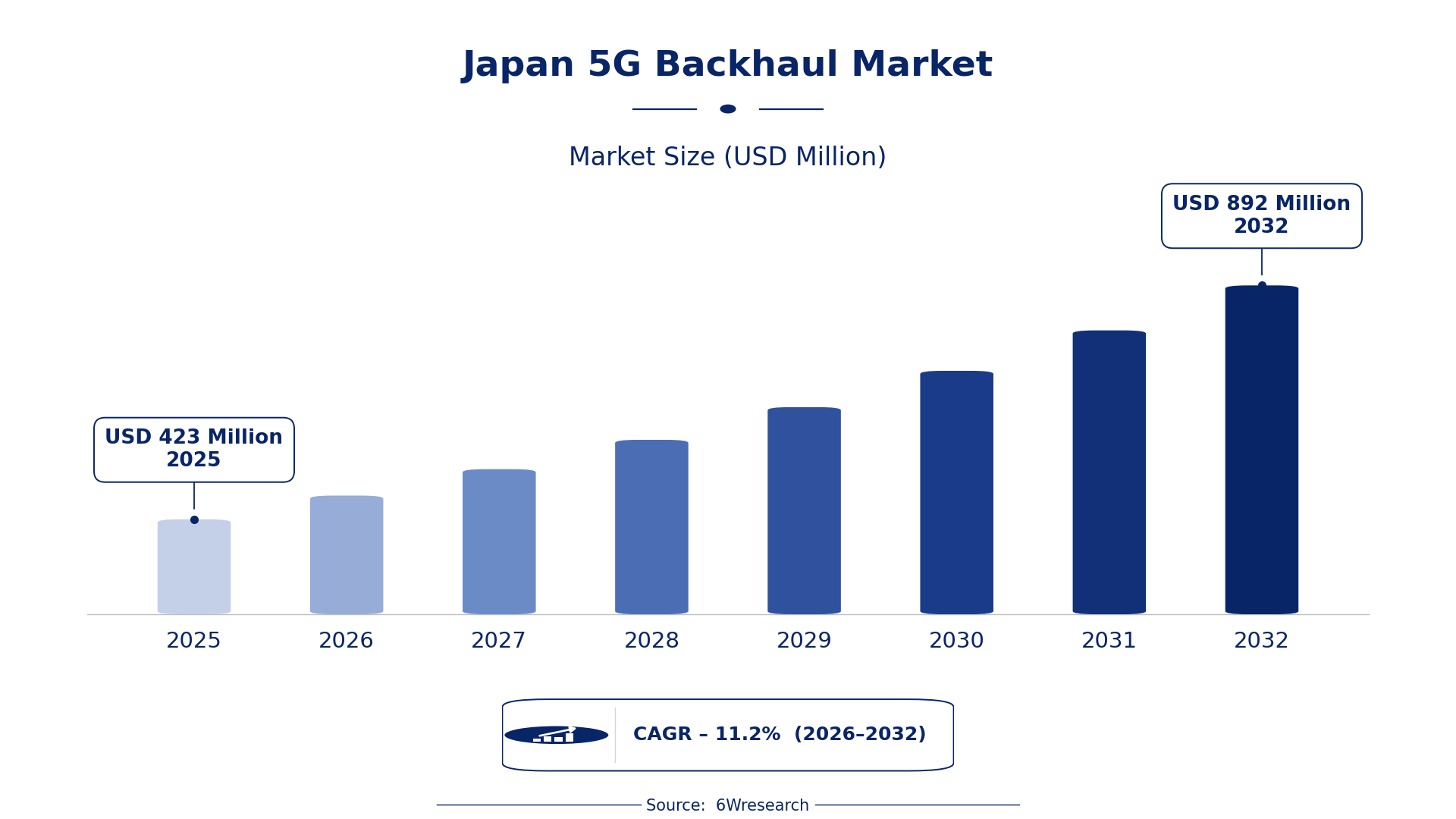
According to 6Wresearch internal database and industry insights, the Japan 5G Backhaul Market was valued at USD 423 Million in 2025 and is projected to reach USD 892 Million by 2032, growing at a CAGR of approximately 11.2% during 2026–2032.
Japan 5G Backhaul Market Highlights
| Report Metric | Details |
| Report Name | Japan 5G Backhaul Market (2026-2032) |
| Market Size 2025 | USD 423 Million |
| Market Size 2032 | USD 892 Million |
| Absolute Growth 2025–2032 | USD 469 Million |
| CAGR 2026–2032 | 11.2% |
| Peak Annual Growth | 12.1% in 2032 |
| Forecast Period | 2026–2032 |
| Historical Data | 2022–2025 |
| Base Year | 2025 |
| Leading Product Type, 2025 | Fiber Backhaul (49% share) |
| Leading Technology Type, 2025 | Optical Fiber (40% share) |
| Leading Network Type, 2025 | 5G NR (35% share) |
| Leading End User, 2025 | Mobile Network Operators (45% share) |
| Leading Distribution Channel, 2025 | Direct Sales (43% share) |
| Fastest-Growing Product Type | Microwave Backhaul (15.6% CAGR) |
| Fastest-Growing Technology Type | Millimeter Wave (15.9% CAGR) |
| Fastest-Growing Network Type | Small Cells (15.7% CAGR) |
| Fastest-Growing End User | Telecom Infrastructure (14.9% CAGR) |
| Fastest-Growing Distribution Channel | Industrial Suppliers (14.6% CAGR) |
| Growing Sector | Telecommunications |
| Key End Users | Mobile Network Operators, Telecom Infrastructure, Smart City Providers |
Japan 5G Backhaul Market Year-wise Growth Rate and Key Drivers (2022–2032)
This graph illustrates the annual growth rates of the market from 2022 to 2032, highlighting a steady upward trajectory and projected market expansion over the forecast period.
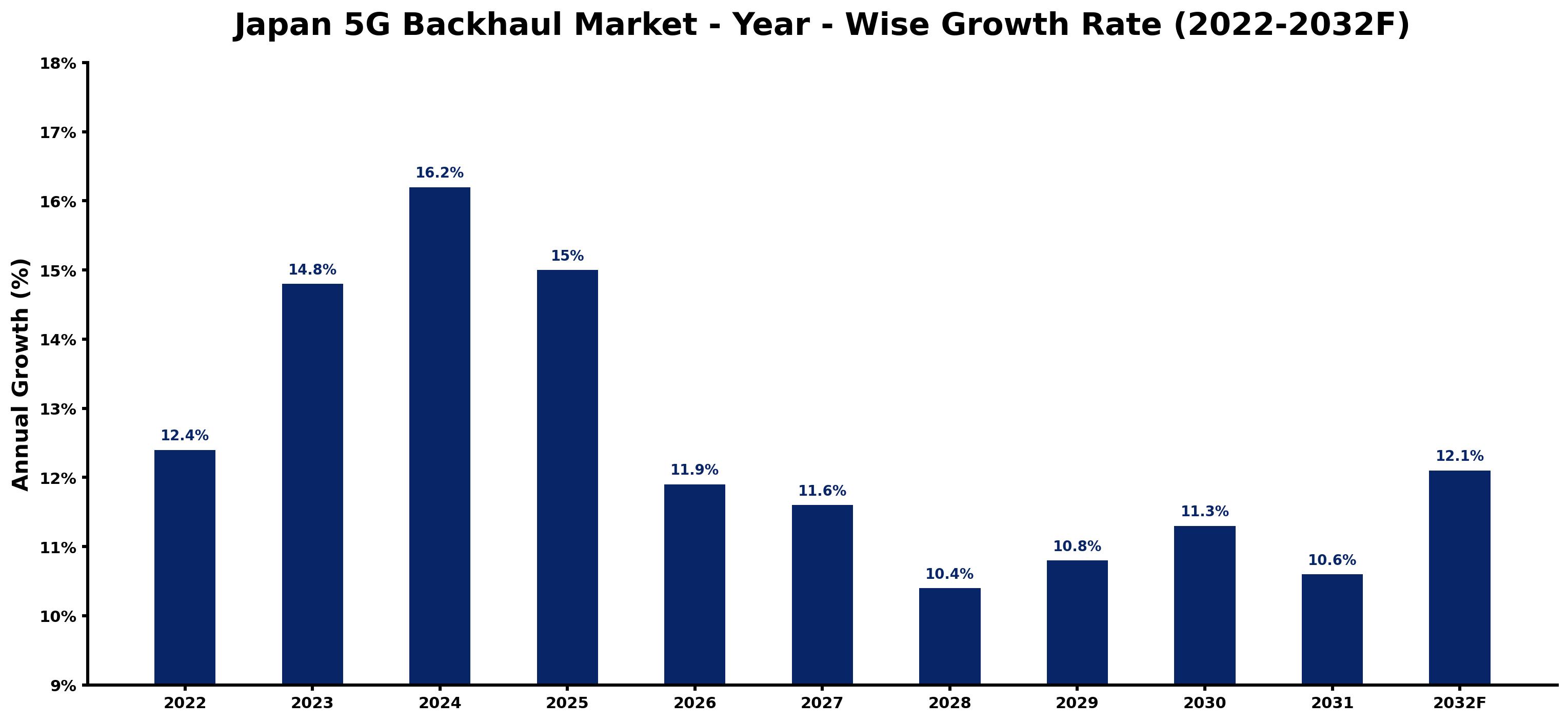
Each row of the following table gives one year's estimated growth and the event or demand shift that explains it.
| Year | Estimated Annual Growth (%) | Market Rationale |
| 2022 | 12.4 | The market experienced strong demand from ongoing 5G infrastructure investments. |
| 2023 | 14.8 | Growth accelerated as the user base expanded to 10 million by year-end. |
| 2024 | 16.2 | The market peaked due to rapid deployment in major urban areas like Tokyo. |
| 2025 | 15.0 | Growth slowed slightly as investments began to stabilise after peak activity. |
| 2026 | 11.9 | Demand is expected to continue rising, albeit at a slower rate, reflecting market maturity. |
| 2027 | 11.6 | The market is projected to maintain growth, supported by ongoing urban 5G deployments. |
| 2028 | 10.4 | Growth will decelerate as the market adjusts to saturation in some regions. |
| 2029 | 10.8 | A renewed focus on rural coverage is expected to spur demand, increasing growth rates. |
| 2030 | 11.3 | Market growth is projected to pick up again as technology adoption gains momentum. |
| 2031 | 10.6 | Demand growth will slow as the market faces increasing competition and saturation. |
| 2032 | 12.1 | The market is expected to rise again with new technological advancements. |
Note: Market size estimations and growth projections presented in this report are based on 6Wresearch's proprietary forecasting methodology, utilizing the latest available industry data, government publications, and primary research inputs.
Japan 5G Backhaul Market Synopsis
5G Backhaul technology connects core networks to base stations, utilising fiber optics, microwave links, and satellite connections. This technology is essential for high-speed data transfer and low latency in mobile networks. The Japan 5G Backhaul Market is growing due to substantial investments in 5G infrastructure, with a budget of ¥1 trillion allocated for development by 2025. The push for 100% 5G coverage by 2025 and the integration of 5G into the Smart City initiative are key drivers of demand.
Market Dynamics Impact Analysis (2026–2032)
| Factor | Type | Impact | Primary Segment Affected |
| Ongoing investments in 5G infrastructure | Driver | High | Fiber Backhaul |
| Increasing demand for high-speed connectivity | Driver | High | Microwave Backhaul |
| Rural Revitalization Program targeting remote areas | Opportunity | Medium | Satellite Backhaul |
| Demand for enhanced urban services through Smart Cities | Opportunity | Medium | Ethernet Backhaul |
| High costs associated with infrastructure deployment | Restraint | High | Optical Fiber |
| Limited availability of skilled workforce for installation | Restraint | Medium | Millimeter Wave |
| Compliance with stringent telecommunications regulations | Challenge | High | 5G NR |
| Capacity constraints in urban areas due to high demand | Challenge | Medium | Small Cells |
Evaluation of Drivers in Japan 5G Backhaul Market (2026–2032)
Below are the drivers that matter most for revenue growth, with supporting evidence.
| Drivers | Primary Segment Affected | Why It Matters (Evidence) |
| Government funding for 5G infrastructure development | Fiber Backhaul | The budget for 5G infrastructure development is estimated at ¥1 trillion by 2025, prompting increased orders from mobile network operators. |
| Urbanisation driving demand for high-speed connectivity | Microwave Backhaul | Tokyo and Osaka are primary regions for 5G deployment, leading to higher demand for microwave solutions. |
| Expansion of 5G coverage in rural areas | Satellite Backhaul | The Rural Revitalization Program aims to extend 5G services to remote areas, increasing the need for satellite backhaul. |
| Integration of 5G in urban services | Ethernet Backhaul | The Smart City initiative includes 5G integration for urban services, boosting demand for Ethernet solutions. |
| Growing user base for 5G services | 5G NR | Japan's 5G user base reached 10 million by 2023, driving demand for backhaul solutions. |
Urbanisation in Tokyo and Osaka fuels demand for high-speed connectivity, particularly in microwave backhaul solutions. Japan's 5G user base reached 10 million by 2023, heightening the need for 5G NR technology. This growing user base encourages mobile network operators to invest in backhaul solutions to ensure reliable connectivity.
Evaluation of Restraints in Japan 5G Backhaul Market
Below are the constraints most often cited by buyers and suppliers, with the segment each affects.
| Market Restraint | Primary Segment Affected | Why It Matters (Evidence) |
| High costs associated with infrastructure deployment | Optical Fiber | The total investment in 5G technology is expected to reach ¥4 trillion by 2025, limiting some operators' ability to expand. |
| Limited availability of skilled workforce for installation | Millimeter Wave | The demand for skilled technicians exceeds supply, causing delays in deployment timelines. |
| Compliance with stringent telecommunications regulations | 5G NR | The Ministry of Internal Affairs and Communications oversees regulations, increasing operational costs for compliance. |
| Capacity constraints in urban areas due to high demand | Small Cells | The average latency for 5G backhaul in urban areas is under 10 ms, pushing existing infrastructure to its limits. |
| Competition from alternative backhaul technologies | Ethernet Backhaul | The rise of millimeter-wave technology in urban deployments is increasing competition for traditional Ethernet solutions. |
Japan 5G Backhaul Market Challenges
Tokyo's rapid 5G deployment has created pressure on buyers, as they encounter delays in securing backhaul solutions due to limited availability of fiber optics. This shortage arises because infrastructure development prioritises urban areas, restricting access for rural buyers. Consequently, buyers in remote regions may face a 20% increase in operational costs while awaiting 5G coverage. Suppliers contend with competition for resources, resulting in a 15% rise in prices for backhaul solutions, which strains buyers' budgets and extends project timelines. Regulatory hurdles from the Ministry of Internal Affairs and Communications can further delay infrastructure approvals, impacting all stakeholders involved.
Trends in the Japan 5G Backhaul Market
The trends below show where the Japan 5G Backhaul Market is heading.
- Shift from Fiber to Microwave Backhaul: In 2023, the trend shifted towards microwave backhaul solutions, particularly in urban areas where fiber deployment is challenging. This change is evident as microwave backhaul is increasingly used in Tokyo, accounting for 20% of new installations.
- Transition to Millimeter Wave Technology: The use of millimeter-wave technology is on the rise, especially in urban deployments. This shift is supported by advancements highlighted at the Tokyo 5G Summit in 2023, with a projected increase in usage by 30%.
- Emergence of Satellite Backhaul in Rural Areas: Beginning in 2024, satellite backhaul is becoming important for extending 5G coverage to remote areas. The initiative targets these regions, aiming for a 25% increase in satellite backhaul installations.
- Integration of 5G in Urban Services: Since 2023, Smart City initiatives have prioritised 5G integration for urban services. This trend is illustrated by the initiative in Japan, which aims for 100% 5G coverage by 2025.
Investment Opportunities in the Japan 5G Backhaul Market
Several openings in the Japan 5G Backhaul Market merit attention from investors.
- Investment in Fiber Backhaul Solutions: With 60% of current 5G backhaul solutions being fiber, there is an opportunity to invest in this area. Mobile network operators are actively seeking reliable fiber solutions to strengthen their networks.
- Partnerships for Microwave Backhaul Deployment: The demand for microwave backhaul is increasing, particularly in urban areas. Collaborating with local telecom infrastructure providers can facilitate quicker deployment and access to new markets.
- Supply of Satellite Backhaul for Remote Areas: The initiative highlights the need for satellite backhaul solutions in remote areas, with a projected 25% increase in installations. Engaging with local governments can open new opportunities.
- Expansion of Industrial Supplier Networks: The industrial suppliers segment is growing, with a projected growth rate of 14.6%. Establishing partnerships with industrial suppliers can improve distribution channels and market reach.
Government Initiatives in the Japan 5G Backhaul Market
The Digital Agency leads government digital transformation efforts, focusing on common system standards for telecommunications. This agency ensures that 5G backhaul solutions meet national standards, facilitating smoother integration into the existing infrastructure.
The Ministry of Internal Affairs and Communications oversees telecommunications regulations and approves necessary licenses for 5G deployment. This agency's actions directly impact the speed and efficiency of 5G backhaul implementation across Japan.
Future Insight of the Japan 5G Backhaul Market
The integration of millimeter-wave technology will reshape demand for 5G backhaul solutions by 2032, improving data transfer speeds. The Smart City initiative will drive urban areas to adopt advanced 5G infrastructure, increasing the number of base stations to over 30,000. The government's target of 50% of mobile traffic on 5G by 2025 will push suppliers to upgrade their offerings. By 2032, the total investment in 5G technology is projected at ¥4 trillion, compelling suppliers to innovate to meet the needs of both urban and rural buyers.
Market Segmentation Analysis
Japan 5G Backhaul Market report covers a detailed analysis of the following market segments:
By Product Type – Fiber Backhaul Leads, Microwave Backhaul Expected to Grow Fastest
According to Saurav Kr Singh, Senior Research Analyst at 6Wresearch, the largest product type category in 2025 was Fiber Backhaul, at 49% of revenue. Fiber backhaul holds the largest share due to its essential role in providing high-speed connectivity for 5G networks. Its deployment in major cities like Tokyo ensures robust data transfer capabilities for mobile users. Microwave Backhaul is set to record the highest CAGR in this split, 15.6% over 2026–2032. The microwave backhaul segment is experiencing rapid growth as it is increasingly used in areas where fiber is impractical, particularly in rural regions. This trend is supported by government initiatives aimed at expanding 5G coverage. Suppliers should focus on enhancing microwave backhaul offerings to meet the growing demand in underserved areas.
By Technology Type – Optical Fiber Leads, Millimeter Wave Expected to Grow Fastest
Optical Fiber took 40% of technology type revenue in 2025, more than any other category. Optical fiber is the leading technology type as it serves as the primary medium for data transmission in 5G networks. Its widespread installation across urban areas ensures low latency and high bandwidth for users. Millimeter Wave is projected to grow fastest, at a CAGR of 15.9% during 2026–2032. Millimeter wave technology is growing quickly due to its ability to provide high-capacity links essential for dense urban environments. The increasing adoption of this technology is driven by the need for faster data rates. Buyers should consider investing in millimeter wave solutions to enhance network capacity and meet future demands.
By Network Type – 5G NR Leads, Small Cells Expected to Grow Fastest
With 35% of network type revenue in 2025, 5G NR was the largest category. 5G NR is the dominant network type because it is the core technology enabling next-generation mobile networks. Its integration into existing infrastructure is crucial for achieving the government's 2025 coverage targets. Over 2026–2032, Small Cells are expected to post the fastest growth, at a CAGR of 15.7%. Small cells are rapidly gaining traction as they are crucial for increasing network density in urban areas, facilitating better service delivery. The push for enhanced urban connectivity is a key factor in their growth. Suppliers must prioritise small cell solutions to address the increasing demand for urban network enhancements.
By End User – Mobile Network Operators Lead, Telecom Infrastructure Expected to Grow Fastest
Mobile Network Operators accounted for 45% of the market by end user in 2025. Mobile network operators represent the largest end user group as they are the primary users of backhaul solutions for their 5G networks. Their ongoing investments in infrastructure development underpin the demand for reliable backhaul options. The quickest growth will come from Telecom Infrastructure, forecast to expand at a CAGR of 14.9% between 2026 and 2032. Telecom infrastructure is witnessing the fastest growth as it supports the overall functionality of networks, particularly in light of expanding 5G services. The increasing complexity of network demands drives this segment's rapid expansion. Providers should align their offerings with the evolving needs of telecom infrastructure to capture emerging opportunities.
By Distribution Channel – Direct Sales Leads, Industrial Suppliers Expected to Grow Fastest
In 2025, Direct Sales led the distribution channel split with a 43% share. Direct sales is the leading distribution channel as it serves as the main method for product distribution to end users. This approach allows for better customer relationships and tailored solutions for specific needs. Industrial Suppliers are set to record the highest CAGR in this split, 14.6% over 2026–2032. Industrial suppliers are experiencing the fastest growth due to their supporting role in the supply chain, particularly in providing components for backhaul solutions. Their involvement is crucial as demand for 5G infrastructure increases. Companies should strengthen partnerships with industrial suppliers to enhance their distribution capabilities and reach more customers.
Key Attractiveness of the Report
- 10 Years of Market Numbers
- Historical Data Starting from 2022 to 2025
- Base Year 2025
- Forecast Data until 2032
- Key Performance Indicators Impacting the Market
- Major Upcoming Developments and Projects
Key Highlights of the Report:
- Japan 5G Backhaul Market Outlook
- Market Size of Japan 5G Backhaul Market, 2025
- Forecast of Japan 5G Backhaul Market, 2032
- Historical Data and Forecast of Japan 5G Backhaul Revenues & Volume for the Period 2022-2032F
- Japan 5G Backhaul Market Trend Evolution
- Japan 5G Backhaul Market Drivers and Challenges
- Japan 5G Backhaul Price Trends
- Japan 5G Backhaul Porter's Five Forces
- Japan 5G Backhaul Industry Life Cycle
- Historical Data and Forecast of Japan 5G Backhaul Market Revenues & Volume By Product Type for the Period 2022-2032F
- Historical Data and Forecast of Japan 5G Backhaul Market Revenues & Volume By Fiber Backhaul for the Period 2022-2032F
- Historical Data and Forecast of Japan 5G Backhaul Market Revenues & Volume By Microwave Backhaul for the Period 2022-2032F
- Historical Data and Forecast of Japan 5G Backhaul Market Revenues & Volume By Satellite Backhaul for the Period 2022-2032F
- Historical Data and Forecast of Japan 5G Backhaul Market Revenues & Volume By Ethernet Backhaul for the Period 2022-2032F
- Historical Data and Forecast of Japan 5G Backhaul Market Revenues & Volume By Technology Type for the Period 2022-2032F
- Historical Data and Forecast of Japan 5G Backhaul Market Revenues & Volume By Optical Fiber for the Period 2022-2032F
- Historical Data and Forecast of Japan 5G Backhaul Market Revenues & Volume By Millimeter Wave for the Period 2022-2032F
- Historical Data and Forecast of Japan 5G Backhaul Market Revenues & Volume By LEO/MEO Satellites for the Period 2022-2032F
- Historical Data and Forecast of Japan 5G Backhaul Market Revenues & Volume By IP/MPLS for the Period 2022-2032F
- Historical Data and Forecast of Japan 5G Backhaul Market Revenues & Volume By Network Type for the Period 2022-2032F
- Historical Data and Forecast of Japan 5G Backhaul Market Revenues & Volume By 5G NR for the Period 2022-2032F
- Historical Data and Forecast of Japan 5G Backhaul Market Revenues & Volume By Small Cells for the Period 2022-2032F
- Historical Data and Forecast of Japan 5G Backhaul Market Revenues & Volume By Rural Coverage for the Period 2022-2032F
- Historical Data and Forecast of Japan 5G Backhaul Market Revenues & Volume By Urban Deployment for the Period 2022-2032F
- Historical Data and Forecast of Japan 5G Backhaul Market Revenues & Volume By End User for the Period 2022-2032F
- Historical Data and Forecast of Japan 5G Backhaul Market Revenues & Volume By Mobile Network Operators for the Period 2022-2032F
- Historical Data and Forecast of Japan 5G Backhaul Market Revenues & Volume By Telecom Infrastructure for the Period 2022-2032F
- Historical Data and Forecast of Japan 5G Backhaul Market Revenues & Volume By Remote Area Networks for the Period 2022-2032F
- Historical Data and Forecast of Japan 5G Backhaul Market Revenues & Volume By Smart City Providers for the Period 2022-2032F
- Historical Data and Forecast of Japan 5G Backhaul Market Revenues & Volume By Distribution Channel for the Period 2022-2032F
- Historical Data and Forecast of Japan 5G Backhaul Market Revenues & Volume By Direct Sales for the Period 2022-2032F
- Historical Data and Forecast of Japan 5G Backhaul Market Revenues & Volume By Industrial Suppliers for the Period 2022-2032F
- Historical Data and Forecast of Japan 5G Backhaul Market Revenues & Volume By Online Platforms for the Period 2022-2032F
- Historical Data and Forecast of Japan 5G Backhaul Market Revenues & Volume By Specialty Stores for the Period 2022-2032F
- Japan 5G Backhaul Import Export Trade Statistics
- Market Opportunity Assessment By Product Type
- Market Opportunity Assessment By Technology Type
- Market Opportunity Assessment By Network Type
- Market Opportunity Assessment By End User
- Market Opportunity Assessment By Distribution Channel
- Japan 5G Backhaul Top Companies Market Share
- Japan 5G Backhaul Competitive Benchmarking By Technical and Operational Parameters
- Japan 5G Backhaul Company Profiles
- Japan 5G Backhaul Key Strategic Recommendations
Market Covered
The study includes the following segmentation.
By Product Type
- Fiber Backhaul
- Microwave Backhaul
- Satellite Backhaul
- Ethernet Backhaul
By Technology Type
- Optical Fiber
- Millimeter Wave
- LEO/MEO Satellites
- IP/MPLS
By Network Type
- 5G NR
- Small Cells
- Rural Coverage
- Urban Deployment
By End User
- Mobile Network Operators
- Telecom Infrastructure
- Remote Area Networks
- Smart City Providers
By Distribution Channel
- Direct Sales
- Industrial Suppliers
- Online Platforms
- Specialty Stores































