Japan 5G Consumer Services Market Size & Growth Rate
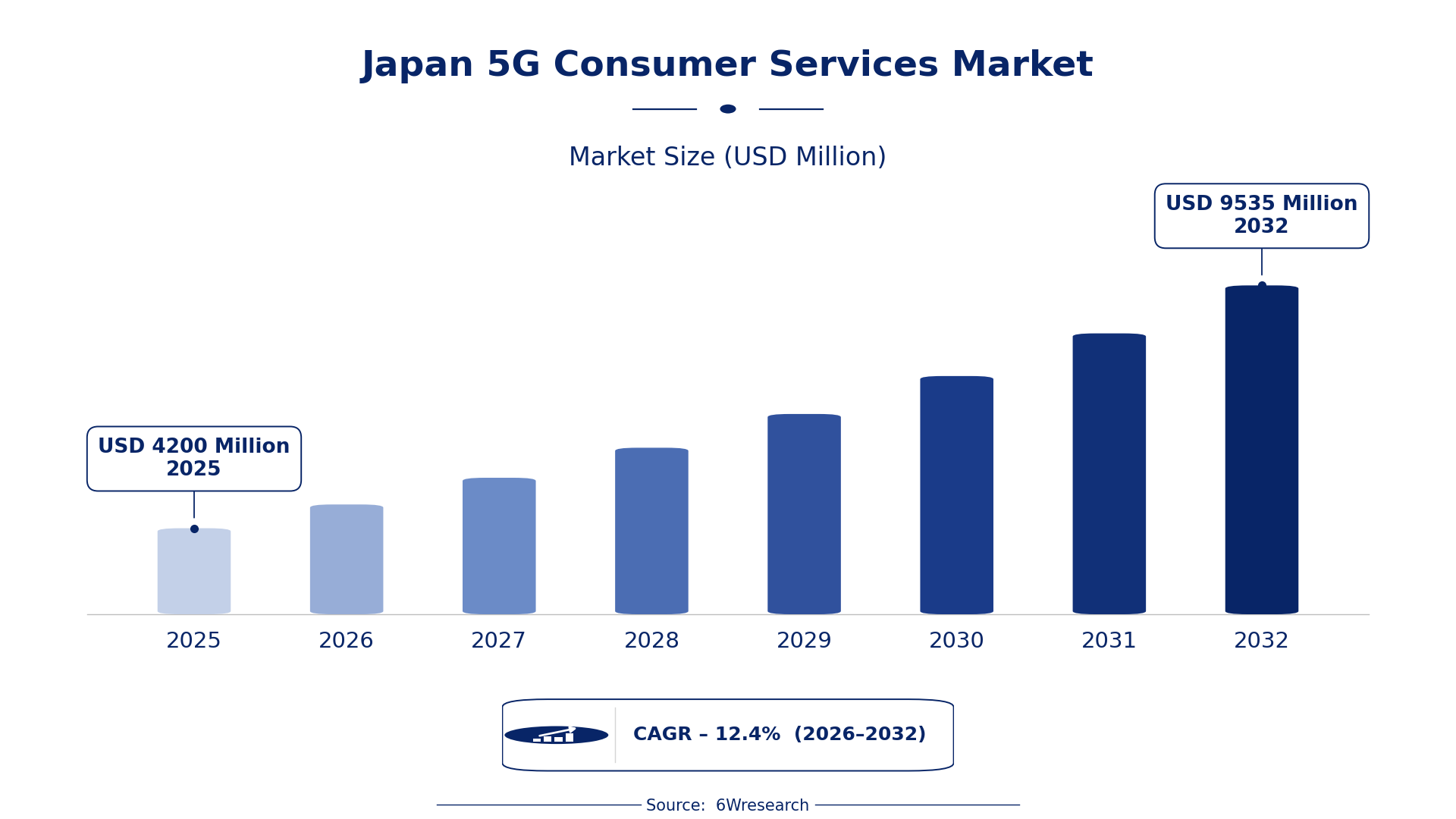
According to 6Wresearch internal database and industry insights, the Japan 5G Consumer Services Market was valued at USD 4,200 Million in 2025 and is projected to reach USD 9,535 Million by 2032, growing at a CAGR of approximately 12.4% during 2026–2032.
Japan 5G Consumer Services Market Highlights
| Report Metric | Details |
| Report Name | Japan 5G Consumer Services Market (2026-2032) |
| Market Size 2025 | USD 4,200 Million |
| Market Size 2032 | USD 9,535 Million |
| Absolute Growth 2025–2032 | USD 5,335 Million |
| CAGR 2026–2032 | 12.4% |
| Peak Annual Growth | 13.4% in 2028 |
| Forecast Period | 2026–2032 |
| Historical Data | 2022–2025 |
| Base Year | 2025 |
| Leading Service Type, 2025 | Enhanced Mobile Broadband (eMBB) (46% share) |
| Leading Delivery Mode, 2025 | Online Access (41% share) |
| Leading User Type, 2025 | Individual Consumers (45% share) |
| Leading Distribution Channel, 2025 | Mobile Operators (37% share) |
| Leading End User, 2025 | Smartphone Users (37% share) |
| Fastest-Growing Service Type | Ultra-Reliable Low Latency (URLLC) (17.0% CAGR) |
| Fastest-Growing Delivery Mode | Managed Services (16.5% CAGR) |
| Fastest-Growing User Type | Enterprise Users (17.5% CAGR) |
| Fastest-Growing Distribution Channel | Network Providers (15.4% CAGR) |
| Fastest-Growing End User | Industrial Automation (16.3% CAGR) |
| Growing Sector | Smart Home Technology |
| Key End Users | Individual Consumers, Enterprise Users, IoT Device Users, Smartphone Users |
Japan 5G Consumer Services Market Year-wise Growth Rate and Key Drivers (2022–2032)
This graph illustrates the annual growth rates of the market from 2022 to 2032, highlighting a steady upward trajectory and projected market expansion over the forecast period.
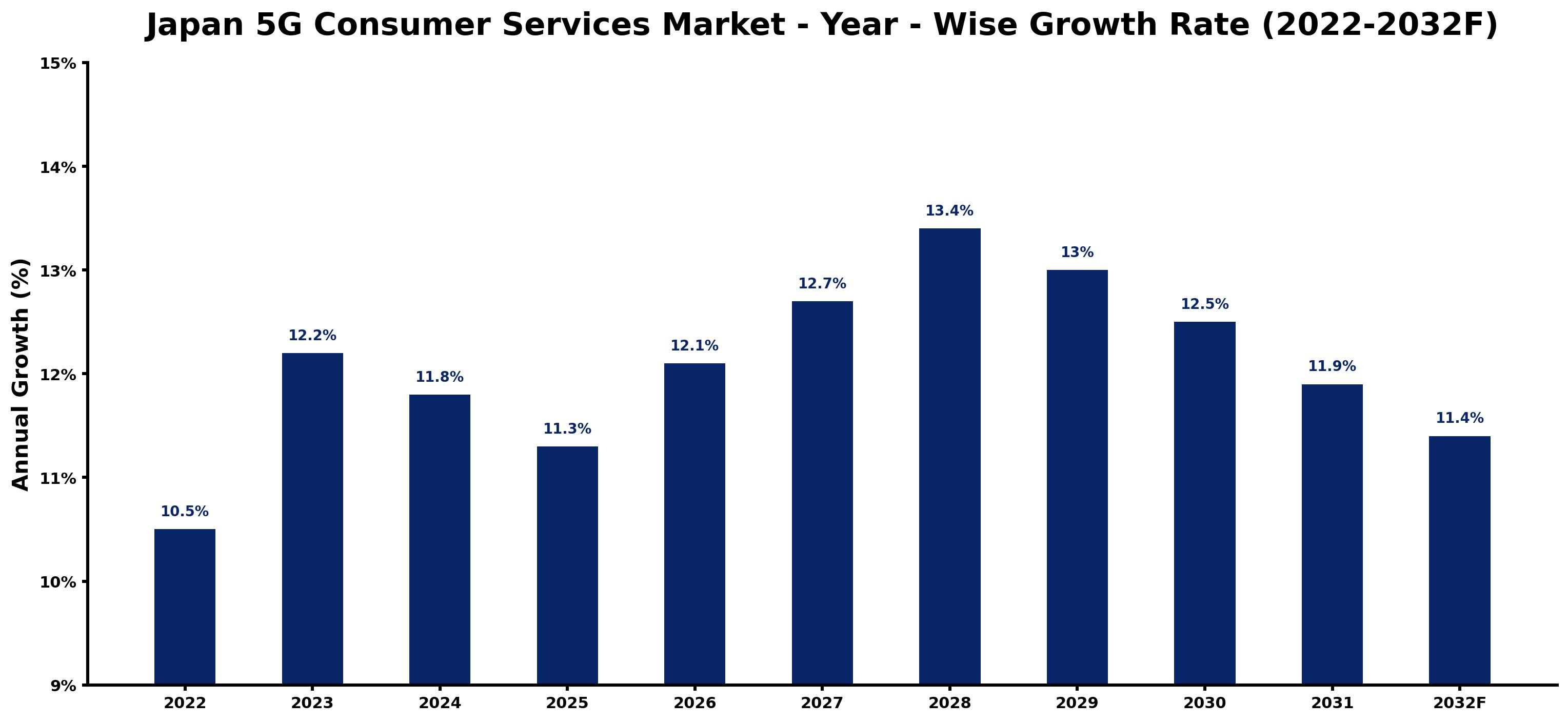
For each year, the table pairs the estimated growth rate with the leading influence on demand, showing how the drivers changed across the period.
| Year | Estimated Annual Growth (%) | Market Rationale |
| 2022 | 10.5 | The market experienced steady growth due to increasing consumer interest in high-speed connectivity. |
| 2023 | 12.2 | Demand surged as more consumers adopted 5G-enabled devices and services. |
| 2024 | 11.8 | Growth slowed slightly as the market began to stabilise after rapid expansion. |
| 2025 | 11.3 | The market continued to grow, driven by ongoing investments in 5G infrastructure. |
| 2026 | 12.1 | Growth is anticipated to accelerate again as new applications and services enter the market. |
| 2027 | 12.7 | Demand will rise further with increased adoption of IoT devices and smart home solutions. |
| 2028 | 13.4 | The market will peak with advancements in technology and service offerings. |
| 2029 | 13.0 | Growth is projected to slow as market saturation begins to impact new subscriptions. |
| 2030 | 12.5 | The market will continue to grow, driven by ongoing technological advancements. |
| 2031 | 11.9 | Growth is expected to slow again as competition intensifies among service providers. |
| 2032 | 11.4 | The market is projected to maintain growth as new use cases for 5G emerge. |
Note: Market size estimations and growth projections presented in this report are based on 6Wresearch's proprietary forecasting methodology, utilizing the latest available industry data, government publications, and primary research inputs.
Japan 5G Consumer Services Market Synopsis
5G Consumer Services in Japan provide high-speed internet access and low latency connectivity through advanced mobile communication technologies. With over 100 million subscriptions as of 2023, the Japan 5G Consumer Services Market is expanding rapidly, driven by the growing adoption of IoT devices and smart home applications. Key factors include the government's '5G Promotion Strategy' and ongoing investments in infrastructure, which contribute to a positive market outlook.
Market Dynamics Impact Analysis (2026–2032)
| Factor | Type | Impact | Primary Segment Affected |
| Rising smartphone penetration and 5G adoption | Driver | High | Enhanced Mobile Broadband (eMBB) |
| Growing demand for IoT applications | Driver | High | Massive Machine Type Communications (mMTC) |
| Expansion of smart home technology | Opportunity | High | Ultra-Reliable Low Latency (URLLC) |
| Increased investment in 5G infrastructure | Opportunity | High | Fixed Wireless Access (FWA) |
| Regulatory challenges in spectrum allocation | Restraint | Medium | Enhanced Mobile Broadband (eMBB) |
| Market saturation limiting new subscriptions | Restraint | Medium | Enhanced Mobile Broadband (eMBB) |
| Intense competition among service providers | Challenge | High | Enhanced Mobile Broadband (eMBB) |
| Rapid technological advancements creating pressure | Challenge | Medium | Enhanced Mobile Broadband (eMBB) |
Evaluation of Drivers in Japan 5G Consumer Services Market (2026–2032)
These are the developments adding the most demand over the forecast period.
| Drivers | Primary Segment Affected | Why It Matters (Evidence) |
| Increased smartphone penetration | Enhanced Mobile Broadband (eMBB) | Approximately 80% of the population uses smartphones, driving demand for high-speed internet. |
| Growing IoT device market | Massive Machine Type Communications (mMTC) | The total number of IoT devices is projected to reach 1.2 billion by 2025, increasing connectivity needs. |
| Government initiatives promoting smart homes | Ultra-Reliable Low Latency (URLLC) | The 'Smart City' initiative in Yokohama aims to integrate 5G technology by 2025, improving urban living standards. |
| Investment in 5G infrastructure | Fixed Wireless Access (FWA) | Total investment in 5G infrastructure is estimated at ¥1 trillion by 2025, boosting service availability. |
| Expansion of digital services | Managed Services | The '5G Challenge' program supports startups developing 5G applications, increasing service diversity. |
Spending rises because of the smartphone penetration rate of approximately 80%, which drives demand for high-speed internet services. The total number of IoT devices is expected to reach 1.2 billion by 2025, increasing the need for connectivity solutions. Investment in 5G infrastructure is estimated at ¥1 trillion by 2025, expanding service availability.
Evaluation of Restraints in Japan 5G Consumer Services Market
The key brakes on demand, and where they bite hardest, are shown below.
| Market Restraint | Primary Segment Affected | Why It Matters (Evidence) |
| Regulatory challenges in spectrum allocation | Enhanced Mobile Broadband (eMBB) | Spectrum allocation issues hinder the deployment of 5G services, delaying market expansion. |
| Market saturation limiting new subscriptions | Enhanced Mobile Broadband (eMBB) | As the market matures, acquiring new subscribers becomes increasingly challenging for providers. |
| High costs associated with infrastructure investment | Fixed Wireless Access (FWA) | The investment required for infrastructure can deter smaller players from entering the market. |
| Limited awareness of 5G benefits among consumers | Enhanced Mobile Broadband (eMBB) | Consumer understanding of 5G advantages remains low, affecting adoption rates. |
| Technological complexities in service integration | Managed Services | Integrating new technologies can be complex, causing delays in service rollout. |
Japan 5G Consumer Services Market Challenges
Tokyo's high demand for 5G services results in increased costs for consumers, as infrastructure expansion struggles to meet expectations. Aging infrastructure hinders technology upgrades, causing delays in service improvements for telecom operators, which may lead to customer dissatisfaction. Intense competition among providers drives prices down, compelling suppliers to compromise on service quality, ultimately impacting the reliability of 5G connectivity for users. Regulatory hurdles imposed by the Ministry of Internal Affairs and Communications can impede the deployment of new technologies, delaying access to advanced services for both consumers and businesses.
Trends in the Japan 5G Consumer Services Market
Buyers and suppliers in the Japan 5G Consumer Services Market are adjusting to the following trends.
- Shift from Traditional to Smart Home Services: The number of 5G-enabled smart homes is expected to grow by 30% annually through 2025, driven by increasing consumer adoption of smart devices and connectivity solutions.
- Transition from Fixed to Mobile Connectivity: As of 2023, over 100 million 5G subscriptions highlight a shift towards mobile connectivity solutions, particularly in urban areas like Tokyo and Osaka.
- Emerging Focus on IoT Integration: The total number of IoT devices in Japan is projected to reach 1.2 billion by 2025, indicating a shift towards IoT integration across various sectors.
- Growing Demand for Ultra-Reliable Services: The Ultra-Reliable Low Latency (URLLC) segment is expected to expand rapidly, supported by critical applications requiring low latency, particularly in industrial automation.
Investment Opportunities in the Japan 5G Consumer Services Market
Below are the investment opportunities with the strongest case in the Japan 5G Consumer Services Market.
- Expansion in Urban Areas: Tokyo and Osaka are prime regions for 5G expansion, with substantial opportunities for infrastructure investment as the market continues to grow.
- Collaboration in Smart City Initiatives: Investing in smart city projects can yield returns, as seen in Yokohama's 'Smart City' initiative, which integrates 5G technology by 2025.
- Supply of IoT Solutions: With the IoT device market projected to reach 1.2 billion by 2025, suppliers can focus on providing connectivity solutions to various sectors.
- Investment in Managed Services: The managed services segment is growing rapidly, presenting opportunities for service providers to enhance their offerings.
Government Initiatives in the Japan 5G Consumer Services Market
The 'Telecommunications Business Act' regulates the telecom sector in Japan, ensuring quality and safety standards for 5G services. The '5G Promotion Strategy' launched in 2020 aims to improve digital infrastructure, targeting 99% population coverage by 2025, which will influence service delivery.
The Ministry of Internal Affairs and Communications oversees telecommunications regulations and funds initiatives to promote 5G adoption. The establishment of the 'Digital Agency' in 2021 supports digital transformation efforts, aiming to streamline approvals and develop infrastructure.
Future Insight of the Japan 5G Consumer Services Market
By 2032, Japan will experience a substantial shift towards extensive 5G integration, driven by initiatives like the 'Smart City' project in Yokohama, which will incorporate advanced connectivity into urban frameworks. The total number of IoT devices is expected to reach 1.2 billion, enhancing interconnectivity across sectors. The average download speed for 5G is anticipated to reach 3 Gbps, enabling a broader range of applications that require high bandwidth. As 5G-enabled smart homes grow by 30% annually, buyers will benefit from improved automation, while suppliers must adapt to meet evolving consumer demands.
Market Segmentation Analysis
Japan 5G Consumer Services Market report covers a detailed analysis of the following market segments:
By Service Type – Enhanced Mobile Broadband (eMBB) Leads, Ultra-Reliable Low Latency (URLLC) Expected to Grow Fastest
According to Saurav Kr Singh, Senior Research Analyst at 6Wresearch, Enhanced Mobile Broadband (eMBB) accounted for 46% of the market by service type in 2025. Enhanced Mobile Broadband holds the largest share due to its appeal to consumers who demand high-speed internet access for everyday activities. With over 100 million 5G subscriptions, urban centres like Tokyo and Osaka are pivotal in driving this demand. Ultra-Reliable Low Latency (URLLC) is set to record the highest CAGR in this split, 17.0% over 2026–2032. Ultra-Reliable Low Latency is experiencing rapid growth as industries increasingly require immediate response capabilities for critical applications. The integration of 5G technology into public transportation systems illustrates the urgent need for low latency solutions across various sectors. Suppliers should prioritise the development of low latency services to align with the increasing demand from diverse industries.
By Delivery Mode – Online Access Leads, Managed Services Expected to Grow Fastest
In 2025, Online Access led the delivery mode split with a 41% share. Online Access is the leading delivery mode, offering consumers convenient access to 5G services through their devices. The smartphone penetration rate of approximately 80% reinforces the effectiveness of this service delivery method. Managed Services are projected to grow fastest, at a CAGR of 16.5% during 2026–2032. Managed Services are growing quickly as businesses seek comprehensive solutions to manage their complex 5G infrastructure. The increasing intricacy of 5G networks is driving the demand for these essential support services. Providers must focus on creating robust managed service solutions to meet the evolving needs of businesses.
By User Type – Individual Consumers Lead, Enterprise Users Expected to Grow Fastest
The largest user type category in 2025 was Individual Consumers, at 45% of revenue. Individual Consumers represent the largest user segment, leveraging 5G for enhanced mobile experiences and connectivity. This demographic plays a crucial role in shaping the demand for high-speed internet and smart applications. Over 2026–2032, Enterprise Users are expected to post the fastest growth, at a CAGR of 17.5%. Enterprise Users are the fastest-growing segment as businesses adopt 5G technology for advanced applications and services. The ongoing push for digital transformation across various sectors is a key factor in this growth. Suppliers should tailor their offerings to meet the specific needs of enterprise users to capitalise on this growth opportunity.
By Distribution Channel – Mobile Operators Lead, Network Providers Expected to Grow Fastest
With 37% of distribution channel revenue in 2025, Mobile Operators was the largest category. Mobile Operators are the primary service providers, delivering 5G services directly to consumers. Their established infrastructure and extensive customer base solidify their leading position in the market. The quickest growth will come from Network Providers, forecast to expand at a CAGR of 15.4% between 2026 and 2032. Network Providers are rapidly expanding their role by facilitating the necessary infrastructure for 5G deployment. The projected investment of ¥1 trillion in 5G infrastructure by 2025 is a major factor driving this growth. Collaborating with network providers can enhance service offerings and broaden market reach for suppliers.
By End User – Smartphone Users Lead, Industrial Automation Expected to Grow Fastest
Smartphone Users took 37% of end user revenue in 2025, more than any other category. Smartphone Users form the major consumer segment, relying heavily on 5G for improved mobile connectivity and applications. Their demand for high-speed internet access is a significant driver of 5G service expansion. Industrial Automation is set to record the highest CAGR in this split, 16.3% over 2026–2032. Industrial Automation is the fastest-growing end user as sectors increasingly adopt 5G to enhance operational efficiency. Initiatives like the Smart Factory highlight the substantial growth potential in this area. Investing in solutions tailored for industrial automation can create new revenue streams for suppliers in the 5G market.
Key Attractiveness of the Report
- 10 Years of Market Numbers
- Historical Data Starting from 2022 to 2025
- Base Year 2025
- Forecast Data until 2032
- Key Performance Indicators Impacting the Market
- Major Upcoming Developments and Projects
Key Highlights of the Report:
- Japan 5G Consumer Services Market Outlook
- Market Size of Japan 5G Consumer Services Market, 2025
- Forecast of Japan 5G Consumer Services Market, 2032
- Historical Data and Forecast of Japan 5G Consumer Services Revenues & Volume for the Period 2022-2032F
- Japan 5G Consumer Services Market Trend Evolution
- Japan 5G Consumer Services Market Drivers and Challenges
- Japan 5G Consumer Services Price Trends
- Japan 5G Consumer Services Porter's Five Forces
- Japan 5G Consumer Services Industry Life Cycle
- Historical Data and Forecast of Japan 5G Consumer Services Market Revenues & Volume By Service Type for the Period 2022-2032F
- Historical Data and Forecast of Japan 5G Consumer Services Market Revenues & Volume By Enhanced Mobile Broadband (eMBB) for the Period 2022-2032F
- Historical Data and Forecast of Japan 5G Consumer Services Market Revenues & Volume By Ultra-Reliable Low Latency (URLLC) for the Period 2022-2032F
- Historical Data and Forecast of Japan 5G Consumer Services Market Revenues & Volume By Massive Machine Type Communications (mMTC) for the Period 2022-2032F
- Historical Data and Forecast of Japan 5G Consumer Services Market Revenues & Volume By Fixed Wireless Access (FWA) for the Period 2022-2032F
- Historical Data and Forecast of Japan 5G Consumer Services Market Revenues & Volume By Delivery Mode for the Period 2022-2032F
- Historical Data and Forecast of Japan 5G Consumer Services Market Revenues & Volume By Online Access for the Period 2022-2032F
- Historical Data and Forecast of Japan 5G Consumer Services Market Revenues & Volume By Managed Services for the Period 2022-2032F
- Historical Data and Forecast of Japan 5G Consumer Services Market Revenues & Volume By Direct Subscription for the Period 2022-2032F
- Historical Data and Forecast of Japan 5G Consumer Services Market Revenues & Volume By Retail Subscription for the Period 2022-2032F
- Historical Data and Forecast of Japan 5G Consumer Services Market Revenues & Volume By User Type for the Period 2022-2032F
- Historical Data and Forecast of Japan 5G Consumer Services Market Revenues & Volume By Individual Consumers for the Period 2022-2032F
- Historical Data and Forecast of Japan 5G Consumer Services Market Revenues & Volume By Enterprise Users for the Period 2022-2032F
- Historical Data and Forecast of Japan 5G Consumer Services Market Revenues & Volume By IoT Device Users for the Period 2022-2032F
- Historical Data and Forecast of Japan 5G Consumer Services Market Revenues & Volume By Household Users for the Period 2022-2032F
- Historical Data and Forecast of Japan 5G Consumer Services Market Revenues & Volume By Distribution Channel for the Period 2022-2032F
- Historical Data and Forecast of Japan 5G Consumer Services Market Revenues & Volume By Mobile Operators for the Period 2022-2032F
- Historical Data and Forecast of Japan 5G Consumer Services Market Revenues & Volume By Network Providers for the Period 2022-2032F
- Historical Data and Forecast of Japan 5G Consumer Services Market Revenues & Volume By Telecom Carriers for the Period 2022-2032F
- Historical Data and Forecast of Japan 5G Consumer Services Market Revenues & Volume By ISP Services for the Period 2022-2032F
- Historical Data and Forecast of Japan 5G Consumer Services Market Revenues & Volume By End User for the Period 2022-2032F
- Historical Data and Forecast of Japan 5G Consumer Services Market Revenues & Volume By Smartphone Users for the Period 2022-2032F
- Historical Data and Forecast of Japan 5G Consumer Services Market Revenues & Volume By Industrial Automation for the Period 2022-2032F
- Historical Data and Forecast of Japan 5G Consumer Services Market Revenues & Volume By Smart Home Users for the Period 2022-2032F
- Historical Data and Forecast of Japan 5G Consumer Services Market Revenues & Volume By Rural/Urban Households for the Period 2022-2032F
- Japan 5G Consumer Services Import Export Trade Statistics
- Market Opportunity Assessment By Service Type
- Market Opportunity Assessment By Delivery Mode
- Market Opportunity Assessment By User Type
- Market Opportunity Assessment By Distribution Channel
- Market Opportunity Assessment By End User
- Japan 5G Consumer Services Top Companies Market Share
- Japan 5G Consumer Services Competitive Benchmarking By Technical and Operational Parameters
- Japan 5G Consumer Services Company Profiles
- Japan 5G Consumer Services Key Strategic Recommendations
Market Covered
Coverage by segment is as follows.
By Service Type
- Enhanced Mobile Broadband (eMBB)
- Ultra-Reliable Low Latency (URLLC)
- Massive Machine Type Communications (mMTC)
- Fixed Wireless Access (FWA)
By Delivery Mode
- Online Access
- Managed Services
- Direct Subscription
- Retail Subscription
By User Type
- Individual Consumers
- Enterprise Users
- IoT Device Users
- Household Users
By Distribution Channel
- Mobile Operators
- Network Providers
- Telecom Carriers
- ISP Services
By End User
- Smartphone Users
- Industrial Automation
- Smart Home Users
- Rural/Urban Households































