Japan 5G Infrastructure Components Market Size & Growth Rate
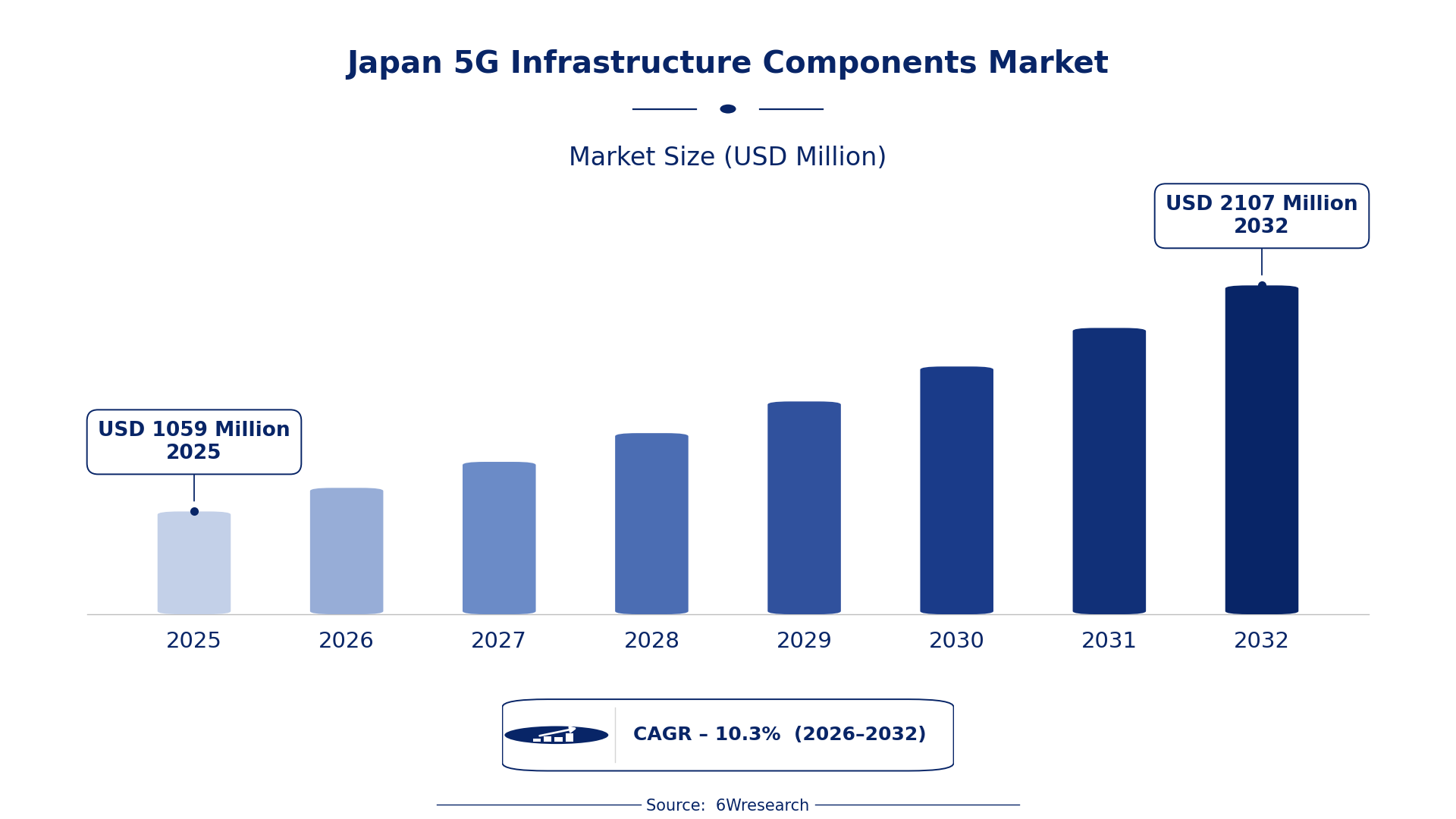
According to 6Wresearch internal database and industry insights, the Japan 5G Infrastructure Components Market was valued at USD 1,059 Million in 2025 and is projected to reach USD 2,107 Million by 2032, growing at a CAGR of approximately 10.3% during 2026–2032.
Japan 5G Infrastructure Components Market Highlights
| Report Metric | Details |
| Report Name | Japan 5G Infrastructure Components Market (2026-2032) |
| Market Size 2025 | USD 1,059 Million |
| Market Size 2032 | USD 2,107 Million |
| Absolute Growth 2025–2032 | USD 1,048 Million |
| CAGR 2026–2032 | 10.3% |
| Peak Annual Growth | 10.9% in 2026 |
| Forecast Period | 2026–2032 |
| Historical Data | 2022–2025 |
| Base Year | 2025 |
| Leading Component Type, 2025 | Antennas (53% share) |
| Leading Material/Tech, 2025 | MIMO Technology (40% share) |
| Leading Application, 2025 | Base Stations (45% share) |
| Leading Distribution Channel, 2025 | OEMs (47% share) |
| Leading End User, 2025 | Mobile Network Operators (45% share) |
| Fastest-Growing Component Type | Optical Fiber Cables (14.7% CAGR) |
| Fastest-Growing Material/Tech | Fiber Optics (14.6% CAGR) |
| Fastest-Growing Application | Backhaul Connectivity (13.6% CAGR) |
| Fastest-Growing Distribution Channel | Industrial Suppliers (13.5% CAGR) |
| Fastest-Growing End User | Data Centers (13.7% CAGR) |
| Growing Sector | Telecommunications |
| Key End Users | Mobile Network Operators, Data Centers, Telecom Companies |
Japan 5G Infrastructure Components Market Year-wise Growth Rate and Key Drivers (2022–2032)
This graph illustrates the annual growth rates of the market from 2022 to 2032, highlighting a steady upward trajectory and projected market expansion over the forecast period.
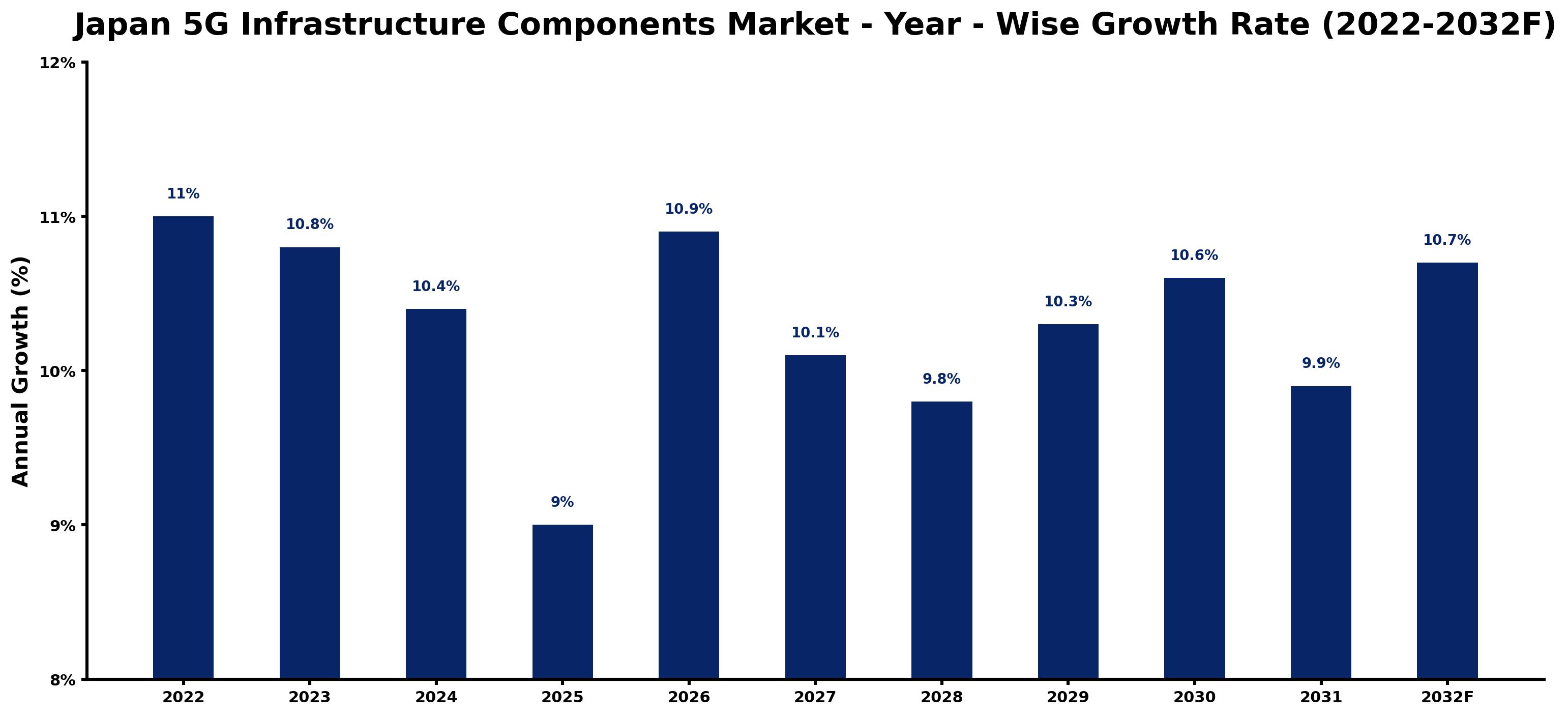
Annual growth estimates for each year appear below with the principal reason behind them, explaining the shifts that set the pace of the market.
| Year | Estimated Annual Growth (%) | Market Rationale |
| 2022 | 11.0 | The market experienced strong growth due to increased demand for high-speed communication. |
| 2023 | 10.8 | Growth slowed slightly as the market adjusted to previous peaks in investment. |
| 2024 | 10.4 | Continued demand for infrastructure kept growth steady, though at a reduced rate. |
| 2025 | 9.0 | Market growth slowed further as saturation began to affect new installations. |
| 2026 | 10.9 | Growth is expected to accelerate again as major urban areas push for expanded 5G coverage. |
| 2027 | 10.1 | A slight slowdown is projected as the market stabilises after rapid expansion. |
| 2028 | 9.8 | Growth will continue to slow as the market matures and demand stabilises. |
| 2029 | 10.3 | An increase in demand for data services will drive growth higher once more. |
| 2030 | 10.6 | The market is projected to see further growth as new technologies improve network capabilities. |
| 2031 | 9.9 | A slight slowdown is expected to reflect market maturation and increased competition. |
| 2032 | 10.7 | Growth will pick up again due to rising demand for data-driven services. |
Note: Market size estimations and growth projections presented in this report are based on 6Wresearch's proprietary forecasting methodology, utilizing the latest available industry data, government publications, and primary research inputs.
Japan 5G Infrastructure Components Market Synopsis
5G Infrastructure Components are critical technologies that enable high-speed wireless communication, primarily made from advanced materials like MIMO antennas and fiber optics. The Japan 5G Infrastructure Components Market is expanding due to investments in digital infrastructure, with a government allocation of ¥1 trillion by 2025. Major buyer groups include mobile network operators and telecom companies, driven by the need for improved network performance and urban data transfer capabilities. This growth is supported by the increasing number of mobile subscriptions and the expansion of data centres.
Market Dynamics Impact Analysis (2026–2032)
| Factor | Type | Impact | Primary Segment Affected |
| Growing mobile subscriptions drive demand for infrastructure components. | Driver | High | Base Stations |
| Increased data centre growth necessitates enhanced connectivity solutions. | Driver | High | Optical Fiber Cables |
| The push for 5G coverage creates opportunities for new installations. | Opportunity | High | Cell Towers |
| Urban areas require upgraded infrastructure to support smart city initiatives. | Opportunity | High | Outdoor Deployment |
| Market saturation in urban areas limits new installations. | Restraint | Medium | Base Stations |
| High initial investment costs can deter smaller players from entering the market. | Restraint | Medium | MIMO Technology |
| Intense competition among telecom companies pressures pricing. | Challenge | High | Telecom Companies |
| Rapid technological advancements require constant updates to infrastructure. | Challenge | Medium | Data Centers |
Evaluation of Drivers in Japan 5G Infrastructure Components Market (2026–2032)
The main growth drivers and the segments they affect most are set out below.
| Drivers | Primary Segment Affected | Why It Matters (Evidence) |
| Increasing mobile subscriptions necessitate more base stations for coverage. | Base Stations | Japan reached 180 million mobile subscriptions in 2023, driving demand for infrastructure. |
| Data centres are expanding to support rising data traffic. | Optical Fiber Cables | Data centres in Japan are expected to grow by 15% in the next five years. |
| Government investments in digital infrastructure boost market growth. | MIMO Technology | The government allocated ¥1 trillion for digital infrastructure by 2025. |
| The Smart City initiative promotes 5G integration in urban planning. | Outdoor Deployment | Tokyo and Osaka are major regions for 5G deployment under this initiative. |
| The need for enhanced connectivity drives demand for backhaul solutions. | Backhaul Connectivity | The country aims for 90% 5G coverage by 2025, increasing backhaul requirements. |
Much of the new demand traces back to the increase in mobile subscriptions, which reached 180 million in 2023, necessitating more base stations for coverage. Data centres are also expanding, with a projected growth of 15% over the next five years, driving the need for optical fiber cables. Investments, including a ¥1 trillion allocation for digital infrastructure by 2025, are further boosting market growth. The push for 90% 5G coverage by 2025 is increasing demand for backhaul connectivity solutions, ensuring efficient data transfer across networks.
Evaluation of Restraints in Japan 5G Infrastructure Components Market
Several factors work against faster growth; the main ones are summarised below.
| Market Restraint | Primary Segment Affected | Why It Matters (Evidence) |
| Market saturation in urban areas limits new installations. | Base Stations | With over 100,000 base stations already in place, growth opportunities are diminishing. |
| High initial investment costs can deter smaller players from entering the market. | MIMO Technology | The substantial costs associated with advanced technology can restrict market entry. |
| Regulatory compliance adds complexity to market operations. | Optical Fiber Cables | Compliance with JIS standards increases operational burdens for suppliers. |
| Limited access to skilled workforce hampers project execution. | Data Centers | The telecom industry faces talent shortages, delaying infrastructure projects. |
| Technological advancements require constant upgrades to existing systems. | Backhaul Connectivity | Rapid changes in technology necessitate frequent investments in new solutions. |
Japan 5G Infrastructure Components Market Challenges
Producers face high production costs due to the demand for advanced materials in 5G infrastructure components, increasing expenses by up to 20%. This situation arises because Japan's market prioritises high-performance technology, straining financial resources for manufacturers. Technology integration delays occur from the complexity of new standards, extending project timelines for buyers by six months. Supply chain issues arise from reliance on specific components, forcing buyers to hold excess inventory, which can tie up capital for three months. Regulatory compliance with JIS standards requires substantial investments, costing telecom operators millions each year.
Trends in the Japan 5G Infrastructure Components Market
The following changes are redrawing the Japan 5G Infrastructure Components Market.
- Shift from Traditional to Smart City Infrastructure: Japan is increasingly integrating 5G technology into urban planning, particularly through the Smart City initiative, which aims to improve connectivity and efficiency. Urban areas are expected to see improvements in infrastructure, with a target of 90% 5G coverage by 2025.
- Transition from Copper to Fiber Optic Networks: The Fiber Optic Association Japan is promoting the adoption of fiber optic technology, which is essential for supporting high-speed data transfer. This shift is projected to improve overall network performance and reliability, with a projected 15% growth in data centres over the next five years.
- Emergence of MIMO Technology: MIMO Technology is becoming increasingly important in boosting network capacity and efficiency. With a projected CAGR of 14.7% from 2026 to 2032, this technology is vital for meeting the demands of growing mobile subscriptions in Japan.
- Increase in Demand for Backhaul Connectivity: As the number of base stations rises, the need for efficient backhaul connectivity solutions is growing. The market for backhaul connectivity is projected to expand, driven by the goal of achieving 90% 5G coverage by 2025.
Investment Opportunities in the Japan 5G Infrastructure Components Market
Below are the investment opportunities with the strongest case in the Japan 5G Infrastructure Components Market.
- Timing for Infrastructure Upgrades: With the government allocating ¥1 trillion for digital infrastructure by 2025, there is an opportunity for suppliers to provide advanced components. Mobile network operators are particularly in need of upgraded systems to improve service delivery.
- Supply of Optical Fibre Solutions: The growing data centre market, expected to increase by 15% in the next five years, presents an opportunity for suppliers of optical fibre cables. Collaborating with data centre operators can facilitate market entry and expansion.
- Investment in MIMO Technology: The rising demand for improved network capacity creates an opportunity to invest in MIMO technology. Mobile network operators are actively seeking solutions to enhance efficiency and capacity in urban areas.
- Expansion of Outdoor Deployment Solutions: The push for smart city initiatives creates a demand for outdoor deployment solutions. Urban planners and telecom companies are looking for innovative infrastructure to support 5G integration.
Government Initiatives in the Japan 5G Infrastructure Components Market
The regulatory framework for 5G infrastructure in Japan is shaped by several key laws, including the Chemical Substances Control Law of 1973, which mandates the evaluation of chemical substances used in manufacturing. Additionally, the JIS standards govern telecommunications equipment, ensuring quality and safety in the industry. These regulations help maintain high standards for 5G infrastructure components.
The government has allocated ¥1 trillion for digital infrastructure by 2025, overseen by the Digital Agency, which leads the transformation of government digital services. The agency also sets common system standards that facilitate the integration of 5G technology across various sectors, ensuring compliance and promoting innovation in telecommunications.
Future Insight of the Japan 5G Infrastructure Components Market
By 2032, the Smart City initiative will drive demand for 5G infrastructure components, reshaping urban planning. The government's ¥500 billion annual budget for telecom infrastructure improvements will enhance network capabilities. Collaboration through the Japan 5G Promotion Consortium will accelerate advancements, enabling suppliers to meet emerging market demands. Adoption of the 5G Security Guidelines will strengthen operational protocols, providing assurance to buyers and suppliers in the evolving telecom environment.
Market Segmentation Analysis
Japan 5G Infrastructure Components Market report covers a detailed analysis of the following market segments:
By Component Type – Antennas Lead, Optical Fiber Cables Expected to Grow Fastest
According to Saurav Kr Singh, Senior Research Analyst at 6Wresearch, the largest component type category in 2025 was Antennas, at 53% of revenue. Antennas hold the largest share due to their essential function in signal transmission for 5G networks, with over 100,000 base stations in Japan depending on them for effective communication. Their critical role in urban areas like Tokyo and Osaka reinforces their significance in the telecommunications framework. Over 2026–2032, Optical Fiber Cables are expected to post the fastest growth, at a CAGR of 14.7%. Optical Fiber Cables are rapidly growing as demand for high-speed data connectivity increases, particularly to meet the government's target of 90% 5G coverage by 2025. The anticipated 15% growth in data centers in the next five years will further drive the need for robust connectivity solutions. Suppliers should focus on enhancing the production of optical fiber cables to meet the rising demand for high-speed connectivity.
By Material/Tech – MIMO Technology Leads, Fiber Optics Expected to Grow Fastest
MIMO Technology held 40% of the Japan 5G Infrastructure Components Market by material/tech in 2025. MIMO Technology leads the market as it greatly enhances network capacity and efficiency, making it indispensable for 5G infrastructure. Its prevalent use in densely populated areas, where high data throughput is essential, underscores its critical importance to users. The quickest growth will come from Fiber Optics, forecast to expand at a CAGR of 14.6% between 2026 and 2032. Fiber Optics is the fastest-growing segment, spurred by the increasing demand for high-speed data transmission in 5G applications. The government's investment of ¥1 trillion in digital infrastructure improvements will likely accelerate fiber optics adoption in the near future. Buyers should prioritise investments in fiber optics to ensure effective data transmission capabilities within their 5G networks.
By Application – Base Stations Lead, Backhaul Connectivity Expected to Grow Fastest
Base Stations accounted for 45% of the market by application in 2025. Base Stations are the leading application segment as they are crucial for the deployment of 5G networks, with numerous installations across Japan. Their fundamental role in enabling mobile connectivity makes them a priority for telecom operators and infrastructure developers alike. Backhaul Connectivity is set to record the highest CAGR in this split, 13.6% over 2026–2032. Backhaul Connectivity is witnessing rapid growth, driven by the need to efficiently link base stations to broader networks. The government's initiative aiming for 90% 5G coverage by 2025 emphasises the urgent requirement for effective backhaul solutions during this expansion. Suppliers must enhance backhaul connectivity solutions to support the expanding 5G network infrastructure.
By Distribution Channel – OEMs Lead, Industrial Suppliers Expected to Grow Fastest
With 47% of distribution channel revenue in 2025, OEMs was the largest category. OEMs lead the distribution channel as they produce essential components for 5G infrastructure, catering to the needs of mobile network operators. Their established relationships with telecom companies facilitate widespread distribution of critical technologies. Industrial Suppliers are projected to grow fastest, at a CAGR of 13.5% during 2026–2032. Industrial Suppliers are experiencing the fastest growth due to the increasing demand for materials necessary for 5G infrastructure development. The ongoing expansion of digital infrastructure initiatives further fuels this demand, ensuring a steady market for suppliers. Suppliers should strengthen partnerships with industrial suppliers to optimise their distribution strategies.
By End User – Mobile Network Operators Lead, Data Centers Expected to Grow Fastest
Mobile Network Operators took 45% of end user revenue in 2025, more than any other category. Mobile Network Operators represent the largest end user group, as they are the primary consumers of 5G infrastructure components necessary for service delivery. Their substantial investments in network expansion illustrate their pivotal role in the market environment. Over 2026–2032, Data Centers are expected to post the fastest growth, at a CAGR of 13.7%. Data Centers are the fastest-growing end user segment, driven by the rising demand for infrastructure to support data processing and storage in a 5G context. The expected 15% growth in data centers over the next five years will significantly increase their need for 5G components. Suppliers should tailor their offerings to accommodate the specific requirements of data centers as they expand their operations.
Key Attractiveness of the Report
- 10 Years of Market Numbers
- Historical Data Starting from 2022 to 2025
- Base Year 2025
- Forecast Data until 2032
- Key Performance Indicators Impacting the Market
- Major Upcoming Developments and Projects
Key Highlights of the Report:
- Japan 5G Infrastructure Components Market Outlook
- Market Size of Japan 5G Infrastructure Components Market, 2025
- Forecast of Japan 5G Infrastructure Components Market, 2032
- Historical Data and Forecast of Japan 5G Infrastructure Components Revenues & Volume for the Period 2022-2032F
- Japan 5G Infrastructure Components Market Trend Evolution
- Japan 5G Infrastructure Components Market Drivers and Challenges
- Japan 5G Infrastructure Components Price Trends
- Japan 5G Infrastructure Components Porter's Five Forces
- Japan 5G Infrastructure Components Industry Life Cycle
- Historical Data and Forecast of Japan 5G Infrastructure Components Market Revenues & Volume By Component Type for the Period 2022-2032F
- Historical Data and Forecast of Japan 5G Infrastructure Components Market Revenues & Volume By Antennas for the Period 2022-2032F
- Historical Data and Forecast of Japan 5G Infrastructure Components Market Revenues & Volume By Optical Fiber Cables for the Period 2022-2032F
- Historical Data and Forecast of Japan 5G Infrastructure Components Market Revenues & Volume By Power Units for the Period 2022-2032F
- Historical Data and Forecast of Japan 5G Infrastructure Components Market Revenues & Volume By Enclosures & Cabinets for the Period 2022-2032F
- Historical Data and Forecast of Japan 5G Infrastructure Components Market Revenues & Volume By Material/Tech for the Period 2022-2032F
- Historical Data and Forecast of Japan 5G Infrastructure Components Market Revenues & Volume By MIMO Technology for the Period 2022-2032F
- Historical Data and Forecast of Japan 5G Infrastructure Components Market Revenues & Volume By Fiber Optics for the Period 2022-2032F
- Historical Data and Forecast of Japan 5G Infrastructure Components Market Revenues & Volume By High Efficiency for the Period 2022-2032F
- Historical Data and Forecast of Japan 5G Infrastructure Components Market Revenues & Volume By Weatherproof Coating for the Period 2022-2032F
- Historical Data and Forecast of Japan 5G Infrastructure Components Market Revenues & Volume By Application for the Period 2022-2032F
- Historical Data and Forecast of Japan 5G Infrastructure Components Market Revenues & Volume By Base Stations for the Period 2022-2032F
- Historical Data and Forecast of Japan 5G Infrastructure Components Market Revenues & Volume By Backhaul Connectivity for the Period 2022-2032F
- Historical Data and Forecast of Japan 5G Infrastructure Components Market Revenues & Volume By Cell Towers for the Period 2022-2032F
- Historical Data and Forecast of Japan 5G Infrastructure Components Market Revenues & Volume By Outdoor Deployment for the Period 2022-2032F
- Historical Data and Forecast of Japan 5G Infrastructure Components Market Revenues & Volume By Distribution Channel for the Period 2022-2032F
- Historical Data and Forecast of Japan 5G Infrastructure Components Market Revenues & Volume By OEMs for the Period 2022-2032F
- Historical Data and Forecast of Japan 5G Infrastructure Components Market Revenues & Volume By Industrial Suppliers for the Period 2022-2032F
- Historical Data and Forecast of Japan 5G Infrastructure Components Market Revenues & Volume By Direct Sales for the Period 2022-2032F
- Historical Data and Forecast of Japan 5G Infrastructure Components Market Revenues & Volume By Specialty Distributors for the Period 2022-2032F
- Historical Data and Forecast of Japan 5G Infrastructure Components Market Revenues & Volume By End User for the Period 2022-2032F
- Historical Data and Forecast of Japan 5G Infrastructure Components Market Revenues & Volume By Mobile Network Operators for the Period 2022-2032F
- Historical Data and Forecast of Japan 5G Infrastructure Components Market Revenues & Volume By Data Centers for the Period 2022-2032F
- Historical Data and Forecast of Japan 5G Infrastructure Components Market Revenues & Volume By Telecom Companies for the Period 2022-2032F
- Historical Data and Forecast of Japan 5G Infrastructure Components Market Revenues & Volume By Network Infrastructure Firms for the Period 2022-2032F
- Japan 5G Infrastructure Components Import Export Trade Statistics
- Market Opportunity Assessment By Component Type
- Market Opportunity Assessment By Material/Tech
- Market Opportunity Assessment By Application
- Market Opportunity Assessment By Distribution Channel
- Market Opportunity Assessment By End User
- Japan 5G Infrastructure Components Top Companies Market Share
- Japan 5G Infrastructure Components Competitive Benchmarking By Technical and Operational Parameters
- Japan 5G Infrastructure Components Company Profiles
- Japan 5G Infrastructure Components Key Strategic Recommendations
Market Covered
The study includes the following segmentation.
By Component Type
- Antennas
- Optical Fiber Cables
- Power Units
- Enclosures & Cabinets
By Material/Tech
- MIMO Technology
- Fiber Optics
- High Efficiency
- Weatherproof Coating
By Application
- Base Stations
- Backhaul Connectivity
- Cell Towers
- Outdoor Deployment
By Distribution Channel
- OEMs
- Industrial Suppliers
- Direct Sales
- Specialty Distributors
By End User
- Mobile Network Operators
- Data Centers
- Telecom Companies
- Network Infrastructure Firms































