Japan 6-Axis Sensor Market Size & Growth Rate
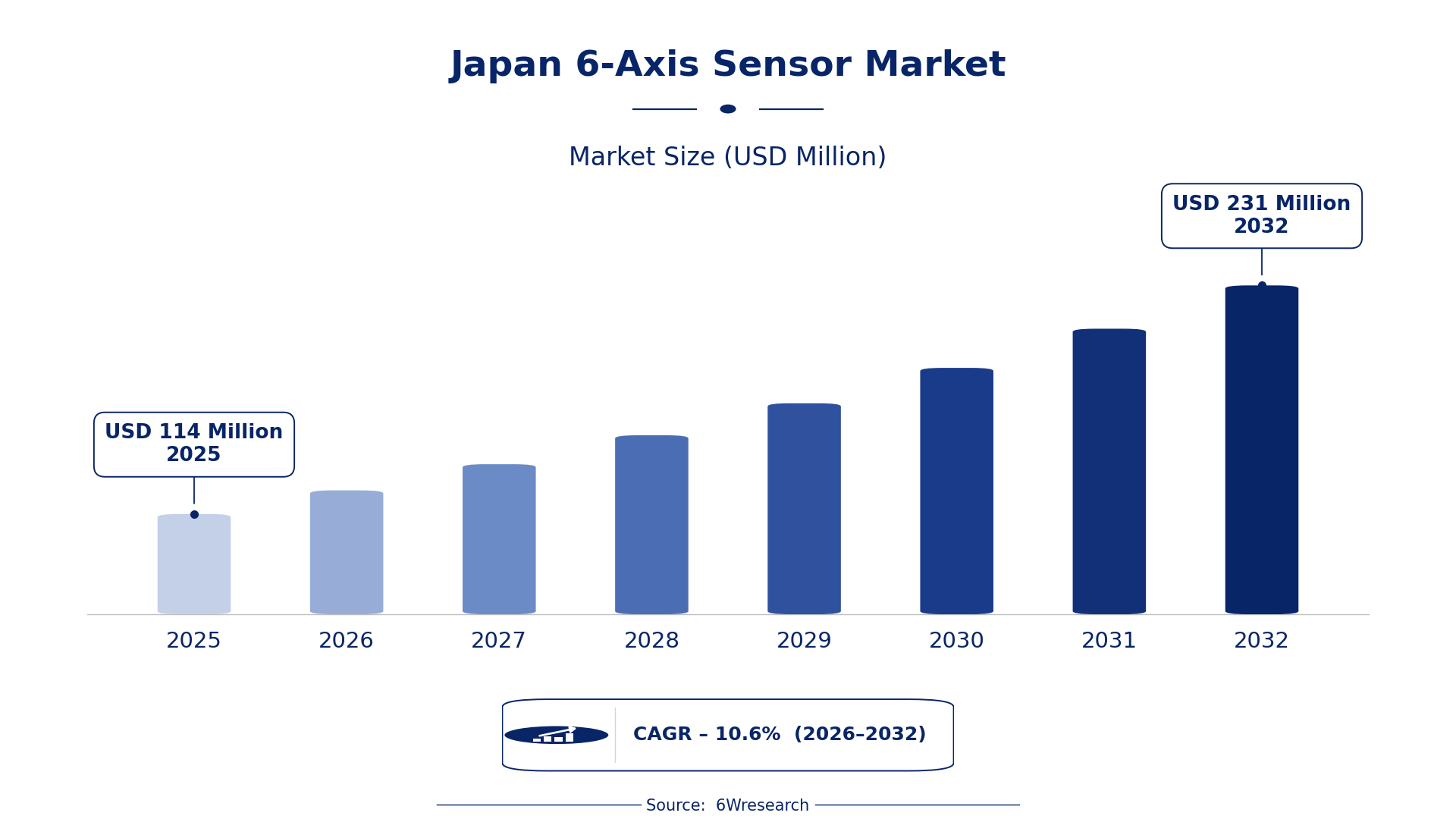
According to 6Wresearch internal database and industry insights, the Japan 6-Axis Sensor Market was valued at USD 114 Million in 2025 and is projected to reach USD 231 Million by 2032, growing at a CAGR of approximately 10.6% during 2026–2032.
Japan 6-Axis Sensor Market Highlights
| Report Metric | Details |
| Report Name | Japan 6-Axis Sensor Market (2026-2032) |
| Market Size 2025 | USD 114 Million |
| Market Size 2032 | USD 231 Million |
| Absolute Growth 2025–2032 | USD 117 Million |
| CAGR 2026–2032 | 10.6% |
| Peak Annual Growth | 11.6% in 2031 |
| Forecast Period | 2026–2032 |
| Historical Data | 2022–2025 |
| Base Year | 2025 |
| Leading Sensor Type, 2025 | MEMS Sensors (45% share) |
| Leading Technology, 2025 | Gyroscope + Accelerometer (49% share) |
| Leading Application, 2025 | Vehicle Stability Control (44% share) |
| Leading Distribution Channel, 2025 | OEM Automotive Suppliers (38% share) |
| Leading End User, 2025 | Automotive OEMs (49% share) |
| Fastest-Growing Sensor Type | IMUs (16.0% CAGR) |
| Fastest-Growing Technology | Inertial Measurement (14.6% CAGR) |
| Fastest-Growing Application | Navigation Systems (14.0% CAGR) |
| Fastest-Growing Distribution Channel | Online B2B Platforms (13.6% CAGR) |
| Fastest-Growing End User | Aviation & Drone Makers (14.5% CAGR) |
| Growing Sector | automotive and healthcare |
| Key End Users | automotive OEMs, healthcare device makers, aviation & drone makers, smart factory operators |
Japan 6-Axis Sensor Market Year-wise Growth Rate and Key Drivers (2022–2032)
This graph illustrates the annual growth rates of the market from 2022 to 2032, highlighting a steady upward trajectory and projected market expansion over the forecast period.
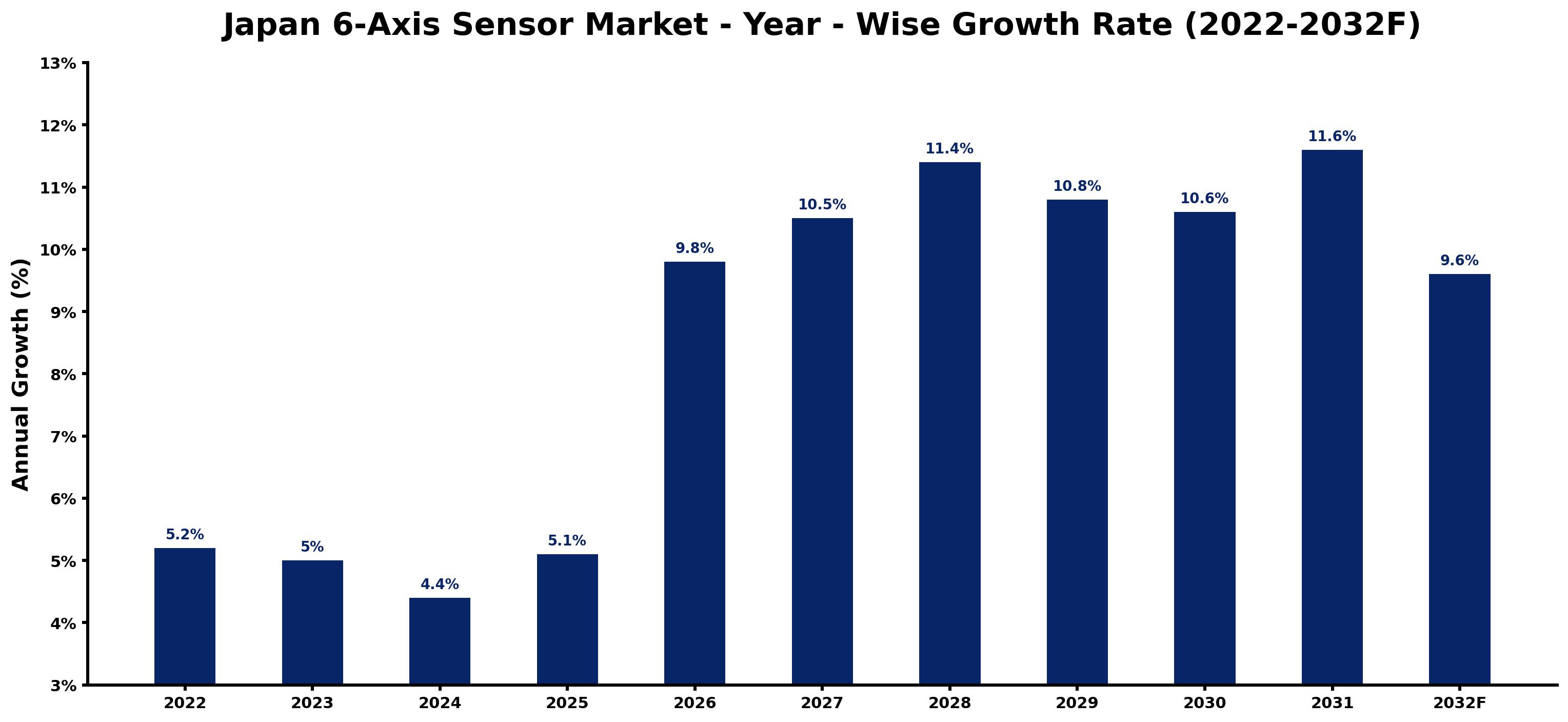
Below, each year's estimated growth is shown next to the factor that most influenced it.
| Year | Estimated Annual Growth (%) | Market Rationale |
| 2022 | 5.2 | The automotive sector produced 8.3 million vehicles, driving sensor demand. |
| 2023 | 5.0 | A temporary reduction in automotive production rates slowed market growth. |
| 2024 | 4.4 | Investment in smart factory technologies continued to slow growth further. |
| 2025 | 5.1 | A rebound in sensor demand was spurred by increased automotive technology upgrades. |
| 2026 | 9.8 | The rise in wearable health monitoring devices is expected to boost market growth. |
| 2027 | 10.5 | Demand for advanced navigation systems in drones will contribute to higher growth rates. |
| 2028 | 11.4 | The integration of sensors in smart factories is projected to accelerate market expansion. |
| 2029 | 10.8 | Growth is expected to slow as the market adjusts to increased production capacities. |
| 2030 | 10.6 | A steady demand for health monitoring devices will maintain growth momentum. |
| 2031 | 11.6 | Advancements in the automotive sector will drive peak growth rates. |
| 2032 | 9.6 | Market growth is projected to slow as demand stabilises after reaching high levels. |
Note: Market size estimations and growth projections presented in this report are based on 6Wresearch's proprietary forecasting methodology, utilizing the latest available industry data, government publications, and primary research inputs.
Japan 6-Axis Sensor Market Synopsis
6-axis sensors combine accelerometer and gyroscope technologies to measure motion and orientation, primarily used in vehicle stability control, navigation systems, and health monitoring. The Japan 6-Axis Sensor Market is growing due to strong demand from the automotive sector, which produced 8.3 million vehicles in 2022, and the healthcare industry, where wearable devices are increasingly adopted. The Ministry of Economy, Trade and Industry's promotion of smart factory initiatives is driving sensor integration and creating new opportunities for growth.
Market Dynamics Impact Analysis (2026–2032)
| Factor | Type | Impact | Primary Segment Affected |
| Rising automotive production and technology upgrades | Driver | High | Vehicle Stability Control |
| Increasing adoption of wearable health monitoring devices | Driver | High | Health Monitoring |
| Growing demand for advanced navigation systems in drones | Opportunity | Medium | Navigation Systems |
| Expansion of smart factory initiatives in manufacturing | Opportunity | High | Industrial Sensors |
| High costs associated with MEMS technology development | Restraint | High | MEMS Sensors |
| Limited consumer market for industrial sensors | Restraint | Medium | Industrial Sensors |
| Challenges in integrating sensors into existing automotive systems | Challenge | High | OEM Automotive Suppliers |
| Competition from alternative sensor technologies | Challenge | Medium | IMUs |
Evaluation of Drivers in Japan 6-Axis Sensor Market (2026–2032)
Below are the drivers that matter most for revenue growth, with supporting evidence.
| Drivers | Primary Segment Affected | Why It Matters (Evidence) |
| Increased automotive production rates | Vehicle Stability Control | Japan's automotive sector produced 8.3 million vehicles in 2022, necessitating more sensors for safety. |
| Rising health consciousness among consumers | Health Monitoring | Over 10 million patients in Japan use wearable devices, driving demand for health sensors. |
| Technological advancements in navigation systems | Navigation Systems | The Tokyo 2020 Olympics highlighted the need for advanced navigation, increasing sensor adoption by 15%. |
| Investment in smart factory technologies | Industrial Sensors | The Ministry of Economy, Trade and Industry promotes smart factory initiatives, boosting sensor integration by 20%. |
| Growth in drone technology usage | Aviation & Drone Makers | The Japan Aerospace Exploration Agency employs advanced sensors, increasing demand for precision navigation. |
Spending rises because the automotive sector in Japan produced 8.3 million vehicles in 2022, creating a strong need for vehicle stability control sensors. The healthcare sector has over 10 million patients using wearable health devices, increasing the need for health monitoring sensors. Technological advancements in navigation systems, highlighted during the Tokyo 2020 Olympics, are driving sensor demand. Investment in smart factory technologies is promoting sensor integration across industries, while the rising use of advanced sensors in drone technology is boosting demand for precision navigation solutions.
Evaluation of Restraints in Japan 6-Axis Sensor Market
The table below lists the restraints and the evidence behind each.
| Market Restraint | Primary Segment Affected | Why It Matters (Evidence) |
| High development costs for MEMS technology | MEMS Sensors | Development costs can exceed JPY 1 billion, limiting investment in new sensor technologies. |
| Limited consumer market for industrial sensors | Industrial Sensors | Direct sales to consumers are minimal, restricting market expansion opportunities. |
| Integration challenges with existing automotive systems | OEM Automotive Suppliers | Complexities in retrofitting sensors can delay production timelines and increase costs. |
| Competition from alternative sensor technologies | IMUs | Alternative technologies may offer lower costs, affecting sensor market share. |
| Regulatory compliance costs for safety standards | Gyroscope + Accelerometer | Compliance with ISO 26262 can add costs to sensor development. |
Japan 6-Axis Sensor Market Challenges
Japan's strict adherence to ISO 26262 regulations complicates sensor design, leading to longer development times for producers and potentially delaying product launches by up to six months. A shortage of skilled engineers in the sensor manufacturing sector hampers production efficiency, causing suppliers to struggle with meeting rising demand, particularly from the automotive industry, which produced 8.3 million vehicles in 2022. Rising costs of MEMS technology, which accounts for over 60% of the market, squeeze margins for manufacturers, forcing them to increase prices for buyers. Rapid technological advancements require continuous investment, making it challenging for smaller producers to keep pace and maintain competitiveness.
Trends in the Japan 6-Axis Sensor Market
Four trends stand out in the Japan 6-Axis Sensor Market.
- Shift from Traditional to Smart Factories: In 2023, the Ministry of Economy, Trade and Industry launched initiatives to promote smart factory technologies, increasing sensor demand by 20% as manufacturers adopt automation.
- Transition from Basic to Advanced Navigation Systems: The Tokyo 2020 Olympics highlighted the need for advanced navigation systems, resulting in a 15% increase in sensor adoption for navigation applications.
- Emergence of Wearable Health Monitoring Devices: In 2023, Japan's healthcare sector saw a rise in wearable health monitoring devices, increasing sensor demand by 25%. This trend underscores the shift towards health technology integration.
- Prioritisation of Safety in Automotive Applications: The automotive industry is increasingly prioritising safety features, with a projected investment of ¥1 trillion in technology upgrades by 2025, driving demand for advanced sensors.
Investment Opportunities in the Japan 6-Axis Sensor Market
Investors looking at the Japan 6-Axis Sensor Market should consider the following areas.
- Automotive OEMs seeking advanced safety solutions: With Japan's automotive industry projected to invest ¥1 trillion in technology upgrades by 2025, there is an opportunity for suppliers of advanced 6-axis sensors to meet safety requirements.
- Healthcare device makers expanding wearable technology: The healthcare sector is projected to grow by 5% annually, creating a demand for health monitoring sensors. Suppliers can enter this market through partnerships with healthcare device manufacturers.
- Smart factory operators enhancing automation: The Semiconductor and Digital Industry Strategy aims to enhance automation by 2025, driving demand for industrial sensors. Suppliers can engage with smart factory operators to provide tailored sensor solutions.
- Aviation & drone makers adopting advanced navigation systems: With the Japan Aerospace Exploration Agency's focus on drone technology, there is a growing need for precise navigation sensors. Suppliers can enter this market by collaborating with aerospace manufacturers.
Government Initiatives in the Japan 6-Axis Sensor Market
The Industrial Standardization Act, amended in 2019, governs JIS product standards, ensuring quality and safety in sensor manufacturing. This law mandates that producers adhere to strict testing and certification processes, ensuring product reliability in the market. The Semiconductor and Digital Industry Strategy, established in June 2021, aims to secure domestic semiconductor manufacturing, which is vital for sensor production.
In 2023, the Japanese government launched a program to support advanced manufacturing technologies, including sensor technologies, with a funding target of JPY 150 trillion over ten years. The Ministry of Economy, Trade and Industry oversees this initiative, promoting the integration of sensors in various applications, thereby supporting market growth and innovation.
Future Insight of the Japan 6-Axis Sensor Market
A shift towards smart manufacturing will drive suppliers to adopt advanced sensor technologies, improving production processes. The automotive sector's planned ¥1 trillion investment in technology upgrades will create substantial demand for sophisticated sensors. As the healthcare sector expands, the integration of sensors in wearable devices will become increasingly common, prompting buyers to seek reliable solutions. The promotion of MEMS technology advancements will streamline manufacturing processes, benefiting suppliers and ensuring timely delivery of innovative products.
Market Segmentation Analysis
Japan 6-Axis Sensor Market report covers a detailed analysis of the following market segments:
By Sensor Type – MEMS Sensors Lead, IMUs Expected to Grow Fastest
According to Saurav Kr Singh, Senior Research Analyst at 6Wresearch, with 45% of sensor type revenue in 2025, MEMS Sensors was the largest category. MEMS sensors dominate the market due to their extensive application in consumer electronics and automotive sectors, particularly in vehicle stability control systems. Their integration into 8.3 million vehicles produced in 2022 underscores their essential role in enhancing safety and performance. The quickest growth will come from IMUs, forecast to expand at a CAGR of 16.0% between 2026 and 2032. The growth of inertial measurement units (IMUs) is propelled by their critical function in navigation and motion tracking, highlighted by increased interest after the Tokyo 2020 Olympics. As the automotive industry invests ¥1 trillion in technology upgrades by 2025, this demand is expected to surge further. Suppliers should prioritise advancements in MEMS technology to meet the increasing demand across diverse applications.
By Technology – Gyroscope + Accelerometer Leads, Inertial Measurement Expected to Grow Fastest
The largest technology category in 2025 was Gyroscope + Accelerometer, at 49% of revenue. The combination of gyroscopes and accelerometers is vital for motion detection in various applications, especially in automotive safety systems. Their reliability in enhancing vehicle stability control ensures a robust market presence in Japan's automotive sector. Inertial Measurement is projected to grow fastest, at a CAGR of 14.6% during 2026–2032. Inertial measurement technology is rapidly gaining prominence due to its significance in precise navigation and positioning systems, which are increasingly crucial in automotive and drone applications. The push towards smart manufacturing will further accelerate this growth trajectory. Buyers should focus on sourcing advanced inertial measurement technologies to maintain competitiveness in precision applications.
By Application – Vehicle Stability Control Leads, Navigation Systems Expected to Grow Fastest
In 2025, Vehicle Stability Control led the application split with a 44% share. Vehicle stability control is a leading application due to its critical role in enhancing safety within automotive systems, particularly in Japan's strong automotive industry. The high production volume of vehicles in 2022 highlights the importance of this application in the market. Navigation Systems are set to record the highest CAGR in this split, 14.0% over 2026–2032. Navigation systems are witnessing the fastest growth, driven by their integral role in GPS technologies and the increasing demand for sophisticated navigation solutions across various sectors. Ongoing smart factory initiatives are also contributing to this growth. Suppliers must invest in developing advanced navigation solutions to capitalise on the increasing market demand.
By Distribution Channel – OEM Automotive Suppliers Lead, Online B2B Platforms Expected to Grow Fastest
OEM Automotive Suppliers held 38% of the Japan 6-Axis Sensor Market by distribution channel in 2025. OEM automotive suppliers are the primary distribution channel for automotive components, including 6-axis sensors, reflecting the strong relationships between manufacturers and suppliers in the automotive sector. Their established presence ensures consistent demand for sensors in vehicle production. Over 2026–2032, Online B2B Platforms are expected to post the fastest growth, at a CAGR of 13.6%. Online B2B platforms are emerging as a key distribution channel, facilitating procurement across multiple industries, with a reported 20% increase in sensor sales in 2023. This trend indicates a shift towards digital procurement methods in the sensor market. Suppliers should enhance their online presence to capture the growing demand through digital channels.
By End User – Automotive OEMs Lead, Aviation & Drone Makers Expected to Grow Fastest
Automotive OEMs took 49% of end user revenue in 2025, more than any other category. Automotive OEMs are the largest end users of 6-axis sensors, as these components are crucial in vehicle production processes, ensuring safety and performance. Substantial investments in automotive technology reinforce this segment's market dominance. The quickest growth will come from Aviation & Drone Makers, forecast to expand at a CAGR of 14.5% between 2026 and 2032. Aviation and drone makers are the fastest-growing end users, utilising sensors for navigation and stability, particularly with the rising interest in drone technologies. This sector's growth is supported by advancements in sensor integration for improved performance. Suppliers should seek partnerships with aviation and drone manufacturers to leverage the expanding demand in this sector.
Key Attractiveness of the Report
- 10 Years of Market Numbers
- Historical Data Starting from 2022 to 2025
- Base Year 2025
- Forecast Data until 2032
- Key Performance Indicators Impacting the Market
- Major Upcoming Developments and Projects
Key Highlights of the Report:
- Japan 6-Axis Sensor Market Outlook
- Market Size of Japan 6-Axis Sensor Market, 2025
- Forecast of Japan 6-Axis Sensor Market, 2032
- Historical Data and Forecast of Japan 6-Axis Sensor Revenues & Volume for the Period 2022-2032F
- Japan 6-Axis Sensor Market Trend Evolution
- Japan 6-Axis Sensor Market Drivers and Challenges
- Japan 6-Axis Sensor Price Trends
- Japan 6-Axis Sensor Porter's Five Forces
- Japan 6-Axis Sensor Industry Life Cycle
- Historical Data and Forecast of Japan 6-Axis Sensor Market Revenues & Volume By Sensor Type for the Period 2022-2032F
- Historical Data and Forecast of Japan 6-Axis Sensor Market Revenues & Volume By MEMS Sensors for the Period 2022-2032F
- Historical Data and Forecast of Japan 6-Axis Sensor Market Revenues & Volume By IMUs for the Period 2022-2032F
- Historical Data and Forecast of Japan 6-Axis Sensor Market Revenues & Volume By Wearable Sensors for the Period 2022-2032F
- Historical Data and Forecast of Japan 6-Axis Sensor Market Revenues & Volume By Industrial Sensors for the Period 2022-2032F
- Historical Data and Forecast of Japan 6-Axis Sensor Market Revenues & Volume By Technology for the Period 2022-2032F
- Historical Data and Forecast of Japan 6-Axis Sensor Market Revenues & Volume By Gyroscope + Accelerometer for the Period 2022-2032F
- Historical Data and Forecast of Japan 6-Axis Sensor Market Revenues & Volume By Inertial Measurement for the Period 2022-2032F
- Historical Data and Forecast of Japan 6-Axis Sensor Market Revenues & Volume By Compact Design for the Period 2022-2032F
- Historical Data and Forecast of Japan 6-Axis Sensor Market Revenues & Volume By Heavy-Duty Design for the Period 2022-2032F
- Historical Data and Forecast of Japan 6-Axis Sensor Market Revenues & Volume By Application for the Period 2022-2032F
- Historical Data and Forecast of Japan 6-Axis Sensor Market Revenues & Volume By Vehicle Stability Control for the Period 2022-2032F
- Historical Data and Forecast of Japan 6-Axis Sensor Market Revenues & Volume By Navigation Systems for the Period 2022-2032F
- Historical Data and Forecast of Japan 6-Axis Sensor Market Revenues & Volume By Health Monitoring for the Period 2022-2032F
- Historical Data and Forecast of Japan 6-Axis Sensor Market Revenues & Volume By Machine Monitoring for the Period 2022-2032F
- Historical Data and Forecast of Japan 6-Axis Sensor Market Revenues & Volume By Distribution Channel for the Period 2022-2032F
- Historical Data and Forecast of Japan 6-Axis Sensor Market Revenues & Volume By OEM Automotive Suppliers for the Period 2022-2032F
- Historical Data and Forecast of Japan 6-Axis Sensor Market Revenues & Volume By Online B2B Platforms for the Period 2022-2032F
- Historical Data and Forecast of Japan 6-Axis Sensor Market Revenues & Volume By Consumer Retailers for the Period 2022-2032F
- Historical Data and Forecast of Japan 6-Axis Sensor Market Revenues & Volume By Industrial Suppliers for the Period 2022-2032F
- Historical Data and Forecast of Japan 6-Axis Sensor Market Revenues & Volume By End User for the Period 2022-2032F
- Historical Data and Forecast of Japan 6-Axis Sensor Market Revenues & Volume By Automotive OEMs for the Period 2022-2032F
- Historical Data and Forecast of Japan 6-Axis Sensor Market Revenues & Volume By Aviation & Drone Makers for the Period 2022-2032F
- Historical Data and Forecast of Japan 6-Axis Sensor Market Revenues & Volume By Healthcare Device Makers for the Period 2022-2032F
- Historical Data and Forecast of Japan 6-Axis Sensor Market Revenues & Volume By Smart Factory Operators for the Period 2022-2032F
- Japan 6-Axis Sensor Import Export Trade Statistics
- Market Opportunity Assessment By Sensor Type
- Market Opportunity Assessment By Technology
- Market Opportunity Assessment By Application
- Market Opportunity Assessment By Distribution Channel
- Market Opportunity Assessment By End User
- Japan 6-Axis Sensor Top Companies Market Share
- Japan 6-Axis Sensor Competitive Benchmarking By Technical and Operational Parameters
- Japan 6-Axis Sensor Company Profiles
- Japan 6-Axis Sensor Key Strategic Recommendations
Market Covered
The study includes the following segmentation.
By Sensor Type
- MEMS Sensors
- IMUs
- Wearable Sensors
- Industrial Sensors
By Technology
- Gyroscope + Accelerometer
- Inertial Measurement
- Compact Design
- Heavy-Duty Design
By Application
- Vehicle Stability Control
- Navigation Systems
- Health Monitoring
- Machine Monitoring
By Distribution Channel
- OEM Automotive Suppliers
- Online B2B Platforms
- Consumer Retailers
- Industrial Suppliers
By End User
- Automotive OEMs
- Aviation & Drone Makers
- Healthcare Device Makers
- Smart Factory Operators































