Japan Abrasive Blasting Systems Market Size & Growth Rate
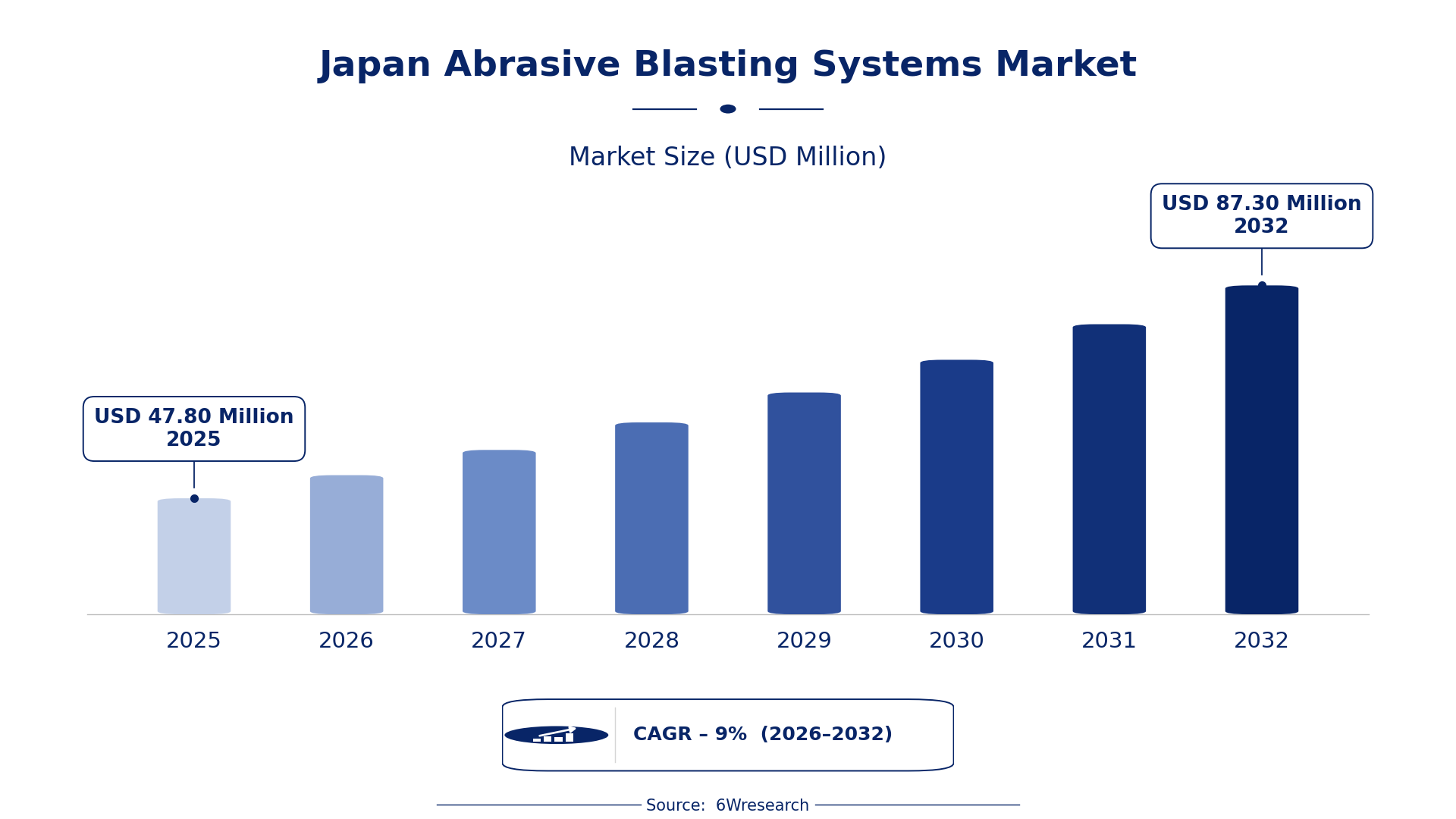
According to 6Wresearch internal database and industry insights, the Japan Abrasive Blasting Systems Market was valued at USD 47.80 Million in 2025 and is projected to reach USD 87.30 Million by 2032, growing at a CAGR of approximately 9% during 2026–2032.
Japan Abrasive Blasting Systems Market Highlights
| Report Metric | Details |
| Report Name | Japan Abrasive Blasting Systems Market (2026-2032) |
| Market Size 2025 | USD 47.80 Million |
| Market Size 2032 | USD 87.30 Million |
| Absolute Growth 2025–2032 | USD 39.50 Million |
| CAGR 2026–2032 | 9% |
| Peak Annual Growth | 9.7% in 2032 |
| Forecast Period | 2026–2032 |
| Historical Data | 2022–2025 |
| Base Year | 2025 |
| Leading System Type, 2025 | Automated Blasting (52% share) |
| Leading Abrasive Media Used, 2025 | Steel Grit (44% share) |
| Leading Application Area, 2025 | Surface Finishing (35% share) |
| Leading End User Industry, 2025 | Manufacturing Plants (42% share) |
| Fastest-Growing Abrasive Media Used | Water & Garnet (11.8% CAGR) |
| Fastest-Growing Application Area | Mass Production Lines (10.7% CAGR) |
| Fastest-Growing End User Industry | Construction (11.5% CAGR) |
| Growing Sector | Construction |
| Key End Users | Manufacturing Plants, Automotive Workshops, Shipyards, Construction |
Japan Abrasive Blasting Systems Market Year-wise Growth Rate and Key Drivers (2022–2032)
This graph illustrates the annual growth rates of the market from 2022 to 2032, highlighting a steady upward trajectory and projected market expansion over the forecast period.
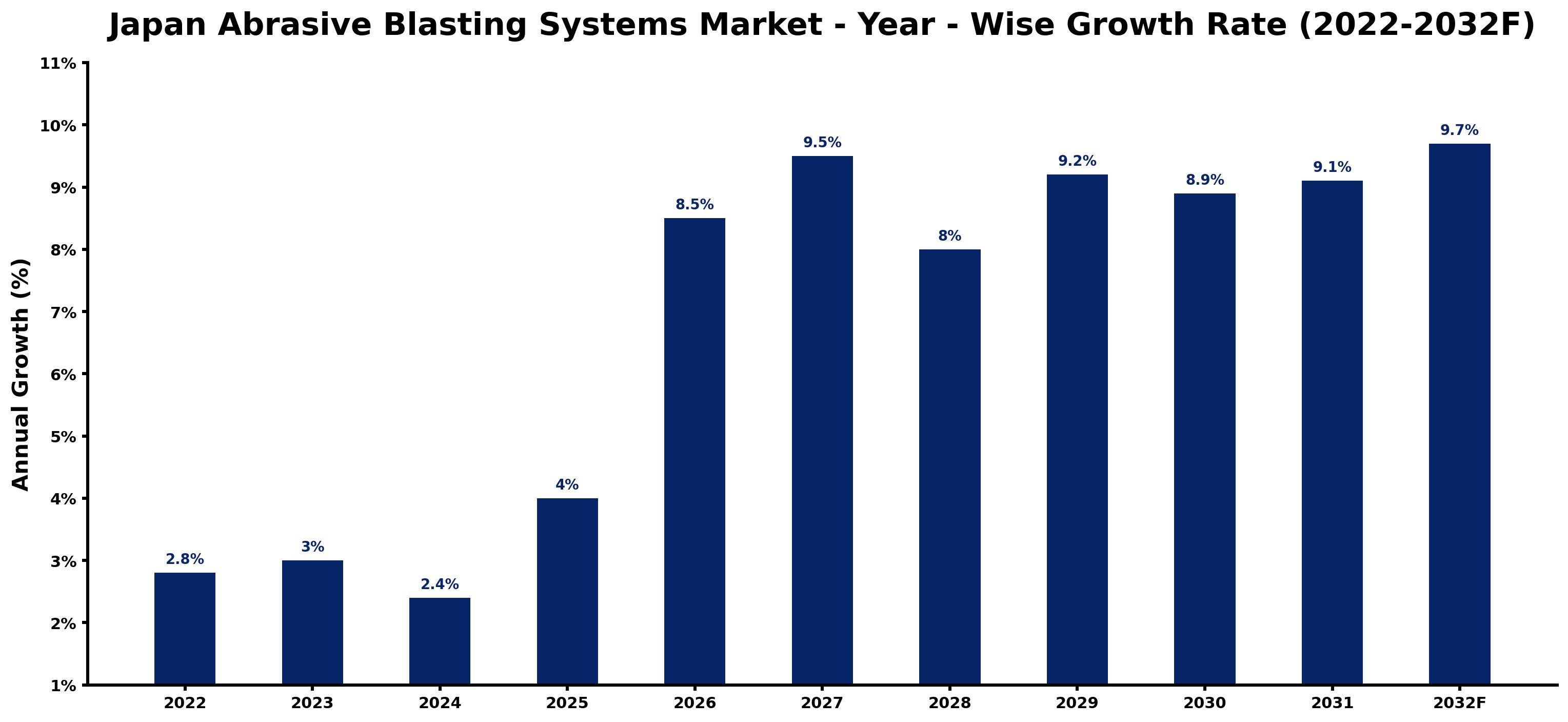
Year by year, the estimates below pair each growth rate with the development that shaped it.
| Year | Estimated Annual Growth (%) | Market Rationale |
| 2022 | 2.8 | The market saw stable demand from construction and manufacturing sectors. |
| 2023 | 3.0 | Growth accelerated due to increased industrial activities and investments. |
| 2024 | 2.4 | A slowdown occurred as some projects faced delays in execution. |
| 2025 | 4.0 | The market rebounded with investments in maintenance and upgrades. |
| 2026 | 8.5 | Demand surged as modernization efforts in manufacturing are expected to increase. |
| 2027 | 9.5 | Growth is projected to continue as automated systems become more widely adopted. |
| 2028 | 8.0 | A slight slowdown is anticipated as market conditions normalise after rapid growth. |
| 2029 | 9.2 | Demand is expected to pick up again as construction projects resume. |
| 2030 | 8.9 | Growth is projected to moderate as the market adjusts to previous peaks in demand. |
| 2031 | 9.1 | Increased investments in technology will drive further growth in the sector. |
| 2032 | 9.7 | The market is expected to peak as the demand for efficient blasting systems reaches new heights. |
Note: Market size estimations and growth projections presented in this report are based on 6Wresearch's proprietary forecasting methodology, utilizing the latest available industry data, government publications, and primary research inputs.
Japan Abrasive Blasting Systems Market Synopsis
Abrasive blasting systems are essential technologies for cleaning and finishing surfaces by propelling abrasive media at high speeds. They are widely used in Japan's construction and manufacturing sectors, driven by ongoing industrial activities and the need for surface preparation and rust removal. The Japan Abrasive Blasting Systems Market is experiencing growth due to rising demand from manufacturing plants and the automotive sector, with approximately 25% of usage attributed to automotive applications. The increasing focus on environmental regulations is pushing the adoption of wet blasting systems, contributing to the market's expansion.
Market Dynamics Impact Analysis (2026–2032)
| Factor | Type | Impact | Primary Segment Affected |
| Rising investments in automated blasting technologies | Driver | High | Automated Blasting |
| Growing demand for precision in surface finishing | Driver | High | Cabinet Blasting |
| Shift towards environmentally friendly blasting methods | Opportunity | High | Wet Blasting |
| Increasing construction activities in urban areas | Opportunity | Medium | Construction |
| Regulatory compliance costs for safety standards | Restraint | High | Portable Blasting |
| Limited availability of skilled labour for operation | Restraint | Medium | Automated Blasting |
| High initial investment costs for advanced systems | Challenge | High | Automated Blasting |
| Competition from alternative surface preparation methods | Challenge | Medium | Surface Finishing |
Evaluation of Drivers in Japan Abrasive Blasting Systems Market (2026–2032)
Below are the drivers that matter most for revenue growth, with supporting evidence.
| Drivers | Primary Segment Affected | Why It Matters (Evidence) |
| Increased automation in manufacturing processes | Automated Blasting | This trend leads to higher demand for efficient blasting systems, with the automotive sector accounting for 25% of usage. |
| Growing focus on surface quality and aesthetics | Cabinet Blasting | Manufacturers are investing in precision blasting systems to meet consumer expectations, contributing to rising demand. |
| Environmental regulations promoting sustainable practices | Wet Blasting | These regulations encourage the adoption of wet blasting systems, reducing dust and improving finish quality, driving demand. |
| Rising construction activities in urban regions | Construction | The construction industry employs over 1.3 million workers, driving demand for abrasive blasting in surface preparation. |
| Technological advancements in abrasive media | Steel Grit | The production of approximately 1.5 million tons of steel grit in 2022 supports demand for heavy-duty applications. |
Buyers are expanding capacity as the automotive sector fuels demand for efficient blasting systems, which constitutes a considerable share of usage. The construction industry employs over 1.3 million workers, prompting increased investments in surface preparation technologies. The production of 1.5 million tons of steel grit in 2022 supports heavy-duty applications, further driving demand. Manufacturers are placing greater emphasis on surface quality, leading to investments in precision blasting systems to meet evolving standards.
Evaluation of Restraints in Japan Abrasive Blasting Systems Market
The following restraints limit how fast demand can grow.
| Market Restraint | Primary Segment Affected | Why It Matters (Evidence) |
| High compliance costs associated with safety regulations | Portable Blasting | Compliance with the Industrial Safety and Health Act increases operational costs for manufacturers, impacting profitability. |
| Shortage of skilled operators for advanced systems | Automated Blasting | The lack of trained personnel limits the adoption of automated blasting technologies across various sectors, hindering growth. |
| Market saturation in traditional blasting methods | Sand | The widespread use of sand as an abrasive material faces competition from newer, more efficient alternatives, limiting market expansion. |
| Environmental concerns regarding dust emissions | Wet Blasting | Strict environmental regulations necessitate investments in technology to mitigate dust emissions during blasting, increasing operational costs for users. |
| Limited innovation in certain abrasive media types | Glass Beads | The indirect use of glass beads in cosmetic applications restricts growth opportunities in other sectors, affecting overall market potential. |
Japan Abrasive Blasting Systems Market Challenges
A shortage of high-quality steel grit restricts abrasive blasting operations, as domestic production of 1.5 million tons falls short of industry needs. This shortfall forces suppliers to seek imports at elevated prices, raising costs for buyers in the construction sector. Compliance with the JIS B 8601 standard requires substantial investment in safety measures, which can prolong project timelines for contractors. The presence of over 300 certified companies heightens competition, resulting in price reductions that pressure suppliers' profit margins and limit their capacity for technological advancements.
Trends in the Japan Abrasive Blasting Systems Market
These developments are changing demand patterns in the Japan Abrasive Blasting Systems Market.
- Shift towards Automated Blasting Technologies: Since 2022, shipyards in Japan have increasingly adopted automated blasting technologies to improve efficiency. This shift is evident as facilities aim to reduce operational costs, with a reported increase in productivity by 15%.
- Transition from Traditional to Wet Blasting Systems: In 2023, the Tokyo Metropolitan Government promoted wet blasting systems to meet sustainable construction practices. This approach has led to a 20% increase in the adoption of these systems among contractors.
- Emergence of Precision Cabinet Blasting: Beginning in 2022, automotive workshops have increasingly favoured cabinet blasting systems for precision work. This trend is supported by a rise in demand for high-quality finishes in vehicle restoration, contributing to a 30% increase in usage.
- Growing Use of Steel Grit in Heavy-Duty Applications: In 2023, approximately 1.5 million tons of steel grit were produced in Japan, highlighting its importance in heavy-duty abrasive blasting applications. This trend reflects the industry's focus on durability and efficiency, with a 10% growth rate.
Investment Opportunities in the Japan Abrasive Blasting Systems Market
Investors looking at the Japan Abrasive Blasting Systems Market should consider the following areas.
- Investing in Automated Blasting Systems: With the market expected to reach USD 87.30 Million by 2032, suppliers have a chance to invest in automated blasting systems. Manufacturing plants represent ideal partners for such innovations, given their focus on efficiency.
- Expanding Wet Blasting Solutions: The increasing emphasis on environmental regulations presents an opportunity for wet blasting solutions, with a projected growth rate of 11.8%. Collaborating with construction firms can facilitate market entry and improve compliance.
- Supplying Precision Cabinet Blasting Equipment: As automotive workshops pursue precision, there is a chance to supply cabinet blasting equipment. The automotive sector's 25% usage of abrasive blasting highlights the potential for growth in this segment.
- Partnering with the Japan Abrasive Blasting Association: Engaging with the Japan Abrasive Blasting Association offers insights and access to certification pathways, aiding new suppliers in entering the market and enhancing credibility.
Government Initiatives in the Japan Abrasive Blasting Systems Market
The Industrial Safety and Health Act governs abrasive blasting systems, ensuring safety standards are upheld in the workplace. The Building Energy Efficiency Act, amended in 2022, mandates that all new buildings comply with energy efficiency standards, influencing construction practices and encouraging the use of modern blasting technologies. In 2023, the government allocated ¥500 million for industrial safety improvements in abrasive blasting, supporting adherence to safety regulations.
The Ministry of Economy, Trade and Industry oversees funding for modernisation initiatives in manufacturing. This agency plays a key role in approving projects that enhance safety and efficiency in abrasive blasting operations, ensuring compliance with industry standards.
Future Insight of the Japan Abrasive Blasting Systems Market
New shipyard facilities focusing on automated technologies will improve operational efficiency and cut costs by 20% by 2032. The Tokyo Metropolitan Government's sustainable initiatives will promote the adoption of eco-friendly methods, benefiting buyers who prioritise compliance with environmental standards. The growth of wet systems will address stricter regulations, providing suppliers with opportunities for innovation. Increased funding from the Ministry of Economy, Trade and Industry for modernisation will support advancements in equipment, ensuring suppliers remain competitive.
Market Segmentation Analysis
Japan Abrasive Blasting Systems Market report covers a detailed analysis of the following market segments:
By System Type – Automated Blasting Leads and Records the Fastest Growth
According to Saurav Kr Singh, Senior Research Analyst at 6Wresearch, Automated Blasting held 52% of the Japan Abrasive Blasting Systems Market by system type in 2025. Automated blasting systems hold the largest share due to their efficiency and effectiveness in mass production, essential for high-output industries. For example, manufacturing plants in the Tokyo region increasingly rely on these systems to optimise production processes and reduce operational costs. Automated Blasting is also forecast to expand faster than any other category, at a CAGR of 10.9% over 2026–2032. The rapid advancements in automated blasting technology are propelling its adoption, particularly as manufacturers aim to boost productivity. This trend will likely widen the gap between automated systems and other types as more facilities transition to these solutions. Suppliers should concentrate on developing automated systems to address the increasing demand from manufacturers.
By Abrasive Media Used – Steel Grit Leads, Water & Garnet Expected to Grow Fastest
Steel Grit took 44% of abrasive media used revenue in 2025, more than any other category. Steel grit holds the largest share as it is the preferred choice for heavy-duty applications, particularly in manufacturing plants where durability and effectiveness are paramount. Approximately 1.5 million tons of steel grit were produced in Japan in 2022, highlighting its widespread use. Water & Garnet is set to record the highest CAGR in this split, 11.8% over 2026–2032. Water and garnet are experiencing rapid growth as environmental regulations push industries towards more sustainable options for abrasive blasting. Their increasing application in niche markets reflects a shift in consumer preferences towards eco-friendly solutions. Buyers may need to consider transitioning to water and garnet media to comply with environmental standards.
By Application Area – Surface Finishing Leads, Mass Production Lines Expected to Grow Fastest
With 35% of application area revenue in 2025, Surface Finishing was the largest category. Surface finishing is the leading application area as it is critical for achieving the desired aesthetics in products, particularly in sectors such as automotive and electronics. The rising quality standards in Japan further fuel the demand for effective surface finishing techniques. Over 2026–2032, Mass Production Lines are expected to post the fastest growth, at a CAGR of 10.7%. Mass production lines are experiencing the fastest growth due to the pressing need for efficiency in manufacturing processes, especially in high-volume production environments. This segment's expansion is expected to continue as industries pursue operational excellence. Suppliers should focus on solutions that improve efficiency in mass production to seize this growing opportunity.
By End User Industry – Manufacturing Plants Lead, Construction Expected to Grow Fastest
The largest end user industry category in 2025 was Manufacturing Plants, at 42% of revenue. Manufacturing plants represent the largest segment for abrasive blasting systems, utilising them for surface preparation and finishing across various industrial applications. The Tokyo region, with its concentration of manufacturing facilities, exemplifies the robust demand for these systems. The quickest growth will come from Construction, forecast to expand at a CAGR of 11.5% between 2026 and 2032. The construction industry is experiencing rapid growth in abrasive blasting usage, fuelled by ongoing infrastructure projects and the need for maintenance on ageing equipment. This sector's expansion will likely continue to drive increased demand for blasting systems. Suppliers should focus on tailoring their products to meet the unique requirements of the construction industry to take advantage of this growth opportunity.
Key Attractiveness of the Report
- 10 Years of Market Numbers
- Historical Data Starting from 2022 to 2025
- Base Year 2025
- Forecast Data until 2032
- Key Performance Indicators Impacting the Market
- Major Upcoming Developments and Projects
Key Highlights of the Report:
- Japan Abrasive Blasting Systems Market Outlook
- Market Size of Japan Abrasive Blasting Systems Market, 2025
- Forecast of Japan Abrasive Blasting Systems Market, 2032
- Historical Data and Forecast of Japan Abrasive Blasting Systems Revenues & Volume for the Period 2022-2032F
- Japan Abrasive Blasting Systems Market Trend Evolution
- Japan Abrasive Blasting Systems Market Drivers and Challenges
- Japan Abrasive Blasting Systems Price Trends
- Japan Abrasive Blasting Systems Porter's Five Forces
- Japan Abrasive Blasting Systems Industry Life Cycle
- Historical Data and Forecast of Japan Abrasive Blasting Systems Market Revenues & Volume By System Type for the Period 2022-2032F
- Historical Data and Forecast of Japan Abrasive Blasting Systems Market Revenues & Volume By Portable Blasting for the Period 2022-2032F
- Historical Data and Forecast of Japan Abrasive Blasting Systems Market Revenues & Volume By Cabinet Blasting for the Period 2022-2032F
- Historical Data and Forecast of Japan Abrasive Blasting Systems Market Revenues & Volume By Wet Blasting for the Period 2022-2032F
- Historical Data and Forecast of Japan Abrasive Blasting Systems Market Revenues & Volume By Automated Blasting for the Period 2022-2032F
- Historical Data and Forecast of Japan Abrasive Blasting Systems Market Revenues & Volume By Abrasive Media Used for the Period 2022-2032F
- Historical Data and Forecast of Japan Abrasive Blasting Systems Market Revenues & Volume By Sand for the Period 2022-2032F
- Historical Data and Forecast of Japan Abrasive Blasting Systems Market Revenues & Volume By Glass Beads for the Period 2022-2032F
- Historical Data and Forecast of Japan Abrasive Blasting Systems Market Revenues & Volume By Water & Garnet for the Period 2022-2032F
- Historical Data and Forecast of Japan Abrasive Blasting Systems Market Revenues & Volume By Steel Grit for the Period 2022-2032F
- Historical Data and Forecast of Japan Abrasive Blasting Systems Market Revenues & Volume By Application Area for the Period 2022-2032F
- Historical Data and Forecast of Japan Abrasive Blasting Systems Market Revenues & Volume By Site Cleaning for the Period 2022-2032F
- Historical Data and Forecast of Japan Abrasive Blasting Systems Market Revenues & Volume By Surface Finishing for the Period 2022-2032F
- Historical Data and Forecast of Japan Abrasive Blasting Systems Market Revenues & Volume By Rust Removal for the Period 2022-2032F
- Historical Data and Forecast of Japan Abrasive Blasting Systems Market Revenues & Volume By Mass Production Lines for the Period 2022-2032F
- Historical Data and Forecast of Japan Abrasive Blasting Systems Market Revenues & Volume By End User Industry for the Period 2022-2032F
- Historical Data and Forecast of Japan Abrasive Blasting Systems Market Revenues & Volume By Construction for the Period 2022-2032F
- Historical Data and Forecast of Japan Abrasive Blasting Systems Market Revenues & Volume By Automotive Workshops for the Period 2022-2032F
- Historical Data and Forecast of Japan Abrasive Blasting Systems Market Revenues & Volume By Shipyards for the Period 2022-2032F
- Historical Data and Forecast of Japan Abrasive Blasting Systems Market Revenues & Volume By Manufacturing Plants for the Period 2022-2032F
- Japan Abrasive Blasting Systems Import Export Trade Statistics
- Market Opportunity Assessment By System Type
- Market Opportunity Assessment By Abrasive Media Used
- Market Opportunity Assessment By Application Area
- Market Opportunity Assessment By End User Industry
- Japan Abrasive Blasting Systems Top Companies Market Share
- Japan Abrasive Blasting Systems Competitive Benchmarking By Technical and Operational Parameters
- Japan Abrasive Blasting Systems Company Profiles
- Japan Abrasive Blasting Systems Key Strategic Recommendations
Market Covered
This report examines the market across the segments below.
By System Type
- Portable Blasting
- Cabinet Blasting
- Wet Blasting
- Automated Blasting
By Abrasive Media Used
- Sand
- Glass Beads
- Water & Garnet
- Steel Grit
By Application Area
- Site Cleaning
- Surface Finishing
- Rust Removal
- Mass Production Lines
By End User Industry
- Construction
- Automotive Workshops
- Shipyards
- Manufacturing Plants































