Japan ABS, EBS, and Hydraulic Brake Technologies Market Size & Growth Rate
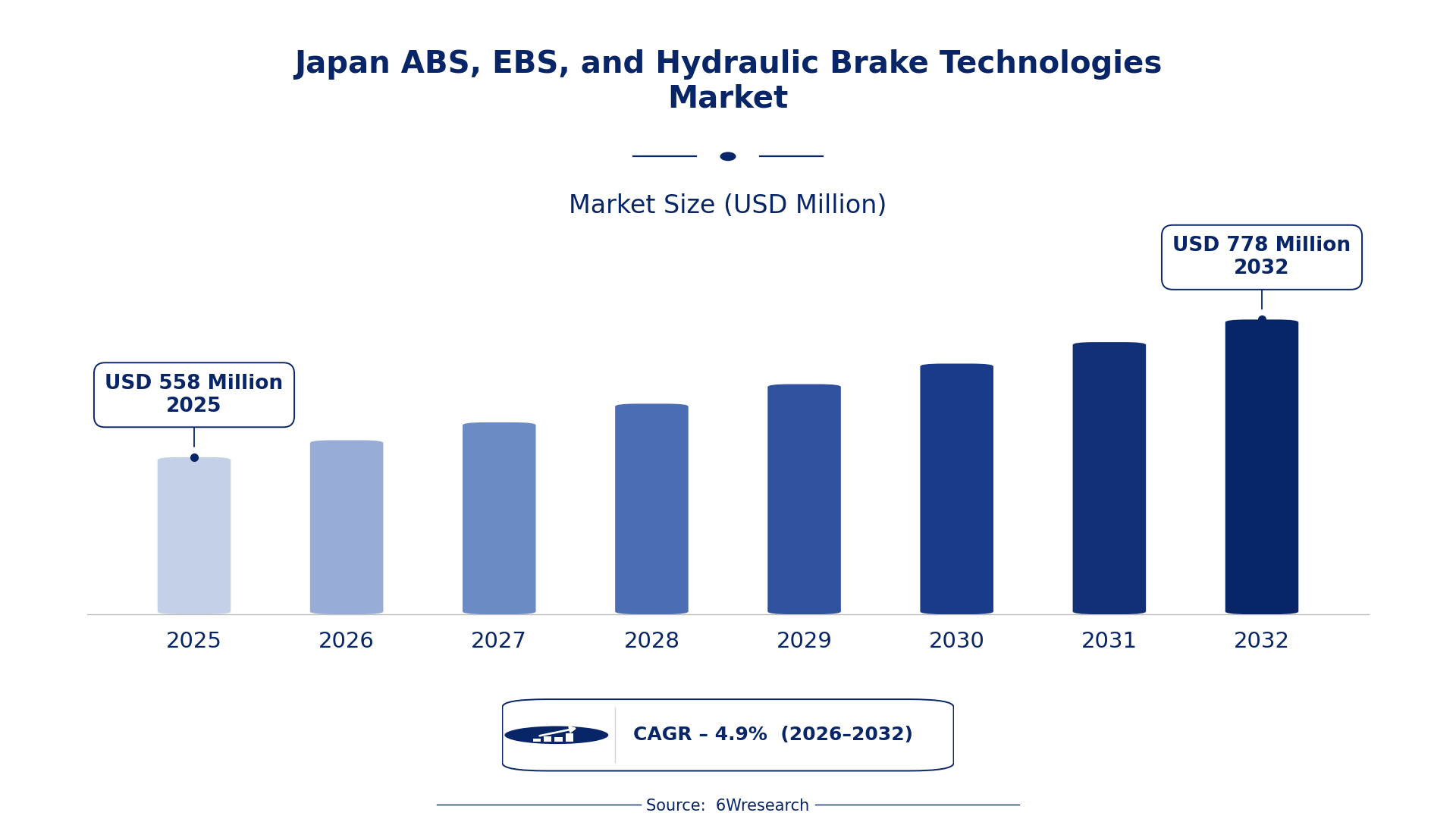
According to 6Wresearch internal database and industry insights, the Japan ABS, EBS, and Hydraulic Brake Technologies Market was valued at USD 558 Million in 2025 and is projected to reach USD 778 Million by 2032, growing at a CAGR of approximately 4.9% during 2026–2032.
Japan ABS, EBS, and Hydraulic Brake Technologies Market Highlights
| Report Metric | Details |
| Report Name | Japan ABS, EBS, and Hydraulic Brake Technologies Market (2026-2032) |
| Market Size 2025 | USD 558 Million |
| Market Size 2032 | USD 778 Million |
| Absolute Growth 2025–2032 | USD 220 Million |
| CAGR 2026–2032 | 4.9% |
| Peak Annual Growth | 5.6% in 2026 |
| Forecast Period | 2026–2032 |
| Historical Data | 2022–2025 |
| Base Year | 2025 |
| Leading Product Type, 2025 | ABS Systems (42% share) |
| Leading Vehicle Type, 2025 | Passenger Cars (39% share) |
| Leading Distribution Channel, 2025 | OEMs (39% share) |
| Leading End User, 2025 | Automotive Manufacturers (43% share) |
| Fastest-Growing Product Type | EBS Systems (6.8% CAGR) |
| Fastest-Growing Vehicle Type | Commercial Trucks (7.2% CAGR) |
| Fastest-Growing Distribution Channel | Aftermarket (6.4% CAGR) |
| Fastest-Growing End User | Logistics Companies (6.2% CAGR) |
| Growing Sector | automotive safety technologies |
| Key End Users | automotive manufacturers, logistics companies, public transport providers, fleet operators |
Japan ABS, EBS, and Hydraulic Brake Technologies Market Year-wise Growth Rate and Key Drivers (2022–2032)
This graph illustrates the annual growth rates of the market from 2022 to 2032, highlighting a steady upward trajectory and projected market expansion over the forecast period.
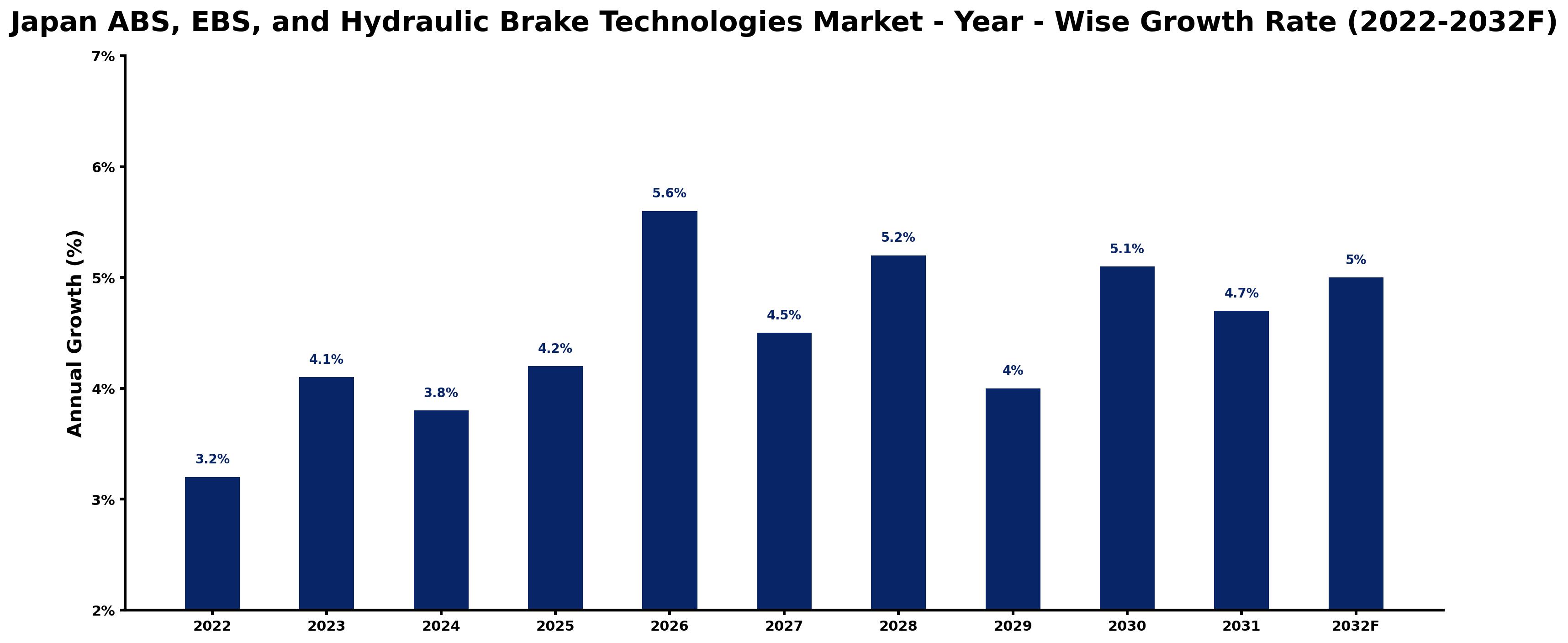
The following figures match every annual growth estimate with the main market development of that year, giving the reasoning behind each rise or slowdown.
| Year | Estimated Annual Growth (%) | Market Rationale |
| 2022 | 3.2 | The market showed steady growth, reflecting ongoing demand from automotive manufacturers. |
| 2023 | 4.1 | Growth accelerated due to increased vehicle production and technological advancements in braking systems. |
| 2024 | 3.8 | The market experienced a slowdown as demand stabilised after a period of rapid growth. |
| 2025 | 4.2 | Growth rebounded with new safety regulations boosting the need for advanced braking technologies. |
| 2026 | 5.6 | The peak growth year is driven by investments in automotive safety and efficiency. |
| 2027 | 4.5 | Growth is expected to slow as the market adjusts to the high demand levels of the previous year. |
| 2028 | 5.2 | The market is projected to see renewed interest from logistics companies investing in safety technologies. |
| 2029 | 4.0 | Growth is expected to moderate as the market begins to stabilise after several years of expansion. |
| 2030 | 5.1 | Increased focus on electric vehicles is expected to spur demand for modern braking technologies. |
| 2031 | 4.7 | The market will continue to grow as automotive manufacturers seek to improve vehicle safety. |
| 2032 | 5.0 | Growth is projected to remain strong, driven by ongoing investments in R&D within the automotive sector. |
Note: Market size estimations and growth projections presented in this report are based on 6Wresearch's proprietary forecasting methodology, utilizing the latest available industry data, government publications, and primary research inputs.
Japan ABS, EBS, and Hydraulic Brake Technologies Market Synopsis
ABS, EBS, and Hydraulic Brake Technologies are crucial for vehicle safety and performance, manufactured using advanced components. The rising vehicle ownership rate, the push for electric vehicle adoption, and substantial investments in automotive R&D are propelling market growth, particularly among domestic automotive manufacturers and logistics companies.
Market Dynamics Impact Analysis (2026–2032)
| Factor | Type | Impact | Primary Segment Affected |
| Increased vehicle production and safety regulations drive demand for advanced braking systems. | Driver | High | ABS Systems |
| Technological advancements in braking efficiency enhance safety, attracting more buyers. | Driver | High | EBS Systems |
| The shift towards electric vehicles creates demand for modern braking solutions. | Opportunity | High | Hydraulic Brake Technologies |
| Growing logistics companies require reliable braking systems for fleet safety. | Opportunity | Medium | Commercial Trucks |
| High costs associated with advanced braking system integration may limit adoption. | Restraint | High | Integrated Braking Solutions |
| The average lifespan of hydraulic brake systems may deter replacement purchases. | Restraint | Medium | Hydraulic Brake Technologies |
| Supply chain disruptions can delay the availability of critical components. | Challenge | High | EBS Systems |
| Intense competition among manufacturers can lead to price wars, affecting margins. | Challenge | Medium | ABS Systems |
Evaluation of Drivers in Japan ABS, EBS, and Hydraulic Brake Technologies Market (2026–2032)
Key forces behind demand, with the segment each one moves most, are listed below.
| Drivers | Primary Segment Affected | Why It Matters (Evidence) |
| Rising vehicle production | ABS Systems | Japan produced 8.3 million vehicles in 2022, increasing demand for safety technologies. |
| Technological advancements in braking systems | EBS Systems | The implementation of ISO 26262 standards improves braking efficiency and safety. |
| Growing electric vehicle market | Hydraulic Brake Technologies | The strategy to promote electric vehicles impacts braking technology needs. |
| Increased investments in automotive R&D | Integrated Braking Solutions | The automotive sector is expected to invest over ¥3 trillion in R&D by 2025. |
| Logistics sector expansion | Commercial Trucks | Logistics companies require reliable braking systems for their growing fleets. |
Purchasing is picking up as vehicle production in Japan reached 8.3 million units in 2022, driving demand for advanced braking technologies. The implementation of ISO 26262 standards has improved braking efficiency, prompting manufacturers to invest in EBS systems. The strategy to promote electric vehicles is reshaping braking technology requirements. The automotive sector's projected investment of over ¥3 trillion in R&D by 2025 supports the growth of integrated braking solutions. Logistics companies are expanding their fleets, necessitating reliable braking systems to ensure safety and compliance.
Evaluation of Restraints in Japan ABS, EBS, and Hydraulic Brake Technologies Market
These are the pressures that could keep growth below its potential.
| Market Restraint | Primary Segment Affected | Why It Matters (Evidence) |
| High integration costs for advanced braking systems may deter adoption. | Integrated Braking Solutions | The average cost of integrating advanced systems can exceed ¥1 million per vehicle. |
| The average lifespan of hydraulic brake systems is around 10 years. | Hydraulic Brake Technologies | This longevity can reduce the frequency of replacement purchases in the aftermarket. |
| Supply chain disruptions can lead to delays in component availability. | EBS Systems | Recent global shortages have affected the timely delivery of critical braking components. |
| Intense competition may lead to reduced profit margins for manufacturers. | ABS Systems | Price wars among manufacturers can drive down profitability, impacting investment in innovation. |
| Regulatory compliance costs can burden smaller manufacturers. | Hydraulic Brake Technologies | Smaller companies may struggle to meet stringent JIS standards, limiting their market entry. |
Japan ABS, EBS, and Hydraulic Brake Technologies Market Challenges
Producers encounter a shortage of skilled technicians, raising training costs and delaying production timelines for automotive manufacturers. Regulatory requirements from the Ministry of Land, Infrastructure, Transport and Tourism complicate compliance, leading to increased operational expenses for suppliers. Supply chain disruptions, resulting from heightened demand for advanced braking technologies, can extend lead times for components, impacting vehicle manufacturers' ability to meet delivery schedules. Continuous technological advancements necessitate ongoing investment in R&D, straining budgets for smaller automotive producers and potentially postponing the rollout of new braking technologies.
Trends in the Japan ABS, EBS, and Hydraulic Brake Technologies Market
The shifts below are changing how Japan ABS, EBS, and Hydraulic Brake Technologies Market products are bought and supplied.
- Shift towards Electric Vehicle Integration: The Japanese government is promoting electric vehicle adoption, impacting braking technology needs. In 2023, this strategy aims for advancements in braking systems tailored for electric vehicles.
- Increase in Aftermarket Sales: The automotive aftermarket in Japan is valued at approximately ¥4 trillion, with growing demand for replacement parts driven by the average vehicle age of 10.5 years.
- Focus on Safety Standards: ISO 26262 is becoming a key standard in Japan, influencing manufacturers to improve the safety features of braking systems, ensuring compliance with functional safety requirements.
- Expansion of Logistics Fleets: Logistics companies are increasing their investments in safety technologies, with approximately 2.5 million registered trucks in Japan requiring advanced braking solutions for fleet safety.
Investment Opportunities in the Japan ABS, EBS, and Hydraulic Brake Technologies Market
Several openings in the Japan ABS, EBS, and Hydraulic Brake Technologies Market merit attention from investors.
- Timing for Advanced Braking Technologies: With the automotive sector expected to invest over ¥3 trillion in R&D by 2025, there is an opportunity to supply advanced braking technologies to manufacturers.
- Entry through Collaboration: Local partnerships with automotive manufacturers can facilitate market entry, particularly in the growing electric vehicle segment, supported by initiatives.
- Gap in Aftermarket Demand: The average vehicle age of 10.5 years indicates a strong need for replacement braking systems, presenting an opportunity for aftermarket suppliers.
- Logistics Companies Seeking Upgrades: Logistics companies are increasingly investing in safety technologies, creating demand for advanced braking systems to ensure fleet compliance and safety.
Government Initiatives in the Japan ABS, EBS, and Hydraulic Brake Technologies Market
The Ministry of Land, Infrastructure, Transport and Tourism oversees vehicle safety regulations, ensuring that manufacturers comply with JIS standards. The Green Growth Strategy, updated in 2021, aims to reduce greenhouse gas emissions from vehicles by 46% by 2030, influencing the adoption of advanced braking technologies.
The Japan Automobile Manufacturers Association (JAMA) supports industry standards and innovation, facilitating the implementation of new safety measures. The Digital Agency, established in 2021, leads government digital transformation, promoting common system standards that impact automotive technologies.
Future Insight of the Japan ABS, EBS, and Hydraulic Brake Technologies Market
The launch of electric vehicle initiatives will drive demand for advanced braking technologies, pushing suppliers to innovate. By 2032, the adoption of enhanced safety standards will compel producers to integrate more sophisticated braking solutions. The automotive sector's planned investment of over ¥3 trillion in R&D by 2025 will likely lead to breakthroughs in braking technology. As the average age of vehicles on the road approaches 11 years, aftermarket opportunities will expand, creating a robust market for replacement braking components.
Market Segmentation Analysis
Japan ABS, EBS, and Hydraulic Brake Technologies Market report covers a detailed analysis of the following market segments:
By Product Type – ABS Systems Lead, EBS Systems Expected to Grow Fastest
According to Saurav Kr Singh, Senior Research Analyst at 6Wresearch, ABS Systems took 42% of product type revenue in 2025, more than any other category. ABS Systems hold the largest market share as they are crucial for vehicle safety and performance, particularly in passenger cars. Their integration into the production of 8.3 million vehicles in Japan in 2022 underscores their importance in the automotive sector. EBS Systems are set to record the highest CAGR in this split, 6.8% over 2026–2032. EBS Systems are witnessing rapid growth due to their ability to improve braking efficiency and safety, especially with the rise of electric vehicles. The government's 2023 strategy promoting electric vehicle adoption is significantly boosting the demand for these systems. Suppliers should prioritise the development of EBS technologies to align with the automotive industry's shift towards electric vehicles.
By Vehicle Type – Passenger Cars Lead, Commercial Trucks Expected to Grow Fastest
The largest vehicle type category in 2025 was Passenger Cars, at 39% of revenue. Passenger Cars dominate the market as they represent the majority of vehicles on Japanese roads, with a vehicle ownership rate of approximately 590 per 1,000 inhabitants. This high ownership level drives continuous demand for advanced braking technologies in this category. The quickest growth will come from Commercial Trucks, forecast to expand at a CAGR of 7.2% between 2026 and 2032. Commercial Trucks are experiencing the fastest growth due to their essential role in ensuring safety for heavy vehicles, with around 2.5 million registered trucks in Japan as of 2022. The increasing emphasis on safety regulations in the logistics sector is propelling this segment's expansion. Manufacturers should focus on developing braking systems specifically designed for commercial trucks to capitalise on this growth opportunity.
By Distribution Channel – OEMs Lead, Aftermarket Expected to Grow Fastest
With 39% of distribution channel revenue in 2025, OEMs was the largest category. OEMs lead the market as they are the primary manufacturers of vehicles, directly integrating advanced braking technologies into new models. Their pivotal role ensures compliance with safety standards such as ISO 26262, solidifying their market position. Over 2026–2032, Aftermarket is expected to post the fastest growth, at a CAGR of 6.4%. The Aftermarket is rapidly growing as vehicle owners increasingly seek replacements and upgrades for ageing systems, particularly given that the average age of vehicles on Japanese roads is around 10.5 years. The substantial value of the Japanese automotive aftermarket, estimated at approximately ¥4 trillion, further fuels this trend. Suppliers should enhance their aftermarket offerings to capture the rising demand for replacement braking systems.
By End User – Automotive Manufacturers Lead, Logistics Companies Expected to Grow Fastest
Automotive Manufacturers accounted for 43% of the market by end user in 2025. Automotive Manufacturers are the largest consumers of braking technologies, necessitating advanced systems for the production of new vehicles. Their significant investments in research and development, projected to exceed ¥3 trillion by 2025, reinforce their dominant market position. Logistics Companies are projected to grow fastest, at a CAGR of 6.2% during 2026–2032. Logistics Companies are experiencing the fastest growth in demand for braking systems due to their need for reliable solutions in heavy-duty vehicles. The critical importance of safety in logistics operations, particularly with a high volume of registered trucks, drives this requirement. Suppliers should tailor their products to meet the specific safety and performance needs of logistics companies.
Key Attractiveness of the Report
- 10 Years of Market Numbers
- Historical Data Starting from 2022 to 2025
- Base Year 2025
- Forecast Data until 2032
- Key Performance Indicators Impacting the Market
- Major Upcoming Developments and Projects
Key Highlights of the Report:
- Japan ABS, EBS, and Hydraulic Brake Technologies Market Outlook
- Market Size of Japan ABS, EBS, and Hydraulic Brake Technologies Market, 2025
- Forecast of Japan ABS, EBS, and Hydraulic Brake Technologies Market, 2032
- Historical Data and Forecast of Japan ABS, EBS, and Hydraulic Brake Technologies Revenues & Volume for the Period 2022-2032F
- Japan ABS, EBS, and Hydraulic Brake Technologies Market Trend Evolution
- Japan ABS, EBS, and Hydraulic Brake Technologies Market Drivers and Challenges
- Japan ABS, EBS, and Hydraulic Brake Technologies Price Trends
- Japan ABS, EBS, and Hydraulic Brake Technologies Porter's Five Forces
- Japan ABS, EBS, and Hydraulic Brake Technologies Industry Life Cycle
- Historical Data and Forecast of Japan ABS, EBS, and Hydraulic Brake Technologies Market Revenues & Volume By Product Type for the Period 2022-2032F
- Historical Data and Forecast of Japan ABS, EBS, and Hydraulic Brake Technologies Market Revenues & Volume By ABS Systems for the Period 2022-2032F
- Historical Data and Forecast of Japan ABS, EBS, and Hydraulic Brake Technologies Market Revenues & Volume By EBS Systems for the Period 2022-2032F
- Historical Data and Forecast of Japan ABS, EBS, and Hydraulic Brake Technologies Market Revenues & Volume By Hydraulic Brake Technologies for the Period 2022-2032F
- Historical Data and Forecast of Japan ABS, EBS, and Hydraulic Brake Technologies Market Revenues & Volume By Integrated Braking Solutions for the Period 2022-2032F
- Historical Data and Forecast of Japan ABS, EBS, and Hydraulic Brake Technologies Market Revenues & Volume By Vehicle Type for the Period 2022-2032F
- Historical Data and Forecast of Japan ABS, EBS, and Hydraulic Brake Technologies Market Revenues & Volume By Passenger Cars for the Period 2022-2032F
- Historical Data and Forecast of Japan ABS, EBS, and Hydraulic Brake Technologies Market Revenues & Volume By Commercial Trucks for the Period 2022-2032F
- Historical Data and Forecast of Japan ABS, EBS, and Hydraulic Brake Technologies Market Revenues & Volume By Buses for the Period 2022-2032F
- Historical Data and Forecast of Japan ABS, EBS, and Hydraulic Brake Technologies Market Revenues & Volume By Trailers for the Period 2022-2032F
- Historical Data and Forecast of Japan ABS, EBS, and Hydraulic Brake Technologies Market Revenues & Volume By Distribution Channel for the Period 2022-2032F
- Historical Data and Forecast of Japan ABS, EBS, and Hydraulic Brake Technologies Market Revenues & Volume By OEMs for the Period 2022-2032F
- Historical Data and Forecast of Japan ABS, EBS, and Hydraulic Brake Technologies Market Revenues & Volume By Aftermarket for the Period 2022-2032F
- Historical Data and Forecast of Japan ABS, EBS, and Hydraulic Brake Technologies Market Revenues & Volume By Distributors for the Period 2022-2032F
- Historical Data and Forecast of Japan ABS, EBS, and Hydraulic Brake Technologies Market Revenues & Volume By Online Platforms for the Period 2022-2032F
- Historical Data and Forecast of Japan ABS, EBS, and Hydraulic Brake Technologies Market Revenues & Volume By End User for the Period 2022-2032F
- Historical Data and Forecast of Japan ABS, EBS, and Hydraulic Brake Technologies Market Revenues & Volume By Automotive Manufacturers for the Period 2022-2032F
- Historical Data and Forecast of Japan ABS, EBS, and Hydraulic Brake Technologies Market Revenues & Volume By Logistics Companies for the Period 2022-2032F
- Historical Data and Forecast of Japan ABS, EBS, and Hydraulic Brake Technologies Market Revenues & Volume By Public Transport Providers for the Period 2022-2032F
- Historical Data and Forecast of Japan ABS, EBS, and Hydraulic Brake Technologies Market Revenues & Volume By Fleet Operators for the Period 2022-2032F
- Japan ABS, EBS, and Hydraulic Brake Technologies Import Export Trade Statistics
- Market Opportunity Assessment By Product Type
- Market Opportunity Assessment By Vehicle Type
- Market Opportunity Assessment By Distribution Channel
- Market Opportunity Assessment By End User
- Japan ABS, EBS, and Hydraulic Brake Technologies Top Companies Market Share
- Japan ABS, EBS, and Hydraulic Brake Technologies Competitive Benchmarking By Technical and Operational Parameters
- Japan ABS, EBS, and Hydraulic Brake Technologies Company Profiles
- Japan ABS, EBS, and Hydraulic Brake Technologies Key Strategic Recommendations
Market Covered
The following segment groups are covered in the report.
By Product Type
- ABS Systems
- EBS Systems
- Hydraulic Brake Technologies
- Integrated Braking Solutions
By Vehicle Type
- Passenger Cars
- Commercial Trucks
- Buses
- Trailers
By Distribution Channel
- OEMs
- Aftermarket
- Distributors
- Online Platforms
By End User
- Automotive Manufacturers
- Logistics Companies
- Public Transport Providers
- Fleet Operators































