Japan ABS/EBS Braking Solutions Market Size & Growth Rate
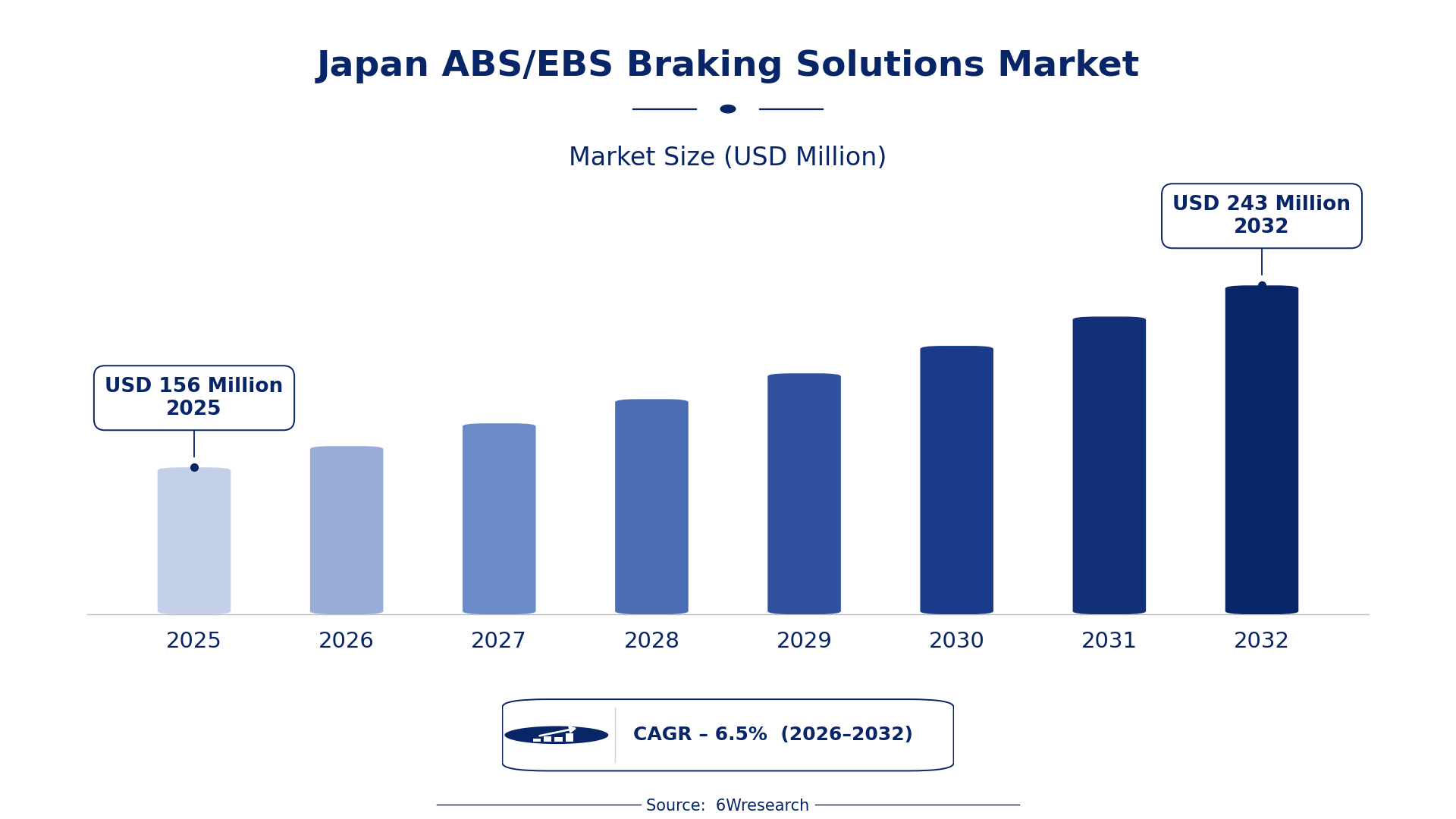
According to 6Wresearch internal database and industry insights, the Japan ABS/EBS Braking Solutions Market was valued at USD 156 Million in 2025 and is projected to reach USD 243 Million by 2032, growing at a CAGR of approximately 6.5% during 2026–2032.
Japan ABS/EBS Braking Solutions Market Highlights
| Report Metric | Details |
| Report Name | Japan ABS/EBS Braking Solutions Market (2026-2032) |
| Market Size 2025 | USD 156 Million |
| Market Size 2032 | USD 243 Million |
| Absolute Growth 2025–2032 | USD 87 Million |
| CAGR 2026–2032 | 6.5% |
| Peak Annual Growth | 7.4% in 2032 |
| Forecast Period | 2026–2032 |
| Historical Data | 2022–2025 |
| Base Year | 2025 |
| Leading Technology Type, 2025 | Standalone ABS (44% share) |
| Leading Vehicle Type, 2025 | Light Commercial Vehicles (38% share) |
| Leading Distribution Channel, 2025 | OEMs (50% share) |
| Leading End User, 2025 | Vehicle Manufacturers (40% share) |
| Fastest-Growing Technology Type | Integrated EBS Systems (9.0% CAGR) |
| Fastest-Growing Vehicle Type | Heavy Trucks (9.4% CAGR) |
| Fastest-Growing Distribution Channel | Industrial Suppliers (8.6% CAGR) |
| Fastest-Growing End User | Fleet Owners (8.3% CAGR) |
| Growing Sector | automotive safety technology |
| Key End Users | vehicle manufacturers, fleet owners, public transport agencies, logistics companies |
Japan ABS/EBS Braking Solutions Market Year-wise Growth Rate and Key Drivers (2022–2032)
This graph illustrates the annual growth rates of the market from 2022 to 2032, highlighting a steady upward trajectory and projected market expansion over the forecast period.
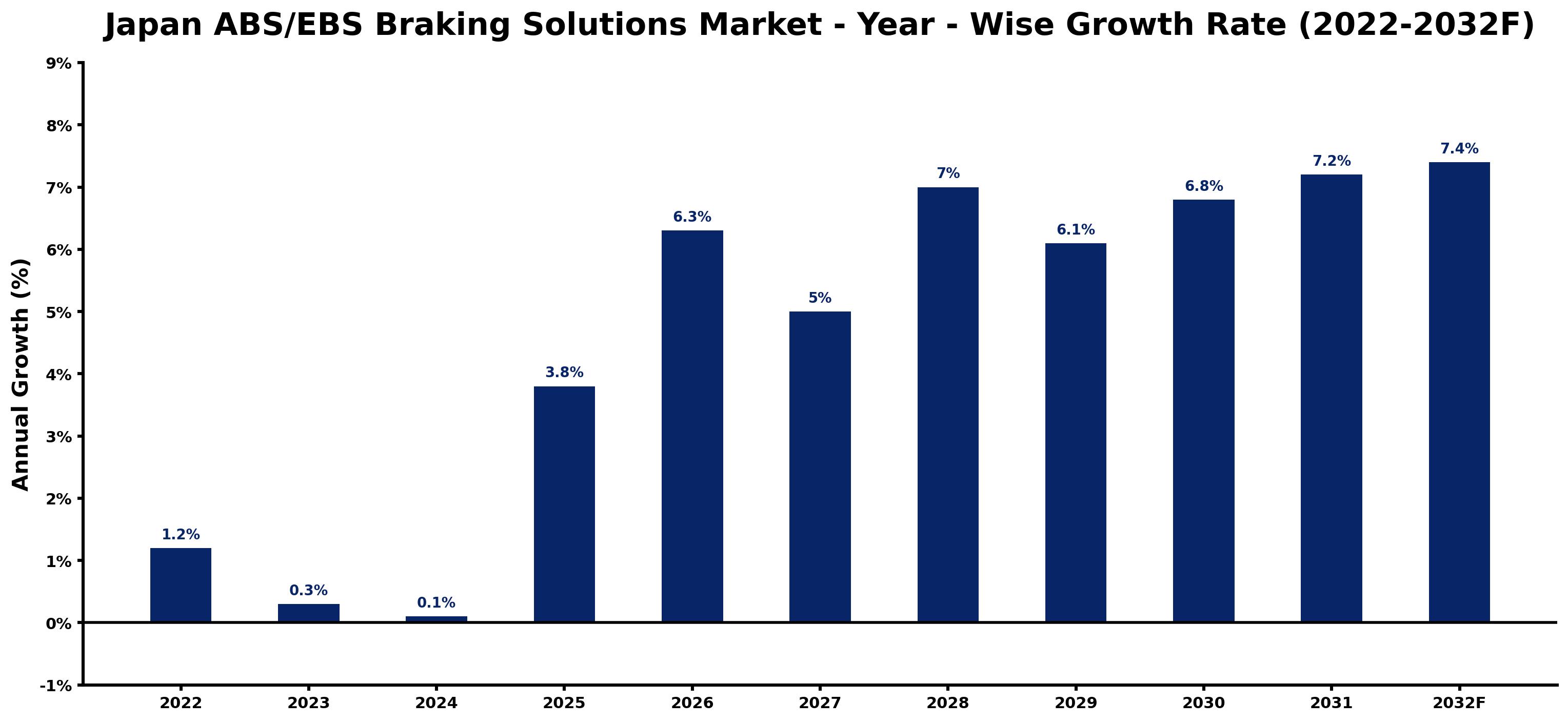
For each year, the table pairs the estimated growth rate with the leading influence on demand, showing how the drivers changed across the period.
| Year | Estimated Annual Growth (%) | Market Rationale |
| 2022 | 1.2 | The market experienced stable activity, driven by ongoing vehicle production. |
| 2023 | 0.3 | Growth slowed due to market saturation and cautious investment by manufacturers. |
| 2024 | 0.1 | Demand continued to decelerate as vehicle manufacturers focused on cost management. |
| 2025 | 3.8 | Growth accelerated as production ramped up, reflecting increased vehicle demand. |
| 2026 | 6.3 | Rising demand for safety features is expected to lead to higher adoption rates of ABS/EBS systems. |
| 2027 | 5.0 | Growth is projected to slow as the market adjusts to previous years' rapid expansion. |
| 2028 | 7.0 | Demand is expected to surge again, driven by new safety regulations and technology adoption. |
| 2029 | 6.1 | Growth will slow as manufacturers face supply chain constraints and rising costs. |
| 2030 | 6.8 | Demand is expected to rise as new vehicle models integrate advanced braking systems. |
| 2031 | 7.2 | The market will experience growth driven by fleet upgrades and safety initiatives. |
| 2032 | 7.4 | Demand peaks as the adoption of EBS systems becomes standard in heavy vehicles. |
Note: Market size estimations and growth projections presented in this report are based on 6Wresearch's proprietary forecasting methodology, utilizing the latest available industry data, government publications, and primary research inputs.
Japan ABS/EBS Braking Solutions Market Synopsis
ABS and EBS Braking Solutions are advanced technologies that prevent wheel lock-up and optimise braking force distribution, improving vehicle safety and control. The Japan ABS/EBS Braking Solutions Market is driven by strong demand from domestic vehicle manufacturers and fleet operators, with 4.5 million vehicles produced in 2022. Growth is propelled by increasing safety regulations, the average vehicle age of 11 years, and government funding of ¥10 billion for automotive safety technology development, supporting retrofitting older vehicles with modern braking systems.
Market Dynamics Impact Analysis (2026–2032)
| Factor | Type | Impact | Primary Segment Affected |
| Rising vehicle production and safety regulations drive demand for advanced braking systems. | Driver | High | Integrated EBS Systems |
| The need for retrofitting older vehicles creates opportunities for suppliers of ABS/EBS solutions. | Opportunity | High | Standalone ABS |
| Supply chain disruptions impact the availability of components needed for ABS/EBS systems. | Restraint | High | Trailer EBS Units |
| The increasing average age of vehicles necessitates upgrades to braking systems. | Driver | Medium | Light Commercial Vehicles |
| The growing focus on public transport safety creates demand for EBS in buses. | Opportunity | Medium | Buses |
| High production costs challenge manufacturers' ability to invest in new technologies. | Challenge | High | Heavy Trucks |
| Regulatory compliance costs can deter smaller manufacturers from entering the market. | Restraint | Medium | OEMs |
| Competition from alternative braking technologies may limit market growth. | Challenge | Medium | Fleet Owners |
Evaluation of Drivers in Japan ABS/EBS Braking Solutions Market (2026–2032)
The table below links each growth driver to the segment it affects and the evidence for it.
| Drivers | Primary Segment Affected | Why It Matters (Evidence) |
| Increasing vehicle production drives demand for ABS/EBS systems. | Integrated EBS Systems | Japan produced 4.5 million vehicles in 2022, leading to higher system adoption. |
| Growing safety regulations boost demand for advanced braking solutions. | Standalone ABS | The adoption rate of ABS in new vehicles exceeds 90%, reflecting regulatory standards. |
| Fleet owners require reliable braking systems for safety and compliance. | Light Commercial Vehicles | Fleet owners manage over 500,000 commercial vehicles, emphasising safety. |
| The average vehicle age of 11 years creates a need for retrofitting. | Heavy Trucks | Older vehicles require updated braking systems to meet current safety standards. |
| Public transport agencies focus on safety improvements in their fleets. | Buses | Over 1,000 buses in Tokyo are equipped with EBS, enhancing passenger safety. |
Spending rises because vehicle production in Japan reached 4.5 million units in 2022, driving demand for ABS/EBS systems. Fleet owners managing a large number of vehicles require reliable braking systems, further boosting demand. The average vehicle age necessitates retrofitting older models with modern braking technologies.
Evaluation of Restraints in Japan ABS/EBS Braking Solutions Market
Several factors work against faster growth; the main ones are summarised below.
| Market Restraint | Primary Segment Affected | Why It Matters (Evidence) |
| Supply chain disruptions hinder the availability of ABS/EBS components. | Integrated EBS Systems | Manufacturers face challenges sourcing materials, affecting production timelines. |
| High production costs deter investment in advanced braking technologies. | Standalone ABS | Rising costs limit smaller manufacturers' ability to compete effectively. |
| Regulatory compliance can be burdensome for smaller manufacturers. | OEMs | Compliance costs may restrict market entry for new players. |
| Competition from alternative braking technologies limits market share. | Fleet Owners | Emerging technologies may divert investment away from traditional systems. |
| Market saturation leads to slower growth rates in established segments. | Heavy Trucks | With many vehicles already equipped, new sales growth is constrained. |
Japan ABS/EBS Braking Solutions Market Challenges
High costs arise for producers due to stringent JIS standards, which require substantial investment in compliance that delays product launches and raises prices for buyers. Technology adoption struggles because the average vehicle age in Japan is 11 years, leading to increased retrofitting costs for fleet operators. Buyers experience pressure from the over 90% adoption rate of ABS in new vehicles, limiting options for those with older models. Supply chain disruptions occur as the Tokyo region hosts the highest concentration of manufacturers, risking delays in component delivery that impact production schedules for producers.
Trends in the Japan ABS/EBS Braking Solutions Market
Four trends stand out in the Japan ABS/EBS Braking Solutions Market.
- Shift towards Integrated EBS Systems: The adoption of Integrated EBS systems is increasing among heavy trucks, driven by safety regulations. In 2023, over 30% of new heavy trucks featured EBS technology, improving braking efficiency.
- Focus on Retrofitting Older Vehicles: Fleet owners are retrofitting older vehicles with ABS/EBS systems to comply with safety standards. In 2023, the government allocated ¥10 billion for automotive safety technology development, incentivising upgrades.
- Growing Demand for Safety in Public Transport: Public transport agencies are prioritising safety by equipping buses with EBS technology. In Tokyo, over 1,000 buses are now fitted with EBS, reflecting a commitment to passenger safety.
- Increased Adoption of ABS in New Vehicles: The adoption rate of ABS in new vehicles has surpassed 90%, driven by JIS standards. This trend indicates a strong commitment to improving vehicle safety across the automotive sector.
Investment Opportunities in the Japan ABS/EBS Braking Solutions Market
Below are the investment opportunities with the strongest case in the Japan ABS/EBS Braking Solutions Market.
- Supply of Advanced Braking Technologies: The demand for ABS/EBS systems is growing, with over 4.5 million vehicles produced in 2022. Suppliers can target vehicle manufacturers in the Tokyo region, where the automotive industry is concentrated.
- Investment in Retrofitting Solutions: With the average vehicle age at 11 years, there is a strong opportunity for retrofitting solutions. Fleet owners managing a significant number of vehicles represent a key market for these upgrades.
- Expansion into Public Transport Safety Solutions: Public transport agencies are focusing on safety improvements, creating a demand for EBS systems. Companies can enter this market by partnering with local transport authorities.
- Development of Innovative Braking Technologies: The growing emphasis on safety regulations presents an opportunity for innovative braking solutions. Suppliers can invest in R&D to meet the evolving standards set by the Japan Automobile Manufacturers Association.
Government Initiatives in the Japan ABS/EBS Braking Solutions Market
The GX Promotion Act, enacted in 2023, strengthens Japan's commitment to automotive safety by mandating advanced braking systems in new vehicles. This builds on previous regulations, ensuring a consistent approach to vehicle safety across the industry. The act includes provisions for funding initiatives that support the development and integration of ABS/EBS technologies.
The Ministry of Land, Infrastructure, Transport and Tourism oversees the implementation of safety regulations and funds initiatives to promote advanced braking technologies. In 2023, the ministry allocated ¥10 billion to support automotive safety technology development, which directly benefits manufacturers and fleet operators by facilitating the adoption of modern braking systems.
Future Insight of the Japan ABS/EBS Braking Solutions Market
The launch of a new government programme to incentivise retrofitting vehicles with modern braking systems will reshape the market by 2032, increasing demand for ABS and EBS technologies. New regulations will likely mandate advanced braking systems in older vehicles, improving overall vehicle safety. As public transport safety initiatives expand, more buses will be outfitted with advanced braking solutions. The rising adoption of EBS in trailers will push suppliers to develop products that meet updated safety standards.
Market Segmentation Analysis
Japan ABS/EBS Braking Solutions Market report covers a detailed analysis of the following market segments:
By Technology Type – Standalone ABS Leads, Integrated EBS Systems Expected to Grow Fastest
According to Saurav Kr Singh, Senior Research Analyst at 6Wresearch, the largest technology type category in 2025 was Standalone ABS, at 44% of revenue. Standalone ABS holds the largest share due to its critical role in vehicle safety, with over 90% adoption in new vehicles. This widespread use is reinforced by JIS standards that ensure compliance among manufacturers, making it a trusted choice. The quickest growth will come from Integrated EBS Systems, forecast to expand at a CAGR of 9.0% between 2026 and 2032. Integrated EBS Systems are experiencing rapid growth as they enhance braking efficiency, particularly in heavy trucks where safety regulations are becoming stricter. The government's ¥10 billion allocation for automotive safety technology development is a key factor driving this trend. Suppliers should focus on advancing integrated EBS technologies to align with the increasing demand for enhanced safety features.
By Vehicle Type – Light Commercial Vehicles Lead, Heavy Trucks Expected to Grow Fastest
Light Commercial Vehicles held 38% of the Japan ABS/EBS Braking Solutions Market by vehicle type in 2025. Light Commercial Vehicles lead the market as they are extensively used across various sectors, ensuring a steady demand for safety technologies like ABS. Their importance is underscored by their significant contribution to Japan's vehicle production figures. Heavy Trucks are set to record the highest CAGR in this split, 9.4% over 2026–2032. Heavy Trucks are growing at the fastest rate due to their essential role in goods transportation, accounting for 30% of total vehicle production. The increasing focus on safety regulations for heavy vehicles is fuelling this demand. Manufacturers should prioritise the development of safety systems specifically designed for heavy trucks to seize this growth opportunity.
By Distribution Channel – OEMs Lead, Industrial Suppliers Expected to Grow Fastest
OEMs accounted for 50% of the market by distribution channel in 2025. OEMs are the dominant distribution channel, serving as the primary market for manufacturers of ABS and EBS systems. Their established relationships with vehicle manufacturers ensure a consistent demand for these technologies. Industrial Suppliers are projected to grow fastest, at a CAGR of 8.6% during 2026–2032. Industrial Suppliers are rapidly expanding as they play a crucial role in the supply chain, facilitating the distribution of advanced braking technologies across various vehicle types. Their significance is highlighted by Japan's extensive automotive supply chain, which includes over 1,000 suppliers. Suppliers should strengthen collaborations with industrial suppliers to improve their market reach and distribution capabilities.
By End User – Vehicle Manufacturers Lead, Fleet Owners Expected to Grow Fastest
In 2025, Vehicle Manufacturers led the end user split with a 40% share. Vehicle Manufacturers represent the largest end user group, being the main users of ABS and EBS technologies in new vehicle production. Their commitment to safety and adherence to regulations drives the demand for these advanced braking systems. Over 2026–2032, Fleet Owners are expected to post the fastest growth, at a CAGR of 8.3%. Fleet Owners are the fastest-growing end user segment, as they require reliable braking systems for their large fleets of commercial vehicles. Managing over 500,000 commercial vehicles illustrates the critical need for enhanced safety features. Suppliers must tailor their offerings to meet the specific requirements of fleet owners, ensuring reliability and compliance with safety standards.
Key Attractiveness of the Report
- 10 Years of Market Numbers
- Historical Data Starting from 2022 to 2025
- Base Year 2025
- Forecast Data until 2032
- Key Performance Indicators Impacting the Market
- Major Upcoming Developments and Projects
Key Highlights of the Report:
- Japan ABS/EBS Braking Solutions Market Outlook
- Market Size of Japan ABS/EBS Braking Solutions Market, 2025
- Forecast of Japan ABS/EBS Braking Solutions Market, 2032
- Historical Data and Forecast of Japan ABS/EBS Braking Solutions Revenues & Volume for the Period 2022-2032F
- Japan ABS/EBS Braking Solutions Market Trend Evolution
- Japan ABS/EBS Braking Solutions Market Drivers and Challenges
- Japan ABS/EBS Braking Solutions Price Trends
- Japan ABS/EBS Braking Solutions Porter's Five Forces
- Japan ABS/EBS Braking Solutions Industry Life Cycle
- Historical Data and Forecast of Japan ABS/EBS Braking Solutions Market Revenues & Volume By Technology Type for the Period 2022-2032F
- Historical Data and Forecast of Japan ABS/EBS Braking Solutions Market Revenues & Volume By Standalone ABS for the Period 2022-2032F
- Historical Data and Forecast of Japan ABS/EBS Braking Solutions Market Revenues & Volume By Integrated EBS Systems for the Period 2022-2032F
- Historical Data and Forecast of Japan ABS/EBS Braking Solutions Market Revenues & Volume By Trailer EBS Units for the Period 2022-2032F
- Historical Data and Forecast of Japan ABS/EBS Braking Solutions Market Revenues & Volume By Adaptive Brake Control for the Period 2022-2032F
- Historical Data and Forecast of Japan ABS/EBS Braking Solutions Market Revenues & Volume By Vehicle Type for the Period 2022-2032F
- Historical Data and Forecast of Japan ABS/EBS Braking Solutions Market Revenues & Volume By Light Commercial Vehicles for the Period 2022-2032F
- Historical Data and Forecast of Japan ABS/EBS Braking Solutions Market Revenues & Volume By Heavy Trucks for the Period 2022-2032F
- Historical Data and Forecast of Japan ABS/EBS Braking Solutions Market Revenues & Volume By Trailers for the Period 2022-2032F
- Historical Data and Forecast of Japan ABS/EBS Braking Solutions Market Revenues & Volume By Buses for the Period 2022-2032F
- Historical Data and Forecast of Japan ABS/EBS Braking Solutions Market Revenues & Volume By Distribution Channel for the Period 2022-2032F
- Historical Data and Forecast of Japan ABS/EBS Braking Solutions Market Revenues & Volume By OEMs for the Period 2022-2032F
- Historical Data and Forecast of Japan ABS/EBS Braking Solutions Market Revenues & Volume By Industrial Suppliers for the Period 2022-2032F
- Historical Data and Forecast of Japan ABS/EBS Braking Solutions Market Revenues & Volume By Specialty Distributors for the Period 2022-2032F
- Historical Data and Forecast of Japan ABS/EBS Braking Solutions Market Revenues & Volume By Online Retailers for the Period 2022-2032F
- Historical Data and Forecast of Japan ABS/EBS Braking Solutions Market Revenues & Volume By End User for the Period 2022-2032F
- Historical Data and Forecast of Japan ABS/EBS Braking Solutions Market Revenues & Volume By Vehicle Manufacturers for the Period 2022-2032F
- Historical Data and Forecast of Japan ABS/EBS Braking Solutions Market Revenues & Volume By Fleet Owners for the Period 2022-2032F
- Historical Data and Forecast of Japan ABS/EBS Braking Solutions Market Revenues & Volume By Logistics Companies for the Period 2022-2032F
- Historical Data and Forecast of Japan ABS/EBS Braking Solutions Market Revenues & Volume By Public Transport Agencies for the Period 2022-2032F
- Japan ABS/EBS Braking Solutions Import Export Trade Statistics
- Market Opportunity Assessment By Technology Type
- Market Opportunity Assessment By Vehicle Type
- Market Opportunity Assessment By Distribution Channel
- Market Opportunity Assessment By End User
- Japan ABS/EBS Braking Solutions Top Companies Market Share
- Japan ABS/EBS Braking Solutions Competitive Benchmarking By Technical and Operational Parameters
- Japan ABS/EBS Braking Solutions Company Profiles
- Japan ABS/EBS Braking Solutions Key Strategic Recommendations
Market Covered
Coverage by segment is as follows.
By Technology Type
- Standalone ABS
- Integrated EBS Systems
- Trailer EBS Units
- Adaptive Brake Control
By Vehicle Type
- Light Commercial Vehicles
- Heavy Trucks
- Trailers
- Buses
By Distribution Channel
- OEMs
- Industrial Suppliers
- Specialty Distributors
- Online Retailers
By End User
- Vehicle Manufacturers
- Fleet Owners
- Logistics Companies
- Public Transport Agencies































