Japan ABUS (Automated Breast Ultrasound System) Market Size & Growth Rate
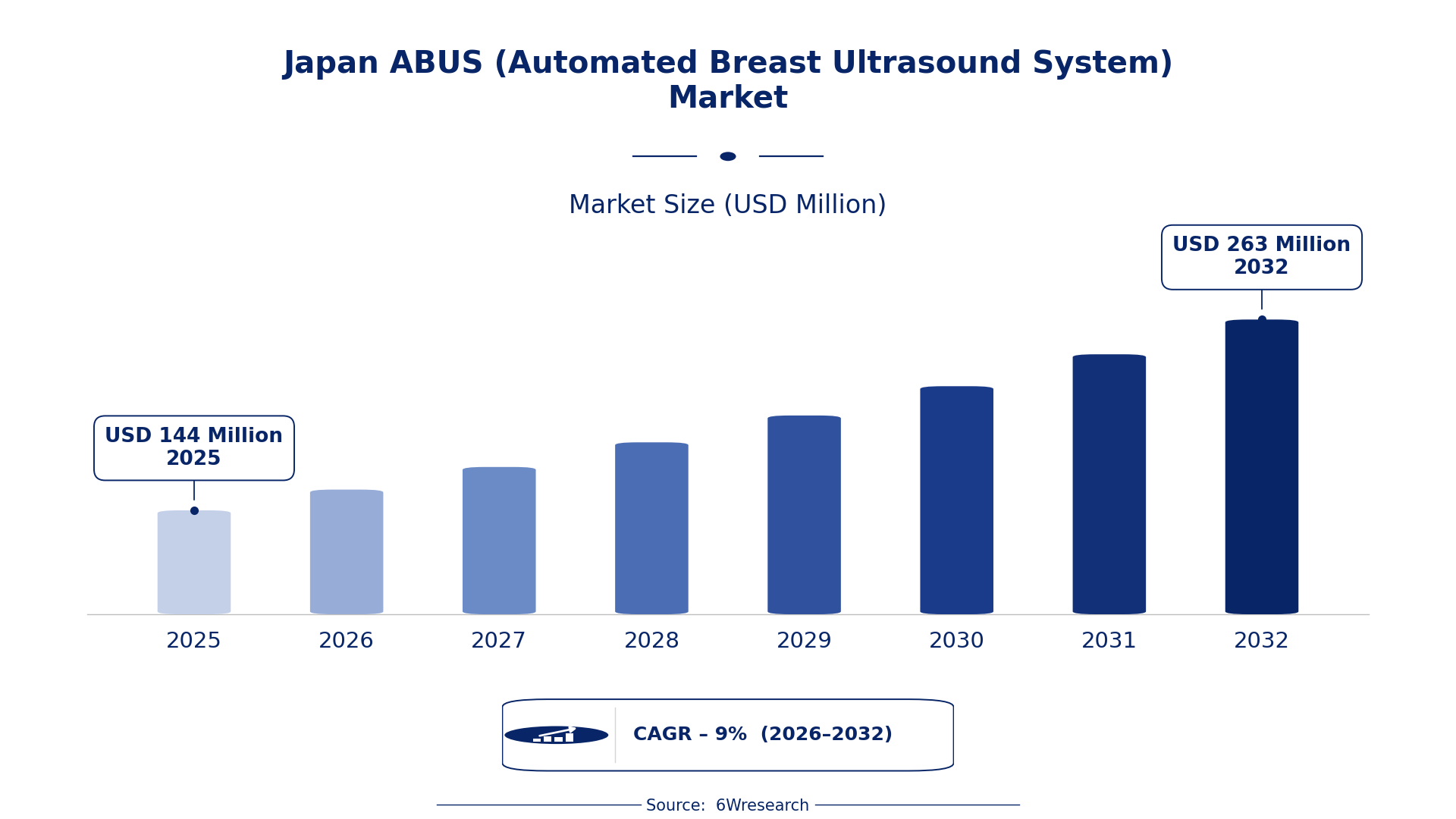
According to 6Wresearch internal database and industry insights, the Japan ABUS (Automated Breast Ultrasound System) Market was valued at USD 144 Million in 2025 and is projected to reach USD 263 Million by 2032, growing at a CAGR of approximately 9% during 2026–2032.
Japan ABUS (Automated Breast Ultrasound System) Market Highlights
| Report Metric | Details |
| Report Name | Japan ABUS (Automated Breast Ultrasound System) Market (2026-2032) |
| Market Size 2025 | USD 144 Million |
| Market Size 2032 | USD 263 Million |
| Absolute Growth 2025–2032 | USD 119 Million |
| CAGR 2026–2032 | 9% |
| Peak Annual Growth | 10.1% in 2027 |
| Forecast Period | 2026–2032 |
| Historical Data | 2022–2025 |
| Base Year | 2025 |
| Leading System Type, 2025 | 2D ABUS Systems (37% share) |
| Leading Imaging Technology, 2025 | Conventional Imaging (37% share) |
| Leading Distribution Channel, 2025 | Hospital Networks (32% share) |
| Leading End User, 2025 | Diagnostic Centers (53% share) |
| Fastest-Growing System Type | 3D ABUS Systems (12.9% CAGR) |
| Fastest-Growing Imaging Technology | Advanced Imaging (13.0% CAGR) |
| Fastest-Growing Distribution Channel | Direct Manufacturer Sales (11.8% CAGR) |
| Fastest-Growing End User | Breast Cancer Clinics (12.3% CAGR) |
| Growing Sector | breast cancer screening |
| Key End Users | diagnostic centers, hospitals, breast cancer clinics, healthcare providers |
Japan ABUS (Automated Breast Ultrasound System) Market Year-wise Growth Rate and Key Drivers (2022–2032)
This graph illustrates the annual growth rates of the market from 2022 to 2032, highlighting a steady upward trajectory and projected market expansion over the forecast period.
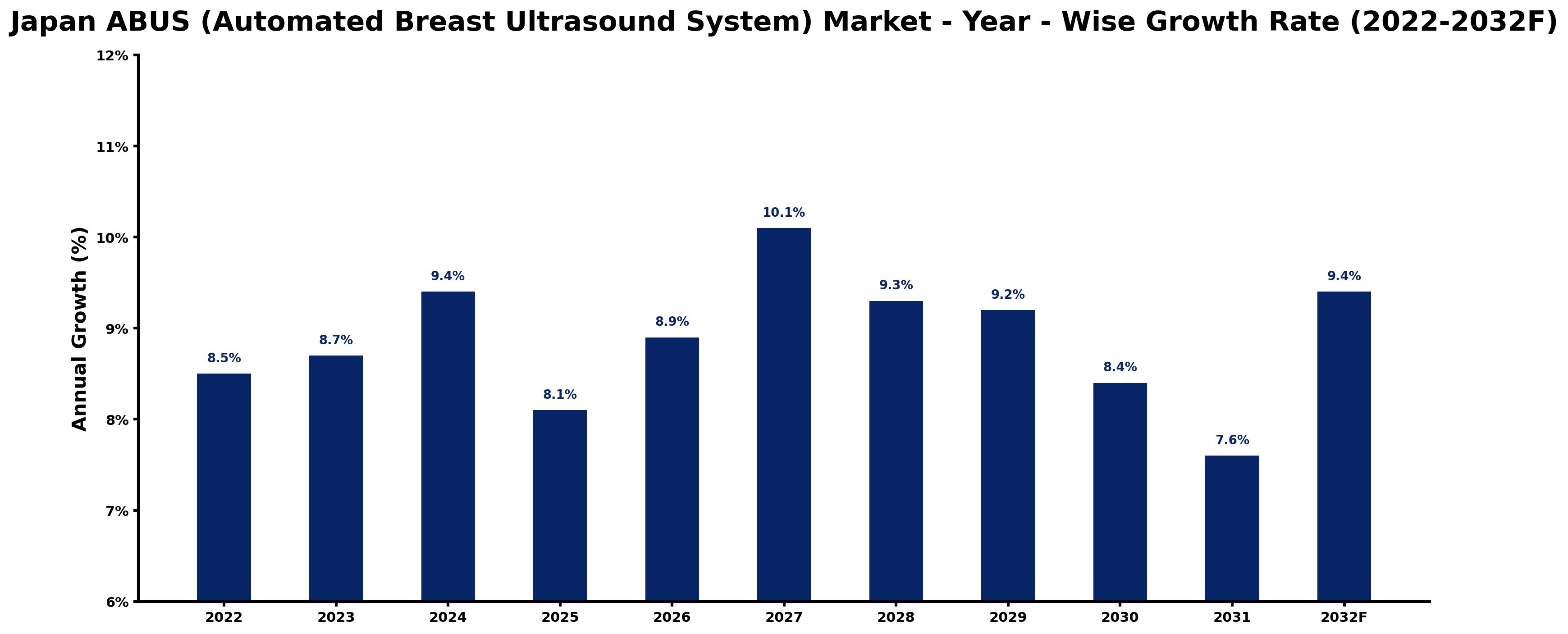
The yearly estimates that follow link every growth rate to its principal driver, so readers can see why the pace changed in each period.
| Year | Estimated Annual Growth (%) | Market Rationale |
| 2022 | 8.5 | The market showed steady growth due to increasing awareness of breast cancer screening. |
| 2023 | 8.7 | Demand rose as healthcare facilities expanded their diagnostic capabilities with advanced systems. |
| 2024 | 9.4 | Growth accelerated with heightened focus on early detection and improved imaging technologies. |
| 2025 | 8.1 | A slowdown occurred as new regulations were introduced affecting procurement processes. |
| 2026 | 8.9 | Demand is expected to increase as hospitals upgrade to more advanced imaging systems for better accuracy. |
| 2027 | 10.1 | The market is projected to peak due to a surge in breast cancer screenings and technological advancements. |
| 2028 | 9.3 | Growth is anticipated to slow as market saturation begins to impact new system installations. |
| 2029 | 9.2 | Demand will continue to slow as healthcare budgets face constraints amid economic pressures. |
| 2030 | 8.4 | The market is expected to experience further slowdown as competition intensifies among suppliers. |
| 2031 | 7.6 | Growth is projected to decelerate as the focus shifts towards cost-effective solutions in healthcare. |
| 2032 | 9.4 | Demand is expected to rebound with renewed investments in breast cancer screening initiatives. |
Note: Market size estimations and growth projections presented in this report are based on 6Wresearch's proprietary forecasting methodology, utilizing the latest available industry data, government publications, and primary research inputs.
Japan ABUS (Automated Breast Ultrasound System) Market Synopsis
ABUS (Automated Breast Ultrasound System) is a medical imaging technology that utilises ultrasound waves to create detailed images of breast tissue, aiding in the detection of abnormalities. The Japan ABUS (Automated Breast Ultrasound System) Market is expanding due to the increasing population aged 50 and above, which reached 35 million in 2023, alongside government initiatives that promote breast cancer screening. The allocation of ¥5 billion for cancer screening initiatives by the Japanese government in 2023 further stimulates demand from diagnostic centres and hospitals, improving their capabilities in early detection and diagnosis.
Market Dynamics Impact Analysis (2026–2032)
| Factor | Type | Impact | Primary Segment Affected |
| Growing population aged 50 and above driving demand for breast cancer screening | Driver | High | Diagnostic Centers |
| Advancements in imaging technology improving diagnostic accuracy | Driver | High | Advanced Imaging |
| Increasing investment in cancer screening initiatives by the government | Opportunity | High | Hospitals and Specialty Clinics |
| Rising demand for portable ABUS devices in rural health outreach | Opportunity | Medium | Portable ABUS Devices |
| High costs associated with advanced imaging systems limiting access | Restraint | High | Integrated ABUS Solutions |
| Market saturation impacting new system installations | Restraint | Medium | 2D ABUS Systems |
| Limited integration of AI technologies in existing systems | Challenge | High | AI-Based Imaging |
| Competition among suppliers leading to price wars | Challenge | Medium | Direct Manufacturer Sales |
Evaluation of Drivers in Japan ABUS (Automated Breast Ultrasound System) Market (2026–2032)
The following drivers explain most of the expected growth.
| Drivers | Primary Segment Affected | Why It Matters (Evidence) |
| Increasing breast cancer awareness | Diagnostic Centers | The number of diagnostic centers in Japan exceeds 1,000, driving demand for ABUS systems. |
| Technological advancements in imaging | Advanced Imaging | AI-based imaging technologies are gaining traction, improving diagnostic capabilities. |
| Government funding for cancer screening | Hospitals and Specialty Clinics | The Japanese government allocated ¥5 billion for cancer screening initiatives in 2023. |
| Growing elderly population | Breast Cancer Clinics | In 2023, the population aged 50 and above reached 35 million, increasing screening demand. |
| Investment in medical imaging technology | Integrated ABUS Solutions | The average annual investment in medical imaging technology in Japan is estimated at ¥1 trillion. |
Volumes grow on the back of rising awareness of breast cancer screening, particularly as the number of diagnostic centres utilising advanced imaging technology exceeds 1,000. The average annual investment in medical imaging technology is estimated at ¥1 trillion, prompting healthcare facilities to adopt more sophisticated systems. The population aged 50 and above reached 35 million in 2023, further driving the need for effective screening solutions. The rise of AI-based imaging technologies is transforming the market, improving diagnostic precision and efficiency.
Evaluation of Restraints in Japan ABUS (Automated Breast Ultrasound System) Market
The following restraints limit how fast demand can grow.
| Market Restraint | Primary Segment Affected | Why It Matters (Evidence) |
| High costs associated with advanced imaging systems | Integrated ABUS Solutions | The average lifespan of an ABUS system is approximately 7 years, requiring substantial investment for upgrades. |
| Market saturation impacting new system installations | 2D ABUS Systems | With over 1,000 diagnostic centers, the market faces challenges in finding new customers. |
| Limited integration of AI technologies in existing systems | AI-Based Imaging | Many facilities still rely on conventional imaging, which restricts the adoption of advanced technologies. |
| Regulatory hurdles affecting procurement processes | 3D ABUS Systems | New regulations have introduced complexities in the approval and purchasing of medical devices. |
| Economic pressures limiting healthcare budgets | Hospitals and Specialty Clinics | Rising operational costs are forcing facilities to reconsider their investment in new technologies. |
Japan ABUS (Automated Breast Ultrasound System) Market Challenges
Limited supply of advanced ABUS systems constrains production, as manufacturers depend on specific high-tech components sourced from a few countries. This situation can delay delivery times, causing hospitals to wait up to six months for new systems. Intense competition among diagnostic centres results in price wars, eroding profit margins for suppliers and leading to reduced investment in technology. Compliance with ISO 13485 increases operational complexity and costs for producers, potentially raising prices for hospitals. Rising operational costs, reflected in Japan's minimum wage increase to JPY 1,055, further strain budgets for clinics, limiting their ability to invest in new equipment.
Trends in the Japan ABUS (Automated Breast Ultrasound System) Market
These developments are changing demand patterns in the Japan ABUS (Automated Breast Ultrasound System) Market.
- Shift towards Advanced Imaging Technologies: Japan is moving towards advanced imaging technologies, particularly AI-based systems, which improve diagnostic capabilities. The adoption of these technologies increased by 20% in 2023, reflecting a growing trend among healthcare providers.
- Increase in Government Funding for Cancer Screening: The Japanese government allocated ¥5 billion for cancer screening initiatives in 2023, boosting funding for breast cancer detection programs. This investment is expected to enhance the availability of advanced imaging systems in diagnostic centres nationwide.
- Rising Adoption of Portable ABUS Devices: Portable ABUS devices are increasingly used in rural health outreach programs, expanding access to breast cancer screening. In 2023, the use of these devices rose by 15%, demonstrating their growing importance in underserved areas.
- Focus on Comprehensive Imaging Solutions: Integrated ABUS solutions are gaining traction as healthcare facilities seek comprehensive imaging capabilities. The trend is evident in the Tokyo region, where hospitals are investing in these systems to improve patient care.
Investment Opportunities in the Japan ABUS (Automated Breast Ultrasound System) Market
Below are the investment opportunities with the strongest case in the Japan ABUS (Automated Breast Ultrasound System) Market.
- Supply of Advanced Imaging Systems: There is a strong opportunity to supply advanced imaging systems, particularly AI-based technologies, to healthcare facilities. The increasing number of diagnostic centres in Japan, exceeding 1,000, presents a significant market for suppliers.
- Investment in Cancer Screening Initiatives: With the Japanese government allocating ¥5 billion for cancer screening initiatives, there is an opportunity for suppliers to engage with hospitals and specialty clinics. Establishing partnerships with local healthcare providers can facilitate market entry.
- Demand for Portable ABUS Devices: The rising need for portable ABUS devices in rural health outreach programs offers a promising opportunity. Suppliers can target rural health units, forming local partnerships to enhance distribution.
- Expansion of Breast Cancer Clinics: The growth of breast cancer clinics across Japan presents an opportunity for suppliers to provide integrated ABUS solutions. Collaborating with these clinics can enhance market penetration.
Government Initiatives in the Japan ABUS (Automated Breast Ultrasound System) Market
The AI Promotion Act (2025) supports the integration of AI into medical imaging technologies, which improves the effectiveness of systems like ABUS. This law complements existing regulations, ensuring that healthcare providers can effectively incorporate AI into their systems, thus improving diagnostic accuracy and patient outcomes. Additionally, Japan's commitment to advancing healthcare technology aligns with the need for new solutions in breast cancer detection.
In 2023, the Japanese government allocated ¥5 billion for cancer screening initiatives, administered by the Ministry of Health. This funding supports the expansion of breast cancer screening programs, enabling diagnostic centres to enhance their imaging capabilities and reach more patients.
Future Insight of the Japan ABUS (Automated Breast Ultrasound System) Market
Japan's commitment to decarbonisation will drive a shift towards more energy-efficient ABUS systems by 2032, prompting suppliers to innovate. The government’s allocation of ¥5 billion for cancer screening initiatives will likely improve access to advanced imaging technologies across hospitals and clinics. As the population aged 50 and above grows, demand for breast cancer detection will increase, pushing producers to expand their offerings. Portable ABUS devices will see greater adoption in rural health outreach programs, improving detection capabilities in underserved areas.
Market Segmentation Analysis
Japan ABUS (Automated Breast Ultrasound System) Market report covers a detailed analysis of the following market segments:
By System Type – 2D ABUS Systems Lead, 3D ABUS Systems Expected to Grow Fastest
According to Saurav Kr Singh, Senior Research Analyst at 6Wresearch, 2D ABUS Systems took 37% of system type revenue in 2025, more than any other category. 2D ABUS Systems dominate the market due to their established presence in over 1,000 diagnostic centers across Japan, making them essential for breast imaging. Their widespread use in routine screenings, particularly in urban areas like Tokyo, solidifies their dominant position. Over 2026–2032, 3D ABUS Systems are expected to post the fastest growth, at a CAGR of 12.9%. 3D ABUS Systems are experiencing rapid growth as they enhance imaging accuracy, crucial for effective breast cancer detection. The increasing adoption of these systems reflects healthcare facilities' commitment to improving diagnostic capabilities with advanced technology. Suppliers should focus on developing and promoting 3D systems to meet the rising demand.
By Imaging Technology – Conventional Imaging Leads, Advanced Imaging Expected to Grow Fastest
The largest imaging technology category in 2025 was Conventional Imaging, at 37% of revenue. Conventional Imaging holds the largest share as it is widely used alongside ABUS systems, ensuring comprehensive breast cancer screening. Its integration into existing workflows in diagnostic centers reinforces its status as a trusted method for imaging. Advanced Imaging is projected to grow fastest, at a CAGR of 13.0% during 2026–2032. Advanced Imaging is growing quickly due to its ability to improve diagnostic capabilities, which is increasingly important as the population ages. The push for better screening methods drives facilities to invest in these advanced technologies. Suppliers must prioritise the development of advanced imaging solutions to align with the market's shift towards improved diagnostic accuracy.
By Distribution Channel – Hospital Networks Lead, Direct Manufacturer Sales Expected to Grow Fastest
Hospital Networks held 32% of the Japan ABUS (Automated Breast Ultrasound System) Market by distribution channel in 2025. Hospital Networks dominate the distribution channel as they are the primary users of ABUS systems, providing essential services in breast cancer screening. Their extensive reach and established infrastructure facilitate the widespread use of these technologies. Direct Manufacturer Sales is set to record the highest CAGR in this split, 11.8% over 2026–2032. Direct Manufacturer Sales are expanding rapidly as manufacturers seek to establish closer relationships with healthcare providers, ensuring timely delivery and support. This trend is propelled by the need for efficient distribution and direct engagement with end-users. Suppliers should consider strengthening direct sales strategies to enhance customer relationships and streamline distribution.
By End User – Diagnostic Centers Lead, Breast Cancer Clinics Expected to Grow Fastest
Diagnostic Centers accounted for 53% of the market by end user in 2025. Diagnostic Centers represent the largest end-user group, utilising ABUS systems extensively for breast cancer screening. Their crucial role in the healthcare system positions them as key players in the adoption of these technologies. The quickest growth will come from Breast Cancer Clinics, forecast to expand at a CAGR of 12.3% between 2026 and 2032. Breast Cancer Clinics are witnessing the fastest growth as they specialise in diagnosis and treatment, driving demand for advanced imaging solutions. The increasing focus on targeted breast cancer care propels these clinics to invest in state-of-the-art systems. This growth suggests that suppliers should tailor their offerings to meet the specific needs of breast cancer clinics.
Key Attractiveness of the Report
- 10 Years of Market Numbers
- Historical Data Starting from 2022 to 2025
- Base Year 2025
- Forecast Data until 2032
- Key Performance Indicators Impacting the Market
- Major Upcoming Developments and Projects
Key Highlights of the Report:
- Japan ABUS (Automated Breast Ultrasound System) Market Outlook
- Market Size of Japan ABUS (Automated Breast Ultrasound System) Market, 2025
- Forecast of Japan ABUS (Automated Breast Ultrasound System) Market, 2032
- Historical Data and Forecast of Japan ABUS (Automated Breast Ultrasound System) Revenues & Volume for the Period 2022-2032F
- Japan ABUS (Automated Breast Ultrasound System) Market Trend Evolution
- Japan ABUS (Automated Breast Ultrasound System) Market Drivers and Challenges
- Japan ABUS (Automated Breast Ultrasound System) Price Trends
- Japan ABUS (Automated Breast Ultrasound System) Porter's Five Forces
- Japan ABUS (Automated Breast Ultrasound System) Industry Life Cycle
- Historical Data and Forecast of Japan ABUS (Automated Breast Ultrasound System) Market Revenues & Volume By System Type for the Period 2022-2032F
- Historical Data and Forecast of Japan ABUS (Automated Breast Ultrasound System) Market Revenues & Volume By 2D ABUS Systems for the Period 2022-2032F
- Historical Data and Forecast of Japan ABUS (Automated Breast Ultrasound System) Market Revenues & Volume By 3D ABUS Systems for the Period 2022-2032F
- Historical Data and Forecast of Japan ABUS (Automated Breast Ultrasound System) Market Revenues & Volume By Portable ABUS Devices for the Period 2022-2032F
- Historical Data and Forecast of Japan ABUS (Automated Breast Ultrasound System) Market Revenues & Volume By Integrated ABUS Solutions for the Period 2022-2032F
- Historical Data and Forecast of Japan ABUS (Automated Breast Ultrasound System) Market Revenues & Volume By Imaging Technology for the Period 2022-2032F
- Historical Data and Forecast of Japan ABUS (Automated Breast Ultrasound System) Market Revenues & Volume By Conventional Imaging for the Period 2022-2032F
- Historical Data and Forecast of Japan ABUS (Automated Breast Ultrasound System) Market Revenues & Volume By Advanced Imaging for the Period 2022-2032F
- Historical Data and Forecast of Japan ABUS (Automated Breast Ultrasound System) Market Revenues & Volume By Handheld Units for the Period 2022-2032F
- Historical Data and Forecast of Japan ABUS (Automated Breast Ultrasound System) Market Revenues & Volume By AI-Based Imaging for the Period 2022-2032F
- Historical Data and Forecast of Japan ABUS (Automated Breast Ultrasound System) Market Revenues & Volume By Distribution Channel for the Period 2022-2032F
- Historical Data and Forecast of Japan ABUS (Automated Breast Ultrasound System) Market Revenues & Volume By Hospital Networks for the Period 2022-2032F
- Historical Data and Forecast of Japan ABUS (Automated Breast Ultrasound System) Market Revenues & Volume By Direct Manufacturer Sales for the Period 2022-2032F
- Historical Data and Forecast of Japan ABUS (Automated Breast Ultrasound System) Market Revenues & Volume By Medical Equipment Dealers for the Period 2022-2032F
- Historical Data and Forecast of Japan ABUS (Automated Breast Ultrasound System) Market Revenues & Volume By Online Platforms for the Period 2022-2032F
- Historical Data and Forecast of Japan ABUS (Automated Breast Ultrasound System) Market Revenues & Volume By End User for the Period 2022-2032F
- Historical Data and Forecast of Japan ABUS (Automated Breast Ultrasound System) Market Revenues & Volume By Diagnostic Centers for the Period 2022-2032F
- Historical Data and Forecast of Japan ABUS (Automated Breast Ultrasound System) Market Revenues & Volume By Breast Cancer Clinics for the Period 2022-2032F
- Historical Data and Forecast of Japan ABUS (Automated Breast Ultrasound System) Market Revenues & Volume By Mobile Health Units for the Period 2022-2032F
- Historical Data and Forecast of Japan ABUS (Automated Breast Ultrasound System) Market Revenues & Volume By Hospitals and Specialty Clinics for the Period 2022-2032F
- Japan ABUS (Automated Breast Ultrasound System) Import Export Trade Statistics
- Market Opportunity Assessment By System Type
- Market Opportunity Assessment By Imaging Technology
- Market Opportunity Assessment By Distribution Channel
- Market Opportunity Assessment By End User
- Japan ABUS (Automated Breast Ultrasound System) Top Companies Market Share
- Japan ABUS (Automated Breast Ultrasound System) Competitive Benchmarking By Technical and Operational Parameters
- Japan ABUS (Automated Breast Ultrasound System) Company Profiles
- Japan ABUS (Automated Breast Ultrasound System) Key Strategic Recommendations
Market Covered
Segments analysed in this report are listed below.
By System Type
- 2D ABUS Systems
- 3D ABUS Systems
- Portable ABUS Devices
- Integrated ABUS Solutions
By Imaging Technology
- Conventional Imaging
- Advanced Imaging
- Handheld Units
- AI-Based Imaging
By Distribution Channel
- Hospital Networks
- Direct Manufacturer Sales
- Medical Equipment Dealers
- Online Platforms
By End User
- Diagnostic Centers
- Breast Cancer Clinics
- Mobile Health Units
- Hospitals and Specialty Clinics































