Japan Academic Integrity Software Market Size & Growth Rate
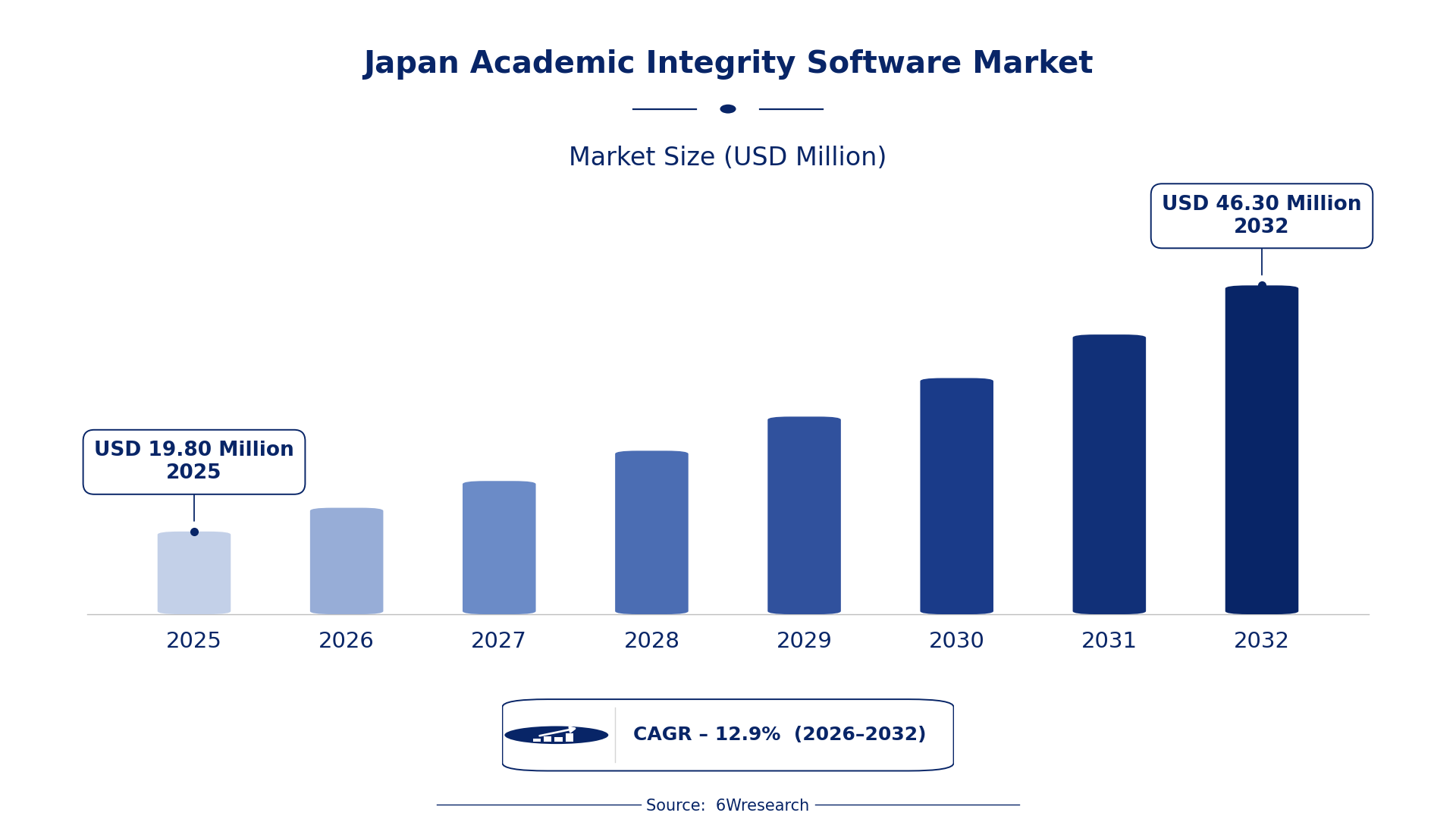
According to 6Wresearch internal database and industry insights, the Japan Academic Integrity Software Market was valued at USD 19.80 Million in 2025 and is projected to reach USD 46.30 Million by 2032, growing at a CAGR of approximately 12.9% during 2026–2032.
Japan Academic Integrity Software Market Highlights
| Report Metric | Details |
| Report Name | Japan Academic Integrity Software Market (2026-2032) |
| Market Size 2025 | USD 19.80 Million |
| Market Size 2032 | USD 46.30 Million |
| Absolute Growth 2025–2032 | USD 26.50 Million |
| CAGR 2026–2032 | 12.9% |
| Peak Annual Growth | 13.6% in 2027 |
| Forecast Period | 2026–2032 |
| Historical Data | 2022–2025 |
| Base Year | 2025 |
| Leading Software Type, 2025 | Plagiarism Detection (48% share) |
| Leading Deployment Model, 2025 | Cloud-Based (42% share) |
| Leading Distribution Channel, 2025 | Direct Sales (42% share) |
| Leading End User, 2025 | Universities (38% share) |
| Fastest-Growing Software Type | AI-Driven Proctoring (18.8% CAGR) |
| Fastest-Growing Deployment Model | SaaS (18.9% CAGR) |
| Fastest-Growing Distribution Channel | Online Subscriptions (17.7% CAGR) |
| Fastest-Growing End User | Online Learning Platforms (17.0% CAGR) |
| Growing Sector | Educational Institutions |
| Key End Users | Universities, Online Learning Platforms, Research Institutions, Testing Agencies |
Japan Academic Integrity Software Market Year-wise Growth Rate and Key Drivers (2022–2032)
This graph illustrates the annual growth rates of the market from 2022 to 2032, highlighting a steady upward trajectory and projected market expansion over the forecast period.
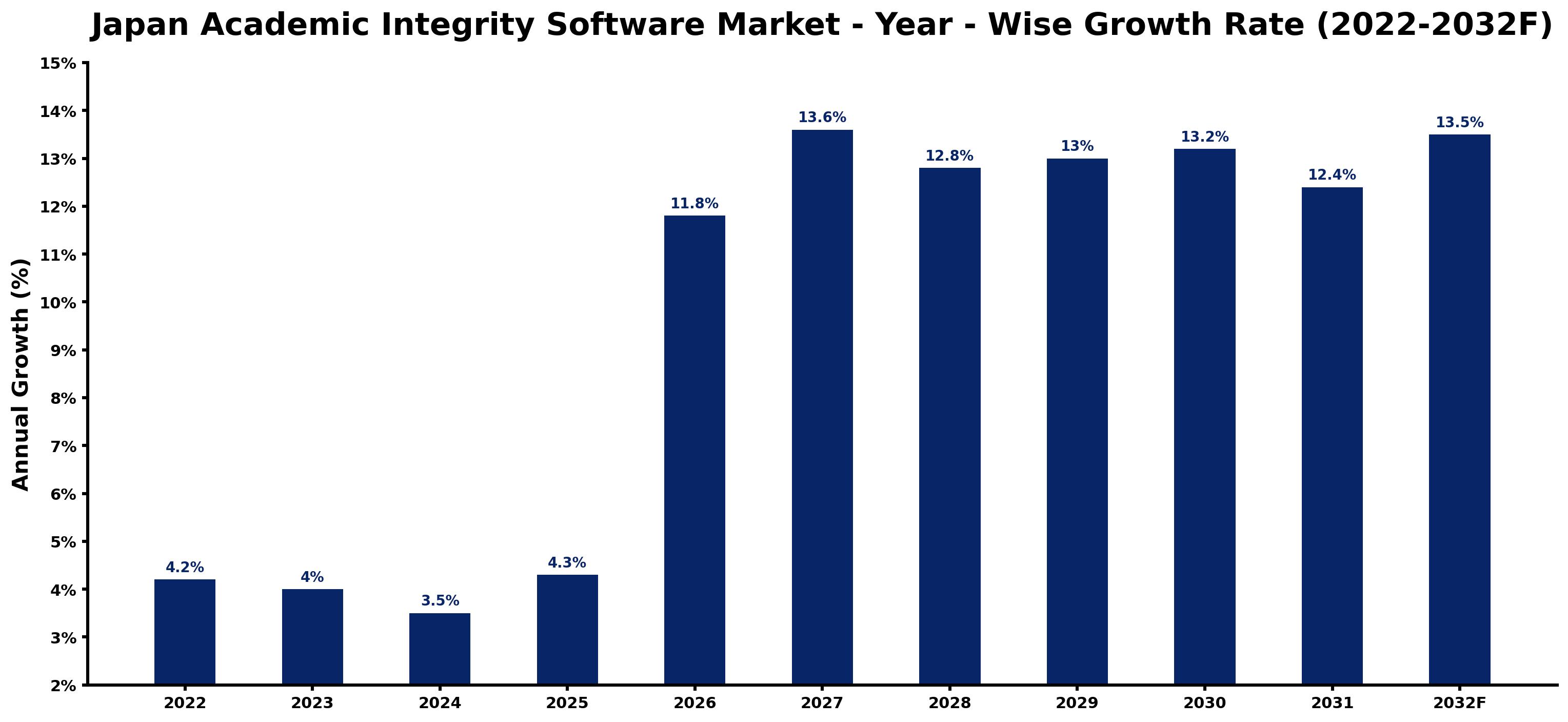
Annual growth estimates for each year appear below with the principal reason behind them, explaining the shifts that set the pace of the market.
| Year | Estimated Annual Growth (%) | Market Rationale |
| 2022 | 4.2 | The market experienced steady growth, reflecting ongoing investments in academic integrity solutions. |
| 2023 | 4.0 | Growth slowed slightly due to market saturation among existing buyers and limited new entrants. |
| 2024 | 3.5 | A further slowdown occurred as institutions focused on budget constraints and existing software capabilities. |
| 2025 | 4.3 | Growth accelerated as universities began adopting new plagiarism detection systems to enhance academic integrity. |
| 2026 | 11.8 | Demand surged as educational institutions increased investments in AI-driven proctoring for remote assessments. |
| 2027 | 13.6 | The peak growth year saw heightened adoption of cloud-based solutions across universities and online platforms. |
| 2028 | 12.8 | Growth slowed slightly as the market began to stabilise after rapid expansion in previous years. |
| 2029 | 13.0 | Demand increased again as online learning platforms expanded, requiring more integrity software solutions. |
| 2030 | 13.2 | Continued growth was driven by the integration of advanced algorithms in academic integrity tools. |
| 2031 | 12.4 | A slight slowdown occurred as the market matured and competition intensified among software providers. |
| 2032 | 13.5 | Growth rebounded as institutions prioritised integrity measures amid rising concerns over academic misconduct. |
Note: Market size estimations and growth projections presented in this report are based on 6Wresearch's proprietary forecasting methodology, utilizing the latest available industry data, government publications, and primary research inputs.
Japan Academic Integrity Software Market Synopsis
Academic Integrity Software includes tools that ensure ethical standards in education by preventing plagiarism and verifying authorship. The primary users are universities, online learning platforms, and research institutions. The market is expanding due to rising adoption of cloud-based solutions, the growth of online education, and an increased emphasis on maintaining academic integrity. In 2023, over 1,200 universities in Japan utilised such software, indicating strong demand for these solutions.
Market Dynamics Impact Analysis (2026–2032)
| Factor | Type | Impact | Primary Segment Affected |
| Increasing adoption of cloud-based solutions among educational institutions | Driver | High | Cloud-Based |
| Growing demand for AI-driven proctoring in remote assessments | Driver | High | AI-Driven Proctoring |
| Expansion of online learning platforms requiring integrity solutions | Opportunity | High | Online Learning Platforms |
| Rising number of universities seeking to enhance academic integrity | Opportunity | High | Universities |
| Budget constraints limiting software investments in smaller institutions | Restraint | Medium | Universities |
| Concerns over data privacy affecting software adoption rates | Restraint | Medium | Cloud-Based |
| Competition among software providers leading to price wars | Challenge | High | Plagiarism Detection |
| Rapid technological advancements requiring constant updates | Challenge | Medium | Plagiarism Detection |
Evaluation of Drivers in Japan Academic Integrity Software Market (2026–2032)
The following drivers explain most of the expected growth.
| Drivers | Primary Segment Affected | Why It Matters (Evidence) |
| Increased investment in cloud-based solutions by universities | Cloud-Based | Cloud-based solutions account for 60% of the market, enabling easier access and scalability for institutions. |
| Growing use of AI-driven proctoring in online assessments | AI-Driven Proctoring | Research institutions are increasingly adopting AI-driven proctoring, improving security and integrity during examinations, with a 30% rise in usage. |
| Rising number of online learning platforms | Online Learning Platforms | The number of online learning platforms surged by 25% since 2021, driving demand for integrity solutions. |
| Implementation of new plagiarism detection systems | Plagiarism Detection | The University of Tokyo implemented a new plagiarism detection system in 2023, reflecting growing institutional focus on integrity. |
| Support from educational technology associations | EdTech Distributors | The Japan Association of Educational Technology supports integration of academic integrity software in schools, boosting market growth. |
Behind the steady rise in orders sits increased investment in cloud-based solutions by universities, which account for 60% of the market. The number of online learning platforms surged by 25% since 2021, driving demand for integrity solutions. Research institutions are increasingly adopting AI-driven proctoring in remote assessments, improving security during examinations. The implementation of new plagiarism detection systems, such as that by the University of Tokyo in 2023, underscores the focus on maintaining academic integrity, while support from educational technology associations further promotes the adoption of these tools across educational institutions.
Evaluation of Restraints in Japan Academic Integrity Software Market
The main factors holding the market back are set out below.
| Market Restraint | Primary Segment Affected | Why It Matters (Evidence) |
| Budget constraints limiting software investments in smaller institutions | Universities | Many smaller universities face budget limitations, restricting their ability to invest in new integrity software. |
| Concerns over data privacy affecting software adoption rates | Cloud-Based | Data privacy concerns have led some institutions to hesitate in adopting cloud-based academic integrity solutions. |
| Limited awareness of available software options among educators | Plagiarism Detection | Many educators are unaware of the latest academic integrity software, limiting market penetration. |
| Resistance to change from traditional assessment methods | Exam Monitoring Tools | Some institutions resist adopting new exam monitoring tools, preferring established methods despite their limitations. |
| Integration challenges with existing systems | SaaS | Integrating new SaaS solutions with existing educational systems can be complex, deterring potential buyers. |
Japan Academic Integrity Software Market Challenges
High development costs for academic integrity software hinder market expansion, as educational institutions often face budget constraints. Buyers in universities experience implementation delays, with integration complexities potentially extending timelines by up to six months. Technological disparities arise, as not all institutions can access the latest features, limiting their effectiveness in addressing academic misconduct. Increased competition among software providers has triggered price wars, which can compromise quality and support services for buyers, ultimately reducing user satisfaction and trust in these solutions.
Trends in the Japan Academic Integrity Software Market
The shifts below are changing how Japan Academic Integrity Software Market products are bought and supplied.
- Shift from Traditional to AI-Driven Proctoring: Since 2023, educational institutions have increasingly adopted AI-driven proctoring solutions, which improve security during online assessments. Research institutions report a 30% increase in AI-driven proctoring usage.
- Transition from On-Premise to Cloud-Based Solutions: The market has experienced a notable shift towards cloud-based solutions, which now account for 60% of the market. This change reflects the need for scalability and ease of access among educational institutions.
- Emergence of Subscription-Based Models: The rise of online subscriptions for academic integrity software has become prominent, with a projected 17.7% CAGR for the segment. This trend is driven by universities seeking flexible payment options for software.
- Increased Focus on Plagiarism Detection: Since 2023, the emphasis on plagiarism detection has intensified, with universities implementing new systems to combat academic misconduct. The University of Tokyo's recent system implementation illustrates this trend.
Investment Opportunities in the Japan Academic Integrity Software Market
Investors looking at the Japan Academic Integrity Software Market should consider the following areas.
- Partnerships with Educational Institutions: By forming partnerships with universities, suppliers can tap into the growing demand for academic integrity software, projected to reach USD 46.30 million by 2032. Collaborating with institutions in the Tokyo region can facilitate market entry.
- Investment in AI-Driven Solutions: With the increasing adoption of AI technologies, there is an opportunity to develop advanced proctoring solutions. Research institutions are particularly interested in these tools, which can improve security during assessments.
- Focus on Data Privacy Solutions: As concerns over data privacy rise, developing software that addresses these issues presents a timely opportunity. Institutions are looking for solutions that comply with regulations while ensuring user data protection.
- Expansion into Online Learning Platforms: The growing number of online learning platforms creates an opportunity to supply tailored integrity solutions. With a 25% increase in platforms since 2021, suppliers can enter this expanding market effectively.
Government Initiatives in the Japan Academic Integrity Software Market
The Act on Japanese Industrial Standards (1949; amended in 2019) governs product and test standards for academic integrity software. This law requires compliance with established standards, ensuring quality and reliability in software development, which benefits both producers and buyers. The AI Promotion Act (2025) establishes a national framework for AI research, development, and use, encouraging educational institutions to adopt AI-driven solutions that improve academic integrity practices.
The Digital Agency leads government digital transformation initiatives and sets common system standards. This agency approves funding for projects aimed at enhancing digital education tools in schools, promoting the integration of academic integrity software across various educational institutions.
Future Insight of the Japan Academic Integrity Software Market
Educational institutions will increasingly implement advanced algorithms to improve plagiarism detection by 2032. The integration of cloud-based solutions will enhance accessibility for approximately 3 million university students, enabling real-time monitoring of academic integrity. A government initiative aimed at enhancing digital education tools will drive further investment in these technologies. The adoption of ISO 9001 standards in software development will promote higher quality and reliability in integrity solutions, benefiting both buyers and suppliers.
Market Segmentation Analysis
Japan Academic Integrity Software Market report covers a detailed analysis of the following market segments:
By Software Type – Plagiarism Detection Leads, AI-Driven Proctoring Expected to Grow Fastest
According to Saurav Kr Singh, Senior Research Analyst at 6Wresearch, with 48% of software type revenue in 2025, Plagiarism Detection was the largest category. Plagiarism detection holds the largest share due to its essential role in ensuring originality within Japan's extensive university network. This method is widely adopted by institutions aiming to uphold academic integrity standards. AI-Driven Proctoring is set to record the highest CAGR in this split, 18.8% over 2026–2032. AI-driven proctoring is experiencing rapid growth, driven by the 25% increase in online learning platforms since 2021. This trend indicates a rising need for secure assessment solutions in the expanding online education sector. Suppliers should focus on enhancing plagiarism detection capabilities to meet the ongoing demand from educational institutions.
By Deployment Model – Cloud-Based Leads, SaaS Expected to Grow Fastest
Cloud-Based accounted for 42% of the market by deployment model in 2025. Cloud-based solutions dominate the market due to their accessibility and scalability, which are vital for institutions managing large numbers of users. This model allows universities to implement software efficiently without heavy infrastructure investments. The quickest growth will come from SaaS, forecast to expand at a CAGR of 18.9% between 2026 and 2032. SaaS is experiencing the fastest growth as it provides flexibility and cost-effective subscription models that appeal to educational institutions. This trend indicates a shift towards more adaptable software solutions in the education sector. Buyers should consider SaaS options to access the latest features while minimising upfront costs.
By Distribution Channel – Direct Sales Leads, Online Subscriptions Expected to Grow Fastest
The largest distribution channel category in 2025 was Direct Sales, at 42% of revenue. Direct sales dominate the market as they enable suppliers to provide tailored solutions that address the specific needs of educational institutions. This method fosters strong relationships and ensures customer satisfaction throughout the distribution process. Online Subscriptions are projected to grow fastest, at a CAGR of 17.7% during 2026–2032. Online subscriptions are witnessing rapid growth, as they offer continuous access to software updates and support that align with modern educational practices. This shift reflects a broader trend towards flexible purchasing options in the market. Suppliers should consider expanding their online subscription models to accommodate the increasing preference for flexible access.
By End User – Universities Lead, Online Learning Platforms Expected to Grow Fastest
In 2025, Universities led the end user split with a 38% share. Universities represent the largest user base for academic integrity tools, driven by the necessity to uphold ethical standards in a competitive academic landscape. With around 3 million university students, the demand for these solutions is substantial and consistent. Over 2026–2032, Online Learning Platforms are expected to post the fastest growth, at a CAGR of 17.0%. Online learning platforms are the fastest-growing segment, reflecting the significant expansion of digital education, which has increased by 25% since 2021. This growth highlights the increasing reliance on technology for educational delivery and assessment. Suppliers must tailor their offerings to meet the unique needs of online learning platforms as they become a vital segment in the market.
Key Attractiveness of the Report
- 10 Years of Market Numbers
- Historical Data Starting from 2022 to 2025
- Base Year 2025
- Forecast Data until 2032
- Key Performance Indicators Impacting the Market
- Major Upcoming Developments and Projects
Key Highlights of the Report:
- Japan Academic Integrity Software Market Outlook
- Market Size of Japan Academic Integrity Software Market, 2025
- Forecast of Japan Academic Integrity Software Market, 2032
- Historical Data and Forecast of Japan Academic Integrity Software Revenues & Volume for the Period 2022-2032F
- Japan Academic Integrity Software Market Trend Evolution
- Japan Academic Integrity Software Market Drivers and Challenges
- Japan Academic Integrity Software Price Trends
- Japan Academic Integrity Software Porter's Five Forces
- Japan Academic Integrity Software Industry Life Cycle
- Historical Data and Forecast of Japan Academic Integrity Software Market Revenues & Volume By Software Type for the Period 2022-2032F
- Historical Data and Forecast of Japan Academic Integrity Software Market Revenues & Volume By Plagiarism Detection for the Period 2022-2032F
- Historical Data and Forecast of Japan Academic Integrity Software Market Revenues & Volume By Exam Monitoring Tools for the Period 2022-2032F
- Historical Data and Forecast of Japan Academic Integrity Software Market Revenues & Volume By Authorship Verification for the Period 2022-2032F
- Historical Data and Forecast of Japan Academic Integrity Software Market Revenues & Volume By AI-Driven Proctoring for the Period 2022-2032F
- Historical Data and Forecast of Japan Academic Integrity Software Market Revenues & Volume By Deployment Model for the Period 2022-2032F
- Historical Data and Forecast of Japan Academic Integrity Software Market Revenues & Volume By Cloud-Based for the Period 2022-2032F
- Historical Data and Forecast of Japan Academic Integrity Software Market Revenues & Volume By On-Premise for the Period 2022-2032F
- Historical Data and Forecast of Japan Academic Integrity Software Market Revenues & Volume By SaaS for the Period 2022-2032F
- Historical Data and Forecast of Japan Academic Integrity Software Market Revenues & Volume By Hybrid for the Period 2022-2032F
- Historical Data and Forecast of Japan Academic Integrity Software Market Revenues & Volume By Distribution Channel for the Period 2022-2032F
- Historical Data and Forecast of Japan Academic Integrity Software Market Revenues & Volume By Direct Sales for the Period 2022-2032F
- Historical Data and Forecast of Japan Academic Integrity Software Market Revenues & Volume By EdTech Distributors for the Period 2022-2032F
- Historical Data and Forecast of Japan Academic Integrity Software Market Revenues & Volume By Online Subscriptions for the Period 2022-2032F
- Historical Data and Forecast of Japan Academic Integrity Software Market Revenues & Volume By Partner Networks for the Period 2022-2032F
- Historical Data and Forecast of Japan Academic Integrity Software Market Revenues & Volume By End User for the Period 2022-2032F
- Historical Data and Forecast of Japan Academic Integrity Software Market Revenues & Volume By Universities for the Period 2022-2032F
- Historical Data and Forecast of Japan Academic Integrity Software Market Revenues & Volume By Online Learning Platforms for the Period 2022-2032F
- Historical Data and Forecast of Japan Academic Integrity Software Market Revenues & Volume By Research Institutions for the Period 2022-2032F
- Historical Data and Forecast of Japan Academic Integrity Software Market Revenues & Volume By Testing Agencies for the Period 2022-2032F
- Japan Academic Integrity Software Import Export Trade Statistics
- Market Opportunity Assessment By Software Type
- Market Opportunity Assessment By Deployment Model
- Market Opportunity Assessment By Distribution Channel
- Market Opportunity Assessment By End User
- Japan Academic Integrity Software Top Companies Market Share
- Japan Academic Integrity Software Competitive Benchmarking By Technical and Operational Parameters
- Japan Academic Integrity Software Company Profiles
- Japan Academic Integrity Software Key Strategic Recommendations
Market Covered
The study includes the following segmentation.
By Software Type
- Plagiarism Detection
- Exam Monitoring Tools
- Authorship Verification
- AI-Driven Proctoring
By Deployment Model
- Cloud-Based
- On-Premise
- SaaS
- Hybrid
By Distribution Channel
- Direct Sales
- EdTech Distributors
- Online Subscriptions
- Partner Networks
By End User
- Universities
- Online Learning Platforms
- Research Institutions
- Testing Agencies































