Japan Accounting Automation Market Size & Growth Rate
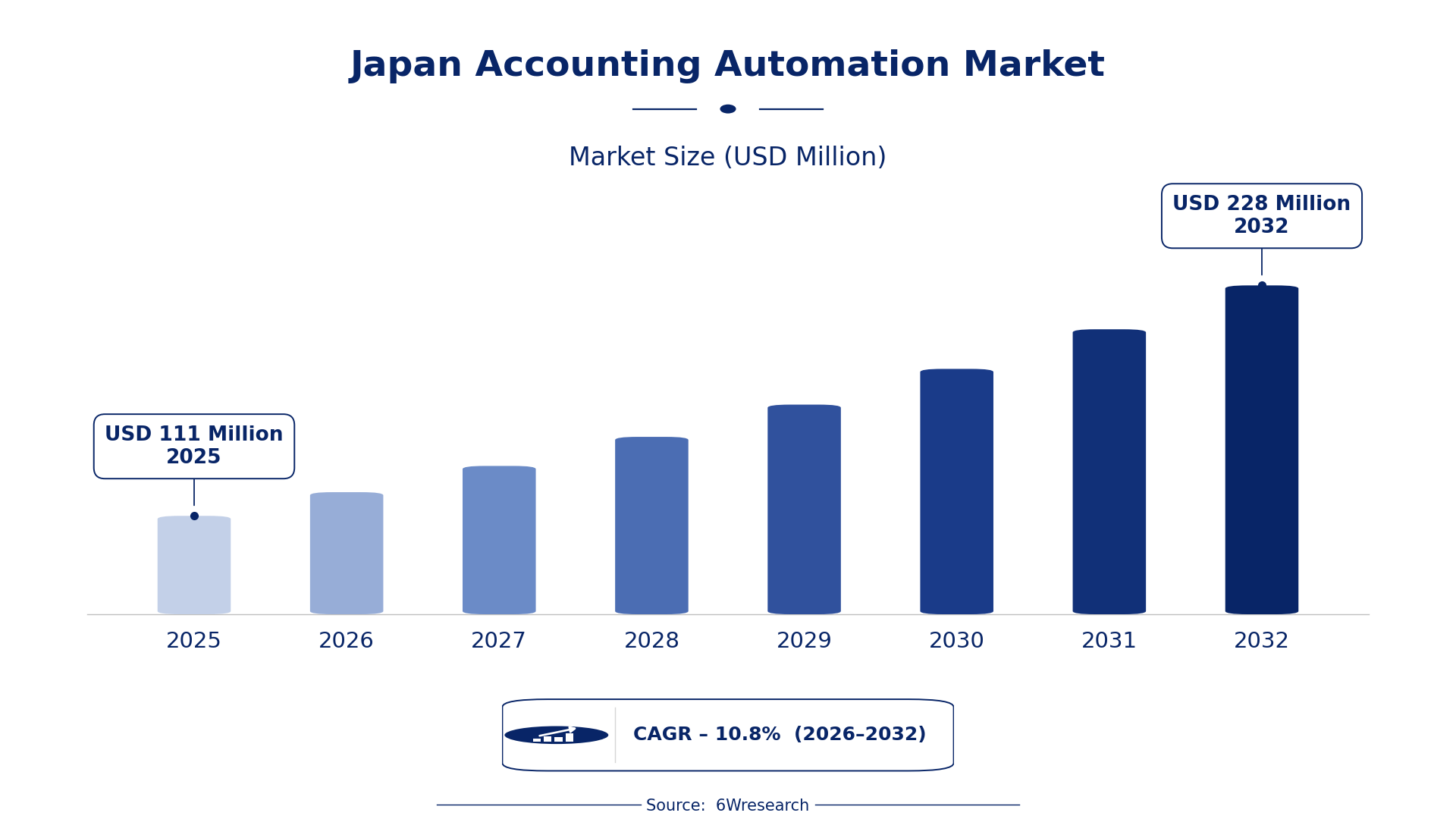
According to 6Wresearch internal database and industry insights, the Japan Accounting Automation Market was valued at USD 111 Million in 2025 and is projected to reach USD 228 Million by 2032, growing at a CAGR of approximately 10.8% during 2026–2032.
Japan Accounting Automation Market Highlights
| Report Metric | Details |
| Report Name | Japan Accounting Automation Market (2026-2032) |
| Market Size 2025 | USD 111 Million |
| Market Size 2032 | USD 228 Million |
| Absolute Growth 2025–2032 | USD 117 Million |
| CAGR 2026–2032 | 10.8% |
| Peak Annual Growth | 12.5% in 2026 |
| Forecast Period | 2026–2032 |
| Historical Data | 2022–2025 |
| Base Year | 2025 |
| Leading Solution Type, 2025 | Invoice Automation (40% share) |
| Leading Technology Used, 2025 | Cloud (46% share) |
| Leading Functionality Area, 2025 | Accounts Payable (42% share) |
| Leading End User, 2025 | Banking Institutions (50% share) |
| Leading Distribution Channel, 2025 | Direct Sales (40% share) |
| Fastest-Growing Solution Type | Expense Management (15.0% CAGR) |
| Fastest-Growing Technology Used | AI & OCR (15.3% CAGR) |
| Fastest-Growing End User | Financial Institutions (13.3% CAGR) |
| Fastest-Growing Distribution Channel | Online Platforms (13.7% CAGR) |
| Growing Sector | Banking and Finance |
| Key End Users | Banking Institutions, Financial Institutions, SMEs |
Japan Accounting Automation Market Year-wise Growth Rate and Key Drivers (2022–2032)
This graph illustrates the annual growth rates of the market from 2022 to 2032, highlighting a steady upward trajectory and projected market expansion over the forecast period.
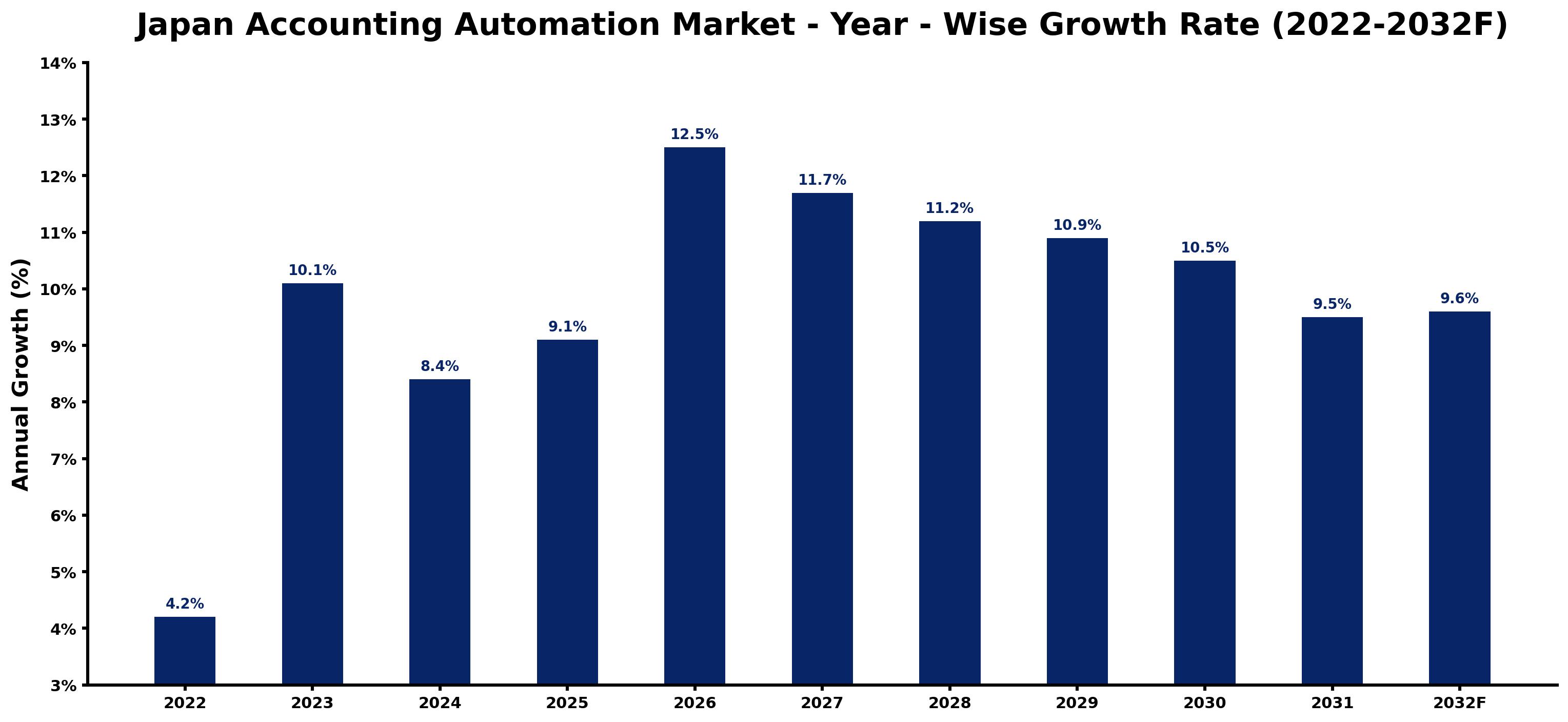
The following figures match every annual growth estimate with the main market development of that year, giving the reasoning behind each rise or slowdown.
| Year | Estimated Annual Growth (%) | Market Rationale |
| 2022 | 4.2 | The market was characterised by steady adoption rates among SMEs seeking efficiency. |
| 2023 | 10.1 | Growth accelerated as more businesses recognised the benefits of automation. |
| 2024 | 8.4 | The market experienced a slowdown as firms adjusted to new technologies. |
| 2025 | 9.1 | Adoption increased again as digital transformation initiatives gained momentum. |
| 2026 | 12.5 | The peak growth rate was driven by heightened demand for efficiency and accuracy. |
| 2027 | 11.7 | Market growth slowed as many firms completed initial automation projects. |
| 2028 | 11.2 | Continued interest in automation led to a further slowdown in growth rates. |
| 2029 | 10.9 | The market maintained steady growth as firms sought to optimise processes. |
| 2030 | 10.5 | Growth moderated as the market matured and competition intensified. |
| 2031 | 9.5 | The market continued to grow, albeit at a slower pace as saturation occurred. |
| 2032 | 9.6 | A slight uptick in growth is expected as new technologies emerge. |
Note: Market size estimations and growth projections presented in this report are based on 6Wresearch's proprietary forecasting methodology, utilizing the latest available industry data, government publications, and primary research inputs.
Japan Accounting Automation Market Synopsis
Accounting automation streamlines financial processes such as invoicing, payroll, and reconciliation through software solutions that integrate various functions. The Japan Accounting Automation Market is expanding rapidly, driven by banking and financial institutions that are increasingly adopting these technologies. Valued at approximately 1 trillion JPY in 2023, the market aims to digitise 80% of financial processes by 2025. Increased efficiency, reduced errors, and the growing need for compliance are propelling this growth, creating substantial opportunities for software providers.
Market Dynamics Impact Analysis (2026–2032)
| Factor | Type | Impact | Primary Segment Affected |
| Increased efficiency in financial processes | Driver | High | Invoice Automation |
| Growing demand for real-time financial insights | Driver | High | Payroll Automation |
| Rising need for expense tracking solutions | Opportunity | Medium | Expense Management |
| Expanding user base in SMEs | Opportunity | Medium | Cloud |
| High initial investment costs for automation tools | Restraint | High | Reconciliation Systems |
| Limited awareness among smaller firms | Restraint | Medium | Accounts Payable |
| Challenges in integrating new systems | Challenge | High | Payroll Automation |
| Shortage of skilled personnel for implementation | Challenge | Medium | AI & OCR |
Evaluation of Drivers in Japan Accounting Automation Market (2026–2032)
These are the developments adding the most demand over the forecast period.
| Drivers | Primary Segment Affected | Why It Matters (Evidence) |
| Increased efficiency in financial processes | Invoice Automation | The average time saved per month by using payroll automation is estimated at 20 hours, encouraging firms to adopt these solutions. |
| Growing demand for real-time financial insights | Payroll Automation | Over 50% of financial institutions in Japan have adopted cloud-based accounting solutions, improving decision-making capabilities. |
| Rising need for expense tracking solutions | Expense Management | The Japanese government has set a target to digitize 80% of financial processes by 2025, driving adoption in this area. |
| Expanding user base in SMEs | Cloud | The number of SMEs using accounting automation tools has increased by 30% since 2020, reflecting growing interest in these technologies. |
| Regulatory compliance requirements | Reconciliation Systems | The Financial Services Agency promotes the use of automation to improve compliance and reporting accuracy. |
Buyers are adding capacity as the market for accounting automation evolves. In 2023, over 50% of financial institutions in Japan adopted cloud-based solutions, enhancing their decision-making capabilities. The number of SMEs using automation tools increased by 30% since 2020, reflecting a growing trend towards digitisation. Payroll automation is estimated to save an average of 20 hours per month, encouraging firms to invest in these technologies.
Evaluation of Restraints in Japan Accounting Automation Market
These are the pressures that could keep growth below its potential.
| Market Restraint | Primary Segment Affected | Why It Matters (Evidence) |
| High initial investment costs for automation tools | Reconciliation Systems | Many SMEs face challenges in allocating budgets for automation, limiting their ability to invest. |
| Limited awareness among smaller firms | Accounts Payable | Smaller businesses often lack knowledge about the benefits of automation, hindering adoption. |
| Challenges in integrating new systems | Payroll Automation | Integration issues can lead to delays and increased costs for firms adopting new technologies. |
| Shortage of skilled personnel for implementation | AI & OCR | The lack of qualified professionals can slow down the deployment of automation solutions. |
| Resistance to change within organisations | Expense Management | Cultural barriers may prevent firms from fully embracing automation technologies. |
Japan Accounting Automation Market Challenges
Over 50% of financial institutions in Japan have adopted cloud-based accounting solutions, increasing competition among software providers. This saturation leads to price wars, forcing producers to lower their margins and invest heavily in marketing to stand out. Many SMEs struggle with skills shortages in digital transformation, which delays their operational efficiency and costs them an estimated 20 hours of payroll processing each month. Compliance pressures from the Financial Services Agency necessitate costly certifications like ISO 9001, straining producers' resources and limiting their ability to innovate.
Trends in the Japan Accounting Automation Market
The following changes are redrawing the Japan Accounting Automation Market.
- Shift towards Cloud-Based Solutions: Banking institutions are increasingly adopting cloud-based accounting solutions, with over 50% of financial institutions in Japan making the transition in 2023. This shift facilitates remote access and collaboration on financial data.
- Surge in Payroll Automation Adoption: Tokyo is experiencing a surge in payroll automation adoption, with an estimated 20 hours saved per month for firms using these solutions. This trend reflects the need for efficiency in payroll processing.
- Focus on Compliance Automation: The Financial Services Agency's promotion of automation for compliance is driving financial institutions to adopt new technologies. This trend is important for improving reporting accuracy and meeting regulatory requirements.
- Growth in Expense Management Solutions: The Ministry of Economy, Trade and Industry's support for digital transformation is driving growth in expense management solutions. This initiative is key for tracking and managing employee expenses effectively.
Investment Opportunities in the Japan Accounting Automation Market
Several openings in the Japan Accounting Automation Market merit attention from investors.
- Partnerships with SMEs: With a 30% increase in SMEs using automation tools, there is a notable opportunity for partnerships. Collaborating with local firms can facilitate market entry and expand reach.
- Investment in Payroll Automation: The payroll automation market is growing, with firms saving an average of 20 hours monthly. Targeting payroll service vendors can yield high returns on investment.
- Development of Compliance Solutions: The push for compliance automation presents an opportunity to develop tailored solutions. Financial institutions are actively seeking tools to improve reporting accuracy.
- Expansion of Cloud Services: With over 50% of financial institutions adopting cloud solutions, there is a growing need for scalable cloud services. Establishing a presence in Tokyo can help tap into this demand.
Government Initiatives in the Japan Accounting Automation Market
The GX Promotion Act (2023) establishes a framework for promoting green growth initiatives, strengthening the legal basis for environmental compliance in accounting automation. This measure complements earlier laws by providing clearer guidelines for firms seeking to adopt sustainable practices. The act aims to encourage investment in green technologies, with a target of JPY 150 trillion in public and private decarbonisation investment over the next decade.
Financial institutions use the 5 billion JPY allocated for technology grants to support accounting automation initiatives. This funding helps firms implement necessary technologies, ensuring compliance and operational efficiency. The Ministry of Economy, Trade and Industry oversees the distribution of these grants, facilitating the adoption of effective solutions in the sector.
Future Insight of the Japan Accounting Automation Market
The digital transformation programme for SMEs will enhance accounting automation capabilities by 2025. Japan aims to digitise 80% of financial processes, streamlining operations for buyers and suppliers. With JPY 5 billion allocated for technology grants, many producers will invest in advanced solutions to improve efficiency. Research on AI applications in accounting will further optimise processes, making automation more effective and accessible for users.
Market Segmentation Analysis
Japan Accounting Automation Market report covers a detailed analysis of the following market segments:
By Solution Type – Invoice Automation Leads, Expense Management Expected to Grow Fastest
According to Saurav Kr Singh, Senior Research Analyst at 6Wresearch, the largest solution type category in 2025 was Invoice Automation, at 40% of revenue. Invoice automation holds the largest share due to its widespread application in efficiently processing invoices across various sectors. For instance, many businesses in Tokyo leverage this solution to streamline their financial workflows, ensuring timely payments and improved cash flow. Over 2026–2032, Expense Management is expected to post the fastest growth, at a CAGR of 15.0%. Expense management is experiencing rapid growth as companies increasingly focus on effectively tracking and managing employee expenses. The notable 30% rise in SMEs adopting accounting automation tools since 2020 highlights the growing importance of this functionality in financial operations. Suppliers should enhance their expense management solutions to cater to the surging demand from businesses.
By Technology Used – Cloud Leads, AI & OCR Expected to Grow Fastest
With 46% of technology used revenue in 2025, Cloud was the largest category. Cloud technology leads the market as it provides essential remote access and collaboration on financial data for modern businesses. Its adoption by over 50% of financial institutions in Japan highlights its critical role in accounting automation. AI & OCR is set to record the highest CAGR in this split, 15.3% over 2026–2032. AI and OCR technologies are rapidly gaining popularity due to their effectiveness in automating data entry and document processing, thus improving operational efficiency. The government's digitisation initiatives further contribute to this growth. Buyers should consider integrating AI and OCR technologies to optimise their accounting processes.
By Functionality Area – Accounts Payable Leads and Records the Fastest Growth
Accounts Payable accounted for 42% of the market by functionality area in 2025. Accounts payable is the leading functionality area as it plays a vital role in managing outgoing payments effectively, ensuring financial stability for organisations. This area is particularly critical for sectors characterised by high transaction volumes and operational demands, necessitating efficient payment processes. Its lead should widen, with a projected CAGR of 12.3% during 2026–2032, the highest in this split. The accounts payable segment is also the fastest-growing, reflecting its increasing importance in financial management. The ongoing digital transformation initiatives across various sectors are further propelling its rapid expansion, ensuring that businesses remain competitive and efficient. Suppliers must prioritise features that enhance accounts payable functionalities to meet the rising market demands.
By End User – Banking Institutions Lead, Financial Institutions Expected to Grow Fastest
In 2025, Banking Institutions led the end user split with a 50% share. Banking institutions are the largest user group of accounting automation, leveraging these tools to improve operational efficiency in transaction processing. Their significant investments in automation solutions are a major factor driving market growth and adoption in this sector. The quickest growth will come from Financial Institutions, forecast to expand at a CAGR of 13.3% between 2026 and 2032. Financial institutions represent the fastest-growing user group, increasingly relying on automation to optimise transaction processing. The competitive landscape of the finance sector compels these institutions to adopt advanced automation solutions to maintain efficiency and accuracy. Suppliers should tailor their offerings to meet the specific needs of financial institutions to seize this growth opportunity.
By Distribution Channel – Direct Sales Leads, Online Platforms Expected to Grow Fastest
Direct Sales held 40% of the Japan Accounting Automation Market by distribution channel in 2025. Direct sales is the primary distribution channel for accounting software solutions, enabling personalised customer engagement and tailored support. This method is particularly effective in the banking sector, where customised solutions are essential for meeting specific client requirements. Over 2026–2032, Online Platforms are expected to post the fastest growth, at a CAGR of 13.7%. Online platforms are rapidly gaining traction as they broaden access to a larger customer base, making purchasing decisions easier for users. The shift towards digital sales channels is evident in the increasing volume of online transactions, highlighting the need for a robust online presence. Suppliers should strengthen their online presence to capitalise on the growing trend towards digital purchasing.
Key Attractiveness of the Report
- 10 Years of Market Numbers
- Historical Data Starting from 2022 to 2025
- Base Year 2025
- Forecast Data until 2032
- Key Performance Indicators Impacting the Market
- Major Upcoming Developments and Projects
Key Highlights of the Report:
- Japan Accounting Automation Market Outlook
- Market Size of Japan Accounting Automation Market, 2025
- Forecast of Japan Accounting Automation Market, 2032
- Historical Data and Forecast of Japan Accounting Automation Revenues & Volume for the Period 2022-2032F
- Japan Accounting Automation Market Trend Evolution
- Japan Accounting Automation Market Drivers and Challenges
- Japan Accounting Automation Price Trends
- Japan Accounting Automation Porter's Five Forces
- Japan Accounting Automation Industry Life Cycle
- Historical Data and Forecast of Japan Accounting Automation Market Revenues & Volume By Solution Type for the Period 2022-2032F
- Historical Data and Forecast of Japan Accounting Automation Market Revenues & Volume By Invoice Automation for the Period 2022-2032F
- Historical Data and Forecast of Japan Accounting Automation Market Revenues & Volume By Expense Management for the Period 2022-2032F
- Historical Data and Forecast of Japan Accounting Automation Market Revenues & Volume By Payroll Automation for the Period 2022-2032F
- Historical Data and Forecast of Japan Accounting Automation Market Revenues & Volume By Reconciliation Systems for the Period 2022-2032F
- Historical Data and Forecast of Japan Accounting Automation Market Revenues & Volume By Technology Used for the Period 2022-2032F
- Historical Data and Forecast of Japan Accounting Automation Market Revenues & Volume By AI & OCR for the Period 2022-2032F
- Historical Data and Forecast of Japan Accounting Automation Market Revenues & Volume By Cloud for the Period 2022-2032F
- Historical Data and Forecast of Japan Accounting Automation Market Revenues & Volume By SaaS for the Period 2022-2032F
- Historical Data and Forecast of Japan Accounting Automation Market Revenues & Volume By Machine Learning for the Period 2022-2032F
- Historical Data and Forecast of Japan Accounting Automation Market Revenues & Volume By Functionality Area for the Period 2022-2032F
- Historical Data and Forecast of Japan Accounting Automation Market Revenues & Volume By Accounts Payable for the Period 2022-2032F
- Historical Data and Forecast of Japan Accounting Automation Market Revenues & Volume By Reimbursement Tracking for the Period 2022-2032F
- Historical Data and Forecast of Japan Accounting Automation Market Revenues & Volume By Employee Management for the Period 2022-2032F
- Historical Data and Forecast of Japan Accounting Automation Market Revenues & Volume By Bank Account Reconciliation for the Period 2022-2032F
- Historical Data and Forecast of Japan Accounting Automation Market Revenues & Volume By End User for the Period 2022-2032F
- Historical Data and Forecast of Japan Accounting Automation Market Revenues & Volume By Banking Institutions for the Period 2022-2032F
- Historical Data and Forecast of Japan Accounting Automation Market Revenues & Volume By Legal Firms for the Period 2022-2032F
- Historical Data and Forecast of Japan Accounting Automation Market Revenues & Volume By Financial Institutions for the Period 2022-2032F
- Historical Data and Forecast of Japan Accounting Automation Market Revenues & Volume By Insurance Companies for the Period 2022-2032F
- Historical Data and Forecast of Japan Accounting Automation Market Revenues & Volume By Distribution Channel for the Period 2022-2032F
- Historical Data and Forecast of Japan Accounting Automation Market Revenues & Volume By Direct Sales for the Period 2022-2032F
- Historical Data and Forecast of Japan Accounting Automation Market Revenues & Volume By Online Platforms for the Period 2022-2032F
- Historical Data and Forecast of Japan Accounting Automation Market Revenues & Volume By Payroll Service Vendors for the Period 2022-2032F
- Historical Data and Forecast of Japan Accounting Automation Market Revenues & Volume By Accounting Software Firms for the Period 2022-2032F
- Japan Accounting Automation Import Export Trade Statistics
- Market Opportunity Assessment By Solution Type
- Market Opportunity Assessment By Technology Used
- Market Opportunity Assessment By Functionality Area
- Market Opportunity Assessment By End User
- Market Opportunity Assessment By Distribution Channel
- Japan Accounting Automation Top Companies Market Share
- Japan Accounting Automation Competitive Benchmarking By Technical and Operational Parameters
- Japan Accounting Automation Company Profiles
- Japan Accounting Automation Key Strategic Recommendations
Market Covered
The report covers the following segments.
By Solution Type
- Invoice Automation
- Expense Management
- Payroll Automation
- Reconciliation Systems
By Technology Used
- AI & OCR
- Cloud
- SaaS
- Machine Learning
By Functionality Area
- Accounts Payable
- Reimbursement Tracking
- Employee Management
- Bank Account Reconciliation
By End User
- Banking Institutions
- Legal Firms
- Financial Institutions
- Insurance Companies
By Distribution Channel
- Direct Sales
- Online Platforms
- Payroll Service Vendors
- Accounting Software Firms































