Japan Accounting Automation Software Market Size & Growth Rate
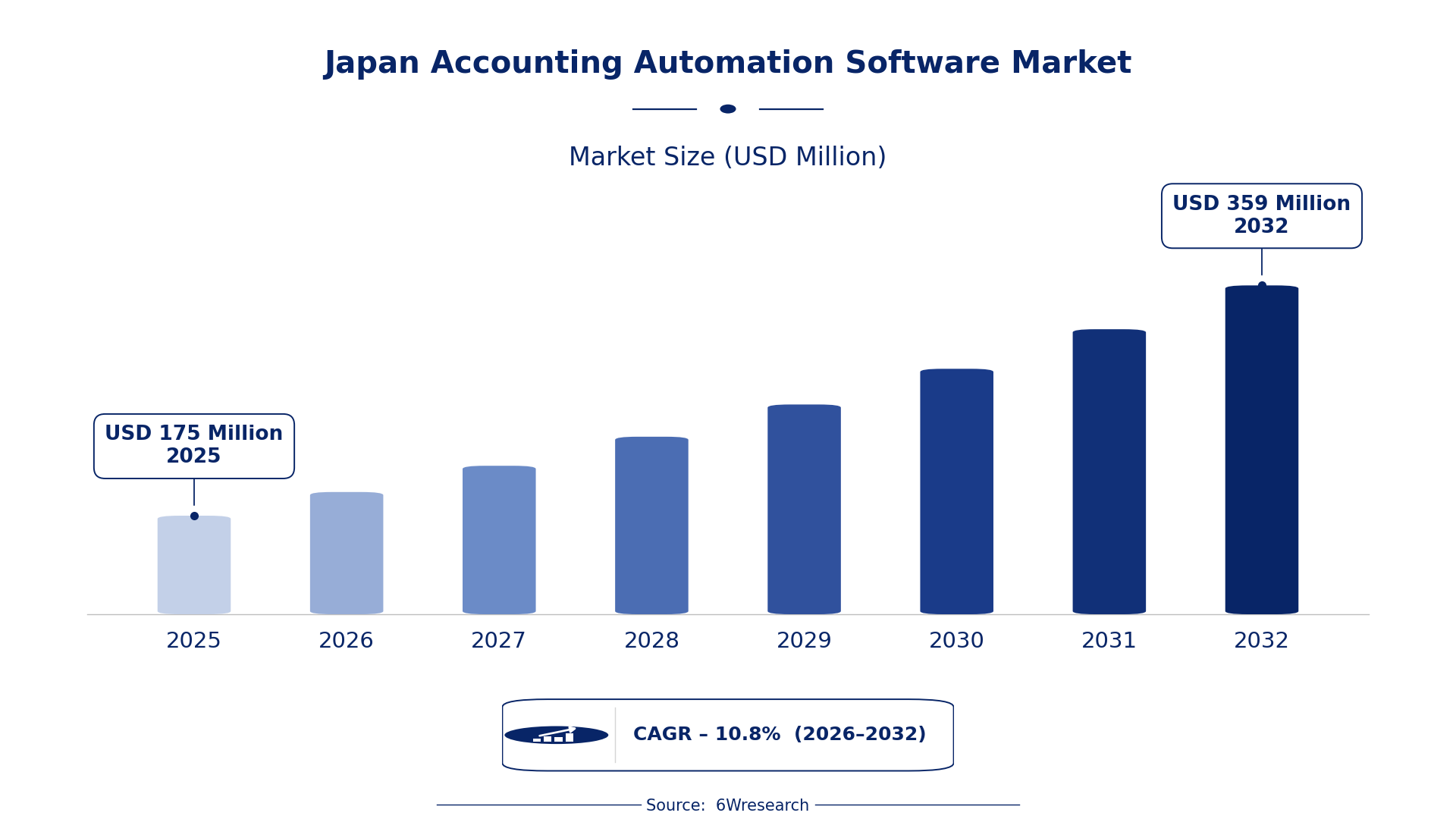
According to 6Wresearch internal database and industry insights, the Japan Accounting Automation Software Market was valued at USD 175 Million in 2025 and is projected to reach USD 359 Million by 2032, growing at a CAGR of approximately 10.8% during 2026–2032.
Japan Accounting Automation Software Market Highlights
| Report Metric | Details |
| Report Name | Japan Accounting Automation Software Market (2026-2032) |
| Market Size 2025 | USD 175 Million |
| Market Size 2032 | USD 359 Million |
| Absolute Growth 2025–2032 | USD 184 Million |
| CAGR 2026–2032 | 10.8% |
| Peak Annual Growth | 12.0% in 2028 |
| Forecast Period | 2026–2032 |
| Historical Data | 2022–2025 |
| Base Year | 2025 |
| Leading Software Type, 2025 | ERP-based Accounting (41% share) |
| Leading Deployment Mode, 2025 | Cloud (59% share) |
| Leading Feature Set, 2025 | Invoicing (37% share) |
| Leading End User, 2025 | Large Enterprises (35% share) |
| Leading Distribution Channel, 2025 | SaaS Providers (41% share) |
| Fastest-Growing Software Type | SME Accounting Tools (15.7% CAGR) |
| Fastest-Growing Feature Set | Analytics (14.5% CAGR) |
| Fastest-Growing End User | Startups (14.6% CAGR) |
| Fastest-Growing Distribution Channel | Online Platforms (13.8% CAGR) |
| Growing Sector | Financial Services |
| Key End Users | Large Enterprises, Mid-sized Firms, Startups, Subscription Services |
Japan Accounting Automation Software Market Year-wise Growth Rate and Key Drivers (2022–2032)
This graph illustrates the annual growth rates of the market from 2022 to 2032, highlighting a steady upward trajectory and projected market expansion over the forecast period.
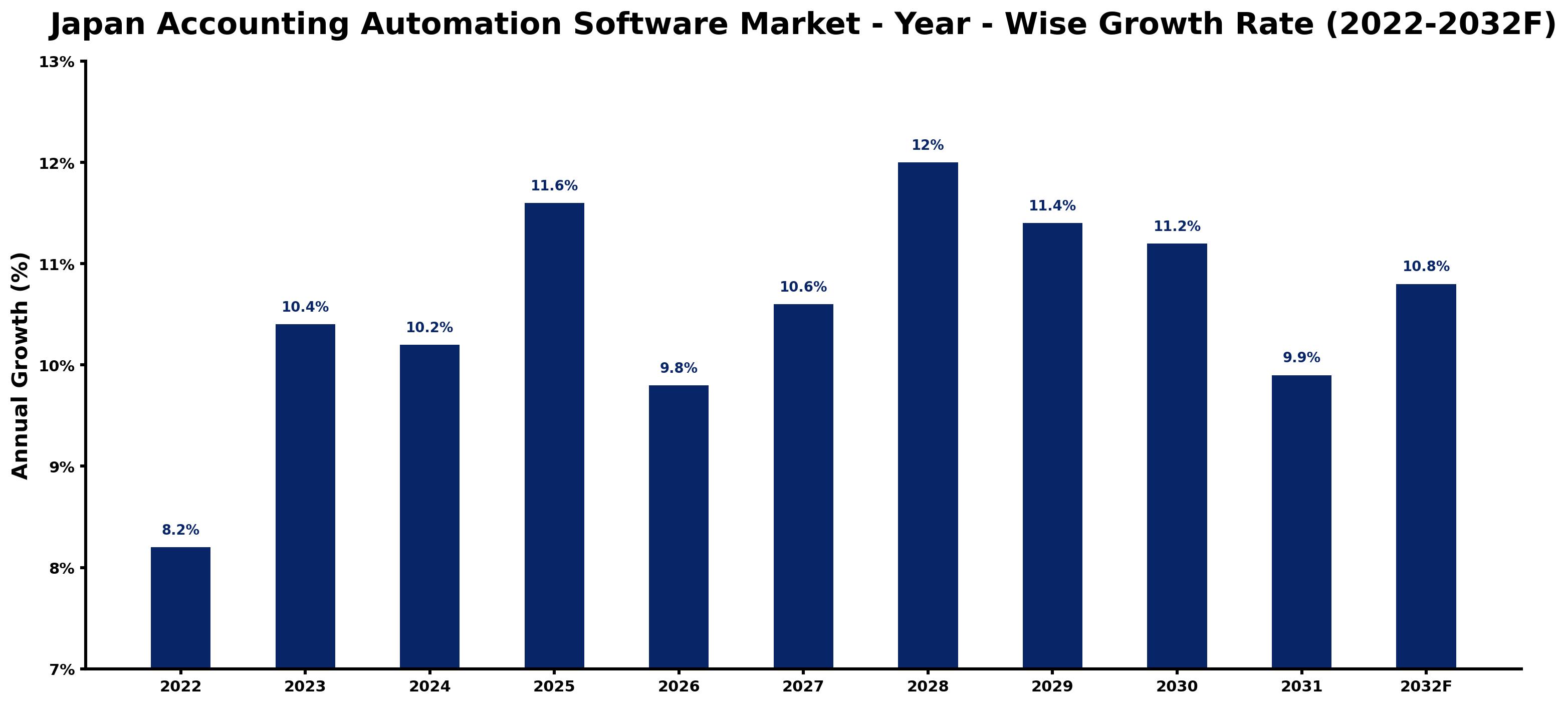
Below, each year's estimated growth is shown next to the factor that most influenced it.
| Year | Estimated Annual Growth (%) | Market Rationale |
| 2022 | 8.2 | The market showed steady growth as businesses began adopting automation solutions. |
| 2023 | 10.4 | Growth accelerated due to increased digital transformation initiatives among firms. |
| 2024 | 10.2 | Growth slowed slightly as companies adjusted to new software implementations. |
| 2025 | 11.6 | The market experienced a peak in growth as large enterprises expanded their automation efforts. |
| 2026 | 9.8 | Growth is expected to slow as the market stabilises after the previous peak. |
| 2027 | 10.6 | Demand is projected to increase again as more firms recognise the benefits of automation. |
| 2028 | 12.0 | The market will peak in growth driven by a surge in cloud adoption. |
| 2029 | 11.4 | Growth is anticipated to slow as the market begins to mature and competition intensifies. |
| 2030 | 11.2 | A further slowdown is expected as firms focus on optimising existing solutions. |
| 2031 | 9.9 | Growth is projected to decelerate as market saturation begins to take effect. |
| 2032 | 10.8 | Demand is expected to rise again as new technologies emerge. |
Note: Market size estimations and growth projections presented in this report are based on 6Wresearch's proprietary forecasting methodology, utilizing the latest available industry data, government publications, and primary research inputs.
Japan Accounting Automation Software Market Synopsis
Accounting Automation Software streamlines financial processes, including invoicing and payroll, to improve efficiency in reporting and compliance. The Japan Accounting Automation Software Market is expanding due to the increasing adoption of cloud-based solutions, with 60% of new businesses preferring this model. The Tokyo region accounts for 40% of demand, driven by a growing number of startups adopting automation tools, which increased by 25% in 2023. Ongoing digital transformation initiatives further fuel this market's growth, presenting substantial opportunities for providers.
Market Dynamics Impact Analysis (2026–2032)
| Factor | Type | Impact | Primary Segment Affected |
| Increasing adoption of cloud-based solutions | Driver | High | Cloud |
| Growing number of startups adopting automation tools | Driver | High | SME Accounting Tools |
| Rising demand for compliance with tax regulations | Opportunity | High | Tax Filing |
| Expansion of digital transformation initiatives for SMEs | Opportunity | High | ERP-based Accounting |
| High initial investment costs for software implementation | Restraint | High | Enterprise Solutions |
| Limited awareness among small businesses about automation benefits | Restraint | Medium | SME Accounting Tools |
| Competition from alternative financial management solutions | Challenge | High | Billing Software |
| Rapid technological changes requiring constant updates | Challenge | Medium | Analytics |
Evaluation of Drivers in Japan Accounting Automation Software Market (2026–2032)
Demand rests on the following drivers, each shown with the segment it touches most.
| Drivers | Primary Segment Affected | Why It Matters (Evidence) |
| Cloud adoption for flexibility and scalability | Cloud | Cloud-based solutions are preferred by 60% of new businesses, leading to increased purchases. |
| Increased digital literacy among accountants | ERP-based Accounting | Government-funded programs aim to boost digital skills by 2025, enhancing software adoption. |
| Growing efficiency in financial reporting | Invoicing | 80% of firms reported improved efficiency after implementing automation tools. |
| Demand for integrated tax compliance solutions | Tax Filing | Tax filing automation tools comply with National Tax Agency guidelines, attracting more users. |
| Rise in subscription-based revenue models | Recurring Billing | Subscription services are growing at 15% annually, increasing demand for billing software. |
Purchasing is picking up as cloud-based solutions gain traction, with 60% of new businesses opting for this model. The average adoption rate of payroll automation is around 45%, reflecting a broader trend towards efficiency in financial processes. The growth of subscription services, increasing at 15% annually, is also boosting demand for billing software. The demand for integrated tax compliance solutions is rising as firms seek to align with compliance guidelines, further expanding the market.
Evaluation of Restraints in Japan Accounting Automation Software Market
Below are the constraints most often cited by buyers and suppliers, with the segment each affects.
| Market Restraint | Primary Segment Affected | Why It Matters (Evidence) |
| High initial investment costs for software implementation | Enterprise Solutions | Many large enterprises face upfront costs of over JPY 10 million, limiting their ability to invest in new solutions. |
| Limited awareness among small businesses about automation benefits | SME Accounting Tools | Small firms often lack knowledge about the advantages of automation, hindering adoption rates. |
| Complexity of integrating new software with existing systems | Cloud | Integration challenges can delay implementation, affecting overall market growth. |
| Concerns over data security in cloud solutions | Cloud | Businesses hesitate to adopt cloud solutions due to fears of data breaches and compliance issues. |
| Inadequate training resources for effective software use | ERP-based Accounting | Many firms struggle with insufficient training, impacting the effective use of automation tools. |
Japan Accounting Automation Software Market Challenges
A lack of skilled professionals limits producers' ability to implement advanced accounting automation software, delaying project timelines and increasing costs by up to 20%. Technology gaps hinder importers, as many struggle to integrate cloud-based solutions, resulting in inefficiencies that can lead to a 15% drop in service quality for buyers. Buyers face high costs due to outdated systems, with 80% reporting inefficiencies that can inflate operational expenses by 25%. Regulatory compliance challenges arise from complex tax guidelines, forcing firms to allocate additional resources for compliance, which can consume 30% of their operational budget.
Trends in the Japan Accounting Automation Software Market
These developments are changing demand patterns in the Japan Accounting Automation Software Market.
- Shift towards Cloud Solutions: Mid-sized firms are increasingly adopting cloud-based accounting solutions, with 60% of new businesses preferring this model. This shift provides flexibility and scalability, enabling firms to adapt quickly to market changes.
- Growing Demand for Invoicing Tools: Invoicing tools are becoming essential for subscription services, which are growing at 15% annually. This trend reflects the need for efficient billing processes in a competitive market.
- Rise of Analytics Features: Analytics features in accounting software are now used by 50% of large enterprises, highlighting the importance of data-driven decision-making in financial management.
- Increased Digital Literacy Initiatives: Government-funded programs aim to boost digital literacy among accountants by 2025, fostering greater adoption of accounting automation tools across various sectors.
Investment Opportunities in the Japan Accounting Automation Software Market
The following opportunities in the Japan Accounting Automation Software Market pair current demand with a clear way in.
- Investment in Cloud Infrastructure: The Tokyo region is experiencing a rise in cloud accounting adoption, presenting opportunities for investment in cloud infrastructure and services as demand grows.
- Focus on Compliance Solutions: With 80% of firms reporting improved efficiency after implementing automation, there is a strong opportunity in developing compliance solutions for tax filing and reporting.
- Partnerships with SMEs: Now is the time for firms to partner with SMEs, as the number of startups adopting accounting automation tools increased by 25% in 2023, creating a growing market.
- Expansion of Training Programs: Investment in training programs endorsed by the Japan Institute of Certified Public Accountants can address the skills gap, improving software adoption among accountants.
Government Initiatives in the Japan Accounting Automation Software Market
The Digital Agency, established in September 2021, leads national digital transformation efforts, improving the framework for software development and adoption. This initiative aims to streamline processes and encourage the integration of accounting automation tools in businesses, with a target of increasing digital literacy by 2025.
The Ministry of Economy, Trade and Industry supports accounting software adoption through subsidies, helping firms offset implementation costs. This funding has enabled many businesses to invest in automation, improving efficiency and compliance with tax regulations.
Future Insight of the Japan Accounting Automation Software Market
Japan's commitment to a 46% reduction in greenhouse gas emissions by 2030 will drive investments in accounting automation technologies, prompting suppliers to innovate. The government’s digital transformation initiative for SMEs will boost software adoption, resulting in improved efficiency for buyers. By 2032, the average adoption rate of accounting automation tools is expected to rise to 70%, reflecting a shift towards streamlined financial processes. Training programs endorsed by professional bodies will ensure a more skilled workforce, benefiting both buyers and suppliers in the evolving market.
Market Segmentation Analysis
Japan Accounting Automation Software Market report covers a detailed analysis of the following market segments:
By Software Type – ERP-based Accounting Leads, SME Accounting Tools Expected to Grow Fastest
According to Saurav Kr Singh, Senior Research Analyst at 6Wresearch, in 2025, ERP-based Accounting led the software type split with a 41% share. ERP-based accounting tools dominate the market due to their comprehensive capabilities in managing complex financial processes for large organisations. This is highlighted by the fact that over 70% of mid-sized firms in Japan utilise these solutions for their financial management needs. SME Accounting Tools are set to record the highest CAGR in this split, 15.7% over 2026–2032. The growth of SME accounting tools is propelled by the rising number of small and medium enterprises seeking tailored solutions for their financial operations. A notable increase of 25% in startups adopting these tools in 2023 underscores the strong demand for such offerings. Suppliers should focus on developing features that specifically cater to the needs of SMEs to effectively capitalise on this expanding market segment.
By Deployment Mode – Cloud Leads and Records the Fastest Growth
The largest deployment mode category in 2025 was Cloud, at 59% of revenue. Cloud deployment leads the market due to its flexibility and scalability, which are essential for businesses undergoing digital transformation. Approximately 60% of new businesses in Japan prefer cloud-based accounting solutions, reflecting their need for adaptable software. The same category is also set to grow fastest, at a CAGR of 12.1% during 2026–2032. The growth of cloud solutions will continue as businesses increasingly recognise the efficiencies they offer in financial management. This trend will further reinforce cloud's dominance over other deployment modes, solidifying its market position. Providers must prioritise robust cloud offerings to meet the rising demand from businesses transitioning to digital platforms.
By Feature Set – Invoicing Leads, Analytics Expected to Grow Fastest
Invoicing accounted for 37% of the market by feature set in 2025. Invoicing features are critical for billing and revenue tracking, making them indispensable for businesses managing cash flow. This functionality is widely utilised across various sectors, ensuring its leading position in the market. Over 2026–2032, Analytics is expected to post the fastest growth, at a CAGR of 14.5%. Analytics features are gaining traction as they enable data-driven decision making, which is increasingly important for businesses aiming to optimise their financial strategies. The use of analytics is prevalent among 50% of large enterprises, highlighting its growing significance. Vendors should prioritise the development of advanced analytics capabilities to attract larger clients seeking strategic insights.
By End User – Large Enterprises Lead, Startups Expected to Grow Fastest
Large Enterprises held 35% of the Japan Accounting Automation Software Market by end user in 2025. Large enterprises hold the largest share of the market as they require advanced accounting automation tools to manage their complex financial structures. Their reliance on these solutions is vital for maintaining operational efficiency across extensive accounting processes. The quickest growth will come from Startups, forecast to expand at a CAGR of 14.6% between 2026 and 2032. Startups are rapidly adopting accounting automation tools to streamline their financial operations, reflecting a wider trend among new businesses seeking efficiency. This segment's growth is driven by the need for effective financial management as they scale their operations. Suppliers should tailor their products to address the specific requirements of startups to capitalise on this rapidly growing market.
By Distribution Channel – SaaS Providers Lead, Online Platforms Expected to Grow Fastest
With 41% of distribution channel revenue in 2025, SaaS Providers was the largest category. SaaS providers are the primary distributors of accounting software solutions, leveraging their platforms to reach a wide customer base. Their crucial role ensures that businesses have access to the latest advancements in accounting technology. Online Platforms are set to record the highest CAGR in this split, 13.8% over 2026–2032. Online platforms are experiencing significant growth as they enhance accessibility for users seeking accounting solutions. This trend is expected to persist, driven by the increasing demand for convenient purchasing options in the market. Distributors must invest in improving online platforms to enhance accessibility and capture a larger share of the accounting software market.
Key Attractiveness of the Report
- 10 Years of Market Numbers
- Historical Data Starting from 2022 to 2025
- Base Year 2025
- Forecast Data until 2032
- Key Performance Indicators Impacting the Market
- Major Upcoming Developments and Projects
Key Highlights of the Report:
- Japan Accounting Automation Software Market Outlook
- Market Size of Japan Accounting Automation Software Market, 2025
- Forecast of Japan Accounting Automation Software Market, 2032
- Historical Data and Forecast of Japan Accounting Automation Software Revenues & Volume for the Period 2022-2032F
- Japan Accounting Automation Software Market Trend Evolution
- Japan Accounting Automation Software Market Drivers and Challenges
- Japan Accounting Automation Software Price Trends
- Japan Accounting Automation Software Porter's Five Forces
- Japan Accounting Automation Software Industry Life Cycle
- Historical Data and Forecast of Japan Accounting Automation Software Market Revenues & Volume By Software Type for the Period 2022-2032F
- Historical Data and Forecast of Japan Accounting Automation Software Market Revenues & Volume By ERP-based Accounting for the Period 2022-2032F
- Historical Data and Forecast of Japan Accounting Automation Software Market Revenues & Volume By SME Accounting Tools for the Period 2022-2032F
- Historical Data and Forecast of Japan Accounting Automation Software Market Revenues & Volume By Enterprise Solutions for the Period 2022-2032F
- Historical Data and Forecast of Japan Accounting Automation Software Market Revenues & Volume By Billing Software for the Period 2022-2032F
- Historical Data and Forecast of Japan Accounting Automation Software Market Revenues & Volume By Deployment Mode for the Period 2022-2032F
- Historical Data and Forecast of Japan Accounting Automation Software Market Revenues & Volume By Cloud for the Period 2022-2032F
- Historical Data and Forecast of Japan Accounting Automation Software Market Revenues & Volume By On-Premise for the Period 2022-2032F
- Historical Data and Forecast of Japan Accounting Automation Software Market Revenues & Volume By Hybrid for the Period 2022-2032F
- Historical Data and Forecast of Japan Accounting Automation Software Market Revenues & Volume By Cloud for the Period 2022-2032F
- Historical Data and Forecast of Japan Accounting Automation Software Market Revenues & Volume By Feature Set for the Period 2022-2032F
- Historical Data and Forecast of Japan Accounting Automation Software Market Revenues & Volume By Invoicing, Reporting for the Period 2022-2032F
- Historical Data and Forecast of Japan Accounting Automation Software Market Revenues & Volume By Tax Filing, Payroll for the Period 2022-2032F
- Historical Data and Forecast of Japan Accounting Automation Software Market Revenues & Volume By Audit Trail, Analytics for the Period 2022-2032F
- Historical Data and Forecast of Japan Accounting Automation Software Market Revenues & Volume By Recurring Billing for the Period 2022-2032F
- Historical Data and Forecast of Japan Accounting Automation Software Market Revenues & Volume By End User for the Period 2022-2032F
- Historical Data and Forecast of Japan Accounting Automation Software Market Revenues & Volume By Mid-sized Firms for the Period 2022-2032F
- Historical Data and Forecast of Japan Accounting Automation Software Market Revenues & Volume By Startups for the Period 2022-2032F
- Historical Data and Forecast of Japan Accounting Automation Software Market Revenues & Volume By Large Enterprises for the Period 2022-2032F
- Historical Data and Forecast of Japan Accounting Automation Software Market Revenues & Volume By Subscription Services for the Period 2022-2032F
- Historical Data and Forecast of Japan Accounting Automation Software Market Revenues & Volume By Distribution Channel for the Period 2022-2032F
- Historical Data and Forecast of Japan Accounting Automation Software Market Revenues & Volume By SaaS Providers for the Period 2022-2032F
- Historical Data and Forecast of Japan Accounting Automation Software Market Revenues & Volume By Online Platforms for the Period 2022-2032F
- Historical Data and Forecast of Japan Accounting Automation Software Market Revenues & Volume By Direct Sales for the Period 2022-2032F
- Historical Data and Forecast of Japan Accounting Automation Software Market Revenues & Volume By Accounting Partners for the Period 2022-2032F
- Japan Accounting Automation Software Import Export Trade Statistics
- Market Opportunity Assessment By Software Type
- Market Opportunity Assessment By Deployment Mode
- Market Opportunity Assessment By Feature Set
- Market Opportunity Assessment By End User
- Market Opportunity Assessment By Distribution Channel
- Japan Accounting Automation Software Top Companies Market Share
- Japan Accounting Automation Software Competitive Benchmarking By Technical and Operational Parameters
- Japan Accounting Automation Software Company Profiles
- Japan Accounting Automation Software Key Strategic Recommendations
Market Covered
Coverage by segment is as follows.
By Software Type
- ERP-based Accounting
- SME Accounting Tools
- Enterprise Solutions
- Billing Software
By Deployment Mode
- Cloud
- On-Premise
- Hybrid
By Feature Set
- Invoicing
- Reporting
- Tax Filing
- Payroll
- Audit Trail
- Analytics
- Recurring Billing
By End User
- Mid-sized Firms
- Startups
- Large Enterprises
- Subscription Services
By Distribution Channel
- SaaS Providers
- Online Platforms
- Direct Sales
- Accounting Partners































