Japan Accounts Receivable Accounts Payable Automation Market Size & Growth Rate
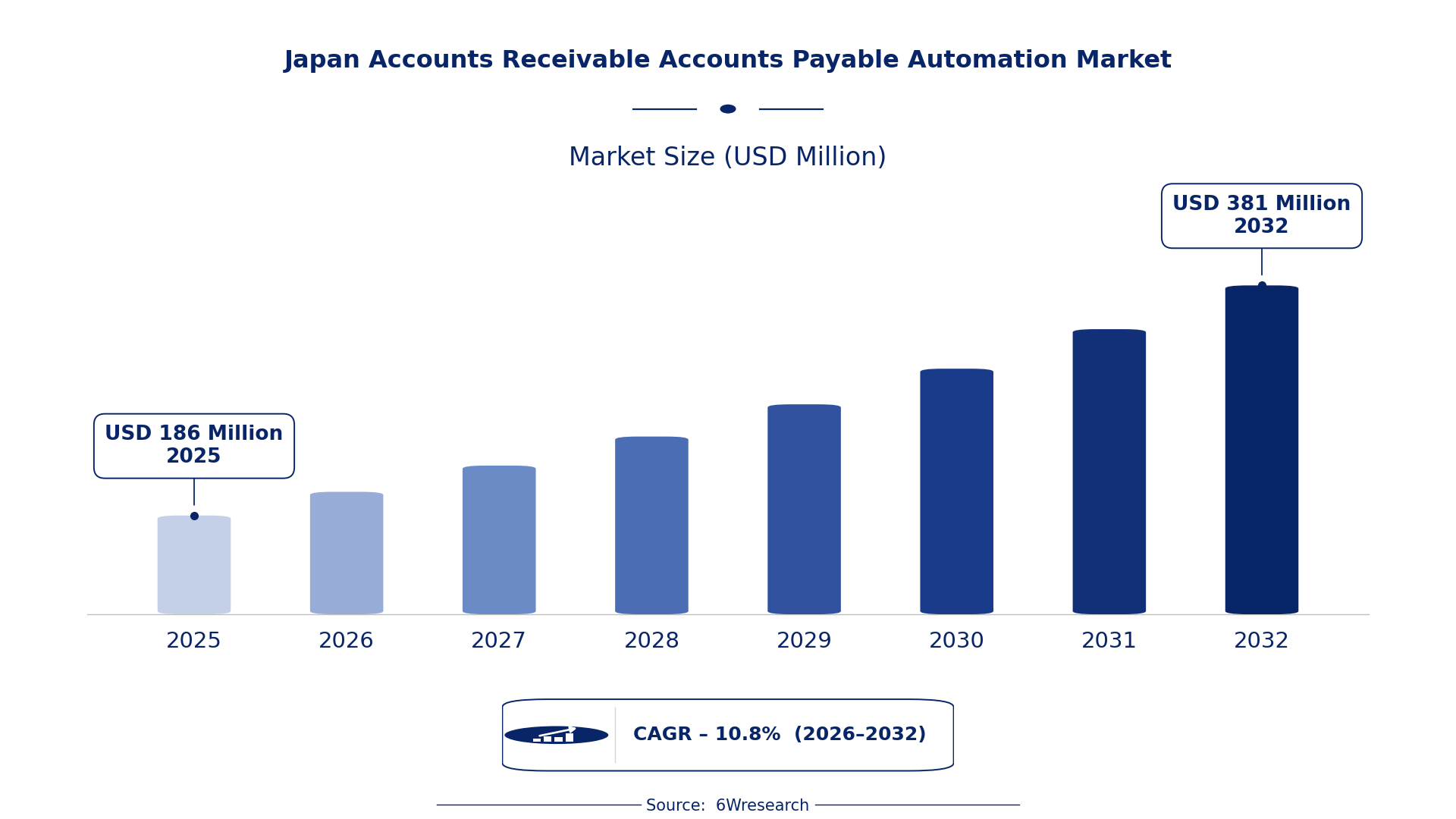
According to 6Wresearch internal database and industry insights, the Japan Accounts Receivable Accounts Payable Automation Market was valued at USD 186 Million in 2025 and is projected to reach USD 381 Million by 2032, growing at a CAGR of approximately 10.8% during 2026–2032.
Japan Accounts Receivable Accounts Payable Automation Market Highlights
| Report Metric | Details |
| Report Name | Japan Accounts Receivable Accounts Payable Automation Market (2026-2032) |
| Market Size 2025 | USD 186 Million |
| Market Size 2032 | USD 381 Million |
| Absolute Growth 2025–2032 | USD 195 Million |
| CAGR 2026–2032 | 10.8% |
| Peak Annual Growth | 13.0% in 2026 |
| Forecast Period | 2026–2032 |
| Historical Data | 2022–2025 |
| Base Year | 2025 |
| Leading Type, 2025 | Cloud-based (59% share) |
| Leading Application, 2025 | SMEs (55% share) |
| Fastest-Growing Type | On-premises (14.5% CAGR) |
| Fastest-Growing Application | Large Enterprises (13.3% CAGR) |
| Growing Sector | financial services |
| Key End Users | SMEs, large enterprises, financial institutions, accounting firms |
Japan Accounts Receivable Accounts Payable Automation Market Year-wise Growth Rate and Key Drivers (2022–2032)
This graph illustrates the annual growth rates of the market from 2022 to 2032, highlighting a steady upward trajectory and projected market expansion over the forecast period.
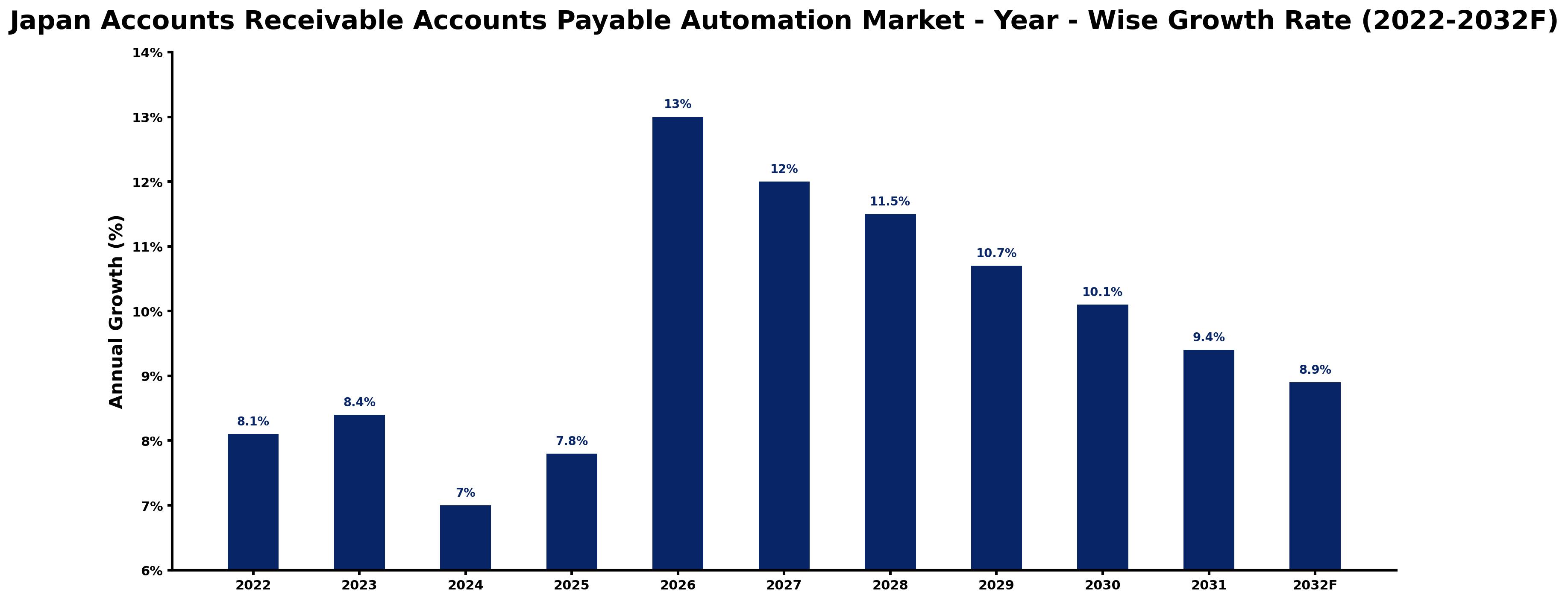
The table below sets out the estimated growth rate for each year and the main factor behind it.
| Year | Estimated Annual Growth (%) | Market Rationale |
| 2022 | 8.1 | The market experienced steady growth due to increased automation adoption among SMEs. |
| 2023 | 8.4 | Demand rose as more businesses recognised the efficiency benefits of automation solutions. |
| 2024 | 7.0 | Growth slowed as market saturation began to affect new adoption rates. |
| 2025 | 7.8 | The introduction of new digital solutions spurred a resurgence in market activity. |
| 2026 | 13.0 | Demand is expected to surge as large enterprises ramp up automation to manage transaction volumes. |
| 2027 | 12.0 | Growth is projected to slow as the market matures and competition intensifies. |
| 2028 | 11.5 | The market is expected to continue growing, driven by ongoing digital transformation initiatives. |
| 2029 | 10.7 | Demand growth is anticipated to slow as many firms complete initial automation implementations. |
| 2030 | 10.1 | The market will maintain growth as new technologies emerge to improve automation. |
| 2031 | 9.4 | Growth is expected to decelerate as the focus shifts to optimising existing automation solutions. |
| 2032 | 8.9 | The market continues to grow as businesses seek to improve operational efficiency. |
Note: Market size estimations and growth projections presented in this report are based on 6Wresearch's proprietary forecasting methodology, utilizing the latest available industry data, government publications, and primary research inputs.
Japan Accounts Receivable Accounts Payable Automation Market Synopsis
Accounts Receivable and Accounts Payable Automation involves software solutions that streamline payment management, integrating with existing financial systems to improve efficiency. The Japan Accounts Receivable Accounts Payable Automation Market is expanding due to rising adoption among SMEs and large enterprises, driven by the need for improved cash flow management and operational efficiency. The prevalence of cloud-based solutions, which constitute 60% of the market, is fuelling this growth. Government initiatives that support digital transformation are creating new demand across various sectors.
Market Dynamics Impact Analysis (2026–2032)
| Factor | Type | Impact | Primary Segment Affected |
| Rising adoption of cloud-based solutions | Driver | High | Cloud-based |
| Increased focus on cash flow management | Driver | High | SMEs |
| Growing demand from large enterprises | Opportunity | High | Large Enterprises |
| Government support for digital transformation | Opportunity | Medium | SMEs |
| Market saturation affecting new adoption rates | Restraint | High | Cloud-based |
| Intense competition among solution providers | Restraint | Medium | Large Enterprises |
| High initial investment costs for automation tools | Challenge | High | Cloud-based |
| Resistance to change from traditional processes | Challenge | Medium | SMEs |
Evaluation of Drivers in Japan Accounts Receivable Accounts Payable Automation Market (2026–2032)
Below are the drivers that matter most for revenue growth, with supporting evidence.
| Drivers | Primary Segment Affected | Why It Matters (Evidence) |
| Increased efficiency through automation | Cloud-based | Cloud-based solutions enhance operational efficiency, with 60% market share driving demand among SMEs. |
| Need for improved cash flow management | SMEs | Over 70% of SMEs are adopting automation solutions to streamline financial processes. |
| High transaction volumes in large enterprises | Large Enterprises | The adoption rate of accounts payable automation reached 80% in large enterprises, improving transaction management. |
| Government initiatives promoting digital transformation | SMEs | The Ministry of Economy, Trade and Industry supports digital initiatives, boosting automation adoption since 2021. |
| ISO 20022 standard for electronic invoicing | Cloud-based | The Tokyo Stock Exchange mandates electronic invoicing by 2025, increasing demand for automation solutions. |
Volumes grow on the back of increased efficiency demands from various sectors. The adoption rate of accounts payable automation in large enterprises reached 80% in 2023, prompting more purchases of automation tools. Over 70% of SMEs are now adopting accounts receivable automation solutions to improve cash flow management. The Tokyo Stock Exchange's requirement for electronic invoicing is further driving demand for cloud-based solutions.
Evaluation of Restraints in Japan Accounts Receivable Accounts Payable Automation Market
The key brakes on demand, and where they bite hardest, are shown below.
| Market Restraint | Primary Segment Affected | Why It Matters (Evidence) |
| High initial investment costs for automation tools | Cloud-based | Initial costs deter SMEs from adopting automation, limiting market growth potential. |
| Market saturation affecting new adoption rates | Cloud-based | As many firms complete initial implementations, new adoption rates slow down. |
| Intense competition among solution providers | Large Enterprises | Increased competition leads to price wars, affecting profitability for suppliers. |
| Resistance to change from traditional processes | SMEs | Many SMEs are hesitant to shift from established manual processes, slowing adoption. |
| Limited awareness of automation benefits | Cloud-based | Some businesses remain unaware of the efficiency improvements offered by automation. |
Japan Accounts Receivable Accounts Payable Automation Market Challenges
Buyers in Japan's accounts payable automation market encounter integration challenges, as many software solutions do not seamlessly connect with existing financial systems, causing implementation delays of up to six months. Technology adoption lags behind global standards, which restricts operational efficiency for producers and results in potential revenue losses estimated at 20%. Supply chain disruptions limit the availability of essential automation tools, leading to project delays for companies reliant on these technologies. Compliance with ISO 20022 standards can increase operational costs by approximately 15% for SMEs, negatively impacting their financial health.
Trends in the Japan Accounts Receivable Accounts Payable Automation Market
Buyers and suppliers in the Japan Accounts Receivable Accounts Payable Automation Market are adjusting to the following trends.
- Shift from On-premises to Cloud-based Solutions: The trend towards cloud-based solutions is accelerating, with 60% of the market share in Japan. This shift is driven by the flexibility and scalability that cloud solutions offer to users, particularly among SMEs.
- Increasing Adoption of Electronic Invoicing Standards: The adoption of ISO 20022 for electronic invoicing is gaining momentum, with the Tokyo Stock Exchange mandating compliance by 2025. This requirement is pushing companies to invest in automation tools to meet new standards.
- Growth of Automation in Large Enterprises: Large enterprises are increasingly adopting automation solutions, with a projected CAGR of 13.3% from 2026 to 2032. This growth is driven by the need to manage high transaction volumes efficiently.
- Government Initiatives Supporting Digital Transformation: Since 2021, the Digital Agency has been promoting digital solutions across industries, with an estimated annual budget of 1 trillion JPY. This funding is supporting the growth of automation technologies among SMEs.
Investment Opportunities in the Japan Accounts Receivable Accounts Payable Automation Market
The opportunities below stand out in the Japan Accounts Receivable Accounts Payable Automation Market for new entrants and existing suppliers.
- Partner with Local SMEs for Automation Solutions: Now is the time to invest in automation tools for SMEs, with over 70% adopting such solutions. Partnering with local SMEs can improve market entry and adoption.
- Supply Cloud-based Automation Tools: With cloud-based solutions accounting for 60% of the market, suppliers should focus on developing scalable tools. Targeting SMEs in Tokyo and Osaka can yield substantial returns.
- Invest in Training and Support Services: As automation adoption increases, there is a growing need for training services. Offering support to SMEs can facilitate smoother transitions to automated systems.
- Engage with Government Funding for Digital Initiatives: The annual budget for digital transformation initiatives is estimated at 1 trillion JPY. Collaborating with government programs can provide financial support for automation projects.
Government Initiatives in the Japan Accounts Receivable Accounts Payable Automation Market
The Digital Agency, established in 2021, plays a crucial role in promoting digital solutions across industries in Japan. With an estimated annual budget of 1 trillion JPY, it supports digital transformation initiatives that directly impact the adoption of accounts receivable and payable automation solutions among SMEs and large enterprises. This funding encourages businesses to invest in automation technologies to improve operational efficiency.
The Ministry of Economy, Trade and Industry (METI) has been instrumental in supporting digital transformation initiatives in SMEs since 2021. METI's efforts include funding projects that promote automation technologies, which have led to a 15% increase in the number of SMEs utilizing automation tools in 2023. This support is crucial for driving the adoption of accounts automation solutions across various sectors.
Future Insight of the Japan Accounts Receivable Accounts Payable Automation Market
Technological advancements in automation will reshape demand by 2032, as new software solutions emerge that improve integration with existing systems. The Tokyo Stock Exchange's requirement for electronic invoicing by 2025 will drive rapid adoption among listed companies. An estimated JPY 150 trillion investment in decarbonisation will push financial automation to align with sustainability goals. Increased government funding for digital transformation initiatives, projected at 1 trillion JPY annually, will stimulate innovation and adoption across various industries.
Market Segmentation Analysis
Japan Accounts Receivable Accounts Payable Automation Market report covers a detailed analysis of the following market segments:
By Type – Cloud-based Leads, On-premises Expected to Grow Fastest
According to Dhaval Chaurasia, Assistant Manager at 6Wresearch, the largest type category in 2025 was Cloud-based, at 59% of revenue. Cloud-based solutions dominate the market owing to their flexibility and scalability, appealing to a wide range of users. This is illustrated by their 60% market share, showcasing extensive adoption across various sectors. On-premises are projected to grow fastest, at a CAGR of 14.5% during 2026–2032. On-premises solutions are experiencing rapid growth as some organisations seek greater control over their data and processes. The 15% increase in SMEs utilising automation tools in 2023 indicates a notable shift towards on-premises options for specific operational requirements. Suppliers should focus on enhancing their on-premises offerings to cater to the growing demand from SMEs.
By Application – SMEs Lead, Large Enterprises Expected to Grow Fastest
SMEs took 55% of application revenue in 2025, more than any other category. SMEs represent the largest segment as they rely on accounts receivable automation to improve cash flow and operational efficiency. The adoption rate exceeding 70% among SMEs underscores their vital importance in the market. Over 2026–2032, Large Enterprises are expected to post the fastest growth, at a CAGR of 13.3%. Large enterprises are the fastest-growing segment, driven by the need to effectively manage high volumes of transactions. The 80% adoption rate of accounts payable automation in large enterprises reflects their increasing dependence on these solutions. Buyers in large enterprises must prioritise automation solutions to optimise financial processes and maintain competitive edge.
Key Attractiveness of the Report
- 10 Years of Market Numbers
- Historical Data Starting from 2022 to 2025
- Base Year 2025
- Forecast Data until 2032
- Key Performance Indicators Impacting the Market
- Major Upcoming Developments and Projects
Key Highlights of the Report:
- Japan Accounts Receivable Accounts Payable Automation Market Outlook
- Market Size of Japan Accounts Receivable Accounts Payable Automation Market, 2025
- Forecast of Japan Accounts Receivable Accounts Payable Automation Market, 2032
- Historical Data and Forecast of Japan Accounts Receivable Accounts Payable Automation Revenues & Volume for the Period 2022-2032
- Japan Accounts Receivable Accounts Payable Automation Market Trend Evolution
- Japan Accounts Receivable Accounts Payable Automation Market Drivers and Challenges
- Japan Accounts Receivable Accounts Payable Automation Price Trends
- Japan Accounts Receivable Accounts Payable Automation Porter's Five Forces
- Japan Accounts Receivable Accounts Payable Automation Industry Life Cycle
- Historical Data and Forecast of Japan Accounts Receivable Accounts Payable Automation Market Revenues & Volume By Type for the Period 2022-2032
- Historical Data and Forecast of Japan Accounts Receivable Accounts Payable Automation Market Revenues & Volume By Cloud-based for the Period 2022-2032
- Historical Data and Forecast of Japan Accounts Receivable Accounts Payable Automation Market Revenues & Volume By On-premises for the Period 2022-2032
- Historical Data and Forecast of Japan Accounts Receivable Accounts Payable Automation Market Revenues & Volume By Application for the Period 2022-2032
- Historical Data and Forecast of Japan Accounts Receivable Accounts Payable Automation Market Revenues & Volume By SMEs for the Period 2022-2032
- Historical Data and Forecast of Japan Accounts Receivable Accounts Payable Automation Market Revenues & Volume By Large Enterprises for the Period 2022-2032
- Japan Accounts Receivable Accounts Payable Automation Import Export Trade Statistics
- Market Opportunity Assessment By Type
- Market Opportunity Assessment By Application
- Japan Accounts Receivable Accounts Payable Automation Top Companies Market Share
- Japan Accounts Receivable Accounts Payable Automation Competitive Benchmarking By Technical and Operational Parameters
- Japan Accounts Receivable Accounts Payable Automation Company Profiles
- Japan Accounts Receivable Accounts Payable Automation Key Strategic Recommendations
Market Covered
This report examines the market across the segments below.
By Type
- Cloud-based
- On-premises
By Application
- SMEs
- Large Enterprises































