Japan Acetylation Reagents Market Size & Growth Rate
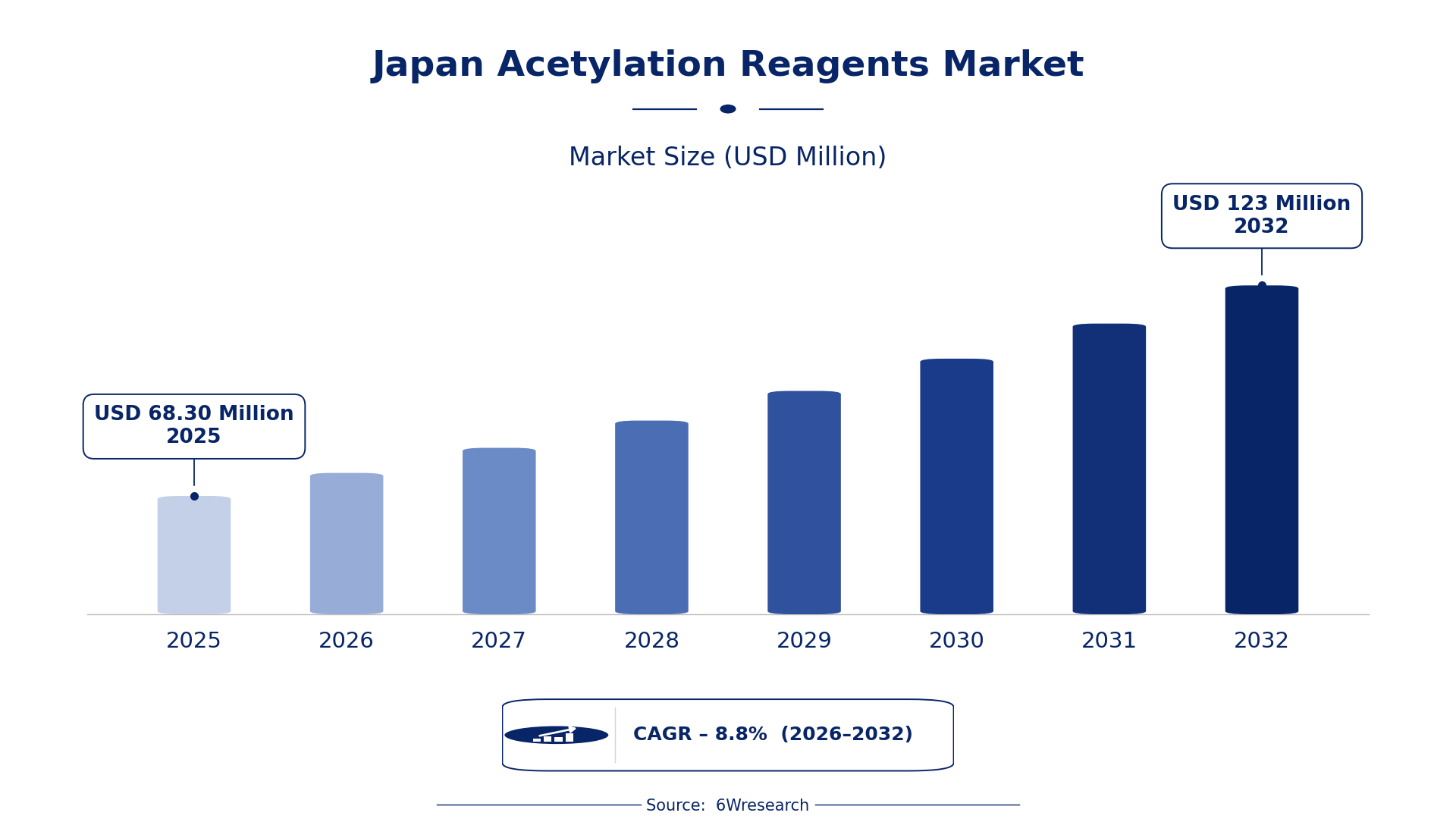
According to 6Wresearch internal database and industry insights, the Japan Acetylation Reagents Market was valued at USD 68.30 Million in 2025 and is projected to reach USD 123 Million by 2032, growing at a CAGR of approximately 8.8% during 2026–2032.
Japan Acetylation Reagents Market Highlights
| Report Metric | Details |
| Report Name | Japan Acetylation Reagents Market (2026-2032) |
| Market Size 2025 | USD 68.30 Million |
| Market Size 2032 | USD 123 Million |
| Absolute Growth 2025–2032 | USD 54.70 Million |
| CAGR 2026–2032 | 8.8% |
| Peak Annual Growth | 10.2% in 2032 |
| Forecast Period | 2026–2032 |
| Historical Data | 2022–2025 |
| Base Year | 2025 |
| Leading Product Type, 2025 | Acetic Anhydride (46% share) |
| Leading Reagent Type, 2025 | Acetyl Chloride (41% share) |
| Leading Distribution Channel, 2025 | Direct Sales (44% share) |
| Leading Application Area, 2025 | Pharmaceutical Synthesis (38% share) |
| Leading End User, 2025 | Chemical Manufacturers (55% share) |
| Fastest-Growing Product Type | Acetyl Chloride (12.4% CAGR) |
| Fastest-Growing Reagent Type | Ketene (12.7% CAGR) |
| Fastest-Growing Distribution Channel | Online Platforms (11.8% CAGR) |
| Fastest-Growing Application Area | Agrochemical Intermediates (10.9% CAGR) |
| Fastest-Growing End User | Research Institutes (11.5% CAGR) |
| Growing Sector | agrochemical sector |
| Key End Users | chemical manufacturers, pharmaceutical companies, food processing units, research institutes |
Japan Acetylation Reagents Market Year-wise Growth Rate and Key Drivers (2022–2032)
This graph illustrates the annual growth rates of the market from 2022 to 2032, highlighting a steady upward trajectory and projected market expansion over the forecast period.
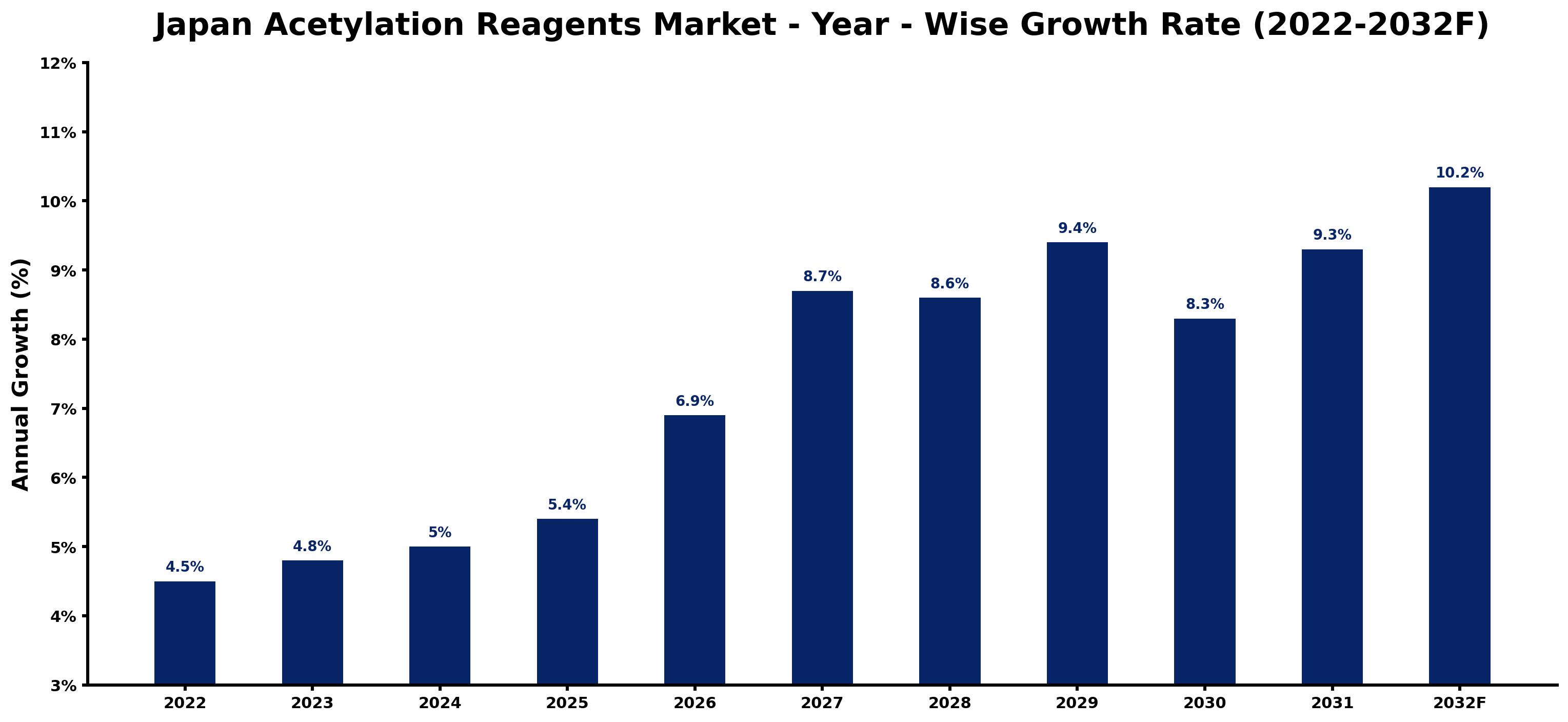
Annual growth estimates for each year appear below with the principal reason behind them, explaining the shifts that set the pace of the market.
| Year | Estimated Annual Growth (%) | Market Rationale |
| 2022 | 4.5 | The market experienced steady demand from chemical manufacturers in Japan. |
| 2023 | 4.8 | Growth accelerated due to increased pharmaceutical production needs. |
| 2024 | 5.0 | Demand continued to rise as agrochemical applications expanded. |
| 2025 | 5.4 | The market peaked historically as cellulose acetate production surged. |
| 2026 | 6.9 | Investment in chemical innovation is expected to create new opportunities. |
| 2027 | 8.7 | Rising demand for agrochemical intermediates drove growth. |
| 2028 | 8.6 | Growth slowed slightly as market conditions began to stabilise. |
| 2029 | 9.4 | Increased focus on food additives led to a faster growth rate. |
| 2030 | 8.3 | The market experienced a slowdown, but demand remained strong. |
| 2031 | 9.3 | Pharmaceutical synthesis continued to boost market growth. |
| 2032 | 10.2 | The market is projected to peak due to heightened investment in chemical manufacturing. |
Note: Market size estimations and growth projections presented in this report are based on 6Wresearch's proprietary forecasting methodology, utilizing the latest available industry data, government publications, and primary research inputs.
Japan Acetylation Reagents Market Synopsis
Acetylation reagents are essential compounds in organic synthesis, primarily used to introduce acetyl functional groups. The Japan Acetylation Reagents Market is experiencing growth, with chemical manufacturing output valued at approximately ¥10 trillion in 2023. This expansion is driven by rising demand from pharmaceutical manufacturers, ongoing investments in chemical innovation, and government support for sustainable practices in the agrochemical sector.
Market Dynamics Impact Analysis (2026–2032)
| Factor | Type | Impact | Primary Segment Affected |
| Increased pharmaceutical production drives demand for acetylation reagents. | Driver | High | Pharmaceutical Synthesis |
| Growing agrochemical sector boosts the need for acetylation reagents. | Driver | High | Agrochemical Intermediates |
| The rise of online platforms creates new sales opportunities for acetylation reagents. | Opportunity | High | Online Platforms |
| Investment in sustainable practices opens avenues for new applications. | Opportunity | Medium | Agrochemical Intermediates |
| Regulatory compliance can limit the introduction of new products. | Restraint | High | Chemical Manufacturers |
| Cost pressures from raw materials can affect pricing strategies. | Restraint | Medium | Pharmaceutical Synthesis |
| Capacity constraints in production facilities may delay supply. | Challenge | High | Chemical Manufacturers |
| Compliance with evolving regulations can increase operational costs. | Challenge | Medium | Agrochemical Intermediates |
Evaluation of Drivers in Japan Acetylation Reagents Market (2026–2032)
The table below links each growth driver to the segment it affects and the evidence for it.
| Drivers | Primary Segment Affected | Why It Matters (Evidence) |
| Rising pharmaceutical production increases the need for acetylation reagents. | Pharmaceutical Synthesis | In 2023, Japan's chemical manufacturing output was valued at approximately ¥10 trillion, driving demand. |
| Growing agrochemical applications boost the market for acetylation reagents. | Agrochemical Intermediates | The agrochemical sector is supported by government initiatives for sustainable practices. |
| The concentration of chemical manufacturing facilities improves production capabilities. | Chemical Manufacturers | This concentration enhances supply chain efficiency and responsiveness to market demands. |
| ISO 9001 certification among manufacturers ensures quality standards are met. | Chemical Manufacturers | This certification builds trust in product quality, encouraging purchases from buyers. |
| Research institutes utilize acetylation reagents for various studies. | Research Institutes | This ongoing research activity stimulates demand for high-quality reagents. |
What keeps demand rising is the increasing pharmaceutical production, which reached approximately ¥10 trillion in 2023, driving the need for acetylation reagents. The concentration of chemical manufacturing facilities in Japan enhances production capabilities, leading to more purchases by manufacturers. Ongoing research activities in various institutes stimulate demand for high-quality products, while adherence to quality standards ensures that manufacturers consistently meet buyer expectations.
Evaluation of Restraints in Japan Acetylation Reagents Market
These are the pressures that could keep growth below its potential.
| Market Restraint | Primary Segment Affected | Why It Matters (Evidence) |
| Regulatory compliance can limit the introduction of new products. | Chemical Manufacturers | The PRTR Law requires businesses to report chemical substance releases, complicating new product launches. |
| Cost pressures from raw materials can affect pricing strategies. | Pharmaceutical Synthesis | Fluctuating prices of acetic acid impact overall production costs for manufacturers. |
| Limited production capacity can delay supply. | Chemical Manufacturers | Insufficient capacity can result in longer lead times for buyers. |
| Compliance with evolving regulations can increase operational costs. | Agrochemical Intermediates | The Chemical Substances Control Law requires extensive evaluation of new substances. |
| Market competition may drive down prices, impacting profitability. | Chemical Manufacturers | Intense competition among suppliers can lead to price wars, affecting margins. |
Japan Acetylation Reagents Market Challenges
Increased competition from foreign producers drives down prices, costing domestic buyers an estimated ¥500 billion in lost margins annually. Pharmaceutical buyers encounter delays due to the Food Sanitation Act, which can extend product approval times by up to six months, hindering timely access to essential drugs. Rising costs of raw materials, particularly acetic acid, have led to a 15% increase in production expenses for chemical manufacturers, squeezing their profitability. A shortage of skilled workers in advanced chemical synthesis limits chemical producers' capacity to innovate, resulting in project delays that can exceed a year.
Trends in the Japan Acetylation Reagents Market
The shifts below are changing how Japan Acetylation Reagents Market products are bought and supplied.
- Shift from Traditional to Sustainable Practices: Since 2023, the agrochemical sector has been moving towards sustainable practices, supported by government initiatives. This shift is reflected in the sector's adaptation to new regulations, which improves product offerings and market appeal.
- Transition from Direct Sales to Online Platforms: In 2026, online platforms began gaining traction as a distribution channel, with a projected CAGR of 11.8%. This change allows suppliers to reach a broader audience, particularly smaller buyers seeking acetylation reagents.
- Emergence of Ketene as a Key Reagent: Starting in 2026, Ketene has emerged as a significant reagent type, driven by its applications in producing various acetyl derivatives. This trend reflects the evolving needs of the chemical industry in Japan.
- Growing Demand for Food Additives: In 2023, the food additives market saw increased demand, driven by consumer preferences for preserved and flavoured foods. This trend highlights the expanding role of acetylation reagents in food processing.
Investment Opportunities in the Japan Acetylation Reagents Market
The following opportunities in the Japan Acetylation Reagents Market pair current demand with a clear way in.
- Gap in Sustainable Agrochemical Solutions: With the agrochemical sector projected to grow, there is a gap for sustainable solutions. Suppliers can partner with local agrochemical manufacturers to develop eco-friendly products.
- Entry into Online Sales Channels: As online platforms gain popularity, suppliers should consider establishing partnerships to enter this distribution channel. Focusing on smaller orders can cater to niche markets effectively.
- Investment in Food Processing Technologies: The food processing industry is expanding, creating opportunities for suppliers of acetylation reagents. Collaborating with food processing units can improve market penetration.
- Expansion of Research Institute Collaborations: Research institutes are increasingly utilising acetylation reagents, presenting an opportunity for suppliers to engage in joint ventures. This collaboration can drive innovation and product development.
Government Initiatives in the Japan Acetylation Reagents Market
The PRTR Law requires businesses to report releases of designated chemical substances, impacting how chemical manufacturers handle acetylation reagents. Compliance with this law ensures that producers maintain transparency and adhere to safety standards, which is essential for maintaining market access. In 2023, approximately 1,500 businesses reported under this law, highlighting its significance in the industry.
The PMD Act regulates the approval and quality of pharmaceuticals, affecting how pharmaceutical manufacturers utilize acetylation reagents. This law ensures that products meet stringent quality requirements, providing assurance to buyers about the safety and efficacy of the reagents used in their processes. In 2023, over 2,000 products were approved under this act, demonstrating its impact on the market.
Future Insight of the Japan Acetylation Reagents Market
Pharmaceutical manufacturers will increasingly adopt advanced synthesis technologies by 2032, enhancing efficiency in drug development. Government initiatives will support sustainable agrochemical practices, encouraging innovation in this sector. The Tokyo region will likely see a 20% increase in chemical manufacturing output by 2032, driven by innovation programs and a focus on safe chemical handling practices. Chemical producers will expand their use of acetylation reagents, driving breakthroughs in various applications.
Market Segmentation Analysis
Japan Acetylation Reagents Market report covers a detailed analysis of the following market segments:
By Product Type – Acetic Anhydride Leads, Acetyl Chloride Expected to Grow Fastest
According to Saurav Kr Singh, Senior Research Analyst at 6Wresearch, Acetic Anhydride accounted for 46% of the market by product type in 2025. Acetic Anhydride holds the largest share because it is vital for producing cellulose acetate, which is extensively used in various applications within Japan's chemical industry. Its importance is highlighted by its widespread use in pharmaceutical synthesis, making it indispensable for creating essential compounds. Acetyl Chloride is projected to grow fastest, at a CAGR of 12.4% during 2026–2032. Acetyl Chloride is experiencing rapid growth due to its critical role in pharmaceutical synthesis, particularly in regions with increasing production demands. This segment's growth is expected to continue as the pharmaceutical industry seeks to expand its capabilities and output. Suppliers should focus on enhancing their Acetyl Chloride offerings to meet the rising demand from the pharmaceutical sector.
By Reagent Type – Acetyl Chloride Leads, Ketene Expected to Grow Fastest
Acetyl Chloride took 41% of reagent type revenue in 2025, more than any other category. Acetyl Chloride leads this segment due to its widespread application in synthesising pharmaceuticals and agrochemicals, making it indispensable for manufacturers. Its importance is highlighted by the ongoing projects in the chemical sector that rely heavily on this reagent. The quickest growth will come from Ketene, forecast to expand at a CAGR of 12.7% between 2026 and 2032. Ketene is the fastest-growing reagent type, driven by its significance in producing various acetyl derivatives that are increasingly sought after in specialised applications. This growth reflects a broader trend towards more complex chemical formulations in the industry. Buyers may benefit from exploring Ketene as a strategic investment for future projects.
By Distribution Channel – Direct Sales Leads, Online Platforms Expected to Grow Fastest
With 44% of distribution channel revenue in 2025, Direct Sales was the largest category. Direct Sales is the dominant channel, catering to industrial customers who require large quantities of acetylation reagents directly from manufacturers. This method ensures reliability and efficiency, which are essential in the chemical manufacturing industry. Online Platforms are set to record the highest CAGR in this split, 11.8% over 2026–2032. Online Platforms are growing quickly, albeit from a smaller base, as they offer convenience for smaller orders and a wider range of products. The ongoing shift towards digital purchasing processes in the chemical industry is driving this trend. Suppliers should improve their online presence to effectively engage with the increasing number of buyers who prefer digital purchasing methods.
By Application Area – Pharmaceutical Synthesis Leads, Agrochemical Intermediates Expected to Grow Fastest
The largest application area category in 2025 was Pharmaceutical Synthesis, at 38% of revenue. Pharmaceutical Synthesis is the leading application area, representing a substantial share of acetylation reagent usage in Japan. This prominence is largely attributed to the robust pharmaceutical sector that relies on these reagents for producing essential medications. Over 2026–2032, Agrochemical Intermediates are expected to post the fastest growth, at a CAGR of 10.9%. Agrochemical Intermediates are the fastest-growing application area, driven by the rising demand for pesticides and a shift towards sustainable agricultural practices. Government initiatives that promote innovation in agrochemicals are further supporting this growth. Suppliers should align their product strategies with the needs of the agrochemical sector to capitalise on its growth potential.
By End User – Chemical Manufacturers Lead, Research Institutes Expected to Grow Fastest
Chemical Manufacturers held 55% of the Japan Acetylation Reagents Market by end user in 2025. Chemical Manufacturers represent the largest end user segment, as they require acetylation reagents for various production processes. The scale of operations in this sector ensures a consistent demand for these chemicals. Research Institutes are projected to grow fastest, at a CAGR of 11.5% during 2026–2032. Research Institutes are the fastest-growing end user group, as they increasingly utilise acetylation reagents for research and development purposes. This trend indicates a rising focus on innovation and new applications in the chemical field. Suppliers should consider tailoring their products to meet the specific needs of research institutions to capture this emerging market.
Key Attractiveness of the Report
- 10 Years of Market Numbers
- Historical Data Starting from 2022 to 2025
- Base Year 2025
- Forecast Data until 2032
- Key Performance Indicators Impacting the Market
- Major Upcoming Developments and Projects
Key Highlights of the Report:
- Japan Acetylation Reagents Market Outlook
- Market Size of Japan Acetylation Reagents Market, 2025
- Forecast of Japan Acetylation Reagents Market, 2032
- Historical Data and Forecast of Japan Acetylation Reagents Revenues & Volume for the Period 2022-2032F
- Japan Acetylation Reagents Market Trend Evolution
- Japan Acetylation Reagents Market Drivers and Challenges
- Japan Acetylation Reagents Price Trends
- Japan Acetylation Reagents Porter's Five Forces
- Japan Acetylation Reagents Industry Life Cycle
- Historical Data and Forecast of Japan Acetylation Reagents Market Revenues & Volume By Product Type for the Period 2022-2032F
- Historical Data and Forecast of Japan Acetylation Reagents Market Revenues & Volume By Acetic Anhydride for the Period 2022-2032F
- Historical Data and Forecast of Japan Acetylation Reagents Market Revenues & Volume By Acetyl Chloride for the Period 2022-2032F
- Historical Data and Forecast of Japan Acetylation Reagents Market Revenues & Volume By Isopropenyl Acetate for the Period 2022-2032F
- Historical Data and Forecast of Japan Acetylation Reagents Market Revenues & Volume By Acetyl Fluoride for the Period 2022-2032F
- Historical Data and Forecast of Japan Acetylation Reagents Market Revenues & Volume By Reagent Type for the Period 2022-2032F
- Historical Data and Forecast of Japan Acetylation Reagents Market Revenues & Volume By Acetyl Chloride for the Period 2022-2032F
- Historical Data and Forecast of Japan Acetylation Reagents Market Revenues & Volume By Ketene for the Period 2022-2032F
- Historical Data and Forecast of Japan Acetylation Reagents Market Revenues & Volume By Vinyl Acetate for the Period 2022-2032F
- Historical Data and Forecast of Japan Acetylation Reagents Market Revenues & Volume By Other Specialty for the Period 2022-2032F
- Historical Data and Forecast of Japan Acetylation Reagents Market Revenues & Volume By Distribution Channel for the Period 2022-2032F
- Historical Data and Forecast of Japan Acetylation Reagents Market Revenues & Volume By Direct Sales for the Period 2022-2032F
- Historical Data and Forecast of Japan Acetylation Reagents Market Revenues & Volume By Online Platforms for the Period 2022-2032F
- Historical Data and Forecast of Japan Acetylation Reagents Market Revenues & Volume By Distributors for the Period 2022-2032F
- Historical Data and Forecast of Japan Acetylation Reagents Market Revenues & Volume By Specialty Stores for the Period 2022-2032F
- Historical Data and Forecast of Japan Acetylation Reagents Market Revenues & Volume By Application Area for the Period 2022-2032F
- Historical Data and Forecast of Japan Acetylation Reagents Market Revenues & Volume By Pharmaceutical Synthesis for the Period 2022-2032F
- Historical Data and Forecast of Japan Acetylation Reagents Market Revenues & Volume By Agrochemical Intermediates for the Period 2022-2032F
- Historical Data and Forecast of Japan Acetylation Reagents Market Revenues & Volume By Food Additives for the Period 2022-2032F
- Historical Data and Forecast of Japan Acetylation Reagents Market Revenues & Volume By Dyes & Pigments for the Period 2022-2032F
- Historical Data and Forecast of Japan Acetylation Reagents Market Revenues & Volume By End User for the Period 2022-2032F
- Historical Data and Forecast of Japan Acetylation Reagents Market Revenues & Volume By Chemical Manufacturers for the Period 2022-2032F
- Historical Data and Forecast of Japan Acetylation Reagents Market Revenues & Volume By Research Institutes for the Period 2022-2032F
- Historical Data and Forecast of Japan Acetylation Reagents Market Revenues & Volume By Food Processing Units for the Period 2022-2032F
- Historical Data and Forecast of Japan Acetylation Reagents Market Revenues & Volume By Textile Industry for the Period 2022-2032F
- Japan Acetylation Reagents Import Export Trade Statistics
- Market Opportunity Assessment By Product Type
- Market Opportunity Assessment By Reagent Type
- Market Opportunity Assessment By Distribution Channel
- Market Opportunity Assessment By Application Area
- Market Opportunity Assessment By End User
- Japan Acetylation Reagents Top Companies Market Share
- Japan Acetylation Reagents Competitive Benchmarking By Technical and Operational Parameters
- Japan Acetylation Reagents Company Profiles
- Japan Acetylation Reagents Key Strategic Recommendations
Market Covered
The study includes the following segmentation.
By Product Type
- Acetic Anhydride
- Acetyl Chloride
- Isopropenyl Acetate
- Acetyl Fluoride
By Reagent Type
- Acetyl Chloride
- Ketene
- Vinyl Acetate
- Other Specialty
By Distribution Channel
- Direct Sales
- Online Platforms
- Distributors
- Specialty Stores
By Application Area
- Pharmaceutical Synthesis
- Agrochemical Intermediates
- Food Additives
- Dyes & Pigments
By End User
- Chemical Manufacturers
- Research Institutes
- Food Processing Units
- Textile Industry































