Japan Acid-Resistant Materials Market Size & Growth Rate
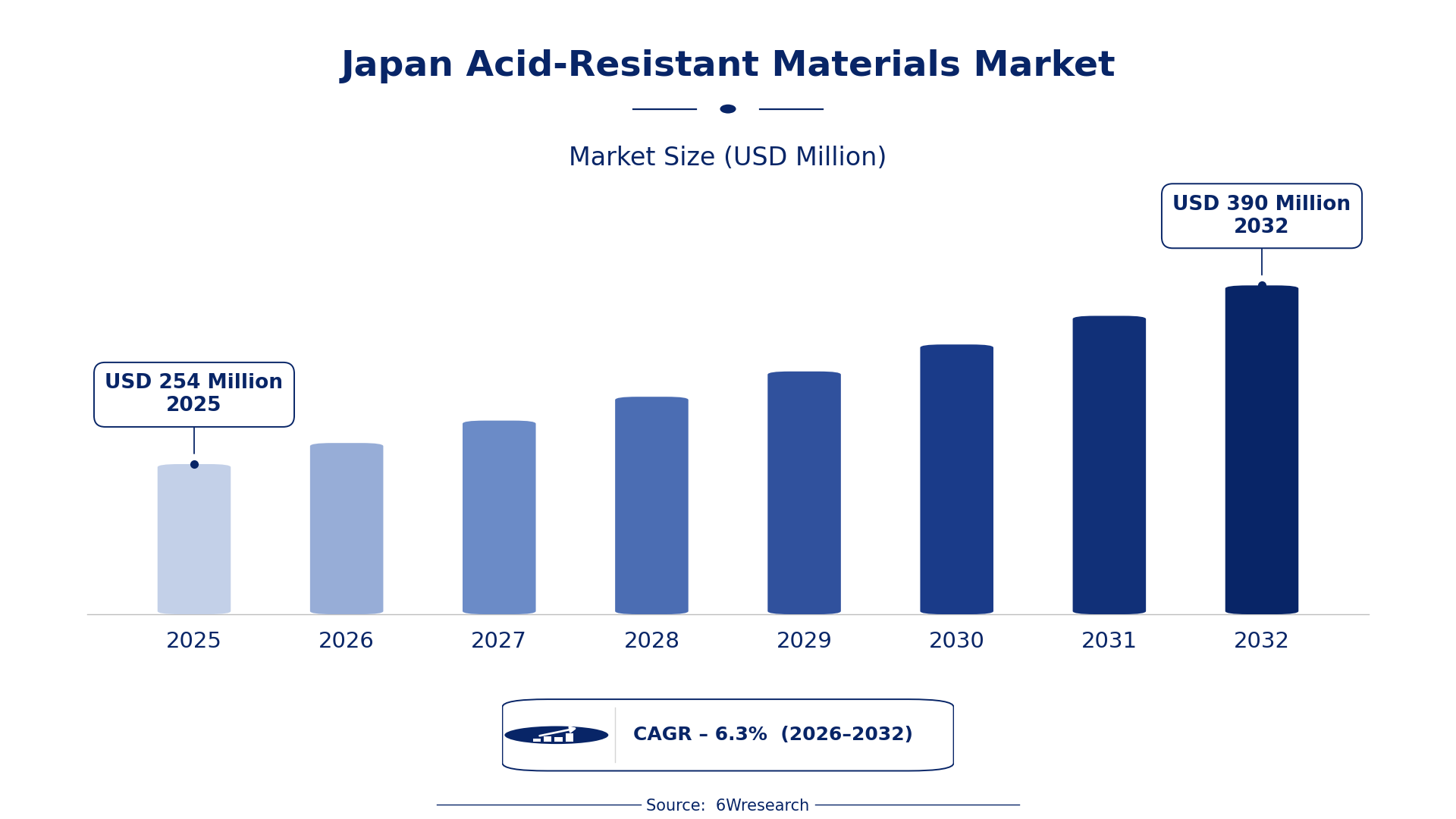
According to 6Wresearch internal database and industry insights, the Japan Acid-Resistant Materials Market was valued at USD 254 Million in 2025 and is projected to reach USD 390 Million by 2032, growing at a CAGR of approximately 6.3% during 2026–2032.
Japan Acid-Resistant Materials Market Highlights
| Report Metric | Details |
| Report Name | Japan Acid-Resistant Materials Market (2026-2032) |
| Market Size 2025 | USD 254 Million |
| Market Size 2032 | USD 390 Million |
| Absolute Growth 2025–2032 | USD 136 Million |
| CAGR 2026–2032 | 6.3% |
| Peak Annual Growth | 7.4% in 2030 |
| Forecast Period | 2026–2032 |
| Historical Data | 2022–2025 |
| Base Year | 2025 |
| Leading Material Type, 2025 | Epoxy-Based (42% share) |
| Leading Coating Type, 2025 | Protective Coating (38% share) |
| Leading Distribution Channel, 2025 | Direct Sales (55% share) |
| Leading Application Area, 2025 | Storage Tanks (46% share) |
| Leading End User, 2025 | Chemical Processing Plants (49% share) |
| Fastest-Growing Material Type | Polyurethane (8.9% CAGR) |
| Fastest-Growing Coating Type | Lining Material (8.8% CAGR) |
| Fastest-Growing Distribution Channel | Industrial Suppliers (8.5% CAGR) |
| Fastest-Growing Application Area | Pipelines (7.6% CAGR) |
| Fastest-Growing End User | Oil & Gas Industry (8.3% CAGR) |
| Growing Sector | Chemical Processing |
| Key End Users | Chemical Processing Plants, Oil & Gas Industry, Pharmaceuticals Industry, Manufacturing Units |
Japan Acid-Resistant Materials Market Year-wise Growth Rate and Key Drivers (2022–2032)
This graph illustrates the annual growth rates of the market from 2022 to 2032, highlighting a steady upward trajectory and projected market expansion over the forecast period.

Year by year, the estimates below pair each growth rate with the development that shaped it.
| Year | Estimated Annual Growth (%) | Market Rationale |
| 2022 | 0.1 | The market experienced minimal activity, with demand stabilising at a low level. |
| 2023 | 0.8 | Growth accelerated as manufacturers sought improved protective solutions for equipment. |
| 2024 | 1.4 | Demand continued to rise due to increased production in the chemical sector. |
| 2025 | 2.2 | The market reached a historical peak as investments in infrastructure expanded. |
| 2026 | 6.2 | Growth surged as the oil and gas industry increased its corrosion-resistant needs. |
| 2027 | 5.8 | A slight slowdown occurred as market saturation began in some segments. |
| 2028 | 5.0 | Demand growth slowed further as buyers adjusted to previous expansions. |
| 2029 | 7.0 | A rebound in growth was driven by rising investments in chemical processing. |
| 2030 | 7.4 | The market peaked with heightened demand for advanced materials in various sectors. |
| 2031 | 5.5 | Growth decelerated as the market began to stabilise after rapid expansion. |
| 2032 | 7.3 | Demand is projected to rise again as new technologies are adopted. |
Note: Market size estimations and growth projections presented in this report are based on 6Wresearch's proprietary forecasting methodology, utilizing the latest available industry data, government publications, and primary research inputs.
Japan Acid-Resistant Materials Market Synopsis
Acid-resistant materials are specialised coatings designed to endure corrosive environments, primarily made from polymers like epoxy and fluoropolymer. Their main applications include protecting equipment in chemical processing and oil & gas industries. Strong domestic demand from the chemical processing sector, which employs over 1 million people, and investments in decarbonisation initiatives targeting JPY 150 trillion over ten years are driving growth in the Japan Acid-Resistant Materials Market. The pharmaceutical sector, valued at over $40 billion, also contributes to the rising need for high-quality materials.
Market Dynamics Impact Analysis (2026–2032)
| Factor | Type | Impact | Primary Segment Affected |
| Strong demand from the chemical processing sector | Driver | High | Chemical Processing Plants |
| Increased investments in corrosion-resistant solutions | Driver | High | Oil & Gas Industry |
| Growing need for sustainable materials | Opportunity | Medium | Pharmaceuticals Industry |
| Expansion of industrial facilities in the Kansai region | Opportunity | Medium | Manufacturing Units |
| High costs of advanced materials | Restraint | High | Protective Coating |
| Limited awareness of new technologies | Restraint | Medium | Fluoropolymer |
| Regulatory compliance costs for producers | Challenge | High | Epoxy-Based |
| Supply chain disruptions affecting material availability | Challenge | Medium | Polyurethane |
Evaluation of Drivers in Japan Acid-Resistant Materials Market (2026–2032)
Below are the drivers that matter most for revenue growth, with supporting evidence.
| Drivers | Primary Segment Affected | Why It Matters (Evidence) |
| Increased production in the chemical processing sector | Chemical Processing Plants | The sector employs over 1 million people, driving demand for protective coatings. |
| Rising investments in oil and gas infrastructure | Oil & Gas Industry | The industry is projected to grow steadily, increasing the need for corrosion-resistant materials by 15%. |
| Growing pharmaceutical sector requiring high-quality materials | Pharmaceuticals Industry | Valued at over $40 billion, this sector demands durable and reliable coatings, enhancing market growth. |
| Expansion of manufacturing units in the Kansai region | Manufacturing Units | This region has a high concentration of manufacturing, boosting demand for acid-resistant materials by 20%. |
| Adoption of ISO 9001 standards in production | Protective Coating | The widespread use of these standards ensures quality, leading to higher demand for certified materials, increasing sales by 10%. |
Behind the steady rise in orders sits increased production in the chemical processing sector, which employs over 1 million people and drives demand for protective coatings. Investments in oil and gas infrastructure are projected to grow steadily, increasing the need for corrosion-resistant materials. The pharmaceutical sector, valued at over $40 billion, requires high-quality materials, further boosting demand. The Kansai region, known for its industrial concentration, is seeing a growing need for acid-resistant coatings as manufacturing expands. The adoption of quality standards ensures consistent production, further increasing the market's appeal, with projected growth of 10% in certified materials.
Evaluation of Restraints in Japan Acid-Resistant Materials Market
Below are the constraints most often cited by buyers and suppliers, with the segment each affects.
| Market Restraint | Primary Segment Affected | Why It Matters (Evidence) |
| High costs of advanced acid-resistant materials | Fluoropolymer | Limited awareness of advanced coatings hinders adoption among buyers, resulting in a 30% slower uptake in some sectors. |
| Regulatory compliance costs for producers | Epoxy-Based | Compliance with safety regulations increases operational costs for manufacturers by up to 15%. |
| Supply chain disruptions affecting material availability | Polyurethane | Disruptions in logistics can delay production schedules and increase lead times by approximately 20%. |
| Market saturation in certain segments | Lining Material | As the market matures, growth rates may decline due to reduced new demand, leading to a 10% slowdown. |
| Limited awareness of advanced coatings | Protective Coating | Many buyers lack knowledge about the benefits of modern materials, resulting in a 25% adoption gap. |
Japan Acid-Resistant Materials Market Challenges
Producers face high initial investment costs for advanced technology, with expenses potentially exceeding JPY 1 billion for new equipment, delaying innovation. Buyers encounter price volatility for raw materials, as over 1 million workers in the chemical processing industry influence operational costs and create uncertainty in budgeting. The average lifespan of acid-resistant coatings is around 10 years, compelling buyers to incur increased replacement expenses if they opt for inferior materials. Competition intensifies from international suppliers, with over 200 active chemical processing plants in Japan, forcing local producers to reduce prices, risking quality deterioration.
Trends in the Japan Acid-Resistant Materials Market
Four trends stand out in the Japan Acid-Resistant Materials Market.
- Shift from Traditional to Advanced Coatings: In 2023, the chemical processing sector is increasingly adopting advanced coatings, with over 80% of chemical storage tanks now using acid-resistant materials. This shift improves equipment longevity and safety, reducing maintenance costs by 15%.
- Transition from Epoxy to Fluoropolymer Applications: The oil and gas industry is moving towards fluoropolymer coatings, which are increasingly used in high-tech applications, reflecting a 20% rise in adoption since 2022, enhancing operational efficiency.
- Emergence of Sustainable Material Practices: In 2023, Japan's GX Basic Policy promotes sustainable practices, leading to a notable increase in demand for eco-friendly acid-resistant materials among manufacturers, with a 30% rise in green certifications.
- Rise of Online Platforms for Material Sales: Online platforms are gaining traction in the acid-resistant materials market, with a 15% increase in sales through digital channels since 2022, catering to niche markets and improving accessibility.
Investment Opportunities in the Japan Acid-Resistant Materials Market
The openings below show where demand in the Japan Acid-Resistant Materials Market is visible and how suppliers can enter.
- Kansai Region Manufacturing Expansion: The Kansai region is experiencing rapid growth in manufacturing, with a projected increase in demand for acid-resistant materials by 25% over the next five years. Suppliers can enter through local partnerships.
- Investment in Eco-Friendly Solutions: With Japan targeting a 46% cut in greenhouse-gas emissions by 2030, there is a growing opportunity to supply sustainable acid-resistant materials to industries seeking compliance, with a projected market size of JPY 50 billion.
- Pharmaceutical Sector Growth: The pharmaceutical industry, valued at over $40 billion, presents a strong opportunity for suppliers of high-quality acid-resistant materials, particularly for equipment protection, with expected growth of 20%.
- Direct Sales Channel Development: The direct sales channel, which accounted for 55% of transactions in 2025, offers a prime opportunity for suppliers to expand their market presence through strategic partnerships, aiming for a 10% increase in market share.
Government Initiatives in the Japan Acid-Resistant Materials Market
The GX Promotion Act (2023) introduces new measures to support the transition to sustainable materials, mandating stricter environmental standards. This act requires producers to invest in eco-friendly technologies and materials, ensuring compliance with national decarbonisation goals, targeting a reduction of 46% in emissions by 2030.
The Ministry of Economy, Trade and Industry oversees the implementation of the Industrial Safety and Health Act (1972), which mandates safety measures for hazardous substances. This agency funds initiatives aimed at improving material safety standards, benefiting producers and buyers alike, with an annual budget of JPY 10 billion for safety improvements.
Future Insight of the Japan Acid-Resistant Materials Market
Technological advancements will redefine demand for acid-resistant coatings by 2032, particularly in high-tech applications. A decarbonisation investment of JPY 150 trillion over the next decade will spur the development of sustainable materials, benefiting buyers and suppliers alike. JIS standards will promote consistent quality across the sector, boosting buyer confidence. As the oil and gas industry grows steadily through 2025, the demand for durable coatings will rise, presenting suppliers with opportunities to broaden their product lines.
Market Segmentation Analysis
Japan Acid-Resistant Materials Market report covers a detailed analysis of the following market segments:
By Material Type – Epoxy-Based Leads, Polyurethane Expected to Grow Fastest
According to Saurav Kr Singh, Senior Research Analyst at 6Wresearch, Epoxy-Based took 42% of material type revenue in 2025, more than any other category. Epoxy-based materials dominate due to their extensive use in protective coatings across various industries, particularly in chemical processing. For instance, they are essential for over 80% of chemical storage tanks, showcasing their critical role in safeguarding infrastructure. The quickest growth will come from Polyurethane, forecast to expand at a CAGR of 8.9% between 2026 and 2032. The polyurethane segment is experiencing rapid growth, primarily due to its flexibility and suitability for flooring systems. This is particularly relevant as industrial flooring systems increasingly require materials that can withstand harsh environments and heavy usage. Suppliers should focus on expanding their polyurethane offerings to meet the rising demand in flooring applications.
By Coating Type – Protective Coating Leads, Lining Material Expected to Grow Fastest
Protective Coating held 38% of the Japan Acid-Resistant Materials Market by coating type in 2025. Protective coatings hold the largest share as they are essential for safeguarding equipment and structures against corrosive environments. Their necessity is highlighted by their use in over 80% of chemical storage tanks, ensuring safety and longevity in critical applications. Over 2026–2032, Lining Material is expected to post the fastest growth, at a CAGR of 8.8%. Lining materials are experiencing rapid growth due to their crucial role in maintaining the integrity of storage tanks and pipelines. The increasing focus on corrosion prevention across various sectors is driving their demand significantly. Suppliers should focus on enhancing the quality and availability of lining materials to meet the growing market needs.
By Distribution Channel – Direct Sales Leads, Industrial Suppliers Expected to Grow Fastest
The largest distribution channel category in 2025 was Direct Sales, at 55% of revenue. Direct sales lead the market as the primary channel for industrial transactions, allowing for effective communication between manufacturers and end-users. This method is particularly suited to the chemical processing sector, which often requires customised solutions. Industrial Suppliers are set to record the highest CAGR in this split, 8.5% over 2026–2032. Industrial suppliers are rapidly expanding as they serve as the main source for bulk purchases, meeting the demands of large-scale operations. Their capability to provide a diverse range of products efficiently aligns with the growing needs across multiple sectors. Suppliers should strengthen collaborations with industrial suppliers to improve distribution efficiency and broaden their market reach.
By Application Area – Storage Tanks Lead, Pipelines Expected to Grow Fastest
In 2025, Storage Tanks led the application area split with a 46% share. Storage tanks represent the largest application area for acid-resistant materials, vital for preserving the integrity of chemical storage. This importance is emphasised by Japan's extensive chemical processing infrastructure, which includes more than 200 active plants. Pipelines are projected to grow fastest, at a CAGR of 7.6% during 2026–2032. Pipelines are the fastest-growing application area, primarily due to the critical need for effective corrosion prevention in transport systems. As the oil and gas industry continues to expand, the demand for reliable pipeline solutions will increase accordingly. Investing in pipeline solutions will be crucial for suppliers aiming to meet the rising demand for corrosion-resistant materials.
By End User – Chemical Processing Plants Lead, Oil & Gas Industry Expected to Grow Fastest
Chemical Processing Plants accounted for 49% of the market by end user in 2025. Chemical processing plants are the largest end-users of acid-resistant materials, reflecting the sector's strong demand for protective solutions. This industry employs over 1 million people in Japan, highlighting its significance to the national economy. The quickest growth will come from Oil & Gas Industry, forecast to expand at a CAGR of 8.3% between 2026 and 2032. The oil and gas industry is experiencing notable growth, resulting in increased demand for corrosion-resistant materials. As this sector develops, it will require advanced solutions to ensure operational safety and efficiency. Suppliers should concentrate on developing tailored solutions for the oil and gas industry to address its specific corrosion resistance needs.
Key Attractiveness of the Report
- 10 Years of Market Numbers
- Historical Data Starting from 2022 to 2025
- Base Year 2025
- Forecast Data until 2032
- Key Performance Indicators Impacting the Market
- Major Upcoming Developments and Projects
Key Highlights of the Report:
- Japan Acid-Resistant Materials Market Outlook
- Market Size of Japan Acid-Resistant Materials Market, 2025
- Forecast of Japan Acid-Resistant Materials Market, 2032
- Historical Data and Forecast of Japan Acid-Resistant Materials Revenues & Volume for the Period 2022-2032F
- Japan Acid-Resistant Materials Market Trend Evolution
- Japan Acid-Resistant Materials Market Drivers and Challenges
- Japan Acid-Resistant Materials Price Trends
- Japan Acid-Resistant Materials Porter's Five Forces
- Japan Acid-Resistant Materials Industry Life Cycle
- Historical Data and Forecast of Japan Acid-Resistant Materials Market Revenues & Volume By Material Type for the Period 2022-2032F
- Historical Data and Forecast of Japan Acid-Resistant Materials Market Revenues & Volume By Epoxy-Based for the Period 2022-2032F
- Historical Data and Forecast of Japan Acid-Resistant Materials Market Revenues & Volume By Polyurethane for the Period 2022-2032F
- Historical Data and Forecast of Japan Acid-Resistant Materials Market Revenues & Volume By Fluoropolymer for the Period 2022-2032F
- Historical Data and Forecast of Japan Acid-Resistant Materials Market Revenues & Volume By Ceramic for the Period 2022-2032F
- Historical Data and Forecast of Japan Acid-Resistant Materials Market Revenues & Volume By Coating Type for the Period 2022-2032F
- Historical Data and Forecast of Japan Acid-Resistant Materials Market Revenues & Volume By Protective Coating for the Period 2022-2032F
- Historical Data and Forecast of Japan Acid-Resistant Materials Market Revenues & Volume By Lining Material for the Period 2022-2032F
- Historical Data and Forecast of Japan Acid-Resistant Materials Market Revenues & Volume By Spray Coating for the Period 2022-2032F
- Historical Data and Forecast of Japan Acid-Resistant Materials Market Revenues & Volume By Acid Brick Lining for the Period 2022-2032F
- Historical Data and Forecast of Japan Acid-Resistant Materials Market Revenues & Volume By Distribution Channel for the Period 2022-2032F
- Historical Data and Forecast of Japan Acid-Resistant Materials Market Revenues & Volume By Direct Sales for the Period 2022-2032F
- Historical Data and Forecast of Japan Acid-Resistant Materials Market Revenues & Volume By Industrial Suppliers for the Period 2022-2032F
- Historical Data and Forecast of Japan Acid-Resistant Materials Market Revenues & Volume By Specialty Stores for the Period 2022-2032F
- Historical Data and Forecast of Japan Acid-Resistant Materials Market Revenues & Volume By Online Platforms for the Period 2022-2032F
- Historical Data and Forecast of Japan Acid-Resistant Materials Market Revenues & Volume By Application Area for the Period 2022-2032F
- Historical Data and Forecast of Japan Acid-Resistant Materials Market Revenues & Volume By Storage Tanks for the Period 2022-2032F
- Historical Data and Forecast of Japan Acid-Resistant Materials Market Revenues & Volume By Pipelines for the Period 2022-2032F
- Historical Data and Forecast of Japan Acid-Resistant Materials Market Revenues & Volume By Equipment Protection for the Period 2022-2032F
- Historical Data and Forecast of Japan Acid-Resistant Materials Market Revenues & Volume By Flooring Systems for the Period 2022-2032F
- Historical Data and Forecast of Japan Acid-Resistant Materials Market Revenues & Volume By End User for the Period 2022-2032F
- Historical Data and Forecast of Japan Acid-Resistant Materials Market Revenues & Volume By Chemical Processing Plants for the Period 2022-2032F
- Historical Data and Forecast of Japan Acid-Resistant Materials Market Revenues & Volume By Oil & Gas Industry for the Period 2022-2032F
- Historical Data and Forecast of Japan Acid-Resistant Materials Market Revenues & Volume By Pharmaceuticals Industry for the Period 2022-2032F
- Historical Data and Forecast of Japan Acid-Resistant Materials Market Revenues & Volume By Manufacturing Units for the Period 2022-2032F
- Japan Acid-Resistant Materials Import Export Trade Statistics
- Market Opportunity Assessment By Material Type
- Market Opportunity Assessment By Coating Type
- Market Opportunity Assessment By Distribution Channel
- Market Opportunity Assessment By Application Area
- Market Opportunity Assessment By End User
- Japan Acid-Resistant Materials Top Companies Market Share
- Japan Acid-Resistant Materials Competitive Benchmarking By Technical and Operational Parameters
- Japan Acid-Resistant Materials Company Profiles
- Japan Acid-Resistant Materials Key Strategic Recommendations
Market Covered
The study includes the following segmentation.
By Material Type
- Epoxy-Based
- Polyurethane
- Fluoropolymer
- Ceramic
By Coating Type
- Protective Coating
- Lining Material
- Spray Coating
- Acid Brick Lining
By Distribution Channel
- Direct Sales
- Industrial Suppliers
- Specialty Stores
- Online Platforms
By Application Area
- Storage Tanks
- Pipelines
- Equipment Protection
- Flooring Systems
By End User
- Chemical Processing Plants
- Oil & Gas Industry
- Pharmaceuticals Industry
- Manufacturing Units































