Japan Acoustic Insulation Material Market Size & Growth Rate
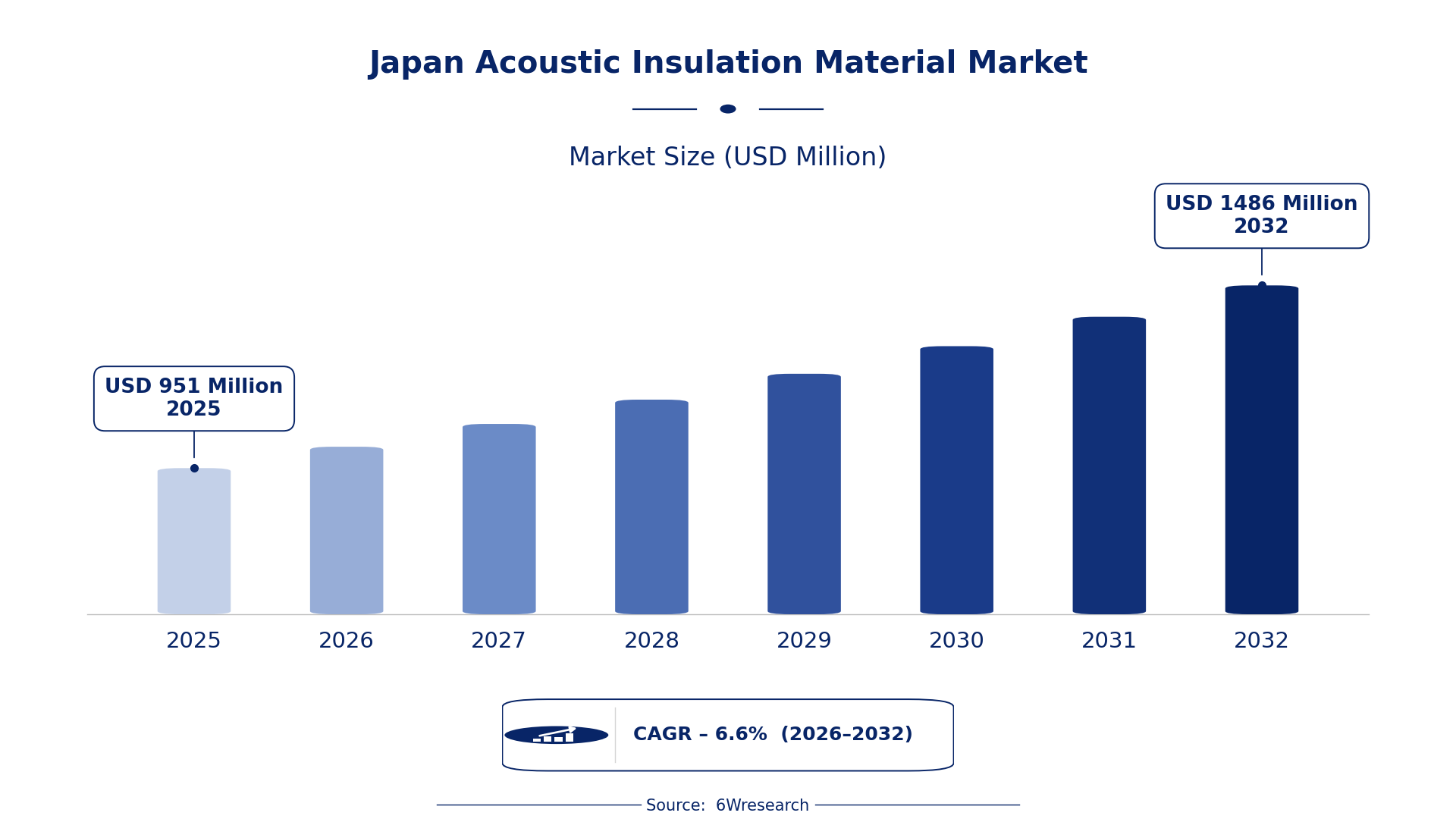
According to 6Wresearch internal database and industry insights, the Japan Acoustic Insulation Material Market was valued at USD 951 Million in 2025 and is projected to reach USD 1,486 Million by 2032, growing at a CAGR of approximately 6.6% during 2026–2032.
Japan Acoustic Insulation Material Market Highlights
| Report Metric | Details |
| Report Name | Japan Acoustic Insulation Material Market (2026-2032) |
| Market Size 2025 | USD 951 Million |
| Market Size 2032 | USD 1,486 Million |
| Absolute Growth 2025–2032 | USD 535 Million |
| CAGR 2026–2032 | 6.6% |
| Peak Annual Growth | 7.1% in 2032 |
| Forecast Period | 2026–2032 |
| Historical Data | 2022–2025 |
| Base Year | 2025 |
| Leading Product Type, 2025 | Glass Wool (51% share) |
| Leading Material Base, 2025 | Fiberglass (47% share) |
| Leading Distribution Channel, 2025 | Direct Sales (41% share) |
| Leading End User Industry, 2025 | Residential Buildings (40% share) |
| Fastest-Growing Product Type | Melamine Foam (9.1% CAGR) |
| Fastest-Growing Material Base | Synthetic Polymers (9.5% CAGR) |
| Fastest-Growing Distribution Channel | Online Platforms (8.6% CAGR) |
| Fastest-Growing End User Industry | Hospitals (8.4% CAGR) |
| Growing Sector | Residential Buildings |
| Key End Users | Construction companies, hospitals, airports, residential developers |
Japan Acoustic Insulation Material Market Year-wise Growth Rate and Key Drivers (2022–2032)
This graph illustrates the annual growth rates of the market from 2022 to 2032, highlighting a steady upward trajectory and projected market expansion over the forecast period.
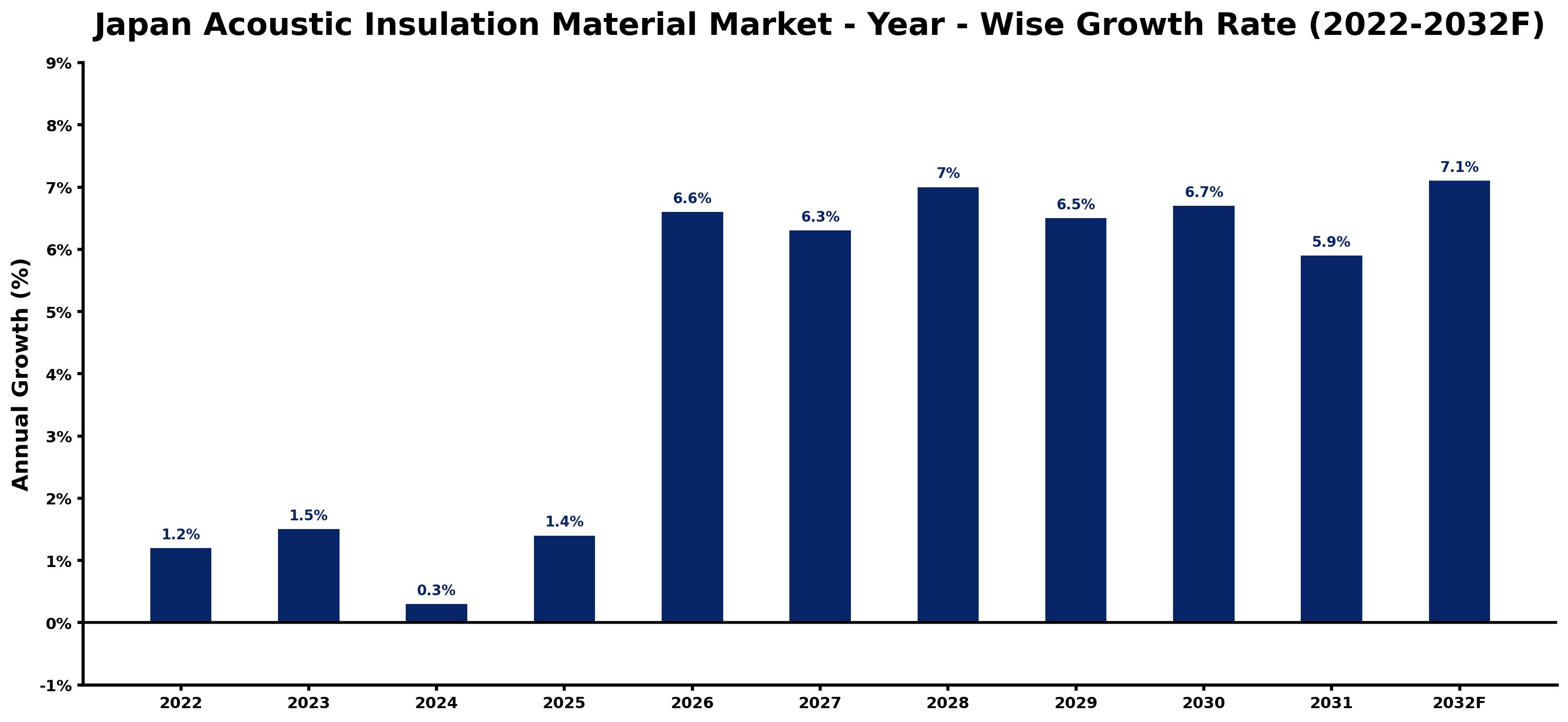
The following figures match every annual growth estimate with the main market development of that year, giving the reasoning behind each rise or slowdown.
| Year | Estimated Annual Growth (%) | Market Rationale |
| 2022 | 1.2 | The market showed stable growth with increased interest in soundproofing solutions. |
| 2023 | 1.5 | Demand rose as construction activities expanded, particularly in urban areas. |
| 2024 | 0.3 | Growth slowed due to a temporary dip in construction projects. |
| 2025 | 1.4 | Increased investments in residential buildings spurred demand for insulation materials. |
| 2026 | 6.6 | The market is expected to accelerate as eco-friendly materials gain traction. |
| 2027 | 6.3 | A slight slowdown is expected as market adjustments take place following rapid growth. |
| 2028 | 7.0 | Growth is projected to rise again with heightened focus on urban noise reduction. |
| 2029 | 6.5 | Demand is expected to slow slightly as the market stabilises after previous peaks. |
| 2030 | 6.7 | Growth is expected to increase as new building regulations come into effect. |
| 2031 | 5.9 | A slowdown is anticipated as market conditions normalise after rapid expansion. |
| 2032 | 7.1 | The market is projected to peak with increased investments in noise reduction. |
Note: Market size estimations and growth projections presented in this report are based on 6Wresearch's proprietary forecasting methodology, utilizing the latest available industry data, government publications, and primary research inputs.
Japan Acoustic Insulation Material Market Synopsis
Acoustic insulation materials are designed to reduce sound transmission in various environments, made from materials like polyurethane foam and glass wool. These materials are primarily used for soundproofing in residential buildings, hospitals, and commercial complexes. The Japan Acoustic Insulation Material Market is expanding due to rising construction activities, especially in urban regions like Tokyo and Osaka, alongside strong government support for noise reduction initiatives, which drives demand from domestic users in the construction and renovation sectors.
Market Dynamics Impact Analysis (2026–2032)
| Factor | Type | Impact | Primary Segment Affected |
| Increased urban construction projects drive demand for soundproofing materials. | Driver | High | Residential Buildings |
| Growing awareness of noise pollution encourages investment in acoustic solutions. | Driver | High | Hospitals |
| Emerging demand for eco-friendly insulation materials presents a gap in the market. | Opportunity | High | Glass Wool |
| Expanding online sales channels create new purchasing opportunities for buyers. | Opportunity | Medium | Online Platforms |
| High costs of raw materials can limit production capabilities. | Restraint | High | Glass Wool |
| Regulatory compliance can delay product approvals and market entry. | Restraint | Medium | Glass Wool |
| Capacity constraints in manufacturing can hinder supply for growing demand. | Challenge | High | Glass Wool |
| Compliance with evolving regulations can increase operational costs. | Challenge | Medium | Glass Wool |
Evaluation of Drivers in Japan Acoustic Insulation Material Market (2026–2032)
Key forces behind demand, with the segment each one moves most, are listed below.
| Drivers | Primary Segment Affected | Why It Matters (Evidence) |
| Rising construction activities in urban areas increase demand for insulation materials. | Residential Buildings | Japan's construction sector, valued over 50 trillion yen, drives purchases of acoustic insulation. |
| Government initiatives promoting noise reduction support market growth. | Hospitals | In 2023, funding for noise reduction programs in urban development reached substantial levels, boosting demand for soundproofing. |
| Increased awareness of environmental impact leads to demand for eco-friendly materials. | Glass Wool | Japan targets a 46% cut in greenhouse gas emissions by 2030, influencing buyer preferences. |
| Technological advancements in insulation materials improve performance and appeal. | Melamine Foam | Innovations in sound absorption technology attract buyers in schools and commercial complexes. |
| Urbanisation trends lead to higher demand for effective soundproofing solutions. | Airports | The need for soundproofing in airports to minimise noise pollution drives material purchases. |
A wider customer base explains much of the growth, as Japan's construction sector, valued over 50 trillion yen, drives demand for acoustic insulation materials. Japan's commitment to a 46% reduction in greenhouse gas emissions by 2030 encourages the adoption of eco-friendly materials. Technological advancements in insulation materials improve performance and appeal, while urbanisation trends further increase the demand for effective soundproofing in airports, supporting overall market growth.
Evaluation of Restraints in Japan Acoustic Insulation Material Market
These restraints slow adoption and weigh on supplier margins.
| Market Restraint | Primary Segment Affected | Why It Matters (Evidence) |
| High costs of raw materials limit production capabilities and market supply. | Glass Wool | Rising prices of insulation materials can deter buyers from making purchases. |
| Regulatory compliance can delay product approvals and market entry. | Glass Wool | Strict regulations require thorough testing and certification, extending time to market. |
| Limited availability of skilled labour affects production capacity. | Glass Wool | A shortage of skilled workers can slow down manufacturing processes. |
| Competition from alternative insulation materials can impact market share. | Glass Wool | Buyers may choose cheaper options, affecting demand for acoustic insulation. |
| Economic fluctuations can influence construction investments and demand. | Glass Wool | Economic downturns may lead to reduced spending on construction projects. |
Japan Acoustic Insulation Material Market Challenges
Buyers of acoustic insulation materials face supply chain disruptions due to reliance on imported raw materials, which can delay construction projects by up to three months. Producers struggle with technology adoption, as outdated production methods lead to inefficiencies that increase operational expenses by approximately 20%. Regulatory compliance with the JIS A 6301 standard imposes financial burdens, requiring producers to allocate around 15% of their annual budgets for necessary upgrades. Competition intensifies as new entrants offer lower-priced alternatives, forcing established suppliers to cut margins, which may compromise quality for buyers.
Trends in the Japan Acoustic Insulation Material Market
The trends below show where the Japan Acoustic Insulation Material Market is heading.
- Shift towards Eco-friendly Insulation Materials: The market is experiencing a shift towards eco-friendly insulation materials, driven by government initiatives. In 2023, funding for noise reduction programs in urban development reached substantial levels, encouraging the adoption of sustainable solutions.
- Transition from Traditional to Advanced Soundproofing Solutions: Since 2022, there has been a transition from traditional insulation materials to advanced soundproofing solutions. The introduction of melamine foam has improved sound absorption, appealing to buyers in hospitals and schools.
- Emergence of Online Sales Channels: The rise of online platforms for purchasing acoustic insulation materials began in 2024. This shift has increased accessibility for buyers, with online sales projected to grow, enhancing market reach.
- Increased Focus on Urban Noise Reduction: In 2025, urban areas began prioritising noise reduction solutions more than ever. The Ministry of Land, Infrastructure, Transport and Tourism's initiatives have led to heightened investments in soundproofing for residential buildings and hospitals.
Investment Opportunities in the Japan Acoustic Insulation Material Market
Several openings in the Japan Acoustic Insulation Material Market merit attention from investors.
- Investment in Eco-friendly Insulation: With Japan targeting a 46% reduction in greenhouse gas emissions by 2030, there is a growing opportunity for eco-friendly insulation materials. Buyers in residential construction are increasingly seeking sustainable options.
- Expansion of Online Sales Platforms: The online sales channel for acoustic insulation is projected to grow, presenting an opportunity. Collaborating with online platforms can help suppliers reach a broader customer base.
- Development of Soundproofing Solutions for Airports: Airports are increasingly investing in soundproofing solutions to minimise noise pollution. This trend creates opportunities for suppliers to provide high-performance acoustic insulation materials.
- Focus on Hospital Soundproofing: Hospitals are prioritising acoustic insulation for patient comfort, with a projected growth rate of 8.4%. Suppliers can enter this market by partnering with healthcare facilities to meet their specific needs.
Government Initiatives in the Japan Acoustic Insulation Material Market
The GX Promotion Act of 2023 establishes a legal framework for promoting eco-friendly insulation materials, building on the Green Growth Strategy initiated in 2020. This act encourages producers to innovate and comply with sustainable practices, expanding the market for acoustic insulation materials.
The Ministry of Land, Infrastructure, Transport and Tourism approves noise reduction programs and allocates substantial funding to support urban development initiatives, ensuring compliance with sound insulation standards. In 2023, the agency allocated JPY 10 billion to enhance urban noise reduction efforts.
Future Insight of the Japan Acoustic Insulation Material Market
Technological advancements in eco-friendly insulation materials will change demand by 2032, driven by the government's Green Building Program. The JPY 150 trillion investment in decarbonisation will stimulate the market for sustainable materials, prompting suppliers to innovate. Urban development initiatives will increase the need for effective soundproofing solutions in densely populated areas. As the focus on patient care intensifies, the demand for high-performance acoustic insulation will rise, urging suppliers to enhance their product offerings.
Market Segmentation Analysis
Japan Acoustic Insulation Material Market report covers a detailed analysis of the following market segments:
By Product Type – Glass Wool Leads, Melamine Foam Expected to Grow Fastest
According to Saurav Kr Singh, Senior Research Analyst at 6Wresearch, the largest product type category in 2025 was Glass Wool, at 51% of revenue. Glass wool holds the largest share due to its widespread application in construction for both thermal and acoustic insulation. Its effectiveness in urban settings, particularly in Tokyo and Osaka, drives substantial demand among builders and contractors. Over 2026–2032, Melamine Foam is expected to post the fastest growth, at a CAGR of 9.1%. Melamine foam is experiencing rapid growth as it is increasingly adopted in schools for its superior sound absorption capabilities. The heightened focus on creating quieter learning environments is propelling this segment's expansion. Suppliers should prioritise the production of melamine foam to capitalise on the growing demand in educational institutions.
By Material Base – Fiberglass Leads, Synthetic Polymers Expected to Grow Fastest
With 47% of material base revenue in 2025, Fiberglass was the largest category. Fiberglass holds the largest market share due to its widespread application in construction for insulation, making it a go-to choice for builders. Its established usage in various projects, particularly in urban developments, ensures consistent demand from the construction sector. Synthetic Polymers are projected to grow fastest, at a CAGR of 9.5% during 2026–2032. Synthetic polymers are growing rapidly as they are increasingly used in the production of advanced acoustic materials. The rising demand for modern building solutions that prioritise sound insulation is propelling this segment's growth. Suppliers should focus on incorporating synthetic polymers in their offerings to align with market trends.
By Distribution Channel – Direct Sales Leads, Online Platforms Expected to Grow Fastest
In 2025, Direct Sales led the distribution channel split with a 41% share. Direct sales serve as the primary distribution channel for acoustic insulation materials, facilitating direct connections between manufacturers and construction firms. This method allows for tailored solutions that effectively meet the unique needs of various projects. Online Platforms are set to record the highest CAGR in this split, 8.6% over 2026–2032. Online platforms are witnessing the fastest growth as a purchasing channel, primarily due to their convenience for buyers seeking acoustic materials. The increasing trend towards digital transactions in the construction sector is significantly propelling this segment forward. Suppliers need to refine their online presence to align with the growing preference for digital purchasing among buyers.
By End User Industry – Residential Buildings Lead, Hospitals Expected to Grow Fastest
Residential Buildings held 40% of the Japan Acoustic Insulation Material Market by end user industry in 2025. Residential buildings represent the largest end user of acoustic insulation materials, driven by the strong demand for soundproofing solutions in homes across Japan. Ongoing construction and renovation projects in urban areas further enhance this substantial market share. The quickest growth will come from Hospitals, forecast to expand at a CAGR of 8.4% between 2026 and 2032. Hospitals are the fastest-growing end user segment, as the need for effective acoustic insulation is vital for ensuring patient comfort and privacy in healthcare settings. The intensified focus on improving healthcare facilities is fuelling the rapid growth of this segment. Suppliers should focus on creating specialised products that address the unique needs of the healthcare industry.
Key Attractiveness of the Report
- 10 Years of Market Numbers
- Historical Data Starting from 2022 to 2025
- Base Year 2025
- Forecast Data until 2032
- Key Performance Indicators Impacting the Market
- Major Upcoming Developments and Projects
Key Highlights of the Report:
- Japan Acoustic Insulation Material Market Outlook
- Market Size of Japan Acoustic Insulation Material Market, 2025
- Forecast of Japan Acoustic Insulation Material Market, 2032
- Historical Data and Forecast of Japan Acoustic Insulation Material Revenues & Volume for the Period 2022-2032F
- Japan Acoustic Insulation Material Market Trend Evolution
- Japan Acoustic Insulation Material Market Drivers and Challenges
- Japan Acoustic Insulation Material Price Trends
- Japan Acoustic Insulation Material Porter's Five Forces
- Japan Acoustic Insulation Material Industry Life Cycle
- Historical Data and Forecast of Japan Acoustic Insulation Material Market Revenues & Volume By Product Type for the Period 2022-2032F
- Historical Data and Forecast of Japan Acoustic Insulation Material Market Revenues & Volume By Polyurethane Foam for the Period 2022-2032F
- Historical Data and Forecast of Japan Acoustic Insulation Material Market Revenues & Volume By Glass Wool for the Period 2022-2032F
- Historical Data and Forecast of Japan Acoustic Insulation Material Market Revenues & Volume By Rock Wool for the Period 2022-2032F
- Historical Data and Forecast of Japan Acoustic Insulation Material Market Revenues & Volume By Melamine Foam for the Period 2022-2032F
- Historical Data and Forecast of Japan Acoustic Insulation Material Market Revenues & Volume By Material Base for the Period 2022-2032F
- Historical Data and Forecast of Japan Acoustic Insulation Material Market Revenues & Volume By Synthetic Polymers for the Period 2022-2032F
- Historical Data and Forecast of Japan Acoustic Insulation Material Market Revenues & Volume By Fiberglass for the Period 2022-2032F
- Historical Data and Forecast of Japan Acoustic Insulation Material Market Revenues & Volume By Mineral Fiber for the Period 2022-2032F
- Historical Data and Forecast of Japan Acoustic Insulation Material Market Revenues & Volume By Thermoset Polymer for the Period 2022-2032F
- Historical Data and Forecast of Japan Acoustic Insulation Material Market Revenues & Volume By Distribution Channel for the Period 2022-2032F
- Historical Data and Forecast of Japan Acoustic Insulation Material Market Revenues & Volume By Direct Sales for the Period 2022-2032F
- Historical Data and Forecast of Japan Acoustic Insulation Material Market Revenues & Volume By Industrial Suppliers for the Period 2022-2032F
- Historical Data and Forecast of Japan Acoustic Insulation Material Market Revenues & Volume By Online Platforms for the Period 2022-2032F
- Historical Data and Forecast of Japan Acoustic Insulation Material Market Revenues & Volume By Specialty Stores for the Period 2022-2032F
- Historical Data and Forecast of Japan Acoustic Insulation Material Market Revenues & Volume By End User Industry for the Period 2022-2032F
- Historical Data and Forecast of Japan Acoustic Insulation Material Market Revenues & Volume By Residential Buildings for the Period 2022-2032F
- Historical Data and Forecast of Japan Acoustic Insulation Material Market Revenues & Volume By Airports for the Period 2022-2032F
- Historical Data and Forecast of Japan Acoustic Insulation Material Market Revenues & Volume By Hospitals for the Period 2022-2032F
- Historical Data and Forecast of Japan Acoustic Insulation Material Market Revenues & Volume By Commercial Complexes for the Period 2022-2032F
- Japan Acoustic Insulation Material Import Export Trade Statistics
- Market Opportunity Assessment By Product Type
- Market Opportunity Assessment By Material Base
- Market Opportunity Assessment By Distribution Channel
- Market Opportunity Assessment By End User Industry
- Japan Acoustic Insulation Material Top Companies Market Share
- Japan Acoustic Insulation Material Competitive Benchmarking By Technical and Operational Parameters
- Japan Acoustic Insulation Material Company Profiles
- Japan Acoustic Insulation Material Key Strategic Recommendations
Market Covered
This report examines the market across the segments below.
By Product Type
- Polyurethane Foam
- Glass Wool
- Rock Wool
- Melamine Foam
By Material Base
- Synthetic Polymers
- Fiberglass
- Mineral Fiber
- Thermoset Polymer
By Distribution Channel
- Direct Sales
- Industrial Suppliers
- Online Platforms
- Specialty Stores
By End User Industry
- Residential Buildings
- Airports
- Hospitals
- Commercial Complexes































