Japan Advanced Persistent Threat Market Size & Growth Rate
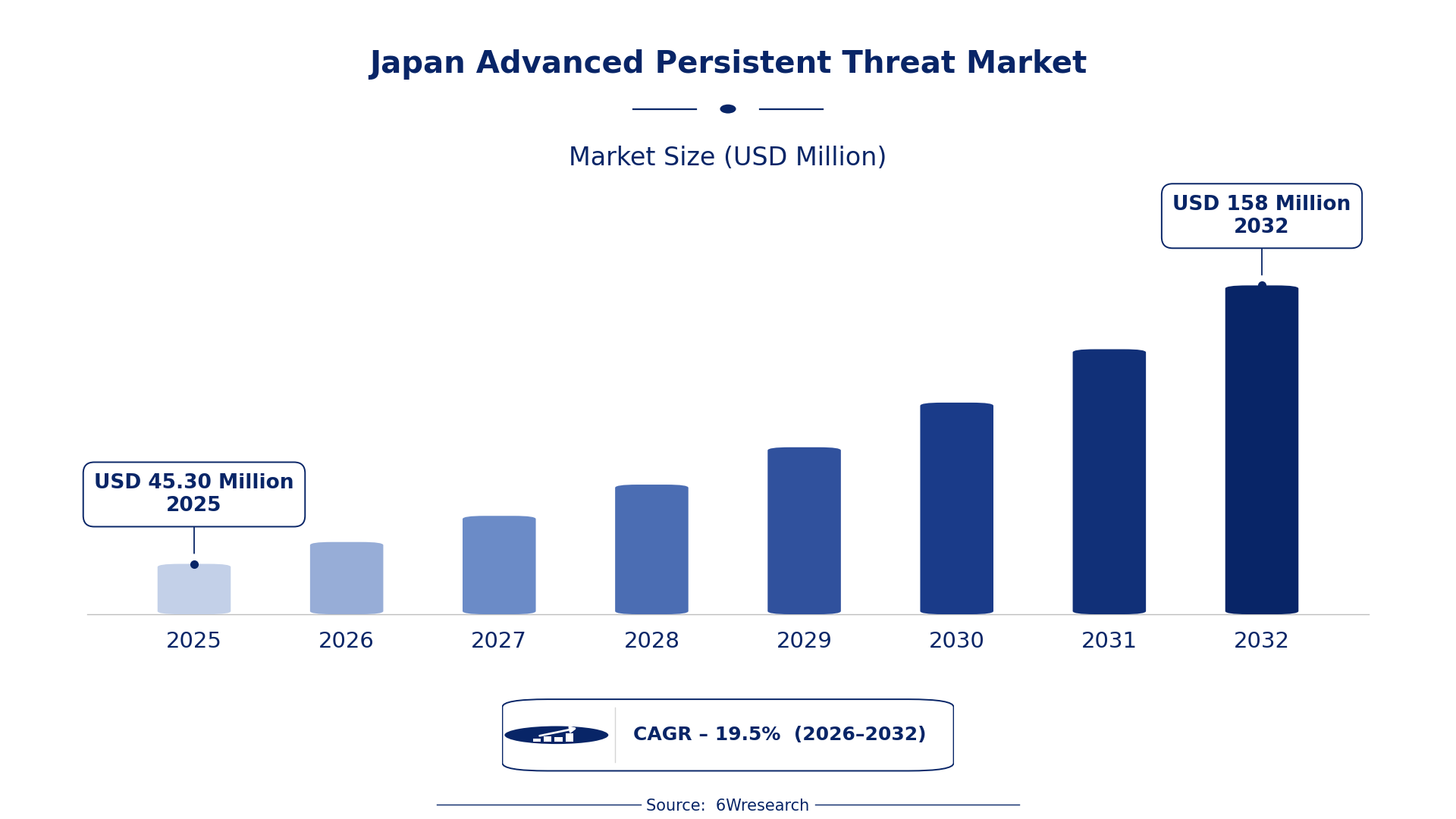
According to 6Wresearch internal database and industry insights, the Japan Advanced Persistent Threat Market was valued at USD 45.30 Million in 2025 and is projected to reach USD 158 Million by 2032, growing at a CAGR of approximately 19.5% during 2026–2032.
Japan Advanced Persistent Threat Market Highlights
| Report Metric | Details |
| Report Name | Japan Advanced Persistent Threat Market (2026-2032) |
| Market Size 2025 | USD 45.30 Million |
| Market Size 2032 | USD 158 Million |
| Absolute Growth 2025–2032 | USD 112.70 Million |
| CAGR 2026–2032 | 19.5% |
| Peak Annual Growth | 29.6% in 2026 |
| Forecast Period | 2026–2032 |
| Historical Data | 2022–2025 |
| Base Year | 2025 |
| Leading Threat Type, 2025 | Malware (48% share) |
| Leading End User, 2025 | Government (54% share) |
| Leading Industry, 2025 | BFSI (40% share) |
| Fastest-Growing Threat Type | Phishing (25.8% CAGR) |
| Fastest-Growing End User | Enterprises (23.6% CAGR) |
| Fastest-Growing Industry | Healthcare (24.1% CAGR) |
| Growing Sector | Cybersecurity |
| Key End Users | Government, Enterprises, BFSI, Healthcare |
Japan Advanced Persistent Threat Market Year-wise Growth Rate and Key Drivers (2022–2032)
This graph illustrates the annual growth rates of the market from 2022 to 2032, highlighting a steady upward trajectory and projected market expansion over the forecast period.
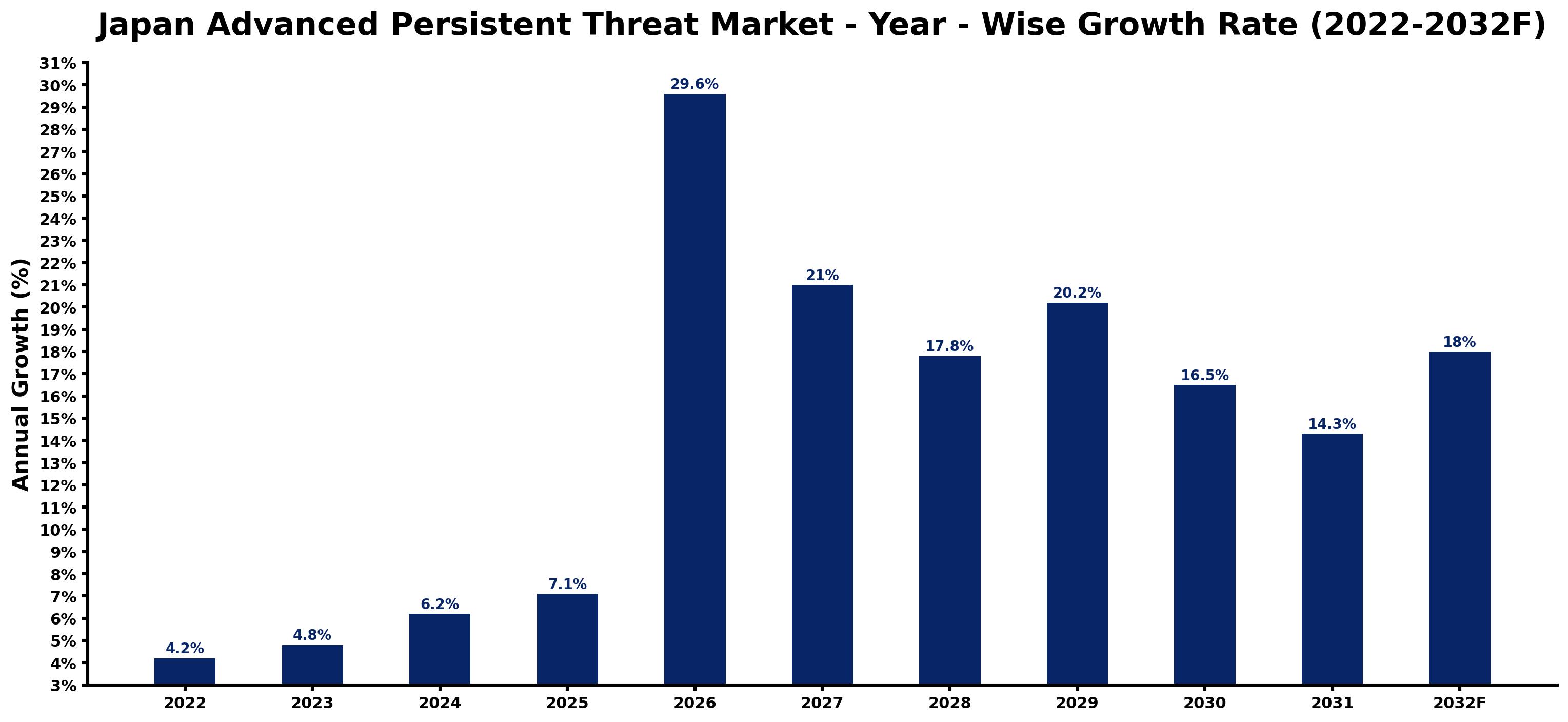
Annual growth estimates for each year appear below with the principal reason behind them, explaining the shifts that set the pace of the market.
| Year | Estimated Annual Growth (%) | Market Rationale |
| 2022 | 4.2 | The market experienced steady growth due to rising awareness of cybersecurity threats. |
| 2023 | 4.8 | Demand rose as organizations implemented more advanced security measures to combat risks. |
| 2024 | 6.2 | The increase in APT incidents prompted further investment in cybersecurity solutions across sectors. |
| 2025 | 7.1 | Growth accelerated with the introduction of new cybersecurity strategies, enhancing protection. |
| 2026 | 29.6 | The market is expected to peak as enterprises strengthen their APT defenses significantly. |
| 2027 | 21.0 | Growth is projected to slow as the market stabilizes after rapid expansion in previous years. |
| 2028 | 17.8 | Demand is expected to continue growing, but at a slower pace as maturity sets in. |
| 2029 | 20.2 | A resurgence in cyber threats is anticipated to drive renewed interest in advanced solutions. |
| 2030 | 16.5 | Growth is projected to slow as the market adjusts to a more competitive environment. |
| 2031 | 14.3 | Demand is expected to remain strong, but growth rates will begin to normalize. |
| 2032 | 18.0 | The market is expected to see renewed growth as new technologies emerge. |
Note: Market size estimations and growth projections presented in this report are based on 6Wresearch's proprietary forecasting methodology, utilizing the latest available industry data, government publications, and primary research inputs.
Japan Advanced Persistent Threat Market Synopsis
Advanced Persistent Threat (APT) refers to a continuous hacking process targeting specific entities for data theft or espionage. In Japan, the cybersecurity industry is responding to increasing threats, particularly in government and critical infrastructure sectors. The Japan Advanced Persistent Threat Market is expanding due to heightened cyber threats, with 1,200 APT incidents reported in 2022 and increased investments in cybersecurity initiatives, such as the ¥10 billion allocated for 2023. Enterprises are seeking to protect sensitive data and comply with evolving security standards, driving demand for effective solutions.
Market Dynamics Impact Analysis (2026–2032)
| Factor | Type | Impact | Primary Segment Affected |
| Rising cyber threats are driving demand for advanced security solutions. | Driver | High | Malware |
| Government initiatives are enhancing cybersecurity measures across sectors. | Driver | High | Government |
| Growing investments in cybersecurity infrastructure present opportunities for suppliers. | Opportunity | High | Enterprises |
| Increasing demand for compliance with cybersecurity standards creates market potential. | Opportunity | High | BFSI |
| Limited awareness of APTs among SMEs can hinder market growth. | Restraint | Medium | SMEs |
| High costs associated with implementing advanced cybersecurity measures can restrict access. | Restraint | Medium | Healthcare |
| Talent shortages in cybersecurity pose challenges for effective implementation. | Challenge | High | IT & Telecom |
| Rapid technological changes can outpace current security measures, creating vulnerabilities. | Challenge | High | Government |
Evaluation of Drivers in Japan Advanced Persistent Threat Market (2026–2032)
Key forces behind demand, with the segment each one moves most, are listed below.
| Drivers | Primary Segment Affected | Why It Matters (Evidence) |
| Increased APT incidents are prompting organizations to invest in advanced malware solutions. | Malware | With 1,200 incidents reported in 2022, companies are prioritizing malware defenses to mitigate risks. |
| Government strategies are mandating cybersecurity measures across sectors to enhance national security. | Government | The 2023 cybersecurity strategy requires compliance from public and private sectors, driving demand. |
| Financial institutions are investing heavily in cybersecurity to protect sensitive data from breaches. | BFSI | The Financial Services Agency mandates cybersecurity measures for all financial institutions, increasing spending. |
| Healthcare organizations are increasingly targeted, leading to higher investments in security protocols. | Healthcare | A 30% increase in cyber threats in 2023 has prompted healthcare facilities to bolster defenses. |
| Enterprises are adopting advanced security measures to safeguard against data breaches effectively. | Enterprises | The rise in cyber threats has led to a focus on comprehensive cybersecurity strategies for protection. |
Purchasing is picking up as organizations face a growing number of APT incidents, with 1,200 reported in 2022. Healthcare organizations also report a 30% rise in cyber threats, prompting them to strengthen their security protocols. Enterprises are prioritising investments in malware defenses to protect sensitive data, responding to the escalating threat environment.
Evaluation of Restraints in Japan Advanced Persistent Threat Market
Below are the constraints most often cited by buyers and suppliers, with the segment each affects.
| Market Restraint | Primary Segment Affected | Why It Matters (Evidence) |
| Limited awareness of APTs among SMEs restricts their ability to implement necessary measures. | SMEs | Many SMEs lack the resources to invest in advanced cybersecurity solutions, which limits their defenses. |
| High implementation costs deter healthcare organizations from adopting effective security measures. | Healthcare | Budget constraints can limit the ability to invest in advanced cybersecurity technologies, affecting their readiness. |
| Talent shortages in cybersecurity make it difficult for organizations to implement effective defenses. | IT & Telecom | A lack of skilled professionals can lead to vulnerabilities in security protocols, increasing risks. |
| Rapid technological changes can render existing security measures obsolete. | Government | Keeping up with evolving threats requires continuous investment and adaptation to new technologies. |
| Complex compliance requirements can overwhelm smaller organizations, hindering their ability to respond. | Enterprises | Navigating regulatory frameworks can be challenging for companies with limited resources, delaying action. |
Japan Advanced Persistent Threat Market Challenges
Healthcare organizations reported a 30% increase in cyber threats in 2023, forcing hospitals to allocate resources away from patient care to improve cybersecurity measures. Buyers in the financial sector encounter rising compliance costs due to mandates from the Financial Services Agency, which can limit budgets for essential technology upgrades. Competition intensifies as new cybersecurity firms enter the market, compelling established providers to lower prices and potentially sacrifice service quality. Technology gaps remain, with many organizations unable to effectively implement APT prevention strategies, leading to longer incident response times and increased vulnerability across all sectors.
Trends in the Japan Advanced Persistent Threat Market
The shifts below are changing how Japan Advanced Persistent Threat Market products are bought and supplied.
- Shift towards Holistic Cybersecurity Strategies: The Cybersecurity Strategy Council's initiatives have led to a shift in focus towards holistic cybersecurity strategies, with ¥10 billion allocated for 2023. This trend encourages organizations to adopt comprehensive approaches to combat APTs.
- Rise of Advanced Malware Solutions: Tokyo is experiencing a surge in advanced malware solutions as organizations respond to increasing APT incidents. In 2022, 1,200 incidents prompted a demand for sophisticated security technologies.
- Increased Collaboration in Cybersecurity: Since 2023, collaboration between sectors has intensified, leading to shared resources and knowledge in combating APTs. This trend strengthens overall cybersecurity resilience across industries.
- Focus on Compliance with International Standards: The adoption of ISO/IEC 27001 is gaining traction, as organizations strive to meet international security standards. This shift is important for improving data protection and building trust.
Investment Opportunities in the Japan Advanced Persistent Threat Market
Below are the investment opportunities with the strongest case in the Japan Advanced Persistent Threat Market.
- Advanced Malware Solutions: With 1,200 APT incidents reported in 2022, there is a notable gap in the market for advanced malware solutions. Enterprises are actively seeking effective security measures to protect sensitive data and mitigate risks.
- Cybersecurity Consulting Services: The demand for cybersecurity consulting services is rising, driven by the need for compliance with evolving regulations. Government agencies are looking for expert guidance to implement effective strategies for APT prevention.
- Investment in Cybersecurity Startups: The Japan Cybersecurity Innovation Program supports startups in cybersecurity, creating opportunities for investment. With ¥10 billion allocated for 2023, investors can tap into emerging technologies and effective solutions.
- Infrastructure Upgrades for Healthcare Organizations: Healthcare organizations are increasingly investing in cybersecurity infrastructure to counter rising threats. With a 30% increase in cyber threats reported, there is a pressing need for enhanced security measures to protect sensitive patient data.
Government Initiatives in the Japan Advanced Persistent Threat Market
The Cybersecurity Strategy Council was formed in 2022 to address APT threats through strategic initiatives and funding, reflecting the government's commitment to improving national security. This measure aims to enhance the capabilities of organizations to combat cyber threats effectively, ensuring a safer digital environment for all sectors.
The Japan Computer Security Incident Response Team (JPCERT) plays a vital role in implementing the cybersecurity strategy by handling over 3,000 incidents annually. This agency ensures that organizations comply with national standards and provides guidance on APT prevention, helping to strengthen the overall cybersecurity framework.
Future Insight of the Japan Advanced Persistent Threat Market
By 2032, suppliers will respond to heightened demand for advanced threat detection technologies, particularly in healthcare, which will significantly reduce incident response times. Government initiatives will drive the adoption of ISO/IEC 27001, leading to improved information management practices across various industries. The National Cyber Security Centre will broaden its guidelines, promoting best practices that strengthen APT prevention efforts. With the Japanese government allocating ¥10 billion for cybersecurity initiatives in 2023, buyers will benefit from enhanced resources and support in combating advanced persistent threats.
Market Segmentation Analysis
Japan Advanced Persistent Threat Market report covers a detailed analysis of the following market segments:
By Threat Type – Malware Leads, Phishing Expected to Grow Fastest
According to Bhawna Singh, Assistant Manager at 6Wresearch, Malware accounted for 48% of the market by threat type in 2025. Malware holds the largest share due to its direct application in executing APT attacks, making it a preferred method for cybercriminals. For instance, the high volume of APT incidents reported by the National Institute of Information and Communications Technology underscores its prevalence. Phishing is projected to grow fastest, at a CAGR of 25.8% during 2026–2032. Phishing is experiencing rapid growth as it is commonly used to gain unauthorized access, particularly with the rise in targeted campaigns. The increasing sophistication of phishing techniques has led to a notable uptick in incidents, reflecting its effectiveness. Suppliers must focus on developing advanced solutions to combat both malware and phishing threats.
By End User – Government Leads, Enterprises Expected to Grow Fastest
Government held 54% of the Japan Advanced Persistent Threat Market by end user in 2025. The government sector commands the largest share as it is specifically targeted for national security reasons, necessitating comprehensive cybersecurity measures. The establishment of the Cybersecurity Strategy Council in 2022 underscores the government's commitment to addressing these persistent threats. The quickest growth will come from Enterprises, forecast to expand at a CAGR of 23.6% between 2026 and 2032. Enterprises are witnessing rapid growth as they become high-value targets for data theft, particularly with the increasing frequency of cyber incidents. The Financial Services Agency's mandates for cybersecurity measures are further propelling the adoption of advanced security protocols across this sector. Suppliers should focus on developing tailored cybersecurity solutions that address the specific requirements of the enterprise sector.
By Industry – BFSI Leads, Healthcare Expected to Grow Fastest
The largest industry category in 2025 was BFSI, at 40% of revenue. The BFSI sector leads the market due to the immense value of financial data, making it a prime target for advanced persistent threats. The regulatory framework in place compels financial institutions to prioritise robust cybersecurity measures to safeguard sensitive information effectively. Healthcare is set to record the highest CAGR in this split, 24.1% over 2026–2032. Healthcare is experiencing the fastest growth as patient data becomes a more frequent target, especially following a reported 30% increase in cyber threats. This sector's vulnerabilities necessitate urgent enhancements in cybersecurity solutions to protect patient information. Suppliers must adapt their offerings to effectively tackle the unique cybersecurity challenges faced by the healthcare industry.
Key Attractiveness of the Report
- 10 Years of Market Numbers
- Historical Data Starting from 2022 to 2025
- Base Year 2025
- Forecast Data until 2032
- Key Performance Indicators Impacting the Market
- Major Upcoming Developments and Projects
Key Highlights of the Report:
- Japan Advanced Persistent Threat Market Outlook
- Market Size of Japan Advanced Persistent Threat Market, 2025
- Forecast of Japan Advanced Persistent Threat Market, 2032
- Historical Data and Forecast of Japan Advanced Persistent Threat Revenues & Volume for the Period 2022-2032
- Japan Advanced Persistent Threat Market Trend Evolution
- Japan Advanced Persistent Threat Market Drivers and Challenges
- Japan Advanced Persistent Threat Price Trends
- Japan Advanced Persistent Threat Porter's Five Forces
- Japan Advanced Persistent Threat Industry Life Cycle
- Historical Data and Forecast of Japan Advanced Persistent Threat Market Revenues & Volume By Threat Type for the Period 2022-2032
- Historical Data and Forecast of Japan Advanced Persistent Threat Market Revenues & Volume By Malware for the Period 2022-2032
- Historical Data and Forecast of Japan Advanced Persistent Threat Market Revenues & Volume By Phishing for the Period 2022-2032
- Historical Data and Forecast of Japan Advanced Persistent Threat Market Revenues & Volume By Denial-of-Service for the Period 2022-2032
- Historical Data and Forecast of Japan Advanced Persistent Threat Market Revenues & Volume By Others for the Period 2022-2032
- Historical Data and Forecast of Japan Advanced Persistent Threat Market Revenues & Volume By End User for the Period 2022-2032
- Historical Data and Forecast of Japan Advanced Persistent Threat Market Revenues & Volume By Government for the Period 2022-2032
- Historical Data and Forecast of Japan Advanced Persistent Threat Market Revenues & Volume By Enterprises for the Period 2022-2032
- Historical Data and Forecast of Japan Advanced Persistent Threat Market Revenues & Volume By SMEs for the Period 2022-2032
- Historical Data and Forecast of Japan Advanced Persistent Threat Market Revenues & Volume By Others for the Period 2022-2032
- Historical Data and Forecast of Japan Advanced Persistent Threat Market Revenues & Volume By Industry for the Period 2022-2032
- Historical Data and Forecast of Japan Advanced Persistent Threat Market Revenues & Volume By BFSI for the Period 2022-2032
- Historical Data and Forecast of Japan Advanced Persistent Threat Market Revenues & Volume By Healthcare for the Period 2022-2032
- Historical Data and Forecast of Japan Advanced Persistent Threat Market Revenues & Volume By IT & Telecom for the Period 2022-2032
- Historical Data and Forecast of Japan Advanced Persistent Threat Market Revenues & Volume By Others for the Period 2022-2032
- Japan Advanced Persistent Threat Import Export Trade Statistics
- Market Opportunity Assessment By Threat Type
- Market Opportunity Assessment By End User
- Market Opportunity Assessment By Industry
- Japan Advanced Persistent Threat Top Companies Market Share
- Japan Advanced Persistent Threat Competitive Benchmarking By Technical and Operational Parameters
- Japan Advanced Persistent Threat Company Profiles
- Japan Advanced Persistent Threat Key Strategic Recommendations
Market Covered
The following segment groups are covered in the report.
By Threat Type
- Malware
- Phishing
- Denial-of-Service
- Others
By End User
- Government
- Enterprises
- SMEs
- Others
By Industry
- BFSI
- Healthcare
- IT & Telecom
- Others































