Japan Agri-Waste Handling Market Size & Growth Rate
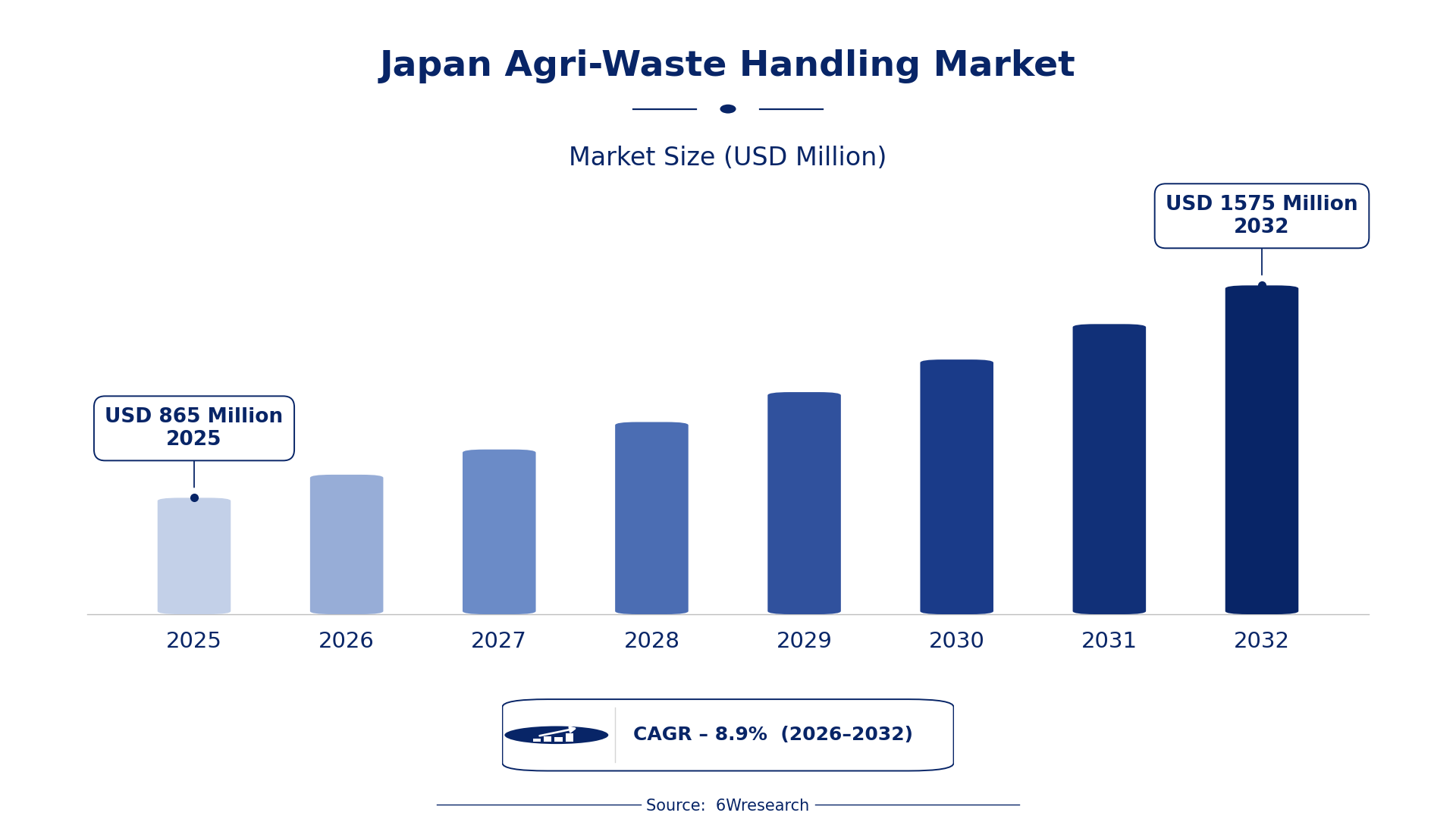
According to 6Wresearch internal database and industry insights, the Japan Agri-Waste Handling Market was valued at USD 865 Million in 2025 and is projected to reach USD 1,575 Million by 2032, growing at a CAGR of approximately 8.9% during 2026–2032.
Japan Agri-Waste Handling Market Highlights
| Report Metric | Details |
| Report Name | Japan Agri-Waste Handling Market (2026-2032) |
| Market Size 2025 | USD 865 Million |
| Market Size 2032 | USD 1,575 Million |
| Absolute Growth 2025–2032 | USD 710 Million |
| CAGR 2026–2032 | 8.9% |
| Peak Annual Growth | 9.7% in 2032 |
| Forecast Period | 2026–2032 |
| Historical Data | 2022–2025 |
| Base Year | 2025 |
| Leading Waste Handling Type, 2025 | Composting Systems (47% share) |
| Leading Processing Technique, 2025 | Aerobic Decomposition (48% share) |
| Leading Distribution Channel, 2025 | Direct Sales (40% share) |
| Leading End User, 2025 | Organic Fertilizer Producers (38% share) |
| Fastest-Growing Waste Handling Type | Biogas Units (12.8% CAGR) |
| Fastest-Growing Processing Technique | Anaerobic Digestion (12.6% CAGR) |
| Fastest-Growing Distribution Channel | Government Schemes (11.2% CAGR) |
| Fastest-Growing End User | Rural Community Plants (11.6% CAGR) |
| Growing Sector | Organic Fertilizer Production |
| Key End Users | Organic Fertilizer Producers, Rural Community Plants, Small-scale Farmers, Municipal Agri Agencies |
Japan Agri-Waste Handling Market Year-wise Growth Rate and Key Drivers (2022–2032)
This graph illustrates the annual growth rates of the market from 2022 to 2032, highlighting a steady upward trajectory and projected market expansion over the forecast period.
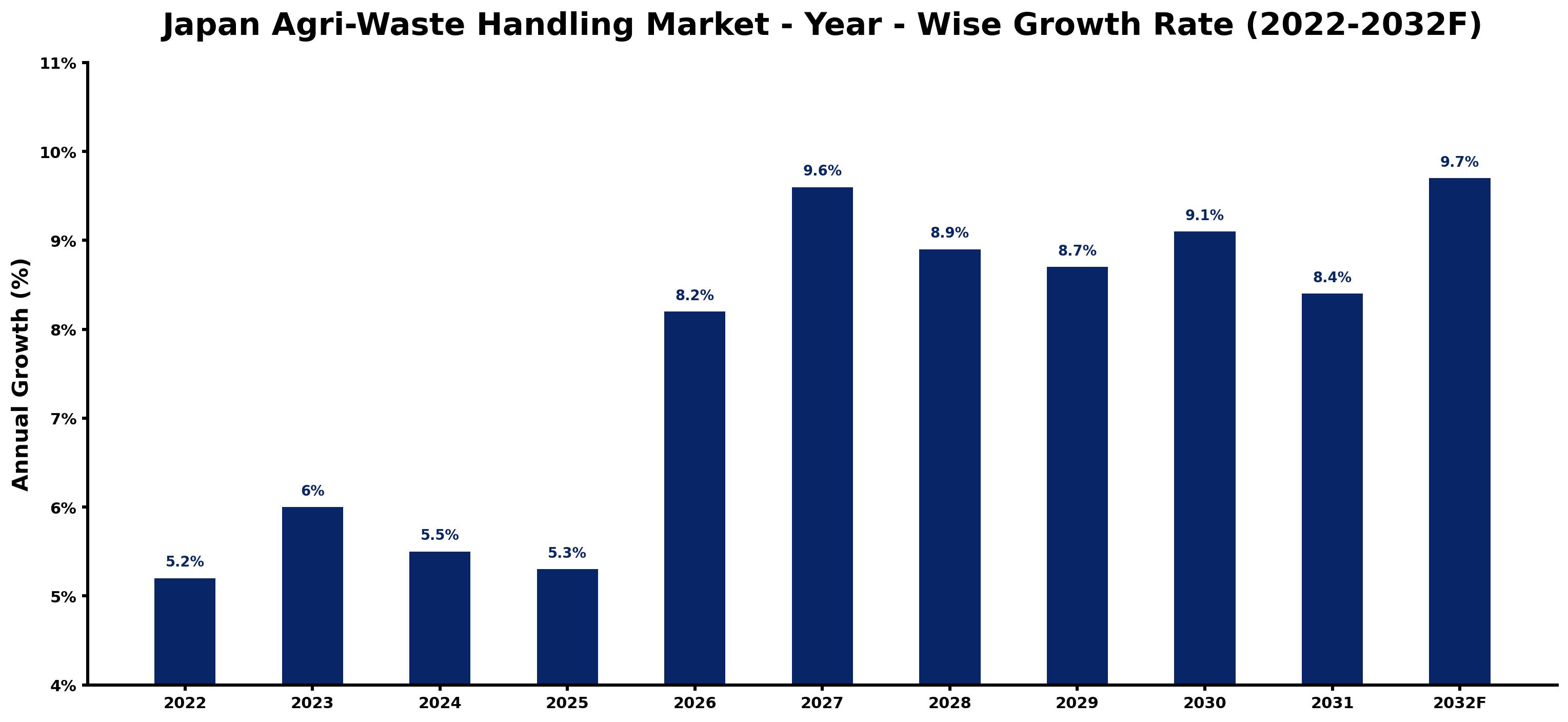
For each year, the table pairs the estimated growth rate with the leading influence on demand, showing how the drivers changed across the period.
| Year | Estimated Annual Growth (%) | Market Rationale |
| 2022 | 5.2 | The market was characterised by steady demand for waste handling solutions. |
| 2023 | 6.0 | Growth accelerated due to increased awareness of organic farming practices. |
| 2024 | 5.5 | Market expansion slowed as competition intensified among service providers. |
| 2025 | 5.3 | Demand continued to rise, though at a slower pace than in 2023. |
| 2026 | 8.2 | Growth is expected to resume as investments in biogas facilities increase. |
| 2027 | 9.6 | A surge in biogas production will drive demand for waste handling systems. |
| 2028 | 8.9 | Growth is projected to moderate as market saturation begins to appear in urban areas. |
| 2029 | 8.7 | Demand will remain strong, but growth rates are expected to stabilise. |
| 2030 | 9.1 | Increased government support for waste management initiatives will boost growth. |
| 2031 | 8.4 | Growth will slow slightly as market conditions begin to normalise. |
| 2032 | 9.7 | A peak in growth is anticipated due to rising investments in sustainable practices. |
Note: Market size estimations and growth projections presented in this report are based on 6Wresearch's proprietary forecasting methodology, utilizing the latest available industry data, government publications, and primary research inputs.
Japan Agri-Waste Handling Market Synopsis
Agri-waste handling involves the collection, processing, and recycling of agricultural waste materials, primarily through composting, anaerobic digestion, and mechanical processing. The primary end uses include producing organic fertilizers, generating biogas, and improving soil health. The Japan Agri-Waste Handling Market is growing due to increasing domestic demand from organic fertilizer producers and local government initiatives, with over 1,000 registered composting facilities and government funding of approximately ¥10 billion for agri-waste projects, indicating strong growth potential.
Market Dynamics Impact Analysis (2026–2032)
| Factor | Type | Impact | Primary Segment Affected |
| Rising demand for organic fertilizers drives the need for efficient waste handling solutions. | Driver | High | Organic Fertilizer Producers |
| Government initiatives promote sustainable practices, increasing investment in waste management technologies. | Driver | High | Composting Systems |
| The increasing focus on renewable energy sources presents opportunities for biogas production. | Opportunity | High | Biogas Units |
| The growth of rural community plants creates a demand for advanced waste processing systems. | Opportunity | High | Rural Community Plants |
| Limited awareness among small-scale farmers hampers the adoption of advanced waste handling technologies. | Restraint | Medium | Small-scale Farmers |
| Competition among waste management service providers can lead to price wars, affecting profitability. | Restraint | Medium | Waste Collection Units |
| High initial investment costs for advanced waste processing facilities deter potential investors. | Challenge | High | Biogas Units |
| Regulatory compliance can be complex, posing challenges for new entrants in the market. | Challenge | Medium | Composting Systems |
Evaluation of Drivers in Japan Agri-Waste Handling Market (2026–2032)
The factors lifting demand, and the evidence behind each, are summarised below.
| Drivers | Primary Segment Affected | Why It Matters (Evidence) |
| Increased production of organic fertilizers drives demand for composting systems. | Composting Systems | Organic fertilizer production reached 1.5 million tons in 2022, motivating farmers to improve waste handling. |
| Growing biogas production encourages investment in anaerobic digestion facilities. | Anaerobic Digestion | Biogas production from agri-waste increased by 15% last year, prompting more facility installations. |
| Local government support boosts waste collection and processing initiatives. | Waste Collection Units | Over 200 waste collection schemes have been implemented nationwide, increasing demand for collection units. |
| Rising environmental awareness among consumers drives demand for sustainable practices. | Organic Fertilizer Producers | The Ministry of Agriculture promotes organic farming, raising the need for effective waste management solutions. |
| Technological advancements in waste processing improve operational efficiency. | Mechanical Processing | Innovations in mechanical processing techniques are improving waste preparation, resulting in higher adoption rates. |
A wider customer base explains much of the growth, as organic fertilizer production reached 1.5 million tons in 2022, motivating farmers to improve waste handling. Biogas production from agri-waste rose by 15% last year, encouraging investments in anaerobic digestion facilities. Rising environmental awareness among consumers is driving demand for sustainable practices, while advancements in mechanical processing techniques are improving efficiency across the sector.
Evaluation of Restraints in Japan Agri-Waste Handling Market
The following restraints limit how fast demand can grow.
| Market Restraint | Primary Segment Affected | Why It Matters (Evidence) |
| Limited awareness among small-scale farmers hampers the adoption of advanced waste handling technologies. | Small-scale Farmers | Small-scale farmers account for 30% of total agri-waste recycling efforts, limiting overall market growth. |
| Competition among waste management service providers can lead to price wars, affecting profitability. | Waste Collection Units | Intense competition has resulted in lower prices, impacting service quality and profitability. |
| High initial investment costs for advanced waste processing facilities deter potential investors. | Biogas Units | The average cost of establishing a biogas facility can be prohibitive for new entrants. |
| Regulatory compliance can be complex, posing challenges for new entrants in the market. | Composting Systems | Navigating the Waste Management and Public Cleansing Act can be daunting for smaller operators. |
| Limited infrastructure in rural areas restricts effective waste collection and processing. | Waste Collection Units | Many rural regions lack adequate facilities, hindering waste management efforts. |
Japan Agri-Waste Handling Market Challenges
Inconsistent supply of organic fertilizers disrupts crop production for farmers, stemming from limited operational capacity at over 1,000 registered composting facilities. Technological limitations impede advanced processing methods, leading to a 15% decline in biogas efficiency, which impacts energy generation for local communities. Skills shortages in rural areas worsen the situation, as only 30% of small-scale farmers actively participate in recycling, resulting in missed opportunities for effective waste management. Competition from imported fertilizers pressures local producers, compelling them to cut prices and affecting their profitability.
Trends in the Japan Agri-Waste Handling Market
The shifts below are changing how Japan Agri-Waste Handling Market products are bought and supplied.
- Shift from Traditional to Advanced Waste Processing Techniques: In 2023, the Tokyo metropolitan area initiated a new waste sorting program, improving waste management efficiency. This shift is likely to increase the adoption of advanced processing technologies by local governments.
- Emergence of Biogas as a Key Energy Source: The Hydrogen Society Promotion Act, effective in 2024, supports biogas production for energy. This initiative aims to increase biogas facilities by 20% by 2030, driving demand for handling solutions.
- Growing Adoption of Organic Farming Practices: The Japan Organic Agriculture Association has been promoting organic fertilizer initiatives, with production reaching 1.5 million tons in 2022. This trend is increasing the need for effective management systems.
- Expansion of Rural Community Plants: In 2023, over 500 rural community plants were operational across Japan, processing an average of 500 tons of waste annually. This growth indicates a rising demand for efficient handling technologies.
Investment Opportunities in the Japan Agri-Waste Handling Market
The following opportunities in the Japan Agri-Waste Handling Market pair current demand with a clear way in.
- Investment in Biogas Facilities: With biogas production increasing by 15% last year, there is an opportunity to invest in anaerobic digestion facilities. Local governments are eager to support these initiatives, making it an attractive market for investors.
- Development of Advanced Composting Systems: The demand for organic fertilizers is on the rise, creating an opportunity to develop advanced composting systems. Organic fertilizer producers are looking for efficient solutions to enhance their production capabilities.
- Expansion of Waste Collection Units: With over 200 waste collection schemes implemented nationwide, there is a pressing need for additional collection units. Local governments are actively seeking suppliers to improve rural management.
- Supply of Mechanical Processing Technologies: As technological advancements boost processing efficiency, there is an opportunity to supply advanced mechanical processing solutions. This demand is driven by the need for improved preparation techniques.
Government Initiatives in the Japan Agri-Waste Handling Market
The Waste Management and Public Cleansing Act regulates the treatment and disposal of agricultural waste, ensuring compliance with environmental standards. This law mandates proper handling practices, which buyers must follow to avoid penalties and ensure sustainability. Over 1,000 registered composting facilities must adhere to these regulations to operate effectively.
In 2023, government funding for agri-waste projects was approximately ¥10 billion, administered by the Ministry of Agriculture, Forestry and Fisheries. This funding supports initiatives aimed at improving management practices and increasing the efficiency of processing facilities.
Future Insight of the Japan Agri-Waste Handling Market
Technological advancements in waste processing will transform organic fertilizer production by 2032, enabling higher efficiency and output. Government initiatives will support the establishment of new composting facilities, contributing to a 30% reduction in agricultural waste by 2030. The adoption of smart waste management systems will improve collection efficiency, particularly benefiting rural communities. With government funding of approximately ¥10 billion in 2023, the market will shift towards stricter compliance with the JIS standard, ensuring higher quality organic fertilizers.
Market Segmentation Analysis
Japan Agri-Waste Handling Market report covers a detailed analysis of the following market segments:
By Waste Handling Type – Composting Systems Lead, Biogas Units Expected to Grow Fastest
According to Saurav Kr Singh, Senior Research Analyst at 6Wresearch, Composting Systems took 47% of waste handling type revenue in 2025, more than any other category. Composting systems dominate the market due to their widespread use in Japan, with over 1,000 registered facilities dedicated to recycling organic waste. These systems are integral to local government initiatives that promote sustainable agricultural practices and environmental responsibility. Over 2026–2032, Biogas Units are expected to post the fastest growth, at a CAGR of 12.8%. Biogas units are experiencing rapid growth, with a notable 15% increase in biogas production from agri-waste last year. This surge is largely influenced by government funding aimed at enhancing energy recovery from agricultural waste, indicating a strong future for biogas solutions. Suppliers should focus on developing biogas solutions to meet the rising demand for renewable energy derived from agricultural waste.
By Processing Technique – Aerobic Decomposition Leads, Anaerobic Digestion Expected to Grow Fastest
With 48% of processing technique revenue in 2025, Aerobic Decomposition was the largest category. Aerobic decomposition is the leading processing technique, utilised in over 60% of composting operations in rural areas. Its effectiveness in facilitating composting processes makes it essential for the recycling of organic waste in Japan. The quickest growth will come from Anaerobic Digestion, forecast to expand at a CAGR of 12.6% between 2026 and 2032. Anaerobic digestion is the fastest-growing technique, crucial for biogas production that is increasingly supported by government initiatives. The rising focus on energy recovery from agricultural waste is driving its adoption across various regions. Buyers should invest in anaerobic digestion technologies to capitalise on the growing emphasis on energy recovery from agricultural waste.
By Distribution Channel – Direct Sales Leads, Government Schemes Expected to Grow Fastest
Direct Sales held 40% of the Japan Agri-Waste Handling Market by distribution channel in 2025. Direct sales serve as the primary distribution method for agri-waste handling solutions, allowing producers to effectively connect with their target markets. This channel is vital for suppliers aiming to establish strong relationships with end users. Government Schemes are set to record the highest CAGR in this split, 11.2% over 2026–2032. Government schemes are rapidly emerging as the fastest distribution channel, providing essential support for waste management initiatives. The implementation of over 200 waste collection schemes nationwide highlights the government's commitment to improving distribution efficiency. Suppliers must engage with government schemes to leverage funding opportunities and strengthen their market presence.
By End User – Organic Fertilizer Producers Lead, Rural Community Plants Expected to Grow Fastest
The largest end user category in 2025 was Organic Fertilizer Producers, at 38% of revenue. Organic fertilizer producers are the largest end user group, accounting for a substantial portion of agri-waste recycling efforts. Their demand for high-quality organic fertilizers necessitates efficient waste handling and processing solutions to satisfy market requirements. Rural Community Plants are projected to grow fastest, at a CAGR of 11.6% during 2026–2032. Rural community plants represent the fastest-growing end user segment, benefiting from enhanced waste processing capabilities and local government support. The operational presence of over 500 rural community plants illustrates their expanding role in sustainable waste management. Suppliers should tailor their offerings to meet the specific needs of rural community plants as they scale up their waste processing operations.
Key Attractiveness of the Report
- 10 Years of Market Numbers
- Historical Data Starting from 2022 to 2025
- Base Year 2025
- Forecast Data until 2032
- Key Performance Indicators Impacting the Market
- Major Upcoming Developments and Projects
Key Highlights of the Report:
- Japan Agri-Waste Handling Market Outlook
- Market Size of Japan Agri-Waste Handling Market, 2025
- Forecast of Japan Agri-Waste Handling Market, 2032
- Historical Data and Forecast of Japan Agri-Waste Handling Revenues & Volume for the Period 2022-2032F
- Japan Agri-Waste Handling Market Trend Evolution
- Japan Agri-Waste Handling Market Drivers and Challenges
- Japan Agri-Waste Handling Price Trends
- Japan Agri-Waste Handling Porter's Five Forces
- Japan Agri-Waste Handling Industry Life Cycle
- Historical Data and Forecast of Japan Agri-Waste Handling Market Revenues & Volume By Waste Handling Type for the Period 2022-2032F
- Historical Data and Forecast of Japan Agri-Waste Handling Market Revenues & Volume By Composting Systems for the Period 2022-2032F
- Historical Data and Forecast of Japan Agri-Waste Handling Market Revenues & Volume By Biogas Units for the Period 2022-2032F
- Historical Data and Forecast of Japan Agri-Waste Handling Market Revenues & Volume By Mulching Tools for the Period 2022-2032F
- Historical Data and Forecast of Japan Agri-Waste Handling Market Revenues & Volume By Waste Collection Units for the Period 2022-2032F
- Historical Data and Forecast of Japan Agri-Waste Handling Market Revenues & Volume By Processing Technique for the Period 2022-2032F
- Historical Data and Forecast of Japan Agri-Waste Handling Market Revenues & Volume By Aerobic Decomposition for the Period 2022-2032F
- Historical Data and Forecast of Japan Agri-Waste Handling Market Revenues & Volume By Anaerobic Digestion for the Period 2022-2032F
- Historical Data and Forecast of Japan Agri-Waste Handling Market Revenues & Volume By Mechanical Processing for the Period 2022-2032F
- Historical Data and Forecast of Japan Agri-Waste Handling Market Revenues & Volume By Collection & Sorting for the Period 2022-2032F
- Historical Data and Forecast of Japan Agri-Waste Handling Market Revenues & Volume By Distribution Channel for the Period 2022-2032F
- Historical Data and Forecast of Japan Agri-Waste Handling Market Revenues & Volume By Direct Sales for the Period 2022-2032F
- Historical Data and Forecast of Japan Agri-Waste Handling Market Revenues & Volume By Government Schemes for the Period 2022-2032F
- Historical Data and Forecast of Japan Agri-Waste Handling Market Revenues & Volume By Agri Dealers for the Period 2022-2032F
- Historical Data and Forecast of Japan Agri-Waste Handling Market Revenues & Volume By Local Distributors for the Period 2022-2032F
- Historical Data and Forecast of Japan Agri-Waste Handling Market Revenues & Volume By End User for the Period 2022-2032F
- Historical Data and Forecast of Japan Agri-Waste Handling Market Revenues & Volume By Organic Fertilizer Producers for the Period 2022-2032F
- Historical Data and Forecast of Japan Agri-Waste Handling Market Revenues & Volume By Rural Community Plants for the Period 2022-2032F
- Historical Data and Forecast of Japan Agri-Waste Handling Market Revenues & Volume By Small-scale Farmers for the Period 2022-2032F
- Historical Data and Forecast of Japan Agri-Waste Handling Market Revenues & Volume By Municipal Agri Agencies for the Period 2022-2032F
- Japan Agri-Waste Handling Import Export Trade Statistics
- Market Opportunity Assessment By Waste Handling Type
- Market Opportunity Assessment By Processing Technique
- Market Opportunity Assessment By Distribution Channel
- Market Opportunity Assessment By End User
- Japan Agri-Waste Handling Top Companies Market Share
- Japan Agri-Waste Handling Competitive Benchmarking By Technical and Operational Parameters
- Japan Agri-Waste Handling Company Profiles
- Japan Agri-Waste Handling Key Strategic Recommendations
Market Covered
Coverage by segment is as follows.
By Waste Handling Type
- Composting Systems
- Biogas Units
- Mulching Tools
- Waste Collection Units
By Processing Technique
- Aerobic Decomposition
- Anaerobic Digestion
- Mechanical Processing
- Collection & Sorting
By Distribution Channel
- Direct Sales
- Government Schemes
- Agri Dealers
- Local Distributors
By End User
- Organic Fertilizer Producers
- Rural Community Plants
- Small-scale Farmers
- Municipal Agri Agencies































