Japan Agricultural Automation Devices Market Size & Growth Rate
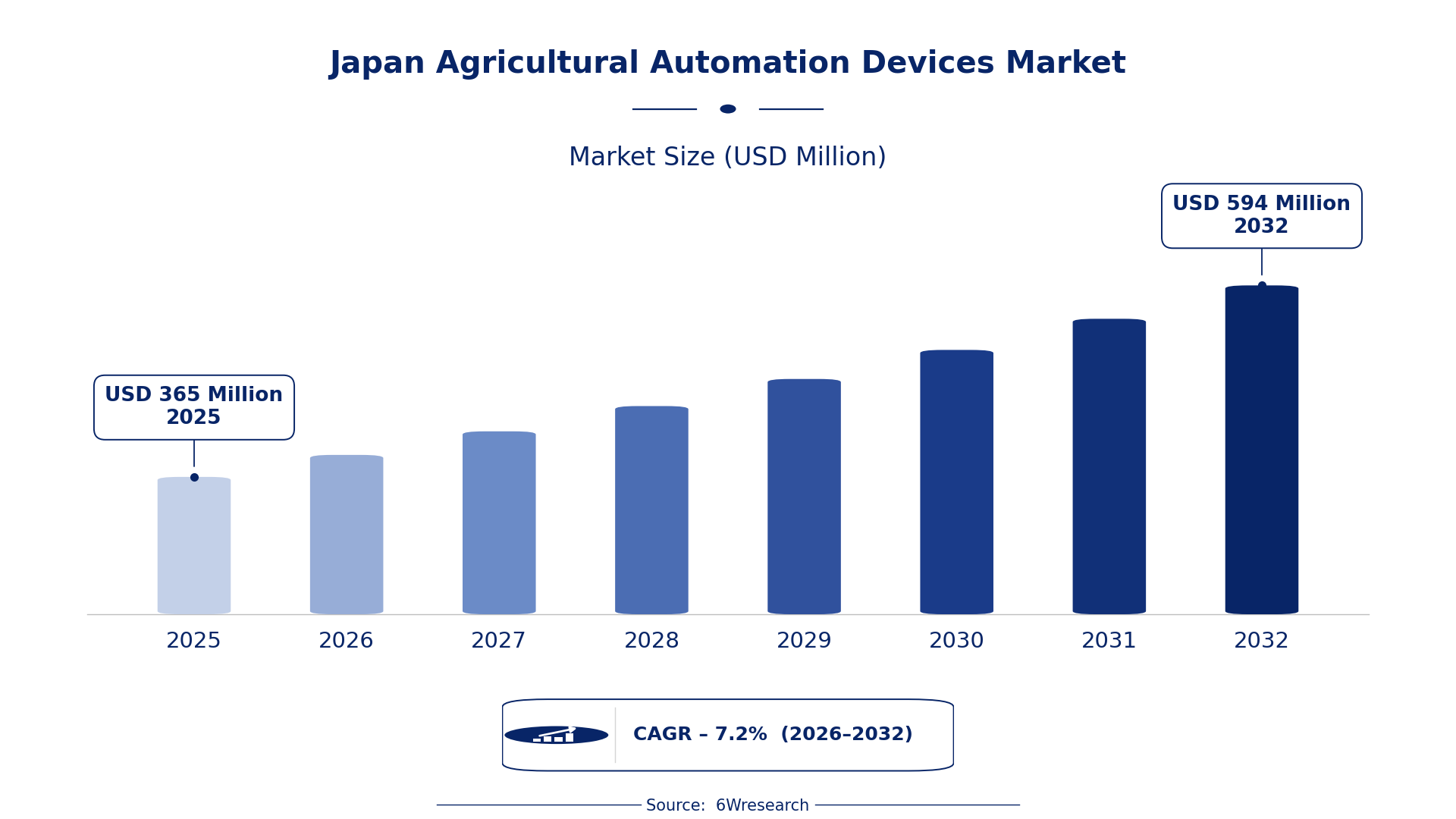
According to 6Wresearch internal database and industry insights, the Japan Agricultural Automation Devices Market was valued at USD 365 Million in 2025 and is projected to reach USD 594 Million by 2032, growing at a CAGR of approximately 7.2% during 2026–2032.
Japan Agricultural Automation Devices Market Highlights
| Report Metric | Details |
| Report Name | Japan Agricultural Automation Devices Market (2026-2032) |
| Market Size 2025 | USD 365 Million |
| Market Size 2032 | USD 594 Million |
| Absolute Growth 2025–2032 | USD 229 Million |
| CAGR 2026–2032 | 7.2% |
| Peak Annual Growth | 8.7% in 2028 |
| Forecast Period | 2026–2032 |
| Historical Data | 2022–2025 |
| Base Year | 2025 |
| Leading Agricultural Automation Devices Market, 2025 | Automated Irrigation Controllers (45% share) |
| Leading Device Type, 2025 | IoT-Based (45% share) |
| Leading Technology, 2025 | Online Platforms (40% share) |
| Leading Distribution Channel, 2025 | Smart Farms (42% share) |
| Fastest-Growing Agricultural Automation Devices Market | Robotic Harvesters (9.6% CAGR) |
| Fastest-Growing Device Type | AI-Based (10.4% CAGR) |
| Fastest-Growing Distribution Channel | Agri-Tech Startups (9.0% CAGR) |
| Growing Sector | Agriculture |
| Key End Users | Farmers, Agri-Tech Startups, Agricultural Cooperatives, Agribusiness Companies |
Japan Agricultural Automation Devices Market Year-wise Growth Rate and Key Drivers (2022–2032)
This graph illustrates the annual growth rates of the market from 2022 to 2032, highlighting a steady upward trajectory and projected market expansion over the forecast period.
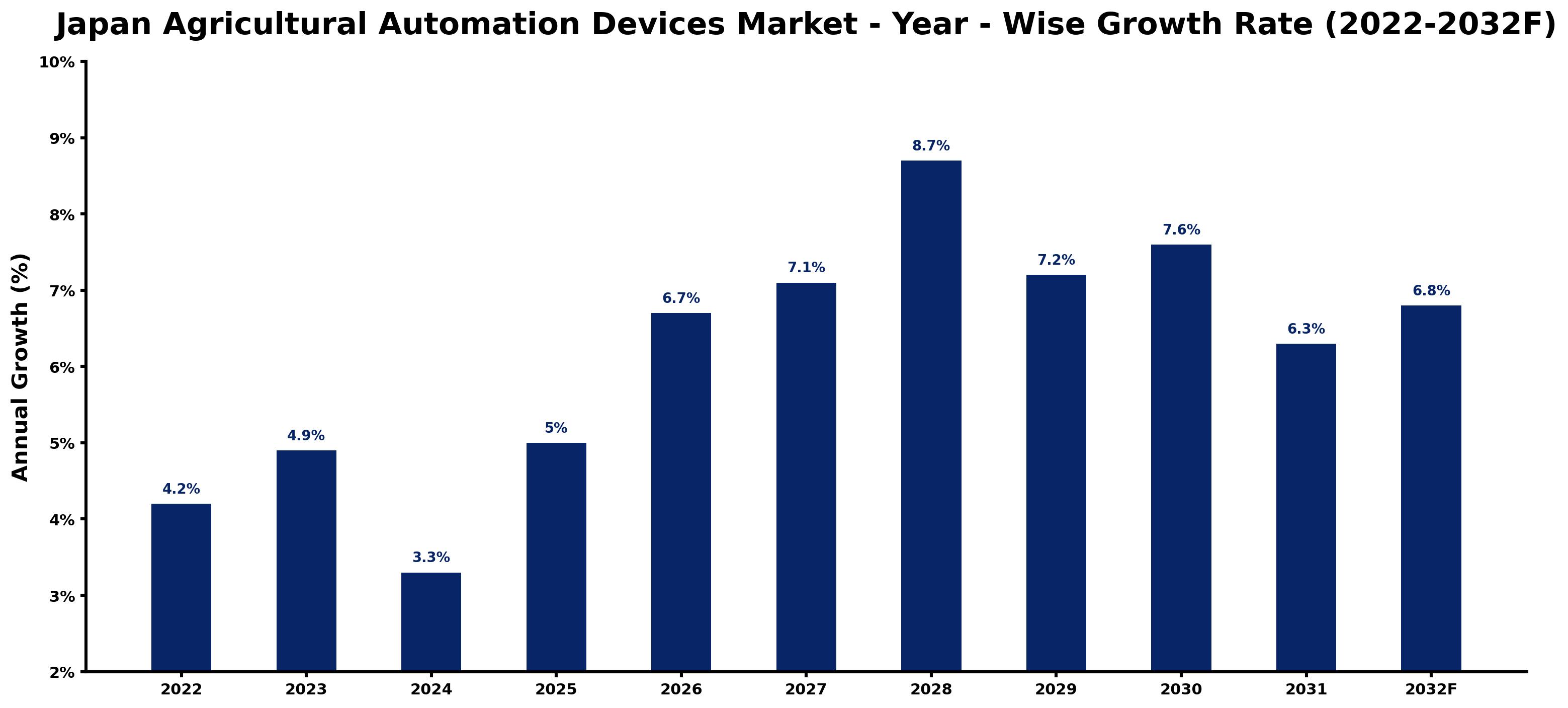
The following figures match every annual growth estimate with the main market development of that year, giving the reasoning behind each rise or slowdown.
| Year | Estimated Annual Growth (%) | Market Rationale |
| 2022 | 4.2 | The market exhibited solid growth as automation began gaining traction among farmers. |
| 2023 | 4.9 | Increased investments in agri-tech solutions contributed to faster growth than the previous year. |
| 2024 | 3.3 | The growth rate slowed as market saturation began to affect new investments. |
| 2025 | 5.0 | The market rebounded with renewed interest in automation technologies for efficiency. |
| 2026 | 6.7 | Rising demand for IoT-based devices is expected to drive faster growth in agricultural automation. |
| 2027 | 7.1 | Continued investment in smart farming technologies will sustain the upward trend in growth. |
| 2028 | 8.7 | Peak growth is projected as robotic harvesting solutions gain widespread adoption. |
| 2029 | 7.2 | The market is expected to experience a slowdown as growth rates normalise after peak levels. |
| 2030 | 7.6 | Demand for precision planting technologies will spur growth, pushing rates higher again. |
| 2031 | 6.3 | The growth rate is projected to slow as market maturity sets in, reflecting stabilised demand. |
| 2032 | 6.8 | Increased adoption of AI-based solutions will lead to a resurgence in growth rates. |
Note: Market size estimations and growth projections presented in this report are based on 6Wresearch's proprietary forecasting methodology, utilizing the latest available industry data, government publications, and primary research inputs.
Japan Agricultural Automation Devices Market Synopsis
Agricultural Automation Devices enhance farming efficiency through automation, utilising advanced sensors, robotics, and IoT technologies. These devices are primarily used for improving irrigation, automating harvesting, and optimising planting precision. The Japan Agricultural Automation Devices Market is expanding due to rising investments from domestic users and agri-tech startups focusing on smart farming solutions. Government funding for agricultural innovation further stimulates demand, indicating strong growth potential in the sector.
Market Dynamics Impact Analysis (2026–2032)
| Factor | Type | Impact | Primary Segment Affected |
| Growing adoption of IoT technologies in agriculture | Driver | High | IoT-Based |
| Increased focus on sustainable farming practices | Driver | High | Precision Planters |
| Emerging agri-tech startups seeking automation solutions | Opportunity | High | Agri-Tech Startups |
| Rising demand for efficient water management solutions | Opportunity | Medium | Automated Irrigation Controllers |
| High initial investment costs for automation devices | Restraint | High | Robotic Harvesters |
| Limited awareness among traditional farmers about automation benefits | Restraint | Medium | Soil Sensors |
| Aging farmer population affecting workforce availability | Challenge | High | Precision Planters |
| Technological integration challenges in existing farming systems | Challenge | Medium | AI-Based |
Evaluation of Drivers in Japan Agricultural Automation Devices Market (2026–2032)
Demand rests on the following drivers, each shown with the segment it touches most.
| Drivers | Primary Segment Affected | Why It Matters (Evidence) |
| Increased investment in smart farming technologies | IoT-Based | The Kanto region's adoption of IoT devices for rice farming has surged, improving efficiency and productivity. |
| Government support for agricultural automation | Precision Planters | Subsidies from the Ministry of Agriculture, Forestry and Fisheries encourage farmers to invest in precision planting solutions. |
| Rising demand for efficient irrigation solutions | Automated Irrigation Controllers | Hokkaido's large-scale agriculture has driven the adoption of automated irrigation systems for better water management. |
| Growth of agri-tech startups focusing on automation | Robotic Harvesters | Urban areas are seeing a rise in agri-tech startups developing solutions, which increases demand for robotic harvesters. |
| Focus on sustainable farming practices | Soil Sensors | The Chubu region's emphasis on optimizing crop yields has led to greater adoption of soil sensors. |
The strongest pull on demand comes from increased investment in smart farming technologies, particularly in the Kanto region, where adoption of IoT devices for rice farming has surged, improving efficiency. Hokkaido's large-scale agriculture has driven the uptake of automated irrigation systems, while urban agri-tech startups are developing new robotic harvesters. The focus on sustainable farming practices in the Chubu region has led to greater adoption of soil sensors, further boosting demand for agricultural automation devices.
Evaluation of Restraints in Japan Agricultural Automation Devices Market
The key brakes on demand, and where they bite hardest, are shown below.
| Market Restraint | Primary Segment Affected | Why It Matters (Evidence) |
| High initial investment costs for automation devices | Robotic Harvesters | The average cost of robotic harvesters can exceed several million yen, deterring small farmers from adoption. |
| Limited awareness among traditional farmers about automation benefits | Soil Sensors | Many farmers in rural areas lack knowledge of how soil sensors can improve crop management, slowing adoption. |
| Dependence on skilled workforce for operation and maintenance | Precision Planters | The aging farmer population complicates the availability of skilled workers needed for operating advanced planting technologies. |
| Market saturation affecting new investments | Automated Irrigation Controllers | As more farmers adopt irrigation automation, the market is becoming saturated, resulting in slower growth. |
| Complex integration of new technologies with existing systems | AI-Based | Farmers face challenges in integrating AI solutions into their traditional farming practices, which hinders uptake. |
Japan Agricultural Automation Devices Market Challenges
Producers contend with high operational costs due to the ageing farmer demographic, with an average age exceeding 67 years, compelling them to invest in automation technologies. Competition from agri-tech startups in urban areas pressures established farmers to innovate rapidly, risking their market positions. Regulatory requirements surrounding the JIS Z 8801 standard for agricultural machinery complicate compliance, delaying product launches and raising costs for suppliers. A shortage of skilled workers in advanced farming techniques hampers automation adoption, costing producers potential productivity gains as Japan aims for a 30% increase by 2030.
Trends in the Japan Agricultural Automation Devices Market
The following changes are redrawing the Japan Agricultural Automation Devices Market.
- Shift from Traditional to Smart Farming: Urban areas in Japan are increasingly adopting smart farming practices, with 5 billion yen allocated for agricultural innovation in 2023. This shift enables farmers to improve productivity through automation.
- Transition from Manual to Automated Harvesting: Since 2022, robotic harvesters have gained traction in the Tohoku region, with adoption rates increasing by 20%. This transition streamlines the harvesting process for fruit growers.
- Emergence of AI-Based Solutions in Agriculture: The AI-Based segment is experiencing rapid growth, projected to increase by 10.4% annually. This trend is driven by the need for improved decision-making in agricultural practices.
- Growing Demand for Precision Agriculture Technologies: In 2023, precision planters are being increasingly adopted in Hokkaido, reflecting a 15% rise in usage. This trend highlights the need for accurate planting solutions among large-scale farmers.
Investment Opportunities in the Japan Agricultural Automation Devices Market
The openings below show where demand in the Japan Agricultural Automation Devices Market is visible and how suppliers can enter.
- Agri-Tech Startups Seeking Solutions: Agri-tech startups in urban areas are rapidly emerging, with the market gap for automation solutions estimated at 50 billion yen. Collaborating with local partners can facilitate entry into this expanding market.
- Need for Efficient Water Management Solutions: The average water usage in agriculture is projected to rise by 20% by 2030, creating a demand for automated irrigation systems. Engaging with farmers in Hokkaido can provide opportunities for suppliers.
- Need for Advanced Soil Management Technologies: Soil sensors are critical for optimising crop yields, with a market gap of 30 billion yen. Suppliers can enter this space by partnering with agricultural cooperatives for distribution.
- Growing Interest in Cloud-Integrated Systems: Cloud-integrated systems are being tested in smart farms across Japan, with an estimated market potential of 25 billion yen. Collaborating with local agricultural bodies can facilitate market entry.
Government Initiatives in the Japan Agricultural Automation Devices Market
The New Robot Strategy, initiated in 2015, aims to expand the use of robots in agriculture and other sectors. This strategy encourages manufacturers to innovate and invest in agricultural automation technologies, ensuring compliance with safety standards like JIS Z 8801. The initiative is expected to enhance productivity and promote the adoption of automation devices among farmers.
In 2023, 5 billion yen was allocated for agricultural innovation, administered by the Ministry of Agriculture, Forestry and Fisheries. This funding supports projects that improve productivity and promote the adoption of advanced agricultural technologies, directly benefiting buyers of agricultural automation devices.
Future Insight of the Japan Agricultural Automation Devices Market
The introduction of cloud-integrated systems will revolutionise agricultural practices by 2032, enabling farms to optimise resource management. Investment in decarbonisation projects will drive market growth, with JPY 150 trillion allocated for agricultural innovation over the next decade. As robotic harvesters become more prevalent, buyers will experience enhanced harvesting efficiency, while urban agriculture initiatives will expand opportunities for suppliers. The emphasis on automation technologies will significantly alter farming methodologies, improving overall productivity in the sector.
Market Segmentation Analysis
Japan Agricultural Automation Devices Market report covers a detailed analysis of the following market segments:
By Agricultural Automation Devices Market – Automated Irrigation Controllers Lead, Robotic Harvesters Expected to Grow Fastest
According to Saurav Kr Singh, Senior Research Analyst at 6Wresearch, Automated Irrigation Controllers took 45% of agricultural automation devices market revenue in 2025, more than any other category. Automated Irrigation Controllers lead the market due to their essential role in efficient water management, especially in the Kanto region where rice farming is prevalent. This technology addresses critical water scarcity issues, making it indispensable for local farmers. The quickest growth will come from Robotic Harvesters, forecast to expand at a CAGR of 9.6% between 2026 and 2032. Robotic Harvesters are experiencing rapid growth as they meet the urgent need for automation in harvesting, particularly in the Tohoku region where an ageing farmer population necessitates such solutions. This trend highlights the increasing demand for labour-saving technologies in agriculture. Suppliers should focus on developing robotic harvesting technologies to meet the rising demand for automation in the agricultural sector.
By Device Type – IoT-Based Leads, AI-Based Expected to Grow Fastest
IoT-Based held 45% of the Japan Agricultural Automation Devices Market by device type in 2025. IoT-Based devices dominate the market as they effectively integrate various technologies to provide comprehensive smart farming solutions, particularly in regions with high agricultural activity like Kanto. Their ability to enhance monitoring and management of farming operations makes them highly sought after. AI-Based is set to record the highest CAGR in this split, 10.4% over 2026–2032. AI-Based devices are rapidly gaining popularity as they significantly improve decision-making processes in agriculture, resulting in better crop yields. This growth is driven by government initiatives encouraging the adoption of advanced technologies in farming practices. Buyers should invest in AI-Based solutions to improve operational efficiency and productivity in their agricultural practices.
By Technology – Online Platforms Lead and Record the Fastest Growth
The largest technology category in 2025 was Online Platforms, at 40% of revenue. Online Platforms are the leading technology segment as they facilitate the sharing of vital information and resources among farmers, promoting collaboration and knowledge exchange. Their importance is underscored by initiatives from organisations advocating for digital solutions in agriculture. Online Platforms are also forecast to expand faster than any other category, at a CAGR of 10.0% over 2026–2032. Online Platforms also represent the fastest-growing technology segment, as their role in connecting various agricultural stakeholders continues to expand. The increasing reliance on digital solutions in farming ensures sustained growth for this segment. Suppliers must enhance online platforms to capitalise on the growing trend of digitalisation in the agricultural sector.
By Distribution Channel – Smart Farms Lead, Agri-Tech Startups Expected to Grow Fastest
Smart Farms accounted for 42% of the market by distribution channel in 2025. Smart Farms are the primary distribution channel as they exemplify advanced agricultural practices, attracting interest from both traditional and modern farming communities. Their role in showcasing automation technologies is vital in regions with high agricultural productivity. Agri-Tech Startups are projected to grow fastest, at a CAGR of 9.0% during 2026–2032. Agri-Tech Startups are the fastest-growing channel, developing innovative solutions tailored to contemporary farming challenges, especially in urban areas. Their growth is supported by government initiatives promoting agricultural innovation and urban farming. Suppliers should partner with Agri-Tech Startups to explore new opportunities and collaborations within the agricultural market.
Key Attractiveness of the Report
- 10 Years of Market Numbers
- Historical Data Starting from 2022 to 2025
- Base Year 2025
- Forecast Data until 2032
- Key Performance Indicators Impacting the Market
- Major Upcoming Developments and Projects
Key Highlights of the Report:
- Japan Agricultural Automation Devices Market Outlook
- Market Size of Japan Agricultural Automation Devices Market, 2025
- Forecast of Japan Agricultural Automation Devices Market, 2032
- Historical Data and Forecast of Japan Agricultural Automation Devices Revenues & Volume for the Period 2022-2032F
- Japan Agricultural Automation Devices Market Trend Evolution
- Japan Agricultural Automation Devices Market Drivers and Challenges
- Japan Agricultural Automation Devices Price Trends
- Japan Agricultural Automation Devices Porter's Five Forces
- Japan Agricultural Automation Devices Industry Life Cycle
- Historical Data and Forecast of Japan Agricultural Automation Devices Market Revenues & Volume By Agricultural Automation Devices Market for the Period 2022-2032F
- Historical Data and Forecast of Japan Agricultural Automation Devices Market Revenues & Volume By Automated Irrigation Controllers for the Period 2022-2032F
- Historical Data and Forecast of Japan Agricultural Automation Devices Market Revenues & Volume By Robotic Harvesters for the Period 2022-2032F
- Historical Data and Forecast of Japan Agricultural Automation Devices Market Revenues & Volume By Precision Planters for the Period 2022-2032F
- Historical Data and Forecast of Japan Agricultural Automation Devices Market Revenues & Volume By Soil Sensors for the Period 2022-2032F
- Historical Data and Forecast of Japan Agricultural Automation Devices Market Revenues & Volume By Device Type for the Period 2022-2032F
- Historical Data and Forecast of Japan Agricultural Automation Devices Market Revenues & Volume By IoT-Based for the Period 2022-2032F
- Historical Data and Forecast of Japan Agricultural Automation Devices Market Revenues & Volume By AI-Based for the Period 2022-2032F
- Historical Data and Forecast of Japan Agricultural Automation Devices Market Revenues & Volume By GPS-Enabled for the Period 2022-2032F
- Historical Data and Forecast of Japan Agricultural Automation Devices Market Revenues & Volume By Cloud Integrated for the Period 2022-2032F
- Historical Data and Forecast of Japan Agricultural Automation Devices Market Revenues & Volume By Technology for the Period 2022-2032F
- Historical Data and Forecast of Japan Agricultural Automation Devices Market Revenues & Volume By Online Platforms for the Period 2022-2032F
- Historical Data and Forecast of Japan Agricultural Automation Devices Market Revenues & Volume By OEMs for the Period 2022-2032F
- Historical Data and Forecast of Japan Agricultural Automation Devices Market Revenues & Volume By Direct Sales for the Period 2022-2032F
- Historical Data and Forecast of Japan Agricultural Automation Devices Market Revenues & Volume By Agri Equipment Dealers for the Period 2022-2032F
- Historical Data and Forecast of Japan Agricultural Automation Devices Market Revenues & Volume By Distribution Channel for the Period 2022-2032F
- Historical Data and Forecast of Japan Agricultural Automation Devices Market Revenues & Volume By Smart Farms for the Period 2022-2032F
- Historical Data and Forecast of Japan Agricultural Automation Devices Market Revenues & Volume By Agri-Tech Startups for the Period 2022-2032F
- Historical Data and Forecast of Japan Agricultural Automation Devices Market Revenues & Volume By Agribusiness Companies for the Period 2022-2032F
- Historical Data and Forecast of Japan Agricultural Automation Devices Market Revenues & Volume By Contract Farmers for the Period 2022-2032F
- Japan Agricultural Automation Devices Import Export Trade Statistics
- Market Opportunity Assessment By Agricultural Automation Devices Market
- Market Opportunity Assessment By Device Type
- Market Opportunity Assessment By Technology
- Market Opportunity Assessment By Distribution Channel
- Japan Agricultural Automation Devices Top Companies Market Share
- Japan Agricultural Automation Devices Competitive Benchmarking By Technical and Operational Parameters
- Japan Agricultural Automation Devices Company Profiles
- Japan Agricultural Automation Devices Key Strategic Recommendations
Market Covered
Segments analysed in this report are listed below.
By Agricultural Automation Devices Market
- Automated Irrigation Controllers
- Robotic Harvesters
- Precision Planters
- Soil Sensors
By Device Type
- IoT-Based
- AI-Based
- GPS-Enabled
- Cloud Integrated
By Technology
- Online Platforms
- OEMs
- Direct Sales
- Agri Equipment Dealers
By Distribution Channel
- Smart Farms
- Agri-Tech Startups
- Agribusiness Companies
- Contract Farmers































